A splendid day in Portsmouth with superb weather made for a memorable coach trip to the Historic Dock Yard and later to the Spinnaker Tower. Organiser Tony Achison could not have hoped for a better combination as 40 of us had a memorable social occasion.
The Historic Naval Dock Yard has multiple attractions including HMS Victory which is undergoing a complete refit with the top masts having been removed being an outward sign of the work, but the main target of our visit was to the Mary Rose museum. As it is probably thirty years since many of us saw it in its original state set in a tent and being sprayed by sea water the transformation into today’s magnificent £31 million exhibition centre has to be seen to be believed. Unfortunately the place is kept in a state of darkness to help preserve the exhibits so apologies for not having any photographs of this part of the day.
Members also had a boat trip around the harbour which they said was full of interesting facets.
The party took lunch anywhere they fancied and assembled in the afternoon at the Spinnaker Tower. Stunning views from the observation platform of the surrounding Portsmouth harbour was supported by the braver members crossing the glass floor.
The President of the Ladies’ Probus Club of Basingstoke, Mrs Joan Mussellwhite, was the guest of honour at the Spring Ladies lunch held at the Test Valley Golf Club. Forty guests, members and their wives/partners and some friends enjoyed a splendid lunch and all appeared to receive their menu selection they had chosen when placing their oder some weeks ago.
It was good to see our newer members attending this annual affair that was once again superbly organised by Alan & Liliane May to whom we all say a big “Thank You”
“Prince Harry trained to be an Apache helicopter pilot here.” John Essery, a Brighton Hill resident who was on Warden Duty, told us the day of our visit to the Museum of Army Flying at Middle Wallop. He had the unusual service record of flying helicopters in the Army Air Corps as a Major and when his service came to an end he joined the RAF as a Squadron Leader to continue his helicopter journey.
A chilly day greeted our group of twenty consisting of members of the Probus Club of Basingstoke and several wives to the museum on the edge of this airfield. RAF Middle Wallop opened in 1940 as a Fighter Command Station during the Battle of Britain, then used by the USAF and returned to the RAF after the war. In 1957 when British Army Aviation became independent of the RAF, Middle Wallop was transferred to the new Army Air Corps. It became the school of Army Aviation, to which it remains to the present day.
The museum tells the story of British Army flying from the early days of military ballooning spanning nearly 150 years of military flight to the modern Army Air Corps. The collection was started in 1946 at RAF Andover but later moved to Middle Wallop and first opened to the public in 1974. Today it houses over 32 types of aircraft, both early fixed wing and rotary, with an array of support machines and memorabilia and charts the history of military flight both at home and the many theatres of operations abroad.
Kempshott resident and Probus member retired RAF Squadron Leader Chris Perkins MVO was on hand to talk about the exhibits. Aircraft range from a First World War biplane to a Huey Cobra attack helicopter equipped with eight missiles and a Lynx helicopter that could reach 200 mph. There was the famous WW1 Sopwith Pup, with later Auster and Chipmunk fixed wing airplanes and examples of every glider from the D Day Landings including one that could carry a light tank.
On display were early rotary experiments including the Rotabuggy which was a converted Jeep with helicopter additions and an aircraft tail to aid manoeuvrability. With displays of the Victoria Cross holders, various uniforms, the evolution of the flying helmet and several field guns and support vehicles the museum even has a 1940s house with most domestic items bringing back memories to visitors.
After lunch in the Apache café we then had the privilege of a private showing of a film about the changing role of helicopter operations in today’s troublesome world.
Fred & Sue Locke in front of WW2 Glider
Ann & Geoff Twine in front of static display
Rob Hopkins & Richard Stettner in the Scout helicopter
Hoey Cobra Attack helicopter
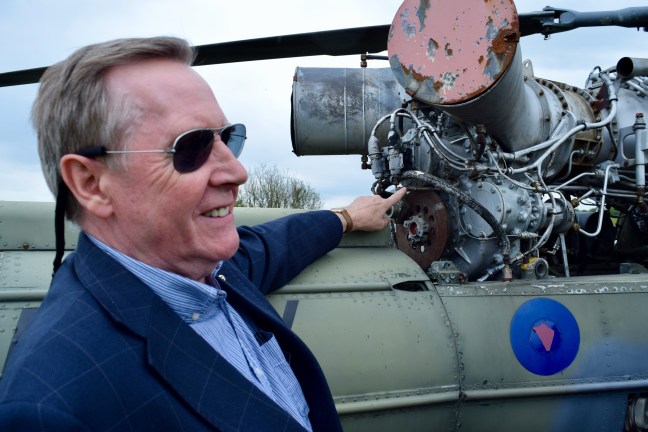
David Wickens points to a thermocouple he made on RR engine
Jackie Chappell is proof women can break through the glass ceiling in business. She told the Probus Club of Basingstoke, the social club for retired professional and business managers, about her rise to the top in a traditionally male working environment.
Being a single mother with a job as a stock controller at Porsche (GB) in Reading she needed to supplement her earnings so she started a market stall selling knitting wool. This proved successful and encouraged by her friend they opened a shop selling the same product range. However overheads meant that there was not sufficient profit to pay both of them. So what to do? Seeing a job advertised working from 5.00am to 9.00am meant that while Jackie’s children could be looked after by her friend, she could continue with the shop and Jackie helped out at the weekend.
This part time position was with British Rail as an on train assistant ticket examiner. After initial training the guard almost prevented her from boarding the train in the sidings on her first week on the job.
“Clearly he didn’t want me to do the job and told me to sit in First Class and read the newspaper. By Friday he had relented and I started at the front of the train and we met in the middle. I was off and running.”
Thereafter she became the first female station manager at Henley. This sounds grand but in reality meant that as well as selling tickets she could keep the station clean and tidy.
Then came privatisation . Working at Paddington for six months she won promotion to area Training and Development supervisor then became Engineering Manager in Reading, where, after fifteen years she took redundancy. A phone call encouraged her to take a different role as the interim manager of the Rail Industry Training Council where after several months she took on the position of Chief Executive. She was the first female CEO across the privatised rail industry which was steeped in male imagery from Stephenson’s Rocket through the Fat Controller in Thomas the Tank Engine stories and burley men driving monstrous smoke belching steam engines. In the 80s there were still times when passengers refused to board a train that had a woman driver.
Arriving at her first board meeting with the heads of all the rail companies she was mistaken for someone to serve the coffee. She summed up all her courage to face these men down.
“No, you are mistaken. I’m the CEO of the Rail Industry Training Council. Mine’s black please with one sugar.”
“I didn’t make the same mistake again of wearing a dark trouser suit as I looked too much like the men. I learned that I had to stand out from the crowd so I always wear something pink.”
Dealing with union leader Jimmy Knapp and government minister John Prescott MP was part and parcel of the job, receiving tremendous industry and government recognition during the seven years she was in charge.
The Paddington rail crash caused Jackie to review her life. She normally used that train but was on holiday. For the last thirteen years she has run her own company in Reading called the Ironing Lady with a sister business the Cleaning Ladies, with twenty two staff and seven vans. She was the Sue Ryder Business Woman of the Year 2013 and in 2016 was winner of Barclays Bank south England heat of the Female Entrepreneur Icon Category. There are few men who could achieve what Jackie Chappell has done.
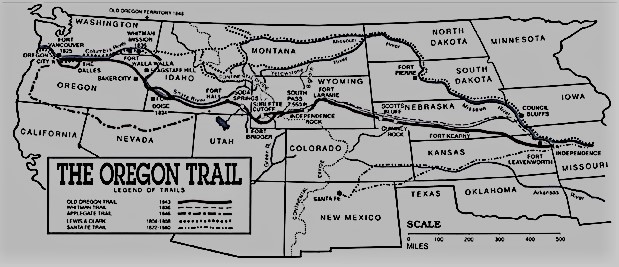
Roger Shaw, a member of Henley Probus, gave a talk to the Probus Club of Basingstoke, about the history of the Oregon Trail. He had lived in America for seven years and together with his wife had driven the entire 3,000 miles route in 2013 and 2015.
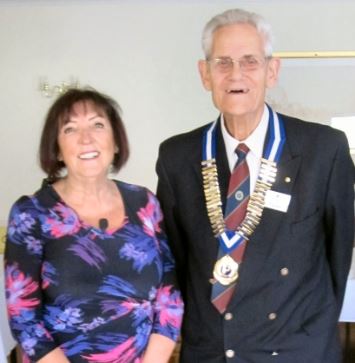
Roger Shaw with President Fred Locke
The American government encouraged immigrants to resettle westwards as the east coast had been swamped by the influx of people from Europe. The attraction was of plentiful and cheap land, originally 600 acres free for a married couple (approximately a square mile) and 320 acres for a single man.. The only stipulation was that they had to improve it. Eventually it was sold for $1 per acre. With the 1849 Gold Rush adding more pioneers, between 1840 and 1860 half a million people, mainly farmers, including 70,000 Mormons and many Irish, made the six months journey from Independence Missouri to the Pacific North West coast. The Mormons diverted south to Utah to establish their own community having promised the government that they would give up polygamy.
The migrants travelled in huge groups in wagon trains, with the preferred smaller lighter covered wagons christened “Prairie Schooners” pulled by oxen. These wagons, some made by Henry Studebaker, a name subsequently made famous in later years by the manufacture of cars, were capable of floating. Each family had to take their own food and water as there were no trading posts along the route in the early years. They traversed the Great Plains, then across the Rockies to the west coast. They favoured a particular route across the mountains called the South Pass, in Wyoming, which was a gradual ascent up 8000 feet where a trail had been worn over many years by millions of buffalo.
Most people will have seen in films or on TV stories about the Wild West and wagon trains that formed circles at night for protection against attacks by American Indians. The reality was somewhat different and while they did form circles it was so the oxen could safely graze within the confines. Initially the Indians were helpful to the immigrants supplying them with buffalo meat but relations soured as time went by. The real problems started in 1847 when half the nomadic Cayuse Indian tribe and all their children were wiped out by a measles epidemic introduced by the Europeans. Their retaliation often took place on later wagon trains but ended after a seven year war with the government during which 400 settlers were killed.
The logistics of wagon trains are incredible with one consisting of 1,600 wagons, 10,000 oxen, 30,000 cattle and 60,000 sheep and was 300 miles long. All but young children walked the distance, many barefoot, averaging 15 miles a day. Death en route was common, including drowning crossing rivers, while diphtheria, measles and accidents took their toll on children and up to ten percent of the travellers died from cholera with records showing that on one trip 57 died on one day alone.
The famous Pony Express was created to act as a postal service and was capable of bringing mail from the Mid West to the Pacific coast in ten days. However failing to obtain a government mail contract and technology, in the form of the telegraph, meant the Pony Express only lasted eighteen months.
The Oregon Trail came to an end when, in 1869, the Union Pacific railroad provided an easier way to complete the journey.
Retired RAF Squadron Leader Chris Perkins MVO, is a member of the Probus Club of Basingstoke and with an old RAF colleague, Dave Stewart, earlier this year they researched some activity of their old RAF 33 Squadron’s actions supporting the Allied Forces in their campaign to free Belgium and Holland from German occupation during WW2.
Based for many years at RAF Odiham, in Hampshire, only a few miles away, 33 Squadron is today more familiar to the residents of Basingstoke for flying the Puma troop carrying helicopter and Chinooks from other squadrons based at this station. However, during the Second World War it operated the Supermarine Spitfire in the ground attack role in support of the army.
In the course of following the fortunes of both air and ground crews in their journey from the Normandy landings, Chris and Dave uncovered an incredible story regarding a battle, almost completely overshadowed by the tragic events occurring at that time at Arnhem.
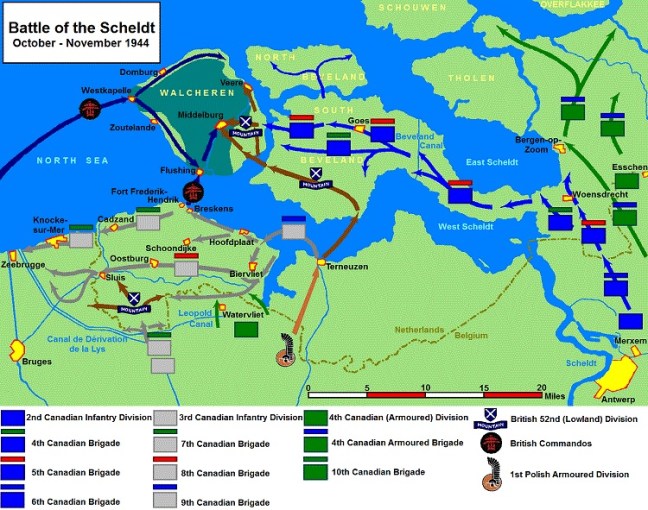
The Battle of the Scheldt estuary was a military operation in northern Belgium and the south western Netherlands to secure the port of Antwerp, essential for allied re-supply use. The First Canadian Army was given the task of clearing the Scheldt area of German occupiers. Believing the retreating troops to be demoralised and lacking in fight, the initial attacks in September 1944 proved otherwise. Hitler had told every member of his forces dug in around the Scheldt estuary that they had to defend their positions to the last man and bullet. Their families would be held as retribution if they failed to do so.
The First Canadian Army was international in character. In addition to Canadian infantry and armoured troops, it included the 1st British Corps, and the 1st Polish Armoured Division. At various times it also included American, Belgian, and Dutch units. The First Canadian Army in north western Europe during the final phases of the war was a powerful force. The strength of this army ranged from approximately 105,000 to 175,000 Canadian soldiers to anywhere from 200,000 to over 450,000 when including the soldiers from other nations.
The enemy opened the sea locks and flooded the whole countryside making what some historians considered to have been the most difficult battlefield of the Second World War. With flooded and muddy terrain and the tenacity of the well-fortified German defences made the Battle of the Scheldt especially gruelling and bloody. At the end of the five week offensive, the victorious First Canadian Army had taken 41,043 prisoners, but suffered 12,873 casualties (killed, wounded, or missing), 6,367 of whom were Canadians.
Flight Sergeant George Roney New Zealand Air Force
And what of 33 Squadron from RAF Odiham? At that time it was also an international unit and consisted of many volunteer pilots from around the world. The Spitfires were used to support the ground troops by attacking enemy positions. Unfortunately many pilots lost their lives. Chris and Dave located a number of these brave young airmen now resting in remote cemeteries. One grave was for New Zealander Warrant Officer George James Roney. He was just twenty two years old.
WO Roney in flying kit
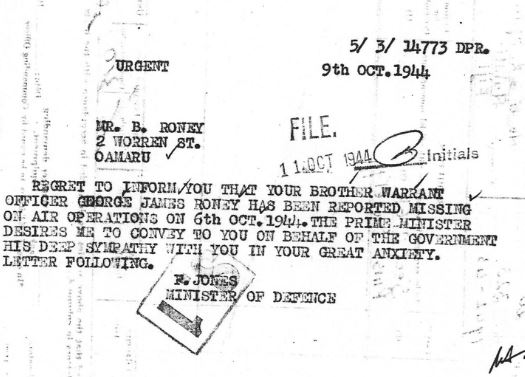
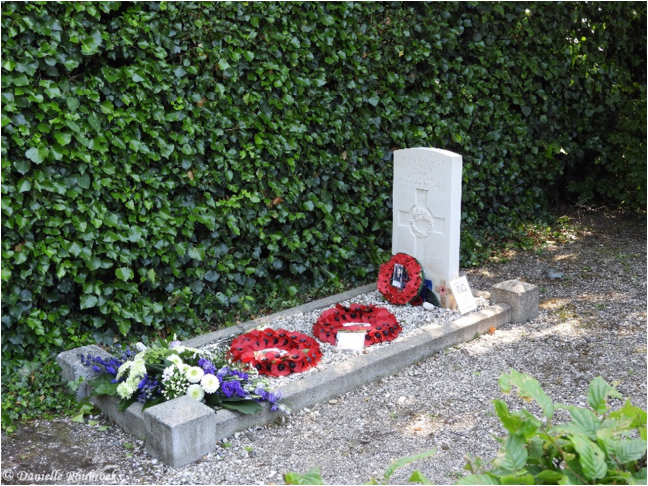
WO George Roney took off at 15.00 on 6th October 1944 as part of a three Spitfire armed reconnaissance sortie. Good weather favoured the German air defence batteries and all three aircraft were shot down after encountering heavy flak. George went down with his Spitfire near the hamlet of Schoondjke, the plane burying itself metres deep into a muddy field. On 9th October 1944 his family received a “Missing on air operations” telegram. The aircraft was not found until 9th June 1948 and George was buried on 12 June in Schoondijke cemetery. His is the only Commonwealth War Grave and has been adopted by children from the local school.
The telegram every family dreaded
Wing Commander Dave Stewart is chairman of the 33 Squadron Association and contacted the New Zealand Genealogy Society for information on any potential family members. A number of relatives came forward and provided photographs, a log book and a number of official letters about George going missing and then about his death.
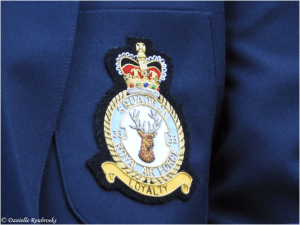
The badge of 33 Squadron
As a result of all this exchange of information about one of their own pilots from 33 Squadron who had been killed in action a moving commemorative service took place in June in the small Schoondijke cemetery in Zeeland. Ten members of the 33 Squadron Association, along with a group of serving 33 Squadron personnel, finally were able to pay tribute to Warrant Officer George James Roney RNZAF. They were joined by George Roney’s nephew, Rob, who had flown in from New Zealand with his wife, Trish, to attend this special event.
Rob Roney is the son of Stanley Roney, George’s brother, who had served in the New Zealand Army in North Africa and Italy while George had joined the RNZAF and then travelled to England to join the RAF. Rob and his wife Trish did not hesitate when it became clear that the puzzle about the life and death of his uncle could finally be completed.
“We heard that the 33 Squadron Association, the one George had served with, were going to visit Zeeland , among other sites, the place where Uncle George crashed, and that they were also going to see the grave. We had to be there. We are very grateful that we are here now”, said nephew Rob.
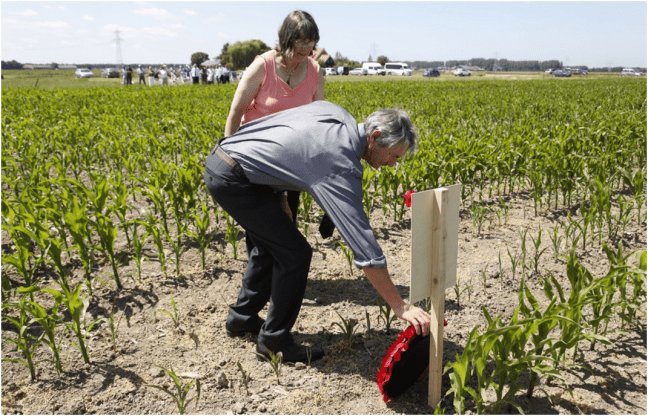
Rob and Trish Roney lay a wreath at the crash site
Before the commemorative service at the church, the group were able to visit the actual crash site in a maize field near to Schoondijke.
3 vintage aircraft made a flypast
The farm is still owned by the same family, the Dekkers, and Rob Roney met the three Dekker sisters who, then aged 7, 10 and 14, had witnessed George’s crash that day. After watching a flypast by three vintage aircraft to salute his uncle. Rob Roney said,
“Yes, it means a lot to me. I did not expect this. It’s really very special. My father never talked about the war and his brother who came over here. This feels like a recognition of my family. That today we are in Zeeland makes it extra special. In some way, it feels like the old country”.
The group then drove to Schoondijke Cemetery to attend the commemorative service at the grave of Warrant Officer George James Roney RNZAF. A small gathering of approx 50 people heard short speeches and dedications from Rob Roney, Dave Stewart, Peter Cammaerts (Burgemeester of Sluis, which now includes the municipality of Schoondijke). Pastor Derk Blom conducted a short service before wreathes were laid by the Roneys, 33 Squadron, 33 Squadron Assocation and serving 33 Squadron personnel and the Municipality of Sluis; Probus member Chris Perkins then recited ‘For the Fallen’.
The fact that civic dignitaries were involved shows the continuing grateful attitude of the Dutch people towards the fighting forces of Great Britain and their allies in freeing their country from Nazi tyranny. National interest was secured for the occasion by Dutch TV filming the whole occasion.
Rob and Trish Roney with the MayorProbus member and 33 Squadron Association member Squadron Leader Chris Perkins MVO pays his respectsWO Roney’s grave, the only Commonwealth War Grave in Schoondijke cemetary, which has been adopted by the local school
Photo Credits:
All colour photos courtesy of Danielle Roubroeks, except Rob and Trish laying a wreath at Dekkar Farm, which is (c) Camile Schelstraete (Provinciale Zeeuwse Courant). B&W photos courtesy of the Roney family
Michael Haxeltine, a member of the British Society of Dowsers, gave an abridged presentation to the Probus Club of Basingstoke, which was a snap shot of the extensive breadth of this subject. His normal presentation can be an all day affair but he had to make do with one hour.
Most of us have heard about water divining. The speaker gave other instances of its practical use and told of an instance where he had been able to identify 15 out of 17 known problems found by CCTV in a 200 m drain. However not many attendees knew about the extensive use made by dowsers in all manner of circumstances and the speaker gave practical demonstrations to help his cause.
And members of this social club for retired professional and business managers were encouraged to take part. One member sat with an open design pyramid over his head for half an hour which when removed was shown to have created an aura of about 75 cms around him. The weighted end of a flexible metal rod was seen to rise when placed in the middle of the pyramid. Similar open pyramids have been proven to help seeds germinate by raising local temperature. A torch beam made a dowsing rod move down the light beam which was explained because light is a mix of waves and particles.
All present had a dowsing rod made of a wire coat hanger with a right angle handle which we had to use to search for articles previously hidden in the room. Some had success but others had to count backwards to stabilise their mental position. One volunteer had the left side of his body checked by a dowsing rod to identify any old injuries. Some foods were checked if still suitable to eat by suspending a pendulum over it, similar in style to a plumb line, and if it rotated clockwise the food was edible.
Everyone had a corrugated plastic pipe with a weighted end called a bobber which if rotated clockwise had been used to find oil fields. All down to our mental process, apparently. Medical work had also been successfully penetrated with the pendulum – plumb line – used in vascular dementia and distance healing. The pendulum is currently under experimentation at the Savill Garden near Windsor where it is being used to establish if when plants are set in a magnetic orientation grow differently to others of the same species. Whilst at these famous gardens he was able to find an ongoing underground water leak to within 6 inches of the fault.
Another occasion Michael had used the pendulum to identify 15 out 16 known faults with a ship’s radar system.
Michael Haxeltine is an enthusiastic amateur member of his society and so is not listed on their web site but see www.britishdowsers.org for more information about this fascinating subject.
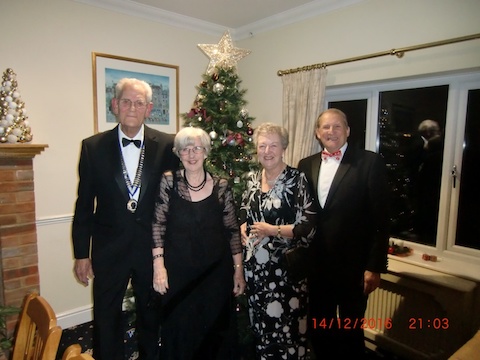
Once again, it was time for the Probus Club Christmas Dinner which took place at the Test Valley Golf Club on Wednesday 14 December. Organised with their usual high skill and aplomb by Alan and Liliane May and hosted by President Fred Locke and his wife Sue, the event was well supported as can be seen from the following photographs. It was heartening to see some widows and equally welcome was seeing our newer members. And for those members who failed to guess the correct answers to the mystery photo quiz on the inside of the menu card, the answers are as follows:
A) Sellotape dispenser
B) Ring pull can
C) Metal tape measure
D) Plastic Zip
E) Microsoft Windows emblem
F) Xmas tree light bulb
G) USB stick
H) Top of Pozidrive screw.
President Fred and Sue Locke with organisers Liliane and Alan May
On the 24th of November, fourteen of us ventured to Cowley to see how MINIs are made. The plant was originally set up by William Morris in 1913 with one of the earliest models being the Morris Oxford, more commonly known as the Bullnose Morris. After WW2 a popular model was the Morris Minor and the original Mini was launched in May 1959 in both Morris Mini and Austin Seven versions.
In later years while under the ownership of the Rover Group the site manufactured the Honda Civic (being similar to one of the smaller Rover designs) and even Rolls Royces before being bought by BMW who invested some £150 million to develop the MINI plant.
We were given an overview of the plant and shown some old models and some specials including one covered in cow skin and some from “The Italian Job”, before being transported in a mini bus with safety glasses and personal audio system (to enable us to hear our guide over the din), to a huge shed where the pressed steel parts were assembled. They were pre coated and silver although referred to as white and the assembly involved about 900 bright orange twisting and nodding robots making 6000 spot welds per car. The large parts seemed to arrive from holes in the ceiling from an upper floor but the smaller pieces were loaded at various stages into hoppers by hand. The pressed metal components were produced by the plant in Swindon or elsewhere and transported here for assembly.
The latest offering from the extensive MINI product range
The Probus group then went in the mini bus again to the main production line where the painted and baked body shells arrived for the fitting of the rear axle, fascia, glass etc. by more robots but also people. Of interest was the fact that each car was made to a specific order so that the production line might have a blue 4 door followed by a yellow 6 door with a sun roof followed by a red 3 door. The engines are produced at Hams Hall in Birmingham and were pushed in from below. Only then was the pre-made front of the car connected. Cowley only has a supply of all major components for two hour’s production at any time so the logistics of “just in time” supply is critical. The seats, trim and eventually wheels were fitted and exactly 11 litres of fuel before each car was thoroughly tested. A car comes off the assembly line every 68 seconds and production continues 24 hours a day. They go straight to car transporters or trains to reduce storage for eventual delivery to over 110 countries
Retired RAF Wing Commander Bryan Jenkins commented, “I am really glad that I went, it was really amazing to see the technology in action. As a Chartered Engineer, I am amazed at how complicated each part of the car is, knowing that each part must be individually designed, manufactured (somewhere) and then assembled into the car to the customer’s specification. In parallel, the car assembly line must also be designed – all 1,000 robots plus a few people and that is even more amazing. So I will look at Minis in a different light now.”
Probus Club Vice President Nick Waring said “The future is here being able to produce cars so efficiently but with even more on the road it doesn’t bode well as this was a good trip spoiled by the horrendous journey home caused by too much traffic”!
Amusing anecdotes kept coming when Susan Howe gave a talk to the Probus Club of Basingstoke, the social club for retired professional and business managers, about what she called her canter through a funny life. This had nothing to do with anything equine but was about her wide experiences of life and with the ability to recall minute details that made the talk so interesting.
She had been working as a cook on a yacht in the Mediterranean in the 60s when she met Bridget Bardot’s ex-husband, Gunter Sachs, who was one of the original playboys. She went to work for him and his celebrity guests in his chalet in St Moritz. During her time there she met several well known people including the Formula 1 World Champion, Jackie Stewart, the film director, Roman Polanski, several members of the Bismarck family and the last king of Morocco. Susan admitted “I couldn’t really cook but the good thing about very rich people is that they dine out a lot.”
In the early 70s Susan worked for Sir John Betjeman, soon to become Poet Laureate. She stood in for his long-standing PA for a year and met his famous teddy bear, Archie and Jumbo the toy elephant. A well known eccentric, John Betjeman had many visitors including Mary Wilson, wife of Prime Minister Harold Wilson, who herself was a published poet. Barrie Humphries, of characters Dame Edna Everage and Sir Les Patterson fame, was a regular caller.
Various men of the cloth came seeking financial support for their particular church. If they were from what he considered to be the lower sects of religion, Methodists or Baptists, he would not let Archie sit in on their discussions in case it affected its thinking. On another occasion Susan recalled that the great poet had made a theatre booking with pre-performance supper for himself and Archie. That night he didn’t think that Archie was feeling up to sitting through a three act play after dining so Susan had to change the bookings.
When John Betjeman got married he arrived, on his wedding night, at his bedroom door wearing a long nightshirt and carrying Archie and Jumbo under each arm. When his new bride commented about what she saw he made it very clear to her that she was very much in fourth position in his life. When Susan left his employment he bade her farewell with “Gosh we’ve had fun – what a shame you couldn’t type!”
During this time she shared a flat in London with Jan who was the daughter of a vet in Thirsk called Donald Sinclair. He was the partner of the vet who used the pen name James Herriot to write “All Creatures Great and Small” that became a successful TV series. Apparently Jan knew he was so incensed by the character Siegfried Farndon, played by Robert Hardy, that he refused to watch the programme.
After completing the notoriously demanding two years course she passed the exam set by the London Tourist Board, qualifying as a Blue Badge Guide which enabled her to guide at all the major London sites. London Blue Badge guides can also guide in other parts of UK which meant she could be away for up to three weeks. She accompanied an amazing array of specialist groups ranging from Hymnologists studying hymn writers to Mills & Boon authors specialising in the Regency period, and from Debt Collectors to the American Bar Association and the 200 strong Yale Alumni choir. Immediately prior to her visit to Probus she had accompanied the Bishop of North Dakota around London.
Not content with acting as a guide in Britain she has taken painting tours to Zanzibar, riding tours in the Rockies, wildlife tours in Africa and tiger tours in the jungles of India.
Her wide interests match the experiences of the members of the Probus Club of Basingstoke.


 “Prince Harry trained to be an Apache helicopter pilot here.” John Essery, a Brighton Hill resident who was on Warden Duty, told us the day of our visit to the Museum of Army Flying at Middle Wallop. He had the unusual service record of flying helicopters in the Army Air Corps as a Major and when his service came to an end he joined the RAF as a Squadron Leader to continue his helicopter journey.




 The First Canadian Army was international in character. In addition to Canadian infantry and armoured troops, it included the 1st British Corps, and the 1st Polish Armoured Division. At various times it also included American, Belgian, and Dutch units. The First Canadian Army in north western Europe during the final phases of the war was a powerful force. The strength of this army ranged from approximately 105,000 to 175,000 Canadian soldiers to anywhere from 200,000 to over 450,000 when including the soldiers from other nations.


 includes the municipality of Schoondijke). Pastor Derk Blom conducted a short service before wreathes were laid by the Roneys, 33 Squadron, 33 Squadron Assocation and serving 33 Squadron personnel and the Municipality of Sluis; Probus member Chris Perkins then recited ‘For the Fallen’.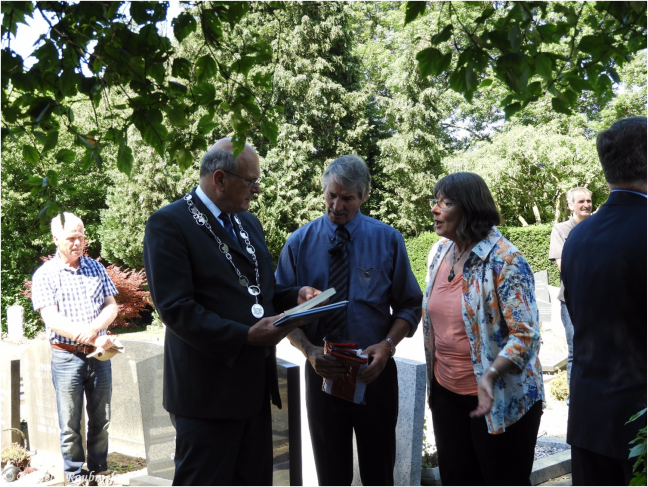

 Michael Haxeltine, a member of the British Society of Dowsers, gave an abridged presentation to the Probus Club of Basingstoke, which was a snap shot of the extensive breadth of this subject. His normal presentation can be an all day affair but he had to make do with one hour.








You must be logged in to post a comment.