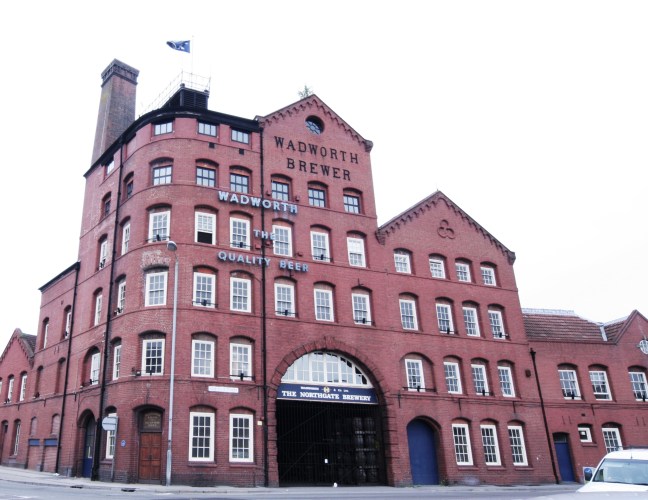
Thursday 26 October saw twenty of us consisting of 6 solo members and 7 with partners having an enjoyable coach trip to Devizes in Wiltshire ostensibly to have a guided tour around the Wadworth brewery. It is still family owned since its foundation in 1875. However as it was market day and the tour was scheduled for 2.00 pm there was ample time to wander around this ancient market town, browse the many individual shops and enjoy a spot of lunch.
Some went to look at the Caen Hill rising lock system on the Kennet & Avon canal that runs through the town while others sampled the delights of this old town that houses an impressive indoor market as well as the extensive and what appeared to be attractive value to be had from the outdoor market. There were visits to a museum and flea market before the brewery tour commenced.
Because of the many steep stairs some excused themselves from the brewery tour but joined later to visit the stables and see the shire horses used to pull the drays to the pubs within two miles of the brewery. They also go on display at several shows in the south western region during the summer. All then adjourned to the Harness bar for a free tasting of the ales on display.
Note the museum exhibit that mentions the Roman Emperor Probus.
Dale Greenwood, a qualified Blue Badge guide is a man also very much involved in historic railways, gave a talk to the Probus Club of Basingstoke which was about a local subject; the Basingstoke to Alton Light railway. Most people will have seen the small section of railway track in the centre of the roundabout at Viables on the Harrow Way and possibly wondered about it.
It was laid very close to the original position of the light railway that was opened in 1901 between Basingstoke and Alton. The line was the first to be constructed after a decision in Parliament to allow light railways to be built, with great savings in costs, as a way of increasing economic activity in sparsely populated areas.
The original idea that the London & South Western Railway Company had was to open up a route to Portsmouth. Passengers could travel from Waterloo to Basingstoke, then on the light railway to Alton and thence on to Portsmouth.
Light railways had restrictions, being built, as the name suggests, to a lower standard than traditional routes, which meant that only lighter engines could be used and were restricted to a top speed of 25 mph.
Our light railway was mainly single track with, initially, only three trains in each direction daily. Stations were built at Cliddesden, Herriard, Bentworth & Lasham and Butts Junction outside of Alton. While all the stations had sidings only Herriard had two platforms. The stations were hardly close to their village names and most of the cottages seen today close to them were built for the railway workers. The cost of the venture was £50,000, being a quarter of the typical budget had the line been laid to the usual standard.
The total distance was only 12 miles and because of the stops and speed restriction the journey would take 45 minutes. During WW1 the tracks were removed for use by the army in France. The company hoped that it would never reopen but due to public pressure the line was relaid and opened in 1924. It was never a commercial success and passenger services ended in 1932 but a goods service continued from Basingstoke as far as Bentworth & Lasham until the line eventually closed in 1936. The whole of the line was dismantled except for short stubbs at either end – from Basingstoke in to the Thorneycroft factory (now the site of Morrisons supermarket) and from Butts Junction to Alton Park, the Treloar Hospital. These short stretches were used for goods traffic until 1967.
The railway was used for the filming of the 1929 film “The Wrecker” and the 1937 film “Oh, Mr Porter” which starred comedian Will Hay and featured Cliddesden station as the fictional Buggleskelly.
A party of twenty, consisting of members and some wives/partners had a real treat when they visited the Lasham Gliding Society at Lasham airfield, south of Basingstoke. In the party were two retired RAF officers maintaining their interest in heavier than air machines.
After coffee in the restaurant we were taken to a briefing room where an extensive presentation on all matters connected to gliding brought some interesting facets about early attempts at flying. Many commercial pilots also own a glider and it is reckoned that the plane that came down on the Hudson River in New York was not the disaster it could have been but for the fact that the pilot also flew gliders. Surprisingly it is possible to own a second hand glider and trailer for around £9,000 although the very latest hi-tech version could cost up to £250,000.
Then driving in a slow convoy around the perimeter of the airfield, passing around the hangers where commercial passenger jet aircraft are serviced and on to the south side to where the Gliding Heritage Centre has its own purpose built hanger. A second one is in construction.
The hanger is chock full of gliders of various vintages clearly showing the evolution of the species from 1932 onwards including two with swastikas and many are still in a flying condition. Every bit of space was filled with these exotic, colourful, little planes hanging from the roof and carefully placed around the floor. This was a visual experience made better by the guide fully explaining the changes to the aircraft on display. Keeping up to date there was even a glider flight simulator.
Just to remind us that Lasham is still an operational airfield, during lunch a Norwegian Air Boeing 737 commercial jet came into land on the mile long runway to then taxi round to the service company that rents its space from the gliding society who owns the airfield.
Thanks are due to member Stephen Thair for arranging this visit, who has maintained his interest in avionics since qualifying for his private pilot’s licence some years ago and to Bryan Nagle for supplying some of the photographs.
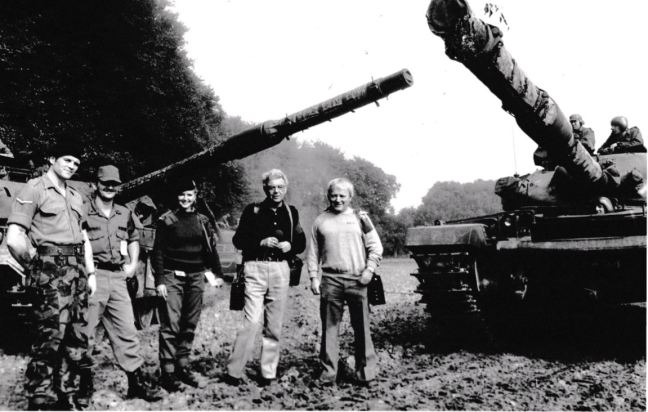
Speaker Alan Grace (far right) with UK troops in Germany 1980
The Probus Club of Basingstoke enjoyed a presentation by Alan Grace about the life of a programme maker living with our armed forces whose broadcasts allowed them to maintain morale by keeping contact with families in UK and also provided them with much needed entertainment.
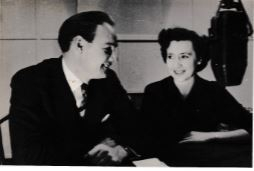
Cliff Michelmore and Jean Metcalfe
Many people of mature age will remember Two Way Family Favourites on Sunday mornings. Then known as the wireless it was broadcast on the BBC Light Programme. It was claimed that this was the only radio programme that had the smell of roast beef and Yorkshire pudding. The German end was run by BFBS (British Forces Broadcasting Service) with, for some time, Jean Metcalfe there and Cliff Michelmore in London.
Bill Crozier the longest serving host of Two Way Family Favourites
In World War 2 both American and Russian military had radio services for their troops and after the Americans joined the war effort the British War Office was persuaded by Col David Niven and supported by Glenn Miller that our troops would benefit from a similar operation. The first military broadcast services saw life begin in Algeria in 1943 and run by the Army Welfare Service. The only drawback was that there was no money, no equipment and no staff. And it was firmly established that editorial control was to be independent of the Ministry of Defence and the armed forces themselves. By some miracle they were on air in seven weeks. It was set in a former harem but the fully glazed floor and wall tiles had to be draped in army blankets to deaden the appalling acoustics. The first requested record was the famous German wartime song, Lily Marlene.
In the following years over 100 radio stations were set up from Aden to Zeltweg. Some of the earlier stations were mobile housed in ten ton trucks with transmitters, generators, record library and studio. They followed troops through the Italian campaign and then into mainland Europe. Fixed sites were based in a range of extreme locations from the magnificent Musikhalle in Hamburg that had escaped bombing, down to an old cow shed in Cyprus, tents in the Canal Zone and shipping containers at Camp Bastion in Afghanistan.
Rehearsing a radio play rewritten to avoid breach of copyright
Some of the people involved became household names. Cliff Michelmore, Frank Muir who was a photographer but volunteered to be a writer, Peter Sellers, Raymond Baxter who went on to front many BBC TV programmes including Tomorrow’s World, Brian Moore who went on to become a top sports presenter with ITV, and Roger Moore who was told that as he could not act he should go back to being a male model for knitting patterns. He later sent a postcard to the producer who had dismissed his talent which said that although he could not act he had still had a good life and signed it 007.
In 1957 Alan Grace started working with what then was BFN in Cologne as an announcer and sports producer, while a national serviceman in the RAF. Over the next four decades he experienced life throughout the world’s trouble spots where British forces were involved. Such places of conflict had radio and then television services provided for service personnel and their dependents worldwide. Places of interest included Palestine, Cyprus during EOKA, Kenya in Mau Mau times, Aden with terrorist troubles, Cyprus, again, during the Turkish invasion, Hong Kong, The Balkans, The Falklands, Gulf Wars 1 and 2 and Afghanistan.
Probus Club member John Terry featured in the Basingstoke Gazette on Thursday 14 September as he was one of the winners of a competition to Spot The Bench by identifying the Sitting with Jane benches around the town from photographs of small sections of each bench. The competition was organised by Basingstoke Deane Rotary whose past president Alan Gibson presented the prizes standing close to the recently unveiled statue of Jane Austen outside the Willis Museum in the market place.
John’s prize was afternoon tea for two at Tylney Hall hotel.
Probus member Richard Stettner took this photograph.
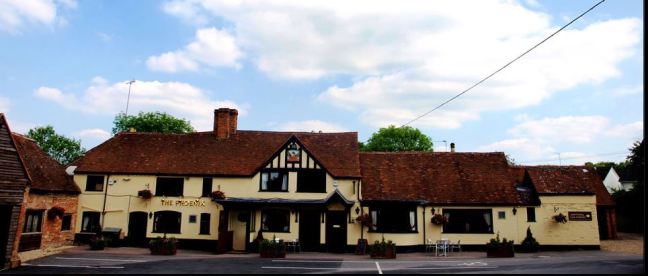
A grey day in August did not prevent our members enjoying their annual pub lunch together at the Phoenix Inn on the A30 near Hartley Wintney. Originally a coaching inn of yesteryear it has morphed into a high quality dining establishment that proudly displays a Les Routiers sign at the door. President Nick Waring made this his choice in the months prior to ascending to high office. The food on offer on the main courses went from a vegetable selection up to a Chateaubriand but it is doubtful that any of us went to that expense since after all we are pensioners.
There were two tables of ten and eight and then tables for four people which is why some people appear not to be seated with their wife/partner as they were sitting opposite. Gerry and June Anslow, together with their two lady guests, left before the photographs were taken.
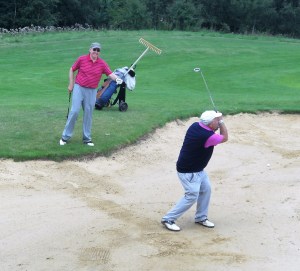
Jeff Grover, David Wickens, Ian Nicholson, Geoff Twine, John Swain, Derek Roberts & Bryan Nagle (missing is Alan May who took the photograph)David Wickens encouraging John Swain in a bunker
The Probus Club of Basingstoke, for some years, played a golf match against Deane Probus for a shield. This happened over a number of consecutive years until we were unable to field a team due to departures of some members, increasing ages and deaths and we only had 2 or 3 golfers left.
After recent recruitment we can now field approx 8-10 golfers and as such challenged Deane Probus to renew our tournament. However, it now appears that Deane only has a couple of golfers left in their Club and they couldn’t make up a team. Geoff Twine then suggested that our Probus play for the shield amongst ourselves on an annual basis and so 9 members agreed to meet at Sherfield Oaks on 1st August 2017.
Finally there were only 8 of us as one member decided to play snooker instead. Geoff Twine, Alan May, Jeff Grover, Bryan Nagle, Ian Nicholson, Derek Roberts, John Swain and David Wickens all battled against the odd shower to complete the course. This was a Stableford competition where points are collected on each hole.
For the rest of us non-golfers the following is offered by way of an explanation. It takes into account your handicap (ie your current skill at the game). Better players need to complete a hole in fewer shots than worse players in order to earn the same points.
The person with the most points is the winner.
Artistic shot of a green (no prizes for guessing who the players are)
Also Royal and Ancient Rules are paramount at all times, for example:-
There should be no swearing on the course unless you have hit a poor shot or your competitor has had a stroke of good luck. Then it is perfectly allowable.
Men should not relieve themselves on the course unless they are over 65 and it is a medical necessity. This should be done behind a large tree and not into the wind.
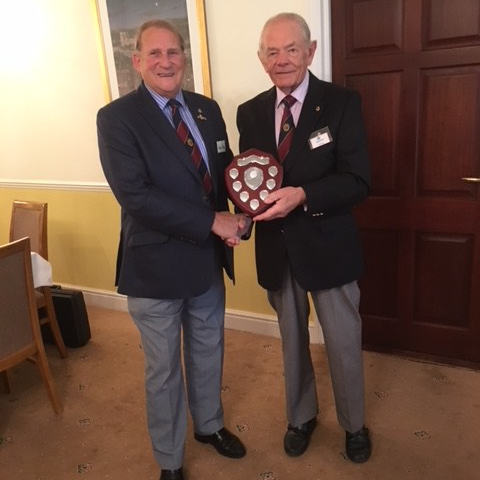
On the day the winner was Alan May (two bottles of wine), 2nd Geoff Twine (one bottle of wine) and 3rd John Swain (three golf balls) who were given the prizes, which had been donated by Geoff, at the meal we all enjoyed together in the bar. Everyone had enjoyed the event and vowed to meet again in a year’s time, maybe at another venue, to again do battle for the Trophy.
Alan May receiving the winner’s trophy from Geoff Twine
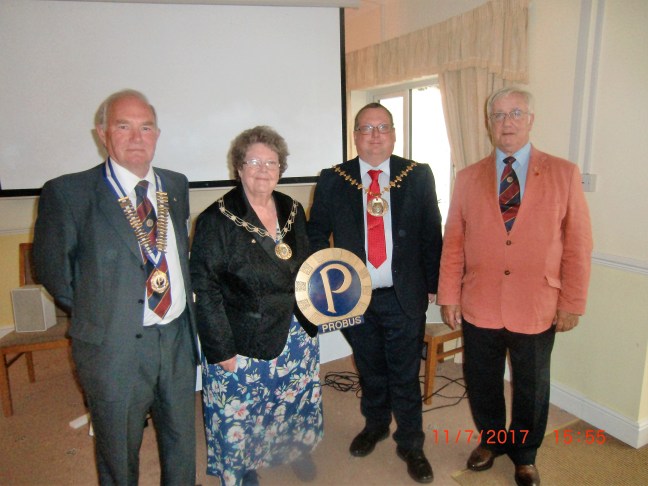
New President Dr Nick Waring, Lady Mayoress Cllr Jane Frankum, Mayor of Basingstoke & Deane BC Cllr Paul Frankum and Rtd RAF Wing Commander Bryan Jenkins
Dr Nick Waring, the new President of the Probus Club of Basingstoke, had an interesting first lunch of the new season at the Test Valley Golf Club. The Club had twin guests of honour, the Worshipful the Mayor of Basingstoke & Deane BC, Cllr Paul Frankum, and also his mother Cllr Jane Frankum who is the Lady Mayoress. On behalf of the Probus Club Dr Waring presented a cheque to the Mayor in aid of his charity appeal. The speaker was retired RAF Wing Commander, Bryan Jenkins, from Sherfield on Loddon, who gave an audio visual presentation about his experiences as an engineering officer in the Cold War at a RAF Vulcan station.
Bryan, himself a member of the Probus Club of Basingstoke and president of the Basingstoke branch of the RAFA, told about his years at RAF Waddington in Lincolnshire which along with nine other RAF stations in eastern England was home to the V bomber nuclear strike force in the early/mid 1960s. The Avro Vulcan, with its famous delta wing design was joined by the Handley Page Victor and the Vickers Valiant.
Probus members were alarmed to hear about the change of UK government defence policy in the swinging sixties. Pre 1960 they had the land based Blue Streak intercontinental ballistic missile. This was cancelled in February 1960 going instead for an air craft based system using the Blue Steel air to ground missile. The Blue Steel was easily fitted to the Vulcan. However this was cancelled after two months when the UK decided to buy the US built Skybolt missile. But this was cancelled by the US in December 1962 in preference to a submarine task force that would be able to fire the Polaris intercontinental ballistic missile. The UK had to follow suit and the Royal Navy took on the role of nuclear deterrence in June 1969 with nuclear powered submarines that could launch this sea to land missile. The V bomber nuclear defence programme was abandoned, the planes having a new role with tactical nuclear weapons and conventional ordnance.
However before this final change of direction there were interesting and occasionally alarming times at RAF Waddington. Of 27 Vulcans based at this station three were on constant standby fully fuelled and loaded with nuclear weapons ready to be in the air within the famous four minute warning. The Vulcan flight crew of five officers were not allowed off base during their period of duty. All three crews lived, ate and slept adjacent to their aircraft.
On one practice scramble the pilot could not unlock the door to enter the Vulcan. This was because the lock had frozen so he had to do what many motorists had to do in the winter back then, he warmed the lock and key with his cigarette lighter. It beggars belief what would have happened if he was a non-smoker and this was a real emergency.
And yet RAF Waddington was selected to be an airfield that could accept civilian aircraft that had developed in flight faults. This meant having to spread foam on the runway to help planes land when their undercarriage would not go down securely. It could then take up to eight hours to have the runway clear and ready for the Vulcans to take off. Fortunately they never experienced a four minute warning during these episodes.
Even though they did not always carry nuclear bombs, the Vulcan could carry twenty one 1000 lbs iron bombs and it was necessary to undertake regular bombing practice. This was usually without ordnance and the Vulcan would be airborne for five hours at a time. To ensure the highest skills and keep up morale there were regular bombing competitions against the USAF. The famous attack on Stanley airfield in the Falklands was made by a Vulcan using conventional 1000 lb iron bombs and the plane was refuelled mid flight by converted V bombers, the Handley Page Victor.
All Vulcans had the capability to refuel in flight and they even went nonstop to Australia which meant in flight refuelling operations, some at night. There was a problem in that although the refuelling probe was illuminated by a spot light for the pilot of the Vulcan to guide it on to the trailing drogue, it really was not bright enough. Bryan had to find a solution, but had to use existing kit and was not permitted to go outside to obtain the ideal solution. No doubt the MoD was conscious that they must not over spend their budget.
The last Vulcan squadron was disbanded in March 1984 leaving only the display team to fly on for many years.
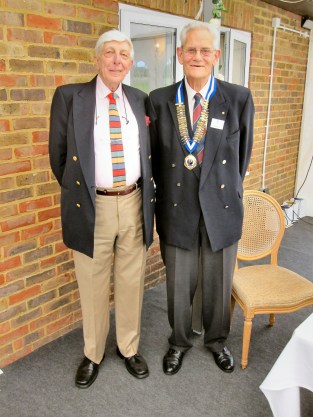
New President Dr Nick Waring receives the chain of office from outgoing President Fred Locke
The 38th Annual General Meeting of the Probus Club of Basingstoke was held on Thursday 22nd June 2017 at Christ Church in Chineham, when a revised Executive Committee was elected to run things at our social organisation for retired professional and business managers.
Dr Nick Waring, of Oakley, was appointed President for the ensuing year by the outgoing holder, Fred Locke of Bramley.
Fred Locke receiving his past President’s tie, lapel badge and name badge from Paul Flint
There is now an even split across Basingstoke as the Treasurer, Alan May also lives in Oakley and the Vice President, Chris Perkins MVO, lives in Kempshott as does Paul Flint the Secretary/Publicity Officer. The eastern side of Basingstoke is equally represented on the committee with new members Alex Marianos and Richard Wood living in Bramley and David Wickens joins Outings Organiser Tony Atchison in Chineham and Stephen Thair the Lunch Steward in Old Basing.
Fred Locke presenting flowers to Lesley Atchison for preparing the refreshments.
The greatest human disaster in the 21st century is how Adrian Sindall sums up the situation in Syria. And he should know because he can see the differences today to when he was our man in Damascus twenty years ago.
Today Syria has become an international proxy war with US, Russia, France, Turkey and the EU involved; sometimes in military action but also attempting a diplomatic solution. This is hindered by 1500 factions either for or against the Syrian government and also fighting amongst themselves. The statistics of this conflict, now in its seventh year, are staggering. 300,000 dead, 1,000,000 wounded, half the population, 6,300,000, living in refugee camps in Syria and 4,900,000 refugees in neighbouring countries.
It was never a straightforward situation in Syria and the surrounding Middle East. This whole region was divided up by the French and British after the First World War following the fall of the Ottoman Empire. Syria was further sub-divided by France to include an area dominated by the Kurds. The Second World War saw Syria support the Palestinian cause with later increasing Russian influence, both militarily and commercially where Syria adopted a Marxist command style economy. Over the years various types of relationships were developed in the region by the dividing powers with increasing support from US.
Syria felt betrayed that Egypt signed a peace accord with Israel and thought it necessary to strengthen ties with Iran. Similarly Iraq was supported by the US. And there were all kinds complicated cross supporting alliances that if charted looked more confusing than an electrical wiring diagramme.
After the end of the Cold War and the collapse of the Soviet Union, Syria was left almost isolated and needed to develop relationships with western countries. It had helped that they had supported the allies in the Gulf War. When President Assad died and his eldest son having previously been killed in a car crash, the second son, Bashar, was in London training to be an ophthalmogist. He returned to Damascus to become leader of the Ba’ath Party and President.
With the rise of the Arab Spring movement in 2011 across several countries it soon became the turn of the Syrian government to defend its position. At that time the US considered that Assad should not benefit from any western assistance as Russia was increasing their influence and Iran wanted to keep him in power. Then Turkey and Qatar and the Muslim Brotherhood put in their pennyworth but this upset Saudi Arabia.
Today, with direct Russian military support Assad appears to have turned a corner in this highly complicated conflict. Looking at a map of the current situation appears confusing to the layman but the reality is that while ISIS and their acolytes occupy 75% of the land mass it only contains 25% of the remaining population whereas Assad controls 25% of the land, mainly by the coast, and this is the important bit, 75% of the population.
In recent times there has emerged an international feeling that Assad might stay in place and therefore should be involved in the diplomatic process of finding a solution. Any US/Russia joint initiative has hit a snag because of a US law that prohibits cooperation between these countries. There then comes a question of who will be in charge of those parts of the country after ISIS has been defeated. Shades of Iraq and Libya where there was a failure to have a proper exit policy.
The toll on Syria, both culturally with the destruction by ISIS of World Heritage sites like Palmyra and economically, has been substantial. Only time will tell if it ever recovers.
Adrian Sindall summed up the overall situation that Syria is rather like a Rubic’s cube when compared to a cross word puzzle.



 pressure the line was relaid and opened in 1924. It was never a commercial success and passenger services ended in 1932 but a goods service continued from Basingstoke as far as Bentworth & Lasham until the line eventually closed in 1936. The whole of the line was dismantled except for short stubbs at either end – from
  Basingstoke in to the Thorneycroft factory (now the site of Morrisons supermarket) and from Butts Junction to Alton Park, the Treloar Hospital. These short stretches were used for goods traffic until 1967.




![John Terry Prizewinner photo[8069]](https://probusbasingstoke.club/wp-content/uploads/2017/09/john-terry-prizewinner-photo8069.jpg?w=529&h=529)










You must be logged in to post a comment.