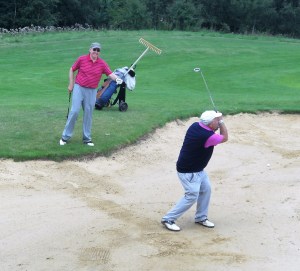
Jeff Grover, David Wickens, Ian Nicholson, Geoff Twine, John Swain, Derek Roberts & Bryan Nagle (missing is Alan May who took the photograph)David Wickens encouraging John Swain in a bunker
The Probus Club of Basingstoke, for some years, played a golf match against Deane Probus for a shield. This happened over a number of consecutive years until we were unable to field a team due to departures of some members, increasing ages and deaths and we only had 2 or 3 golfers left.
After recent recruitment we can now field approx 8-10 golfers and as such challenged Deane Probus to renew our tournament. However, it now appears that Deane only has a couple of golfers left in their Club and they couldn’t make up a team. Geoff Twine then suggested that our Probus play for the shield amongst ourselves on an annual basis and so 9 members agreed to meet at Sherfield Oaks on 1st August 2017.
Finally there were only 8 of us as one member decided to play snooker instead. Geoff Twine, Alan May, Jeff Grover, Bryan Nagle, Ian Nicholson, Derek Roberts, John Swain and David Wickens all battled against the odd shower to complete the course. This was a Stableford competition where points are collected on each hole.
For the rest of us non-golfers the following is offered by way of an explanation. It takes into account your handicap (ie your current skill at the game). Better players need to complete a hole in fewer shots than worse players in order to earn the same points.
The person with the most points is the winner.
Artistic shot of a green (no prizes for guessing who the players are)
Also Royal and Ancient Rules are paramount at all times, for example:-
There should be no swearing on the course unless you have hit a poor shot or your competitor has had a stroke of good luck. Then it is perfectly allowable.
Men should not relieve themselves on the course unless they are over 65 and it is a medical necessity. This should be done behind a large tree and not into the wind.
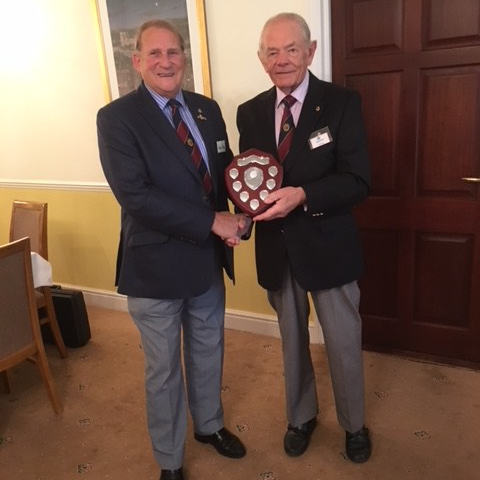
On the day the winner was Alan May (two bottles of wine), 2nd Geoff Twine (one bottle of wine) and 3rd John Swain (three golf balls) who were given the prizes, which had been donated by Geoff, at the meal we all enjoyed together in the bar. Everyone had enjoyed the event and vowed to meet again in a year’s time, maybe at another venue, to again do battle for the Trophy.
Alan May receiving the winner’s trophy from Geoff Twine
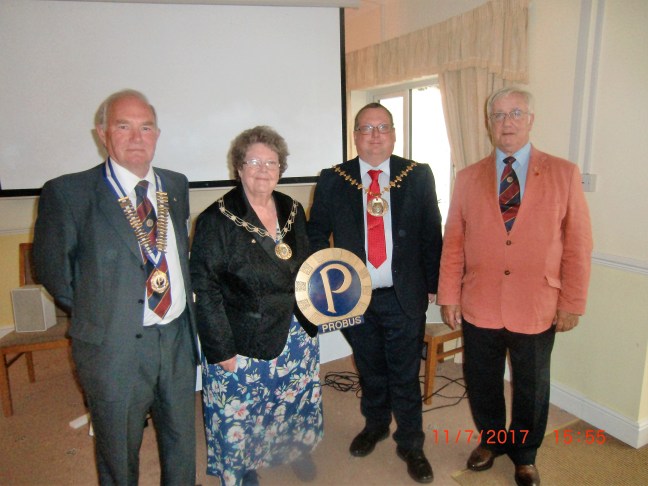
New President Dr Nick Waring, Lady Mayoress Cllr Jane Frankum, Mayor of Basingstoke & Deane BC Cllr Paul Frankum and Rtd RAF Wing Commander Bryan Jenkins
Dr Nick Waring, the new President of the Probus Club of Basingstoke, had an interesting first lunch of the new season at the Test Valley Golf Club. The Club had twin guests of honour, the Worshipful the Mayor of Basingstoke & Deane BC, Cllr Paul Frankum, and also his mother Cllr Jane Frankum who is the Lady Mayoress. On behalf of the Probus Club Dr Waring presented a cheque to the Mayor in aid of his charity appeal. The speaker was retired RAF Wing Commander, Bryan Jenkins, from Sherfield on Loddon, who gave an audio visual presentation about his experiences as an engineering officer in the Cold War at a RAF Vulcan station.
Bryan, himself a member of the Probus Club of Basingstoke and president of the Basingstoke branch of the RAFA, told about his years at RAF Waddington in Lincolnshire which along with nine other RAF stations in eastern England was home to the V bomber nuclear strike force in the early/mid 1960s. The Avro Vulcan, with its famous delta wing design was joined by the Handley Page Victor and the Vickers Valiant.
Probus members were alarmed to hear about the change of UK government defence policy in the swinging sixties. Pre 1960 they had the land based Blue Streak intercontinental ballistic missile. This was cancelled in February 1960 going instead for an air craft based system using the Blue Steel air to ground missile. The Blue Steel was easily fitted to the Vulcan. However this was cancelled after two months when the UK decided to buy the US built Skybolt missile. But this was cancelled by the US in December 1962 in preference to a submarine task force that would be able to fire the Polaris intercontinental ballistic missile. The UK had to follow suit and the Royal Navy took on the role of nuclear deterrence in June 1969 with nuclear powered submarines that could launch this sea to land missile. The V bomber nuclear defence programme was abandoned, the planes having a new role with tactical nuclear weapons and conventional ordnance.
However before this final change of direction there were interesting and occasionally alarming times at RAF Waddington. Of 27 Vulcans based at this station three were on constant standby fully fuelled and loaded with nuclear weapons ready to be in the air within the famous four minute warning. The Vulcan flight crew of five officers were not allowed off base during their period of duty. All three crews lived, ate and slept adjacent to their aircraft.
On one practice scramble the pilot could not unlock the door to enter the Vulcan. This was because the lock had frozen so he had to do what many motorists had to do in the winter back then, he warmed the lock and key with his cigarette lighter. It beggars belief what would have happened if he was a non-smoker and this was a real emergency.
And yet RAF Waddington was selected to be an airfield that could accept civilian aircraft that had developed in flight faults. This meant having to spread foam on the runway to help planes land when their undercarriage would not go down securely. It could then take up to eight hours to have the runway clear and ready for the Vulcans to take off. Fortunately they never experienced a four minute warning during these episodes.
Even though they did not always carry nuclear bombs, the Vulcan could carry twenty one 1000 lbs iron bombs and it was necessary to undertake regular bombing practice. This was usually without ordnance and the Vulcan would be airborne for five hours at a time. To ensure the highest skills and keep up morale there were regular bombing competitions against the USAF. The famous attack on Stanley airfield in the Falklands was made by a Vulcan using conventional 1000 lb iron bombs and the plane was refuelled mid flight by converted V bombers, the Handley Page Victor.
All Vulcans had the capability to refuel in flight and they even went nonstop to Australia which meant in flight refuelling operations, some at night. There was a problem in that although the refuelling probe was illuminated by a spot light for the pilot of the Vulcan to guide it on to the trailing drogue, it really was not bright enough. Bryan had to find a solution, but had to use existing kit and was not permitted to go outside to obtain the ideal solution. No doubt the MoD was conscious that they must not over spend their budget.
The last Vulcan squadron was disbanded in March 1984 leaving only the display team to fly on for many years.
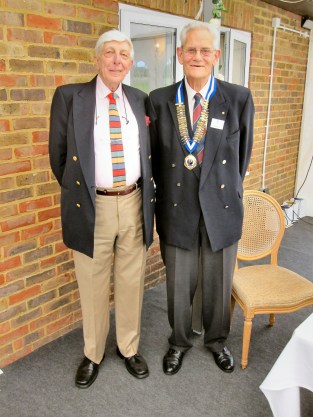
New President Dr Nick Waring receives the chain of office from outgoing President Fred Locke
The 38th Annual General Meeting of the Probus Club of Basingstoke was held on Thursday 22nd June 2017 at Christ Church in Chineham, when a revised Executive Committee was elected to run things at our social organisation for retired professional and business managers.
Dr Nick Waring, of Oakley, was appointed President for the ensuing year by the outgoing holder, Fred Locke of Bramley.
Fred Locke receiving his past President’s tie, lapel badge and name badge from Paul Flint
There is now an even split across Basingstoke as the Treasurer, Alan May also lives in Oakley and the Vice President, Chris Perkins MVO, lives in Kempshott as does Paul Flint the Secretary/Publicity Officer. The eastern side of Basingstoke is equally represented on the committee with new members Alex Marianos and Richard Wood living in Bramley and David Wickens joins Outings Organiser Tony Atchison in Chineham and Stephen Thair the Lunch Steward in Old Basing.
Fred Locke presenting flowers to Lesley Atchison for preparing the refreshments.
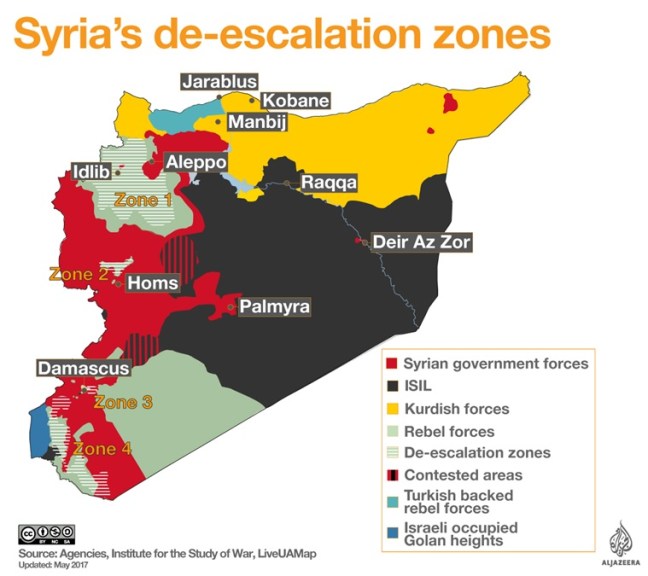
The greatest human disaster in the 21st century is how Adrian Sindall sums up the situation in Syria. And he should know because he can see the differences today to when he was our man in Damascus twenty years ago.
Today Syria has become an international proxy war with US, Russia, France, Turkey and the EU involved; sometimes in military action but also attempting a diplomatic solution. This is hindered by 1500 factions either for or against the Syrian government and also fighting amongst themselves. The statistics of this conflict, now in its seventh year, are staggering. 300,000 dead, 1,000,000 wounded, half the population, 6,300,000, living in refugee camps in Syria and 4,900,000 refugees in neighbouring countries.
It was never a straightforward situation in Syria and the surrounding Middle East. This whole region was divided up by the French and British after the First World War following the fall of the Ottoman Empire. Syria was further sub-divided by France to include an area dominated by the Kurds. The Second World War saw Syria support the Palestinian cause with later increasing Russian influence, both militarily and commercially where Syria adopted a Marxist command style economy. Over the years various types of relationships were developed in the region by the dividing powers with increasing support from US.
Syria felt betrayed that Egypt signed a peace accord with Israel and thought it necessary to strengthen ties with Iran. Similarly Iraq was supported by the US. And there were all kinds complicated cross supporting alliances that if charted looked more confusing than an electrical wiring diagramme.
After the end of the Cold War and the collapse of the Soviet Union, Syria was left almost isolated and needed to develop relationships with western countries. It had helped that they had supported the allies in the Gulf War. When President Assad died and his eldest son having previously been killed in a car crash, the second son, Bashar, was in London training to be an ophthalmogist. He returned to Damascus to become leader of the Ba’ath Party and President.
With the rise of the Arab Spring movement in 2011 across several countries it soon became the turn of the Syrian government to defend its position. At that time the US considered that Assad should not benefit from any western assistance as Russia was increasing their influence and Iran wanted to keep him in power. Then Turkey and Qatar and the Muslim Brotherhood put in their pennyworth but this upset Saudi Arabia.
Today, with direct Russian military support Assad appears to have turned a corner in this highly complicated conflict. Looking at a map of the current situation appears confusing to the layman but the reality is that while ISIS and their acolytes occupy 75% of the land mass it only contains 25% of the remaining population whereas Assad controls 25% of the land, mainly by the coast, and this is the important bit, 75% of the population.
In recent times there has emerged an international feeling that Assad might stay in place and therefore should be involved in the diplomatic process of finding a solution. Any US/Russia joint initiative has hit a snag because of a US law that prohibits cooperation between these countries. There then comes a question of who will be in charge of those parts of the country after ISIS has been defeated. Shades of Iraq and Libya where there was a failure to have a proper exit policy.
The toll on Syria, both culturally with the destruction by ISIS of World Heritage sites like Palmyra and economically, has been substantial. Only time will tell if it ever recovers.
Adrian Sindall summed up the overall situation that Syria is rather like a Rubic’s cube when compared to a cross word puzzle.
A splendid day in Portsmouth with superb weather made for a memorable coach trip to the Historic Dock Yard and later to the Spinnaker Tower. Organiser Tony Achison could not have hoped for a better combination as 40 of us had a memorable social occasion.
The Historic Naval Dock Yard has multiple attractions including HMS Victory which is undergoing a complete refit with the top masts having been removed being an outward sign of the work, but the main target of our visit was to the Mary Rose museum. As it is probably thirty years since many of us saw it in its original state set in a tent and being sprayed by sea water the transformation into today’s magnificent £31 million exhibition centre has to be seen to be believed. Unfortunately the place is kept in a state of darkness to help preserve the exhibits so apologies for not having any photographs of this part of the day.
Members also had a boat trip around the harbour which they said was full of interesting facets.
The party took lunch anywhere they fancied and assembled in the afternoon at the Spinnaker Tower. Stunning views from the observation platform of the surrounding Portsmouth harbour was supported by the braver members crossing the glass floor.
The President of the Ladies’ Probus Club of Basingstoke, Mrs Joan Mussellwhite, was the guest of honour at the Spring Ladies lunch held at the Test Valley Golf Club. Forty guests, members and their wives/partners and some friends enjoyed a splendid lunch and all appeared to receive their menu selection they had chosen when placing their oder some weeks ago.
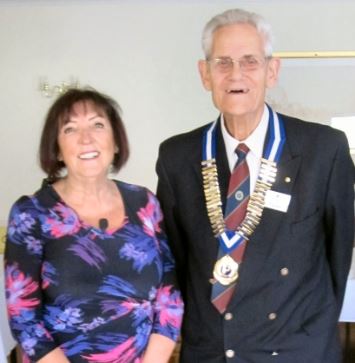
It was good to see our newer members attending this annual affair that was once again superbly organised by Alan & Liliane May to whom we all say a big “Thank You”
“Prince Harry trained to be an Apache helicopter pilot here.” John Essery, a Brighton Hill resident who was on Warden Duty, told us the day of our visit to the Museum of Army Flying at Middle Wallop. He had the unusual service record of flying helicopters in the Army Air Corps as a Major and when his service came to an end he joined the RAF as a Squadron Leader to continue his helicopter journey.
A chilly day greeted our group of twenty consisting of members of the Probus Club of Basingstoke and several wives to the museum on the edge of this airfield. RAF Middle Wallop opened in 1940 as a Fighter Command Station during the Battle of Britain, then used by the USAF and returned to the RAF after the war. In 1957 when British Army Aviation became independent of the RAF, Middle Wallop was transferred to the new Army Air Corps. It became the school of Army Aviation, to which it remains to the present day.
The museum tells the story of British Army flying from the early days of military ballooning spanning nearly 150 years of military flight to the modern Army Air Corps. The collection was started in 1946 at RAF Andover but later moved to Middle Wallop and first opened to the public in 1974. Today it houses over 32 types of aircraft, both early fixed wing and rotary, with an array of support machines and memorabilia and charts the history of military flight both at home and the many theatres of operations abroad.
Kempshott resident and Probus member retired RAF Squadron Leader Chris Perkins MVO was on hand to talk about the exhibits. Aircraft range from a First World War biplane to a Huey Cobra attack helicopter equipped with eight missiles and a Lynx helicopter that could reach 200 mph. There was the famous WW1 Sopwith Pup, with later Auster and Chipmunk fixed wing airplanes and examples of every glider from the D Day Landings including one that could carry a light tank.
On display were early rotary experiments including the Rotabuggy which was a converted Jeep with helicopter additions and an aircraft tail to aid manoeuvrability. With displays of the Victoria Cross holders, various uniforms, the evolution of the flying helmet and several field guns and support vehicles the museum even has a 1940s house with most domestic items bringing back memories to visitors.
After lunch in the Apache café we then had the privilege of a private showing of a film about the changing role of helicopter operations in today’s troublesome world.
Fred & Sue Locke in front of WW2 Glider
Ann & Geoff Twine in front of static display
Rob Hopkins & Richard Stettner in the Scout helicopter
Hoey Cobra Attack helicopter
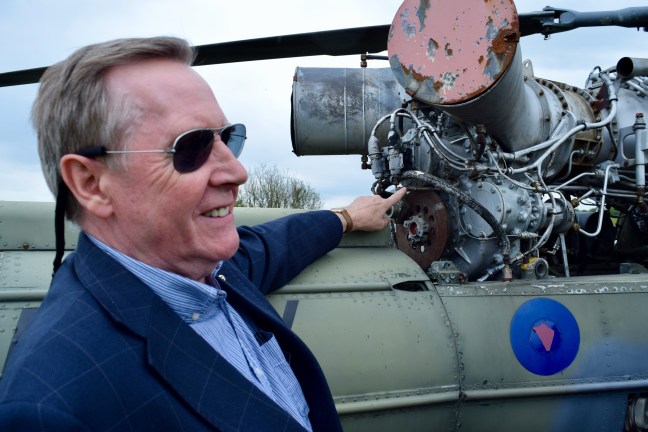
David Wickens points to a thermocouple he made on RR engine
Jackie Chappell is proof women can break through the glass ceiling in business. She told the Probus Club of Basingstoke, the social club for retired professional and business managers, about her rise to the top in a traditionally male working environment.
Being a single mother with a job as a stock controller at Porsche (GB) in Reading she needed to supplement her earnings so she started a market stall selling knitting wool. This proved successful and encouraged by her friend they opened a shop selling the same product range. However overheads meant that there was not sufficient profit to pay both of them. So what to do? Seeing a job advertised working from 5.00am to 9.00am meant that while Jackie’s children could be looked after by her friend, she could continue with the shop and Jackie helped out at the weekend.
This part time position was with British Rail as an on train assistant ticket examiner. After initial training the guard almost prevented her from boarding the train in the sidings on her first week on the job.
“Clearly he didn’t want me to do the job and told me to sit in First Class and read the newspaper. By Friday he had relented and I started at the front of the train and we met in the middle. I was off and running.”
Thereafter she became the first female station manager at Henley. This sounds grand but in reality meant that as well as selling tickets she could keep the station clean and tidy.
Then came privatisation . Working at Paddington for six months she won promotion to area Training and Development supervisor then became Engineering Manager in Reading, where, after fifteen years she took redundancy. A phone call encouraged her to take a different role as the interim manager of the Rail Industry Training Council where after several months she took on the position of Chief Executive. She was the first female CEO across the privatised rail industry which was steeped in male imagery from Stephenson’s Rocket through the Fat Controller in Thomas the Tank Engine stories and burley men driving monstrous smoke belching steam engines. In the 80s there were still times when passengers refused to board a train that had a woman driver.
Arriving at her first board meeting with the heads of all the rail companies she was mistaken for someone to serve the coffee. She summed up all her courage to face these men down.
“No, you are mistaken. I’m the CEO of the Rail Industry Training Council. Mine’s black please with one sugar.”
“I didn’t make the same mistake again of wearing a dark trouser suit as I looked too much like the men. I learned that I had to stand out from the crowd so I always wear something pink.”
Dealing with union leader Jimmy Knapp and government minister John Prescott MP was part and parcel of the job, receiving tremendous industry and government recognition during the seven years she was in charge.
The Paddington rail crash caused Jackie to review her life. She normally used that train but was on holiday. For the last thirteen years she has run her own company in Reading called the Ironing Lady with a sister business the Cleaning Ladies, with twenty two staff and seven vans. She was the Sue Ryder Business Woman of the Year 2013 and in 2016 was winner of Barclays Bank south England heat of the Female Entrepreneur Icon Category. There are few men who could achieve what Jackie Chappell has done.
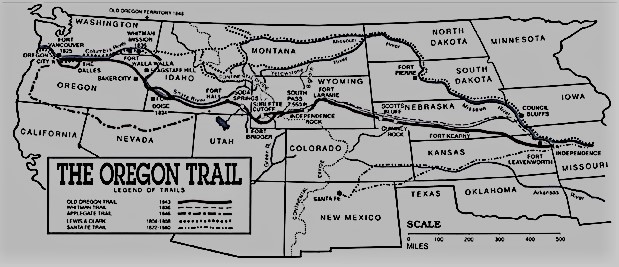
Roger Shaw, a member of Henley Probus, gave a talk to the Probus Club of Basingstoke, about the history of the Oregon Trail. He had lived in America for seven years and together with his wife had driven the entire 3,000 miles route in 2013 and 2015.
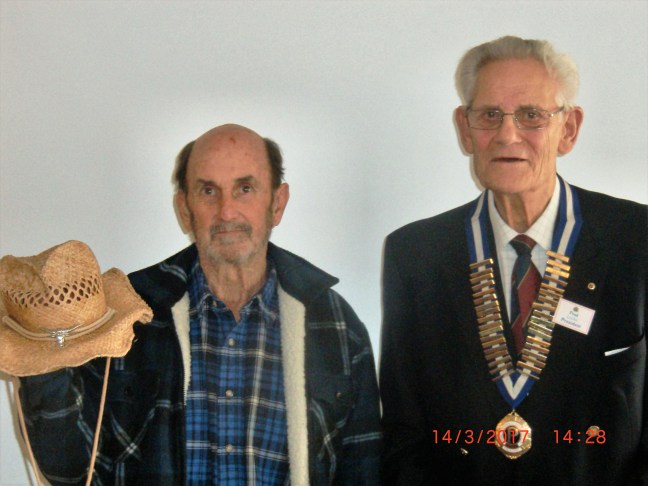
Roger Shaw with President Fred Locke
The American government encouraged immigrants to resettle westwards as the east coast had been swamped by the influx of people from Europe. The attraction was of plentiful and cheap land, originally 600 acres free for a married couple (approximately a square mile) and 320 acres for a single man.. The only stipulation was that they had to improve it. Eventually it was sold for $1 per acre. With the 1849 Gold Rush adding more pioneers, between 1840 and 1860 half a million people, mainly farmers, including 70,000 Mormons and many Irish, made the six months journey from Independence Missouri to the Pacific North West coast. The Mormons diverted south to Utah to establish their own community having promised the government that they would give up polygamy.
The migrants travelled in huge groups in wagon trains, with the preferred smaller lighter covered wagons christened “Prairie Schooners” pulled by oxen. These wagons, some made by Henry Studebaker, a name subsequently made famous in later years by the manufacture of cars, were capable of floating. Each family had to take their own food and water as there were no trading posts along the route in the early years. They traversed the Great Plains, then across the Rockies to the west coast. They favoured a particular route across the mountains called the South Pass, in Wyoming, which was a gradual ascent up 8000 feet where a trail had been worn over many years by millions of buffalo.
Most people will have seen in films or on TV stories about the Wild West and wagon trains that formed circles at night for protection against attacks by American Indians. The reality was somewhat different and while they did form circles it was so the oxen could safely graze within the confines. Initially the Indians were helpful to the immigrants supplying them with buffalo meat but relations soured as time went by. The real problems started in 1847 when half the nomadic Cayuse Indian tribe and all their children were wiped out by a measles epidemic introduced by the Europeans. Their retaliation often took place on later wagon trains but ended after a seven year war with the government during which 400 settlers were killed.
The logistics of wagon trains are incredible with one consisting of 1,600 wagons, 10,000 oxen, 30,000 cattle and 60,000 sheep and was 300 miles long. All but young children walked the distance, many barefoot, averaging 15 miles a day. Death en route was common, including drowning crossing rivers, while diphtheria, measles and accidents took their toll on children and up to ten percent of the travellers died from cholera with records showing that on one trip 57 died on one day alone.
The famous Pony Express was created to act as a postal service and was capable of bringing mail from the Mid West to the Pacific coast in ten days. However failing to obtain a government mail contract and technology, in the form of the telegraph, meant the Pony Express only lasted eighteen months.
The Oregon Trail came to an end when, in 1869, the Union Pacific railroad provided an easier way to complete the journey.
Retired RAF Squadron Leader Chris Perkins MVO, is a member of the Probus Club of Basingstoke and with an old RAF colleague, Dave Stewart, earlier this year they researched some activity of their old RAF 33 Squadron’s actions supporting the Allied Forces in their campaign to free Belgium and Holland from German occupation during WW2.
Based for many years at RAF Odiham, in Hampshire, only a few miles away, 33 Squadron is today more familiar to the residents of Basingstoke for flying the Puma troop carrying helicopter and Chinooks from other squadrons based at this station. However, during the Second World War it operated the Supermarine Spitfire in the ground attack role in support of the army.
In the course of following the fortunes of both air and ground crews in their journey from the Normandy landings, Chris and Dave uncovered an incredible story regarding a battle, almost completely overshadowed by the tragic events occurring at that time at Arnhem.
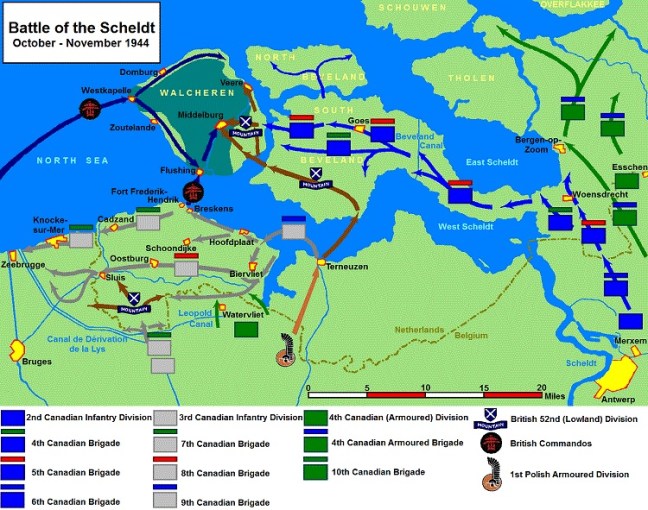
The Battle of the Scheldt estuary was a military operation in northern Belgium and the south western Netherlands to secure the port of Antwerp, essential for allied re-supply use. The First Canadian Army was given the task of clearing the Scheldt area of German occupiers. Believing the retreating troops to be demoralised and lacking in fight, the initial attacks in September 1944 proved otherwise. Hitler had told every member of his forces dug in around the Scheldt estuary that they had to defend their positions to the last man and bullet. Their families would be held as retribution if they failed to do so.
The First Canadian Army was international in character. In addition to Canadian infantry and armoured troops, it included the 1st British Corps, and the 1st Polish Armoured Division. At various times it also included American, Belgian, and Dutch units. The First Canadian Army in north western Europe during the final phases of the war was a powerful force. The strength of this army ranged from approximately 105,000 to 175,000 Canadian soldiers to anywhere from 200,000 to over 450,000 when including the soldiers from other nations.
The enemy opened the sea locks and flooded the whole countryside making what some historians considered to have been the most difficult battlefield of the Second World War. With flooded and muddy terrain and the tenacity of the well-fortified German defences made the Battle of the Scheldt especially gruelling and bloody. At the end of the five week offensive, the victorious First Canadian Army had taken 41,043 prisoners, but suffered 12,873 casualties (killed, wounded, or missing), 6,367 of whom were Canadians.
Flight Sergeant George Roney New Zealand Air Force
And what of 33 Squadron from RAF Odiham? At that time it was also an international unit and consisted of many volunteer pilots from around the world. The Spitfires were used to support the ground troops by attacking enemy positions. Unfortunately many pilots lost their lives. Chris and Dave located a number of these brave young airmen now resting in remote cemeteries. One grave was for New Zealander Warrant Officer George James Roney. He was just twenty two years old.
WO Roney in flying kit
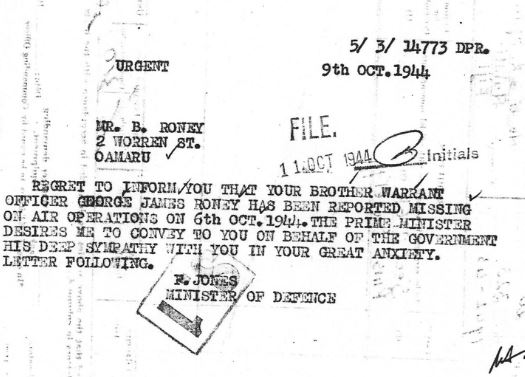
WO George Roney took off at 15.00 on 6th October 1944 as part of a three Spitfire armed reconnaissance sortie. Good weather favoured the German air defence batteries and all three aircraft were shot down after encountering heavy flak. George went down with his Spitfire near the hamlet of Schoondjke, the plane burying itself metres deep into a muddy field. On 9th October 1944 his family received a “Missing on air operations” telegram. The aircraft was not found until 9th June 1948 and George was buried on 12 June in Schoondijke cemetery. His is the only Commonwealth War Grave and has been adopted by children from the local school.
The telegram every family dreaded
Wing Commander Dave Stewart is chairman of the 33 Squadron Association and contacted the New Zealand Genealogy Society for information on any potential family members. A number of relatives came forward and provided photographs, a log book and a number of official letters about George going missing and then about his death.
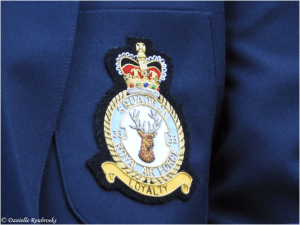
The badge of 33 Squadron
As a result of all this exchange of information about one of their own pilots from 33 Squadron who had been killed in action a moving commemorative service took place in June in the small Schoondijke cemetery in Zeeland. Ten members of the 33 Squadron Association, along with a group of serving 33 Squadron personnel, finally were able to pay tribute to Warrant Officer George James Roney RNZAF. They were joined by George Roney’s nephew, Rob, who had flown in from New Zealand with his wife, Trish, to attend this special event.
Rob Roney is the son of Stanley Roney, George’s brother, who had served in the New Zealand Army in North Africa and Italy while George had joined the RNZAF and then travelled to England to join the RAF. Rob and his wife Trish did not hesitate when it became clear that the puzzle about the life and death of his uncle could finally be completed.
“We heard that the 33 Squadron Association, the one George had served with, were going to visit Zeeland , among other sites, the place where Uncle George crashed, and that they were also going to see the grave. We had to be there. We are very grateful that we are here now”, said nephew Rob.
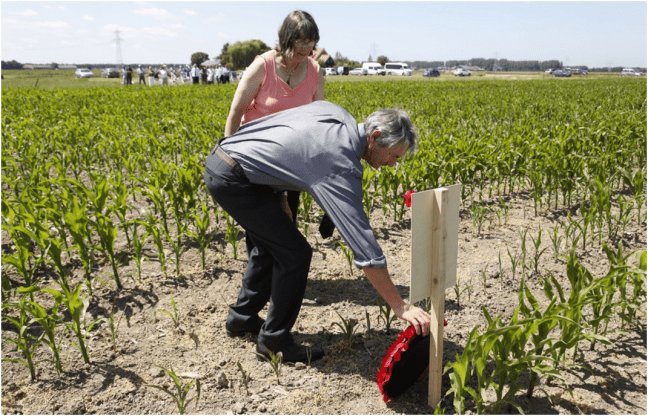
Rob and Trish Roney lay a wreath at the crash site
Before the commemorative service at the church, the group were able to visit the actual crash site in a maize field near to Schoondijke.
3 vintage aircraft made a flypast
The farm is still owned by the same family, the Dekkers, and Rob Roney met the three Dekker sisters who, then aged 7, 10 and 14, had witnessed George’s crash that day. After watching a flypast by three vintage aircraft to salute his uncle. Rob Roney said,
“Yes, it means a lot to me. I did not expect this. It’s really very special. My father never talked about the war and his brother who came over here. This feels like a recognition of my family. That today we are in Zeeland makes it extra special. In some way, it feels like the old country”.
The group then drove to Schoondijke Cemetery to attend the commemorative service at the grave of Warrant Officer George James Roney RNZAF. A small gathering of approx 50 people heard short speeches and dedications from Rob Roney, Dave Stewart, Peter Cammaerts (Burgemeester of Sluis, which now includes the municipality of Schoondijke). Pastor Derk Blom conducted a short service before wreathes were laid by the Roneys, 33 Squadron, 33 Squadron Assocation and serving 33 Squadron personnel and the Municipality of Sluis; Probus member Chris Perkins then recited ‘For the Fallen’.
The fact that civic dignitaries were involved shows the continuing grateful attitude of the Dutch people towards the fighting forces of Great Britain and their allies in freeing their country from Nazi tyranny. National interest was secured for the occasion by Dutch TV filming the whole occasion.
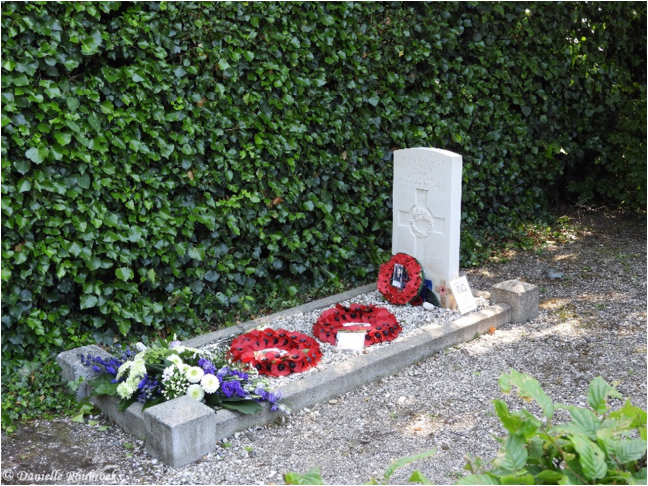
Rob and Trish Roney with the MayorProbus member and 33 Squadron Association member Squadron Leader Chris Perkins MVO pays his respectsWO Roney’s grave, the only Commonwealth War Grave in Schoondijke cemetary, which has been adopted by the local school
Photo Credits:
All colour photos courtesy of Danielle Roubroeks, except Rob and Trish laying a wreath at Dekkar Farm, which is (c) Camile Schelstraete (Provinciale Zeeuwse Courant). B&W photos courtesy of the Roney family









 “Prince Harry trained to be an Apache helicopter pilot here.” John Essery, a Brighton Hill resident who was on Warden Duty, told us the day of our visit to the Museum of Army Flying at Middle Wallop. He had the unusual service record of flying helicopters in the Army Air Corps as a Major and when his service came to an end he joined the RAF as a Squadron Leader to continue his helicopter journey.




 The First Canadian Army was international in character. In addition to Canadian infantry and armoured troops, it included the 1st British Corps, and the 1st Polish Armoured Division. At various times it also included American, Belgian, and Dutch units. The First Canadian Army in north western Europe during the final phases of the war was a powerful force. The strength of this army ranged from approximately 105,000 to 175,000 Canadian soldiers to anywhere from 200,000 to over 450,000 when including the soldiers from other nations.


 includes the municipality of Schoondijke). Pastor Derk Blom conducted a short service before wreathes were laid by the Roneys, 33 Squadron, 33 Squadron Assocation and serving 33 Squadron personnel and the Municipality of Sluis; Probus member Chris Perkins then recited ‘For the Fallen’.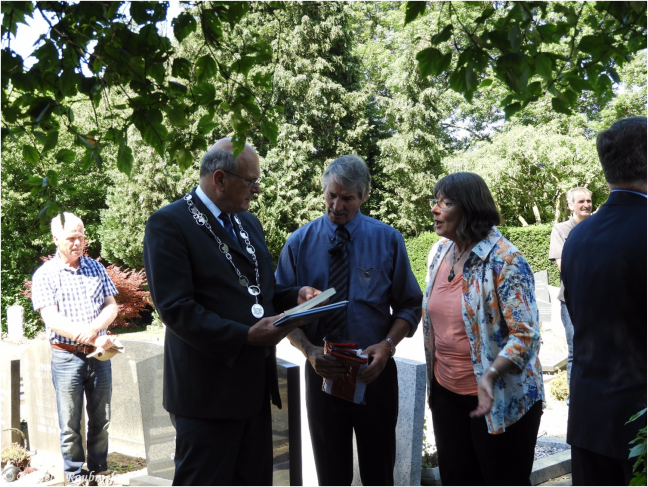

 Probus Club of Basingstoke
You must be logged in to post a comment.