Friday 19 January was the funeral of past president Peter Morley at the Basingstoke Crematorium. He had been a resident of Crossways Nursing Home at Up Nately for some time suffering from Alzheimer’s. Peter’s death on Christmas Eve, came only two months after the passing of his wife Muriel.
Peter had been a civil servant all his working life and for twenty years a member of the Basingstoke Male Voice Choir of which one of their recordings was played as the exit music.
The Probus Club was represented by President Dr Nick Waring along with Paul Flint, Fred Locke, David Tivey, Geoff Twine and Jim Wragg.
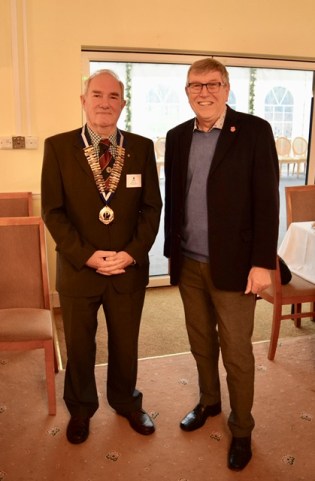
The Probus Club of Basingstoke, the social group for retired professional and business managers, listened with interest about radio broadcasting memories in the era of 1930s – 60s. It was presented by John Pitman, who grew up during WW2 on a farm near Winchester, where the “wireless” was the main form of information and entertainment.
President Dr Nick Waring & John Pitman
Like many places in those days his home had no electrical supply and the radio was powered by an accumulator, an early form of battery consisting of glass phials filled with acid and it had to be taken away weekly for recharging. Some readers may remember “crystal sets” which were usually homemade and did not require an electrical supply. However radio broadcasting goes back to the turn of the twentieth century after the invention of valves made it possible to receive electrical signals. The first broadcast took place on Christmas Eve 1906 from the New York Metropolitan Opera House but the only listeners were ships moored in New York harbour.
1920 saw the first radio news broadcast by the Marconi Experimental Station at Writtle near Chelmsford in Essex followed two years later with regular entertainment programmes. The British Broadcasting Company, whose main station was 2LO, morphed into the Corporation in 1926 becoming the BBC.
Many memories were stirred as old radio programmes were recalled, ITMA (It’s that man again – Hitler during the war) with Tommy Handley and Mrs Mop asking “Can I do you now sir” and Worker’s Playtime was broadcast from factory canteens. Have a Go starred Wilfred Pickles with Mabel at the Table and in later series Violet Carson, of Ena Sharples fame, playing the piano. Ray’s aLaugh with Ted Ray was the fastest joke teller on radio, Much-Binding-in-the-Marsh, with Kenneth Horne and Richard Murdoch was broadcast from a fictitious RAF station. Hi Gang in the war became in peacetime Life with the Lyons with American Ben Lyon with his English wife Bebe Daniels and Vic Oliver. Take it from Here starred “Professor” Jimmy Edwards, Alma Cogan with Dick Bentley and June Whitfield playing the dim witted engaged couple whose famous phrase was “Oooh Ron; yes Eth?”.
Dick Barton Special Agent was on every weekday evening while Journey in to Space with Jet Morgan was on Monday evenings. In Town Tonight was a Saturday teatime current affairs and personality show “We stop the roar of London’s traffic to see who is in town tonight”. Sunday lunchtimes had Two Way Family Favourites with Cliff Michelmoore in London and Jean Metcalfe in Germany followed by the Billy Cotton Band Show which opened with the phrase “Wakey wakey”.
The Goon Show had Peter Sellers, Spike Milligan, Michael Bentine and Harry Secombe while Round the Horne had Kenneth Horne, Marty Feldman with Kenneth Williams and Hugh Paddick as Julian and his friend Sandy. Mrs Dale’s Diary was always worried about Jim and The Archers the everyday story of country folk is still on air today.
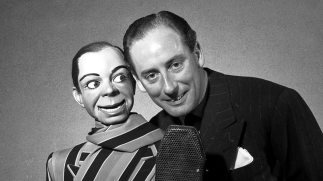
Dummy Archie Andrews & Peter Brough
Who would believe that a ventriloquist’s dummy would have a successful radio show called Educating Archie! It couldn’t happen today but stars of the day appeared like Beryl Reid as Monica but introduced herself in a Brummie accent “Good evening each, my name’s Marlene” and Max Bygraves had two catch phrases “I’ve arrived and to prove it I’m here” and “Good idea,son”. The programme had 15 million listeners but was less successful when it transferred to TV, perhaps because viewers could see Peter Brough’s lips move.
The New York Opera still broadcasts on Christmas Eve but today over 300 radio stations around the world carry the programme.
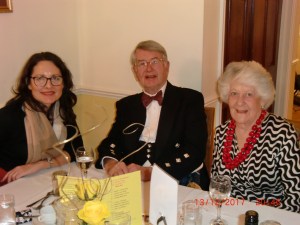
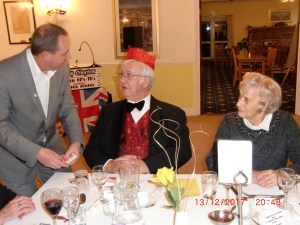
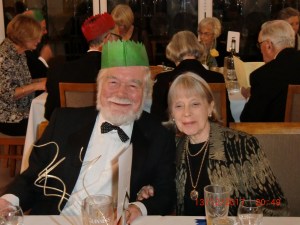
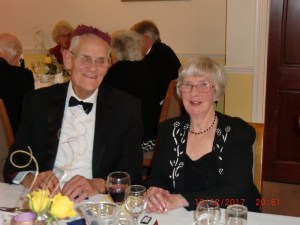
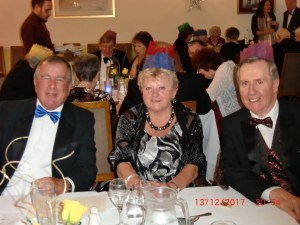
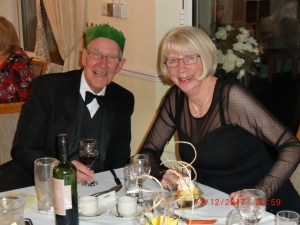
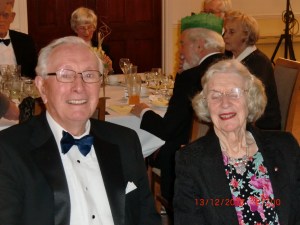
A great night was enjoyed by 48 on Wednesday 13 December 2017 at the Probus Club of Basingstoke Christmas Dinner. This black tie event was once again held at the Test Valley Golf Club where two entertainers kept all entranced.
During dinner, Magic Andy, went to all tables and demonstrated his expertise as a close up magician which left everyone mystified and after dinner Billy Clayton gave wonderful renditions of 60s and 70s pop music with the words remembered by most of the attendees. It was also pleasing to see the majority get on the floor and prove that although some time had passed since those days the spirit was willing and even if there was some evidence of “dad dancing” a good time was had by all.
The event was once again superbly organised by Alan and Liliane May and the raffle run by David and Bridget Tivey netted the sum of £143.50.
President Dr Nick Waring, Ann Raisin, Liliane & Alan May
Speaker Liz Barron OBE with President Dr Nick Waring
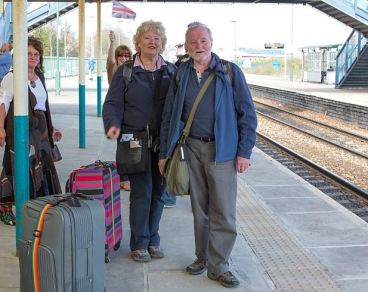
“Two first class tickets to Shanghai please” was how Liz Barron OBE and her husband Tony requested the ticket office clerk at Barry in South Wales as they set out on the first stage of an epic train journey to Shanghai.
Liz & Tony on Barry Station
Liz told the Probus Club of Basingstoke, the social club for retired professional and business managers, about how her grandfather Leslie Pardoe had set out on this journey 100 years before. He was a 21 years old bachelor going to start a new job as the deputy surveyor for the authorities in this Chinese city. Shanghai had become an important trading port where British, French and Americans had established enclaves.
“As a little girl I was fascinated with all the Chinese artefacts in my grandma’s house” Liz explained. ”And when grandpa’s diary came to light and I realised that we were coming up to a century since he made that journey the idea came to mind that maybe we could replicate it.”
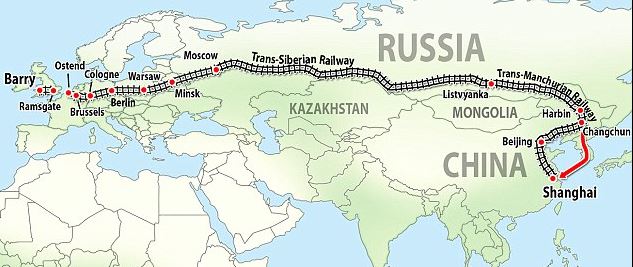
Liz and Tony took eleven months to plan their trip to ensure that they were able to stay in the same cities and hotels as Leslie had experienced on this 6000 miles adventure. Although she and Tony live in Southampton they decided to start from Barry just as Leslie Pardoe had done a century before.
6,000 miles rail journey from Barry in south Wales to Shanghai
The route took them on the short stretch to Cardiff and then to London Paddington. They dined that night in the same London restaurant as her grandfather had done and the following day went down to Ramsgate to cross the Channel to Ostend. They had a train journey though northern Europe stopping for short breaks in Brussels, Cologne, Berlin, Warsaw, Minsk and Moscow. Then they had four days and nights on the Trans Siberian railway to Listvyanka on Lake Baikal in Siberia. From there the Trans Manchurian railway took them via Harbin to Changchun in Northern China.
The only change to the route was that her grandfather had taken a three days ferry from Dailen across the East China Sea to Shanghai but the service no longer operates so they completed the final leg by overnight train which passed through Beijing. Leslie’s journey had taken 15 days while the journey for Liz and Tony was longer at 24 days because they wanted to take in some sight-seeing knowing that it was unlikely they would pass this way again.
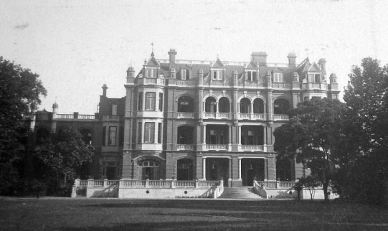
The Ravenscourt Country Club in Shanghai
The large ex-pat communities in Shanghai enjoyed a good social life with horse racing and the Ravenscourt Country Club being some of the attractions.
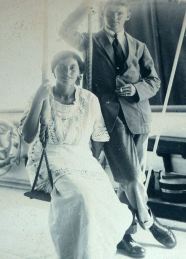
Leslie & Margaret on honeymoon in Japan
Leslie Pardoe met there and married Liz’s grandmother, Margaret. Liz’s father, John, was the youngest of their four children. The family left Shanghai after 27 years when the Japanese took over the city in 1940 and they escaped back to England via Canada.
Leslie Pardoe had travelled first class for £10 7s 3d but it cost Liz and Tony £25,000 to replicate this transit.
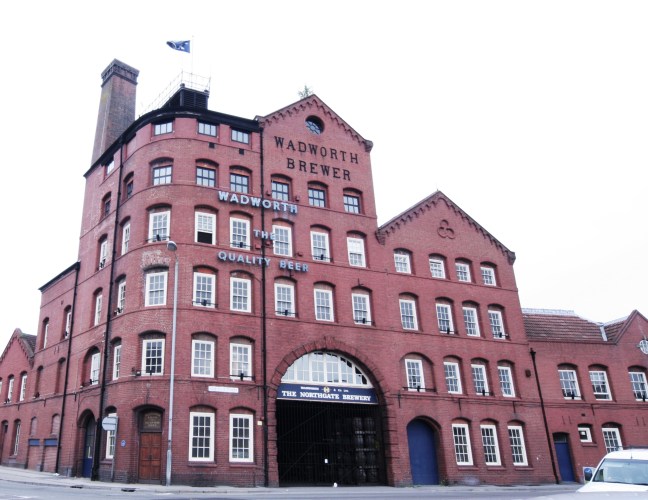
Thursday 26 October saw twenty of us consisting of 6 solo members and 7 with partners having an enjoyable coach trip to Devizes in Wiltshire ostensibly to have a guided tour around the Wadworth brewery. It is still family owned since its foundation in 1875. However as it was market day and the tour was scheduled for 2.00 pm there was ample time to wander around this ancient market town, browse the many individual shops and enjoy a spot of lunch.
Some went to look at the Caen Hill rising lock system on the Kennet & Avon canal that runs through the town while others sampled the delights of this old town that houses an impressive indoor market as well as the extensive and what appeared to be attractive value to be had from the outdoor market. There were visits to a museum and flea market before the brewery tour commenced.
Because of the many steep stairs some excused themselves from the brewery tour but joined later to visit the stables and see the shire horses used to pull the drays to the pubs within two miles of the brewery. They also go on display at several shows in the south western region during the summer. All then adjourned to the Harness bar for a free tasting of the ales on display.
Note the museum exhibit that mentions the Roman Emperor Probus.
Dale Greenwood, a qualified Blue Badge guide is a man also very much involved in historic railways, gave a talk to the Probus Club of Basingstoke which was about a local subject; the Basingstoke to Alton Light railway. Most people will have seen the small section of railway track in the centre of the roundabout at Viables on the Harrow Way and possibly wondered about it.
It was laid very close to the original position of the light railway that was opened in 1901 between Basingstoke and Alton. The line was the first to be constructed after a decision in Parliament to allow light railways to be built, with great savings in costs, as a way of increasing economic activity in sparsely populated areas.
The original idea that the London & South Western Railway Company had was to open up a route to Portsmouth. Passengers could travel from Waterloo to Basingstoke, then on the light railway to Alton and thence on to Portsmouth.
Light railways had restrictions, being built, as the name suggests, to a lower standard than traditional routes, which meant that only lighter engines could be used and were restricted to a top speed of 25 mph.
Our light railway was mainly single track with, initially, only three trains in each direction daily. Stations were built at Cliddesden, Herriard, Bentworth & Lasham and Butts Junction outside of Alton. While all the stations had sidings only Herriard had two platforms. The stations were hardly close to their village names and most of the cottages seen today close to them were built for the railway workers. The cost of the venture was £50,000, being a quarter of the typical budget had the line been laid to the usual standard.
The total distance was only 12 miles and because of the stops and speed restriction the journey would take 45 minutes. During WW1 the tracks were removed for use by the army in France. The company hoped that it would never reopen but due to public pressure the line was relaid and opened in 1924. It was never a commercial success and passenger services ended in 1932 but a goods service continued from Basingstoke as far as Bentworth & Lasham until the line eventually closed in 1936. The whole of the line was dismantled except for short stubbs at either end – from Basingstoke in to the Thorneycroft factory (now the site of Morrisons supermarket) and from Butts Junction to Alton Park, the Treloar Hospital. These short stretches were used for goods traffic until 1967.
The railway was used for the filming of the 1929 film “The Wrecker” and the 1937 film “Oh, Mr Porter” which starred comedian Will Hay and featured Cliddesden station as the fictional Buggleskelly.
A party of twenty, consisting of members and some wives/partners had a real treat when they visited the Lasham Gliding Society at Lasham airfield, south of Basingstoke. In the party were two retired RAF officers maintaining their interest in heavier than air machines.
After coffee in the restaurant we were taken to a briefing room where an extensive presentation on all matters connected to gliding brought some interesting facets about early attempts at flying. Many commercial pilots also own a glider and it is reckoned that the plane that came down on the Hudson River in New York was not the disaster it could have been but for the fact that the pilot also flew gliders. Surprisingly it is possible to own a second hand glider and trailer for around £9,000 although the very latest hi-tech version could cost up to £250,000.
Then driving in a slow convoy around the perimeter of the airfield, passing around the hangers where commercial passenger jet aircraft are serviced and on to the south side to where the Gliding Heritage Centre has its own purpose built hanger. A second one is in construction.
The hanger is chock full of gliders of various vintages clearly showing the evolution of the species from 1932 onwards including two with swastikas and many are still in a flying condition. Every bit of space was filled with these exotic, colourful, little planes hanging from the roof and carefully placed around the floor. This was a visual experience made better by the guide fully explaining the changes to the aircraft on display. Keeping up to date there was even a glider flight simulator.
Just to remind us that Lasham is still an operational airfield, during lunch a Norwegian Air Boeing 737 commercial jet came into land on the mile long runway to then taxi round to the service company that rents its space from the gliding society who owns the airfield.
Thanks are due to member Stephen Thair for arranging this visit, who has maintained his interest in avionics since qualifying for his private pilot’s licence some years ago and to Bryan Nagle for supplying some of the photographs.
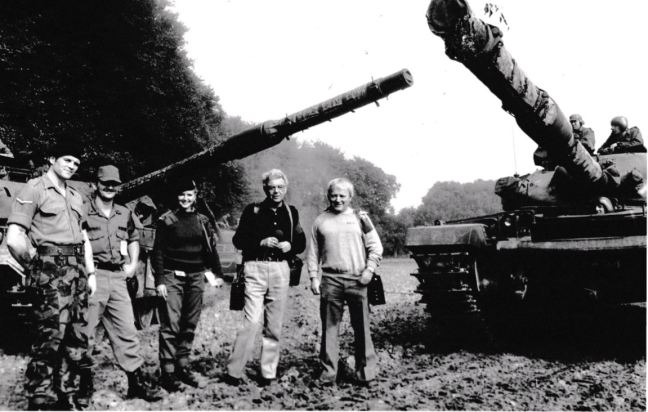
Speaker Alan Grace (far right) with UK troops in Germany 1980
The Probus Club of Basingstoke enjoyed a presentation by Alan Grace about the life of a programme maker living with our armed forces whose broadcasts allowed them to maintain morale by keeping contact with families in UK and also provided them with much needed entertainment.
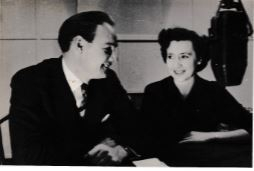
Cliff Michelmore and Jean Metcalfe
Many people of mature age will remember Two Way Family Favourites on Sunday mornings. Then known as the wireless it was broadcast on the BBC Light Programme. It was claimed that this was the only radio programme that had the smell of roast beef and Yorkshire pudding. The German end was run by BFBS (British Forces Broadcasting Service) with, for some time, Jean Metcalfe there and Cliff Michelmore in London.
Bill Crozier the longest serving host of Two Way Family Favourites
In World War 2 both American and Russian military had radio services for their troops and after the Americans joined the war effort the British War Office was persuaded by Col David Niven and supported by Glenn Miller that our troops would benefit from a similar operation. The first military broadcast services saw life begin in Algeria in 1943 and run by the Army Welfare Service. The only drawback was that there was no money, no equipment and no staff. And it was firmly established that editorial control was to be independent of the Ministry of Defence and the armed forces themselves. By some miracle they were on air in seven weeks. It was set in a former harem but the fully glazed floor and wall tiles had to be draped in army blankets to deaden the appalling acoustics. The first requested record was the famous German wartime song, Lily Marlene.
In the following years over 100 radio stations were set up from Aden to Zeltweg. Some of the earlier stations were mobile housed in ten ton trucks with transmitters, generators, record library and studio. They followed troops through the Italian campaign and then into mainland Europe. Fixed sites were based in a range of extreme locations from the magnificent Musikhalle in Hamburg that had escaped bombing, down to an old cow shed in Cyprus, tents in the Canal Zone and shipping containers at Camp Bastion in Afghanistan.
Rehearsing a radio play rewritten to avoid breach of copyright
Some of the people involved became household names. Cliff Michelmore, Frank Muir who was a photographer but volunteered to be a writer, Peter Sellers, Raymond Baxter who went on to front many BBC TV programmes including Tomorrow’s World, Brian Moore who went on to become a top sports presenter with ITV, and Roger Moore who was told that as he could not act he should go back to being a male model for knitting patterns. He later sent a postcard to the producer who had dismissed his talent which said that although he could not act he had still had a good life and signed it 007.
In 1957 Alan Grace started working with what then was BFN in Cologne as an announcer and sports producer, while a national serviceman in the RAF. Over the next four decades he experienced life throughout the world’s trouble spots where British forces were involved. Such places of conflict had radio and then television services provided for service personnel and their dependents worldwide. Places of interest included Palestine, Cyprus during EOKA, Kenya in Mau Mau times, Aden with terrorist troubles, Cyprus, again, during the Turkish invasion, Hong Kong, The Balkans, The Falklands, Gulf Wars 1 and 2 and Afghanistan.
Probus Club member John Terry featured in the Basingstoke Gazette on Thursday 14 September as he was one of the winners of a competition to Spot The Bench by identifying the Sitting with Jane benches around the town from photographs of small sections of each bench. The competition was organised by Basingstoke Deane Rotary whose past president Alan Gibson presented the prizes standing close to the recently unveiled statue of Jane Austen outside the Willis Museum in the market place.
John’s prize was afternoon tea for two at Tylney Hall hotel.
Probus member Richard Stettner took this photograph.
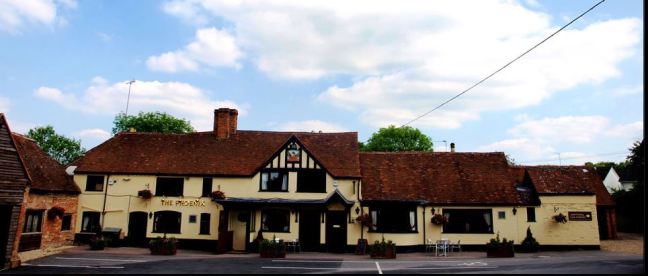
A grey day in August did not prevent our members enjoying their annual pub lunch together at the Phoenix Inn on the A30 near Hartley Wintney. Originally a coaching inn of yesteryear it has morphed into a high quality dining establishment that proudly displays a Les Routiers sign at the door. President Nick Waring made this his choice in the months prior to ascending to high office. The food on offer on the main courses went from a vegetable selection up to a Chateaubriand but it is doubtful that any of us went to that expense since after all we are pensioners.
There were two tables of ten and eight and then tables for four people which is why some people appear not to be seated with their wife/partner as they were sitting opposite. Gerry and June Anslow, together with their two lady guests, left before the photographs were taken.















 pressure the line was relaid and opened in 1924. It was never a commercial success and passenger services ended in 1932 but a goods service continued from Basingstoke as far as Bentworth & Lasham until the line eventually closed in 1936. The whole of the line was dismantled except for short stubbs at either end – from
  Basingstoke in to the Thorneycroft factory (now the site of Morrisons supermarket) and from Butts Junction to Alton Park, the Treloar Hospital. These short stretches were used for goods traffic until 1967.




![John Terry Prizewinner photo[8069]](https://probusbasingstoke.club/wp-content/uploads/2017/09/john-terry-prizewinner-photo8069.jpg?w=529&h=529)


 Probus Club of Basingstoke
You must be logged in to post a comment.