President Chris Perkins MVO with speaker Jenny Mallin
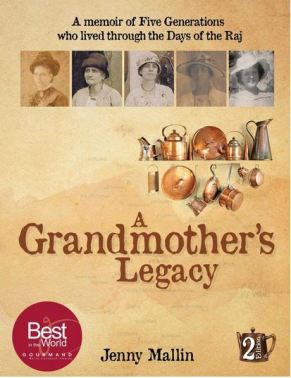
Jenny Mallin, who gave a talk to the Probus Club of Basingstoke, is rightly proud of her five generations of women of British ancestry in India from the days of the Empire to the present day. Although based on her great great great grandmother’s hand written recipes she has written and published a charming book which is not just a collection of cookery expertise but it encompasses the life and times of Anglo-Indians during the prime days of the Raj spanning the 19th and 20th centuries.
Army service took the first generation from Mirfield in Yorkshire to India in the late 1700s and she has established a family tree to the present day. During this time each generation of women added to the original cookbook which formed the basis of her talk.
She covers the railways which grew from 25,000 miles to over 41,000 miles with one grandfather a train driver. Another was a teacher who with the Maharaja of Mysore founded a school that today is the Mysore University, another antecedent became Postmaster General and yet another was the governess to sixteen years old Benazir Bhutto, who became prime minister of Pakistan on two occasions.
She talked about her parents marrying in the Andaman islands, the Indian expedition to Mesopotamia during World War 1, the Victorian style of dressing in the 19th century, Eventide homes in Bangalore, Poonas’s military station, of hunting trips and the 1,000 miles walk back from Burma during World War 2. The Imperial Civil Service had 1000 people administering a country of over 300 million inhabitants and many bungalows were built to house the travelling administrators. Jenny Mallin has every reason to call her book a memoir instead of a cook book, though fans of cooking will find it a treasure trove.
A practical chef she has been a tutor at many prestigious culinary centres including in our area the Newlyn’s Farm Cookery School near Odiham and at Lainston House hotel near Winchester.
Vice President Richard Wood with Janet Fagg the President of Basingstoke Ladies Probus Club
The annual Spring Ladies’ lunch was the latest formal gathering of the Probus Club of Basingstoke, the social club for retired professional and business managers. Organised once again by Alan and Liliane May they came up with the goods when they arranged this occasion for members and their spouses. It was held at the Test Valley Golf Club. By working closely with the chef they ensured that all forty one attendees received their pre-ordered food – there were four selections available from three courses – and they produced all the printed menus and table name cards as well as the information sheets after they devised two separate quizzes. And if that wasn’t enough that also ran the raffle.
Alan has been the Honorary Treasurer of the Probus Club of Basingstoke for over a decade. In that time he and Liliane have become experts at successfully arranging not only this lunch but also the club’s Christmas dinner. While these are the two formal events to which wives/lady friends are invited there are many other social occasions during the year when the distaff side of the family are involved.
Guest of honour was Janet Fagg, the President of Basingstoke Ladies’ Probus Club, who was welcomed by Vice President Richard Wood. She was equally at home on this occasion as the wives of some members of the men’s club belong to the Ladies’ Probus Club.
For more information about the Probus Club of Basingstoke see their web site http://www.probusbasingstoke.wordpress.com or for an informal chat contact their Secretary, Paul Flint, on 07770 886521. For enquiries about Basingstoke Ladies’ Probus Club contact Janet Fagg on 07986 133382.
Peter Cross with his late wife as shown on the back page of his Funeral Order of Service.
7th September 1928 – 5th April 2019
The funeral took place on Wednesday 1st May 2019 of Peter Cross at Basingstoke Crematorium. The roundal of the Royal Air Force Ensign was draped on his coffin to represent his service in the RAF where he has been an armaments specialist working on Scimitar jets. He served in Hong Kong, Singapore and Scotland as well as in England. He had been married to his late wife Brenda for 58 years and they had four children, five grandchildren and six great grandchildren.
Peter joined Probus on 10th June 2008 and was a regular attendee at our meetings and on various coach outings. He resigned through ill health in June 2018.
Our Probus Club was represented by Paul Flint, Gerry and Joan Anslow and Rob Hopkins.
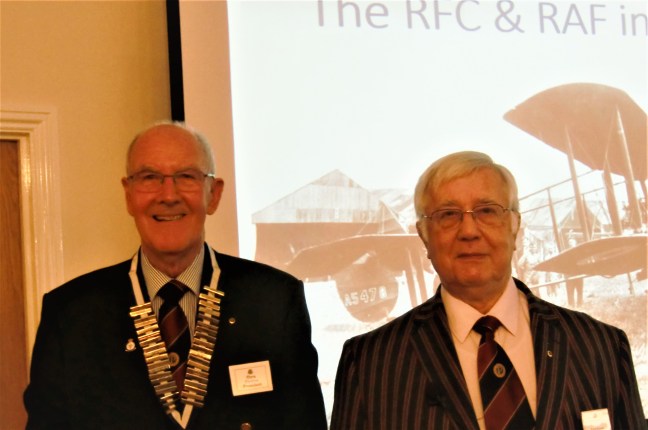
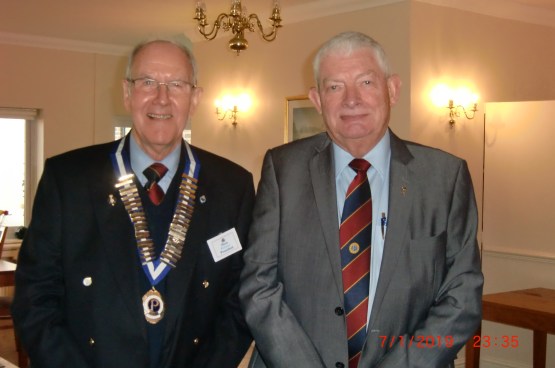
President Chris Perkins MVO and speaker rtd RAF Wing Commander Bryan Jenkins
Probus Club member, retired RAF Wing Commander Bryan Jenkins, gave a presentation to this social club for retired professional and business managers about the foundation of the Royal Flying Corps at the outbreak of the Great War. The corps was viewed by the generals as there to serve the needs of the army.
Bleriot flying across the English Channel in 1910 caused military chiefs to rethink the previous year’s philosophy that aeroplanes could have no use in war. Aviation, in order to progress for military use, had to rethink its design and production. There were no real manufacturing facilities, no aircraft engine industry with much reliance on French aircraft and engines. There were no aircrew training schools and initial thoughts were that pilots should not be aware of the physical limits of their planes as it would impact on their confidence.
Thinking changed from General Haig’s comments in July 1914 that aeroplanes could not be usefully employed in reconnaissance, this was the cavalry’s role; to September that year when aerial reconnaissance enabled the British Expeditionary Force win the battle known as “Miracle of the Marne”. Such flight information enabled the Generals to deploy their forces to maximum effect.
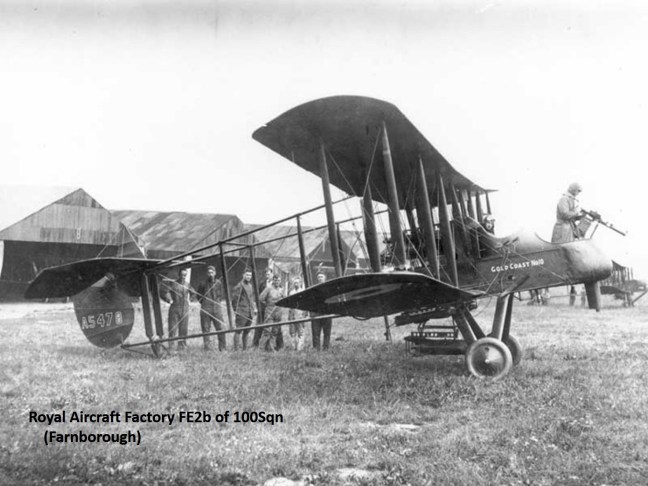
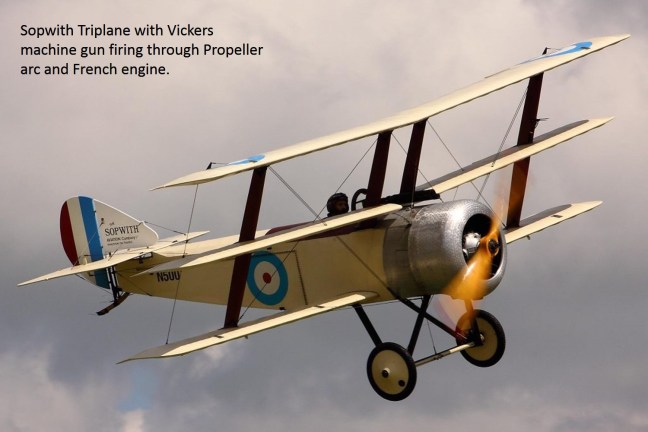
Technical difficulties had to be overcome such as being able to fire guns through the propeller. Initially, this was overcome by having the propeller at the rear of the pilot.
Pusher type propeller with separate air gunner who had no harness or parachute
By 1915 the German Fokker Eindecker monoplane was able to fire through the propeller and had superior aerial performance than any British design. Fokker continued with bi-plane and tri-plane designs, the latter made famous by Manfred von Richthofen who was credited with 80 “kills” and became known as the Red Baron.
Early aerial battles against enemy aircraft were not successful. RFC planes strafed enemy infantry and bombed airfields, factories and transportation facilities. The bombs being hand held over the side of the plane as had been the early cameras used in photographic missions although bigger and heavier cameras became fixed to the side of the fuselage.
Training gradually improved, as it needed to be, since the average life expectancy of a pilot on the Western Front was only 23 days. Some pilots only survived for three days. Of 10,000 RFC airmen who lost their lives, 4,000 died in training, 4,000 in post training and only 2,000 killed as a result of enemy action.
Problem solved being able to fire a machine gun through the propeller arc.
Aircraft production was ramped up with the creation of aircraft manufacturing factories but the front line was always waiting for replacements. The main problem was insufficient engines and by 1918 there were over 4,000 planes in storage waiting for an engine.
After starting the Royal Flying Corps in 1914 with 2073 personnel, by the beginning of 1919 there were 114,000 personnel and 4,000 planes in some 150 squadrons. Some 900,000 flying hours had been logged during the war and almost 7,000 tons of bombs had been dropped on enemy positions. Eleven members of the RFC were awarded the Victoria Cross.
This design was copied by Fokker and made successful by the Red Baron
John Moore- Brabazon , who had been the first Englishman to fly a heavier than air machine on British soil in 1909 and who became responsible for aircraft production in WW2, summed up the progress made.
“We started the Kaiser war with very little equipment, and not very good equipment at that. Many of the RFC squadrons were equipped with French aircraft. There was, however, during the war an immense concentration upon producing better engines and better machines than anyone else. We ended up that war absolutely supreme throughout the world. We had better machines, better engines and better pilots than existed anywhere in the world”.
As a result of its success the RFC became a fully independent third military sector of UK defence forces and on 1st April 1918 it merged with the Royal Naval Air Service to become the Royal Air Force.
Once again it was the annual quiz night organised by Deane Probus and held at Basingstoke Golf Club. Our members “swept the board” not only winning the lion’s share of raffle prizes but one of our tables won the quiz. Modestly I identify that table of Paul Flint and Janet Fagg, David and Pat Rawden and Paul’s son Mark and daughter in law Fiona who gamely made up our numbers. The prize for coming first was a £10 voucher for each member of the team.
Those members and their partners attending the event had a really enjoyable time.
It was a very entertaining evening which included a fish and chip supper with stiff competetion. Provided such a quiz evening is organised next year we shall attend determined to defend our superior position.
It is received wisdom that following retirement it is important to keep both physical and mental capabilities in good working order. There are plenty of things that people can find to occupy their minds if they are not into visiting a gym on a regular basis.
Alan May has a boyish enthusiasm for filling his life with interesting pastimes. He outlined his hobbies to fellow members of the Probus Club of Basingstoke, the social club for male retired professional and business managers. While he plays golf once a month and with his wife regularly enjoys ballroom dancing he has several cerebral interests, one being very unconventional.
For many years attendees at the Probus Club Spring Ladies’ lunches and Christmas Dinners have been entertained by the pictorial and brain teaser quizzes he has compiled, many details of which concern Basingstoke and its environs. Clearly his interest in crossword puzzles comes to the fore.
May Family tree
An interest in genealogy over time has thrown up many interesting facts. His wife has Belgian parentage so he produced family trees of his Belgian in laws with the family name of Faes going back to the mid 1700s in Watou near the Belgian/French border. They have seen on a WW1 memorial and the graves of three brothers, George, Gaston and Jerome Faes, who were on his wife’s family tree. In 2018 Alan and his wife were invited by the Belgian local council to the naming ceremony of a street commemorating the three Faes brothers.
Three Faes brothers remembered with a street name
Another branch of his wife’s family lived on the outskirts of Brussels. During WW2 her little cousin Fifi was often asked by her mother to deliver messages to different people. After the war she discovered her mother had hidden British soldiers in the attic. The messages were to get the soldiers moved further down the resistance line and back to England. Very much like the television series “Allo Allo”.
He traced his mother’s side back to the 1600s in Gloucestershire and their travels through railway service to Swindon and thence on to London and eventually Dover. As a man of Kent he traced his father’s family back to the late 1700s. In the 1930s an uncle had a pleasure boat near Deal. Sometimes at night the boat picked up contraband which was then buried in the garden.
“Although his civic duty included being a member of the Lifeboat crew “, Alan explained “but inexplicitly he refused to go to Dunkirk with the small boats to rescue the British troops from the beaches.”
A 1959 GCE “O” level in Art has been put to good use in retirement when Alan bought a set of water colours. In the U3A he has progressed from Beginners to Improvers and concentrates on flowers and birds. His paintings on display were to a very high standard.
Alan May with some of his artwork
“I enjoy the peace and quiet together with the calming effect and is very relaxing. You meet others who are always willing to help and comment.”
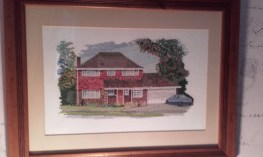
This artistic bent comes in useful with his “secret hobby” of Cross Stitch. Usually a female pastime his wife taught him to such a degree that he featured in the Cross Stitch magazine. As a regular cruiser he can often be found in the ships’ lounges with a small design.
Cross Stitch Fire ScreenCross Stitch of his previous house
“I get a few raised eyebrows but I am too old to worry what people think. I bet they can’t do it.”
Alan is an inspirational example following the advice that people should get out of their comfort zone and try something new.
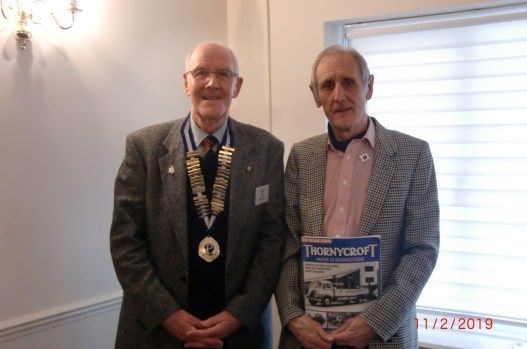
President Chris Perkins MVO with speaker Garry Bone
In the 19th century Thornycroft had been successful boat builders and marine engineers based on the river Thames at Chiswick. Steam power was the means of propulsion for paddle steamers and boats for the Admiralty, including torpedo boats. One such Thornycroft torpedo boat featured in the film The AfricanQueen enacting historical fact where the German vessel that had been controlling Lake Tanganyika was eventually sunk. Other torpedo boats were successful in sinking part of the Russian Red fleet during the Bolshevik revolution. The company expanded with a yard in Southampton and eventually in Singapore and Australia.
It was the repeal of the red flag act in 1896 that had required someone to walk in front of a vehicle waving a red flag at a maximum speed of 6 mph that prompted Thornycroft to realise the potential for self propelled road vehicles. They were already making steam driven vans but clearly needed new premises to expand production. Thornycroft settled on Basingstoke because the town had good road and rail links.
The company moved to Basingstoke in 1898 where they established their works on a 16 acre site on the Worting Road. Eventually Thornycroft became the town’s largest employer. Today Morrison’s supermarket occupies part of this acreage. The roundabout at the junction of Churchill Way West and the Ringway carries the name of Thornycroft as a lasting reminder of the importance this company made to the rising fortunes of Basingstoke.
Garry Bone was a long serving employee of Thornycroft and is a founding member and director of the Thornycroft Society and gave an insight of the changing fortunes of Thornycroft in a presentation to the Probus Club of Basingstoke.
An early Thornycroft steam van produced at Chiswick
Steam powered lorries were supplied to the British Army from the Boer War onwards, with commercial vehicles supplied to many retail customers. London’s first steam powered bus was a Thornycroft double decker and overseas companies were regular customers, as were many UK bus companies. Petrol vehicles were introduced in the early 1900s which saw Thornycroft making a series of cars until 1913 when they decided to concentrate on lorry production.
One of a range of Thornycroft cars made in Basingstoke
The outbreak of WW1 saw an immediate requirement for lorries and Thornycroft was tasked to deliver as many as possible. They concentrated on their J Type lorry and many chassis were fitted with anti tank guns, mobile aircraft guns, ammunition carriers and as general transport vehicles. Over 5,000 were delivered during this conflict during which time 35% of the workforce were women.
Other war supplies made by Thornycroft in Basingstoke were marine engines, trench mortars, over 3,000 depth charge throwers for the Admiralty and thousands of shells.
Post war saw a reduction in the fortunes of Thornycroft as surplus military vehicles were available at a quarter of the price of new vehicles but by the mid 1920s the company was rising again with the introduction of the Lightening coach that was capable of carrying its full load of passengers at 50 mph. Other orders were placed by railway companies for lorries and buses and by this time about half of the output was exported.
By the 1930s the loss making Thornycroft was criticised by its bank for having too many models on offer and poor senior management that needed to grasp the realities of the market. As well as making buses and coaches they were making eleven types of lorries. In 1930 they had 1800 employees which reduced to 731 by 1936 by which time the firm returned to profitability.
WW2 saw a massive improvement of the order book. The firm worked 24 hours a day with 2,500 employees, over 800 being women. As well as munitions the company made over 8,000 Bren gun carriers some with floatation gear to cross canals and rivers under their own power, 13,000 wheeled vehicles including mobile cranes, others with generating sets, 670 two-pounder guns, 1,700 17–pounder guns and 15,000 sets of torpedo parts. In addition Thornycroft made nearly 2,000 Nippy and Sturdy lorries for essential civilian work. There were huge numbers of parts made for various military and marine engines.
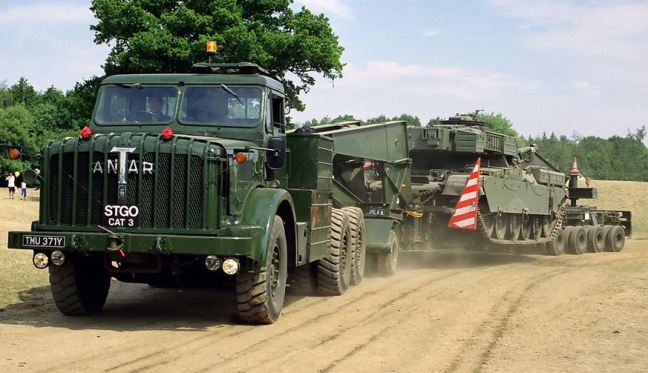
1948 saw the vehicle and engine manufacturing formed into the subsidiary company Transport Equipment (Thornycroft) Ltd. TET announced in 1949 that the Iraq Petroleum Company had placed a large order for Mighty Antar lorries to carry pipe lines across the desert. This was followed over many years by the UK military using this vehicle in many guises as its main heavy transporter.
A Thornycroft Mighty Antar as a tank transporter
TET was sold in 1961 to Associated Commercial Vehicles (ACV) announcing that the Basingstoke works would concentrate on the Mighty Antar, Big Ben and Nubian heavy duty vehicles while other parts of the group would be responsible for mass produced vehicles. June 1962 saw ACV becoming part of the Leyland Group, whose subsidiary, Scammell, also produced specialised lorries which led to reducing orders for Basingstoke.
In 1972 British Leyland sold the Basingstoke works to the Eaton Corporation of Ohio. The work force was reduced from 1,100 to 738 with the pledge to employ them in its transmission business. This did not last long as the last lorry was built in 1972 and the works sold on 14 January 1973 although Eaton carried on locally. So ended 74 years’ connection between Thornycroft and Basingstoke where thousands of commercial vehicles had been made with great numbers of a highly skilled labour force. With its highs and lows of commercial endeavour, war work, and successful heavy duty vehicle manufacturing it had brought the benefit of employment to thousands of Basingstoke folk who regard their time there fondly.
(Bob Clarke is acknowledged as providing many of the above statistics)
Just about everyone has heard of NATO (the North Atlantic Treaty Organisation) but very few recall that it was founded in 1948 and enlarged in 1949 to a total of 12 countries bordering the North Atlantic. It was formed because of the perceived threat from Russia following their land blockade of West Berlin which caused the airlift to operate for eight months to ensure the western sector of the city could be supplied with everything necessary to sustain life.
The key criterion of NATO membership was that any armed attack on any member country in Europe and North America would constitute an attack on them all.
NATO logo
All this and much more was explained by Probus member and Basingstoke borough councillor Paul Miller who outlined his personal involvement in this international defence structure over four decades which included the cold war and then the Bosnian and Kosovo difficulties and several other campaigns. As an officer in the RAF and then latterly as a civilian he rose within NATO eventually based at their headquarters in Belgium.
Member countries agree to assign assets in the form of military hardware and personnel to NATO and are managed in all operational roles by NATO staff. As such they have been involved in many conflict zones and incidents during this time many of which have not been reported in the free press.
With the fall of the Berlin wall in 1989 there was great excitement as other former communist countries threw off the yoke of the old USSR and embraced social change and democracy. However this brought up several concerns – would a unified Germany remain neutral and what would happen to the nuclear weapons held in the old communist countries? It also brought up the question of whether there still existed a future need of NATO but other events only served to confirm that it was indeed still needed.
In fact today the membership has grown to 29 countries. Many newer members of NATO were originally eastern bloc countries that formed the basis of the Warsaw Pact organisation set up by Russia in response to West Germany joining NATO in 1955.
The Balkans crisis starting in 1989 which included the Bosnian and Kosovo campaigns were only as successful as they were due to the cooperation of the former communist countries of the Czech Republic, Poland and Hungary who allowed their airfields to be used by NATO forces. In return they hoped that it would create a favourable climate to their subsequent applications to join the EC.
NATO fighters supporting an AWAC surveillance plane
It was complicated by the fact that the old Yugoslavia was a member of Eurocontrol which coordinated civilian air traffic which had increased considerably in recent years with tourist expansion on the Dalmation coast. The NATO air forces needed to have surveillance and operational access to this airspace and eventually ran an air campaign over 78 days involving 38,000 sorties which allowed in a multinational peacekeeping force which brought an end to ethnic cleansing.
Today NATO has become a Crisis Management organisation as its forces continue to lead the way in Kosovo, Afghanistan, in the Mediterranean and several other places including Iraq where it is carrying out training of national forces. It is also helping the African Union and in the Gulf of Aden guarding against Somali pirates. NATO is carrying out work on the European migrant crisis and has 20,000 troops in action around Europe and elsewhere.
NATO headquarters in Belgium
The United Nations does not recognise NATO, only Nation States but fully appreciates the role played by this military cooperative of North American and European countries in striving to maintain peace in this troublesome world. It does however involve its organisation UNHCR, based in Geneva, to become incorporated with NATO actions in various humanitarian projects.
Yet again another calendar year comes to an end and it was celebrated with the annual Christmas dinner of the Probus Club of Basingstoke held at the Test Valley Golf Club on Wednesday 12 December 2018.
President Chris Perkins MVO with wife Carolyn welcomed each couple on arrival. Chris also gave a speech after the meal thanking all those involved in the preparation of the night’s activities and made special mention of the work that Alan and Liliane May had put in. They were not present this evening as they were away on a cruise but they had prepared everything in advance with the creation of all the printed matter needed. Where do they find all the quiz questions? And the individual place cards contained flags of nations all of which takes considerable research time and effort. Most importantly they liaised with the chef to ensure everyone received their particular meal selection – no mean feat.
David and Bridget Tivey once again organised the raffle which successfully netted £130 for the club funds.
Ladies resplendent in their finery and the men in black tie this is one of the two formal events of the year when the ladies are made welcome – the other being the Spring Ladies’ Lunch in May. There are, of course, many social occasions during the year that our wives/partners are encouraged to attend.
President Chris Perkins MVO and wife Carolyn welcomed all the guests
A party of 16 members and their spouses/partners enjoyed an excellent evening out at the Mill theatre at Sonning on 8th November. As it was dark, the views of the attractive old buildings were somewhat limited, but inside there is a very cosy bar, and an upstairs dining area, from which there is easy access into the rather intimate auditorium. The low ceilings and wooden beams give an indication of the age of the buildings which date from the 1700s and 1800s, but there is a mention of mills at Sonning in the Domesday Book so the site has a long history. The mill closed as a flour mill in 1969, and it was purchased and converted into a theatre by the Richards family who reopened it as a theatre in 1982.
The evening started with a drink at the bar and we then went for an excellent buffet-style meal before the performance. The highlight of the meal for some of us was the bread and butter pudding and custard.
A Night in Provence is a comedy written by Robin Hawdon about an English couple who have booked a luxury villa for a 2-week summer holiday, only to find that there has been a mix-up by the agents who had not told the owners about the booking. The trouble – or entertainment – starts when the owners arrive from Paris expecting to use the villa for their own holiday. Shortly after they arrive, the English couple’s Irish friends turn up as well. They all decide that they will have to share the villa, and the play is about the stresses and strains that this causes – a heady mixture of champagne, (misdirected) sexual attraction, and cultural differences.
The play is very well cast, and the actors all performed enthusiastically and with good comic timing. This is perhaps just as well, as the “stage” is effectively a pit, with the audience in a semi-circle looking down on them, rather like a classical Roman or Greek theatre. The play is in some ways something of a Gladiatorial combat, so may be the setting is appropriate!
Our thanks to Tony Atchison for organising a very enjoyable evening.


 She covers the railways which grew from 25,000 miles to over 41,000 miles with one grandfather a train driver. Another was a teacher who with the Maharaja of Mysore founded a school that today is the Mysore University, another antecedent became Postmaster General and yet another was the governess to sixteen years old Benazir Bhutto, who became prime minister of Pakistan on two occasions.











![Merry_Christmas_Red_Transparent_PNG_Clip_Art [267x195]](https://probusbasingstoke.club/wp-content/uploads/2018/12/Merry_Christmas_Red_Transparent_PNG_Clip_Art-267x195.png?w=648)

![candle_bow_holly [267x189]](https://probusbasingstoke.club/wp-content/uploads/2018/12/candle_bow_holly-267x189.jpg?w=648)


![christmas box [1000x1000]](https://i0.wp.com/probusbasingstoke.club/wp-content/uploads/2018/12/christmas-box-1000x1000.png?w=212&h=212&crop=1&ssl=1 "christmas box [1000x1000]")

![santa clause [1000x1000]](https://i0.wp.com/probusbasingstoke.club/wp-content/uploads/2018/12/santa-clause-1000x1000.png?w=212&h=212&crop=1&ssl=1 "santa clause [1000x1000]")


You must be logged in to post a comment.