Probus Hears About the Loss of American colonies

Mayor of Basingstoke & Deane BC Cllr Jacky Tustain with President Paul Klinger

The Mayor of Basingstoke & Deane BC, the Worshipful Cllr Jacky Tustain, was the guest of honour at the latest meeting of the Probus Club of Basingstoke.  She spoke about her aim to be more community focussed with charities that are trying to improve circumstances for young people especially in the job market. Basingstoke has a positive image with 7,000 business employing 85,000 people generating £8 billion per annum for the local economy.

The Probus Club of Basingstoke was please to make a donation to the mayor’s charity appeal.

President Paul Klinger with Dr Stephen Goss

The guest speaker was historian Dr Stephen Goss whose subject title “America is Lost” was topical as it was 250 years ago, on 4th July 1776, the Declaration of Independence was signed on behalf of the thirteen colonies situated on the eastern side of America.

Declaration of Independence signed on 4 July 1776 Author Thomas Jefferson owned hundreds of slaves

The principal author was Thomas Jefferson, a member of the Continental Congress. It was a statement of universal rights with the famous phrase “all men are created equal” that set the tone for the world’s first modern republic.

The American War of Independence began as tensions between Great Britain and its North American colonies escalated beyond repair. What started as disputes over taxation, representation, and imperial authority that included the demand that locals provide quarters for up to 10,000 Red Coats soon grew into a full‑scale struggle for self‑government.

Driven by a rising sense of political identity and resentment toward British control, the colonies ultimately chose to fight for a new nation built on principles of liberty and democratic rule.

An example of intervention by foreign powers was the smuggling of tea by the Dutch was seen by the British as a loss of tax revenue which brought about the closure of Boston harbour. The infamous Boston Tea Party took place in December 1773 as locals dressed as native American Indians threw over 300 cases of tea into the Boston harbour to the value of £10,000, a fortune in yesterday’s money.

The Boston Tea Party had colonists disguised as native American Indians

The colonists resisted what they saw as escalating tyranny by Britain whereas Britain saw things differently, as was the case with many proposals during what became a seven years’ war that involved other countries. France, Spain and the Netherlands sided with the colonists while the Prussians were on Britain’s side as were most native American Indians who supported Britain’s view that the colonies should not be permitted to expand westwards of the Mississippi river.

The Americans had an unequal split of opinion as to the merits of fighting for recognition. This was also the case in Britain with an increasing appreciation of the difficulties and cost in fighting a war at least 3,000 miles away that was spreading into the Caribbean, the Mediterranean and even as far as India.

The colonists saw things in simplistic terms – liberty versus tyranny, the new world versus the old world, citizen farmers versus professional Red Coats. 

10,000 Red Coats were stationed in the colonies

George Washington led the Continental Army but did not normally attempt frontal assaults against members of the most powerful army in the world at that time but relied on short skirmishes to harry the British. Bunker Hill, Lexington, Concord, Germantown and the defeat of the British at York Town by the combined forces of the Continental Army, supported by the French military and French navy, are names made famous in this revolutionary war.

Final agreement was made in the Treaty of Paris in 1783 being signed by Benjamin Franklin and John Adams, and others, on behalf of the colonists. British policy was to be generous to the colonists, formally recognising the United States as an independent and sovereign nation. It set boundaries between British North America, later known as Canada, and the United States. The purpose was to establish good trading links with the expanding market in north America without having the responsibility and cost of governing the country.

As part of the reparations and settlements on all sides the Spanish regained Menorca but gave up all claims to Gibraltar. A situation that in very recent times has seen Spain dismantle all border controls between itself and this British Overseas Territory.
Probus Learn About Black Broadcasting the Secret Weapon of WW2

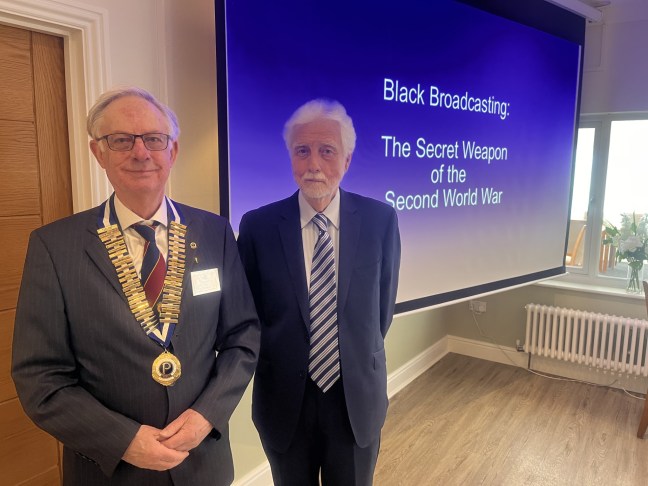
President Stephen Thair with speaker Guy Caplin

Members of the Probus Club of Basingstoke were treated to a fascinating slice of little‑known wartime history when speaker Guy Caplin explored the covert world of “black broadcasting” during the Second World War.

Most people recognise the chilling call sign “Germany calling, Germany calling,” made infamous by William Joyce—better known as Lord Haw-Haw—who broadcast Nazi propaganda in English from Germany. Joseph Goebbels, one of the most senior figures in the Nazi Party, understood the power of radio, and his propaganda machine was relentless. In response, Winston Churchill authorised Britain to develop its own clandestine broadcasting operation.

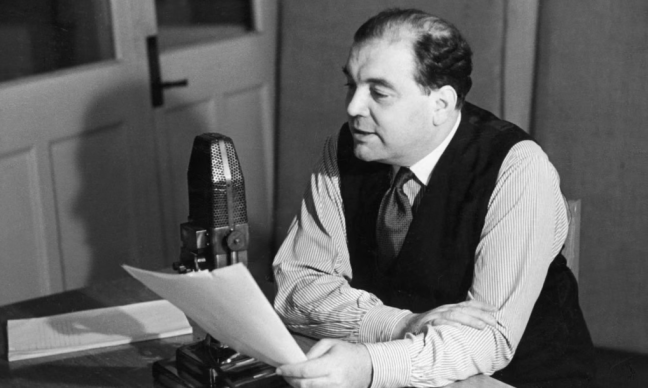
The BBC already produced German‑language programmes but refused to engage in subversive work. As a result, a secret unit was formed under the leadership of Dennis Sefton Delmer. Born in Berlin to an Australian professor, Delmer was fluent in German and had worked as the Daily Express newspaper’s foreign correspondent. His close contact with rising Nazi figures—including a 1931 interview with Hitler—made him simultaneously suspected by the Germans of being a British spy and by the British of being a German one.

Sefton Delmer broadcasting to German audiences in 1941

Delmer’s acquaintance with Commander Ian Fleming, then deputy head of Naval Intelligence and later creator of James Bond, likely helped secure his role. Delmer’s mission was to broadcast in German, blending accurate news with carefully crafted misinformation designed to sow doubt and anxiety within the German military.

A Network of Deception

The first of several covert radio stations was established at Wavendon Towers near Bletchley Park. These stations mimicked genuine German broadcasters with remarkable skill, using up‑to‑the‑minute news, recordings of Hitler’s speeches, and snippets of local detail supplied by agents to create an air of authenticity.

At Fleming’s request, a dedicated station was created to target the German navy and U‑boat crews operating in the North Atlantic. Styled after pre‑war commercial stations like Radio Luxembourg, it played popular German songs, British orchestras performing German music, and American dance band tracks—much to the irritation of German authorities but to the delight of listeners. Interspersed among the entertainment were subtle pieces of misinformation.

One of the British operation’s greatest advantages was speed. German broadcasts were slowed by layers of internal checks, while British stations could leap ahead, airing news before the enemy could. Agents even supplied local football results, and a popular presenter known as “Vicki” took music requests, further enhancing the illusion of legitimacy.

Influencing the Axis

Fleming also oversaw the creation of Radio Livorno, an English‑run but Italian‑language station. Its propaganda proved so persuasive that, fearing the British advance through southern Italy, the Italian navy surrendered its fleet to the British in Malta.

Aspidistra the world’s most powerful radio transmitter

Another major asset was the Aspidistra transmitter at Crowborough in Sussex. Named after the Gracie Fields song, it was the most powerful medium‑wave transmitter in the world at 500 kW. Its ability to switch frequencies instantly allowed it to replace German stations knocked off the air, convincing listeners they were still tuned to their local broadcaster.

Unusual Tactics

The British also experimented with more unconventional methods. The RAF dropped boxes containing homing pigeons and questionnaires, encouraging civilians to send back information—though many pigeons, sadly, ended up as food during shortages.

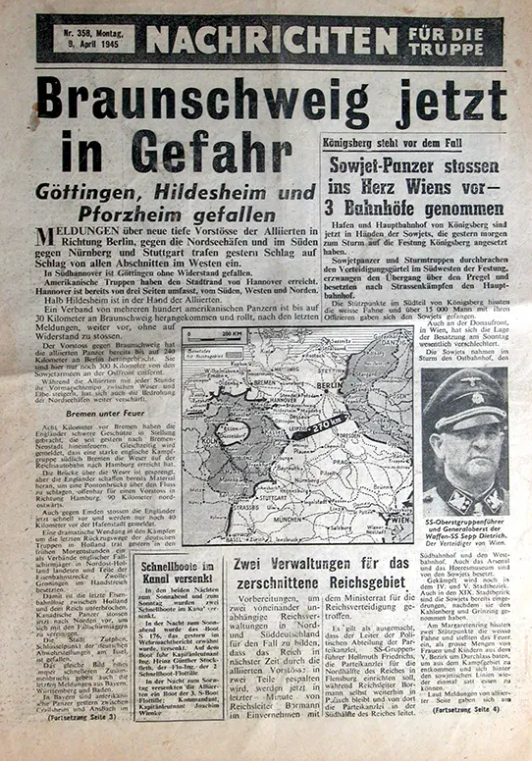
A daily newspaper summarising the previous day’s broadcasts was also printed and dropped over Germany, reinforcing the disinformation campaign and gradually eroding public confidence.

German language newspaper dropped by RAF

After the War

Following Germany’s defeat, Sefton Delmer was sent to help rebuild the German newspaper industry. With little support, he eventually returned to the Daily Express. In recognition of his wartime service, he was awarded the OBE in 1945, being described as a section head in the Foreign Office.