
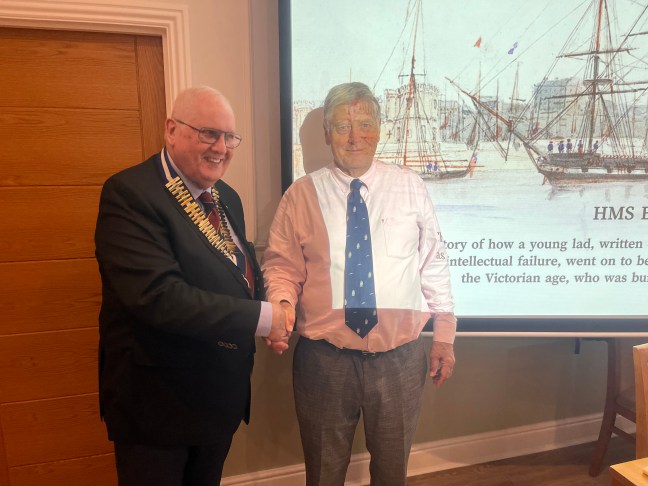
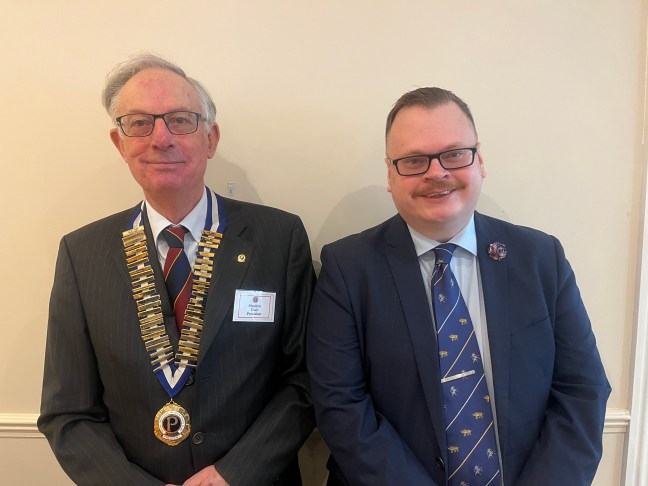
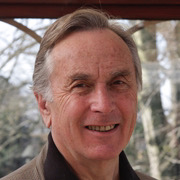
The talk by Ian Worley to the Probus Club of Basingstoke had the simple title “Charles Darwin” but what emerged was a life of coincidences that led to him becoming a world-famous naturalist.
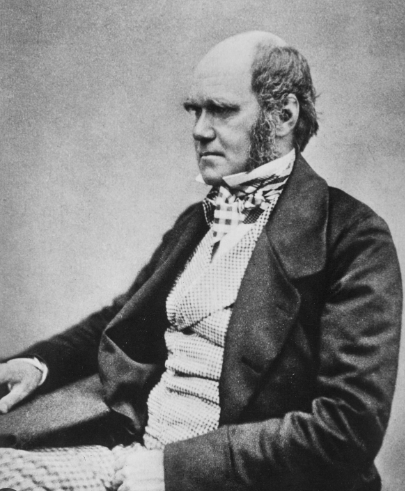
Born into a wealthy family in Shrewsbury in 1809, his father was a physician who was married to Susannah Wedgwood a member of the famous pottery family. Having a large kitchen garden, he kept a detailed diary which probably stirred an interest in plants in the young Charles.
Sent to Shrewsbury school which majored in the Classics of Latin and Greek Charles was a poor scholar and in 1825 was sent to Edinburgh University to study medicine in the hope that he would eventually be able to assist his father. Disappointment followed and in January 1828 his father sent him to Christ College, Cambridge to study for a clerical career hoping that he might rise in the church to become a bishop.
The received wisdom of the day followed the statement by Archbishop James Usher, the Primate of All Ireland in the seventeenth century, who using the Bible as reference had worked out that the earth had been established around 6.00pm on the evening before Sunday 23rd October 4004 BC.
Graduating in January 1831 Charles surprised even himself by coming 10th out of 178 entrants. One of his contemporaries at Cambridge, John Henslow, knew of a planned round the world surveying expedition that required an onboard naturalist. This was an unpaid position but as Charles had a substantial allowance, was a single man with no responsibilities, had gained an extensive knowledge about plants, he felt qualified for the position of naturalist on board HMS Beagle.
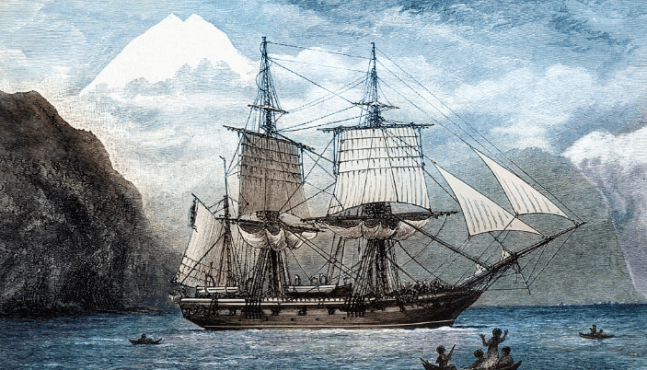
His father, though, thought differently and wanting Charles to go into the church forbade him from applying for the position. His brother-in-law, Josiah Wedgwood was the person to change his mind which allowed Charles to apply to Captain Fitzroy.
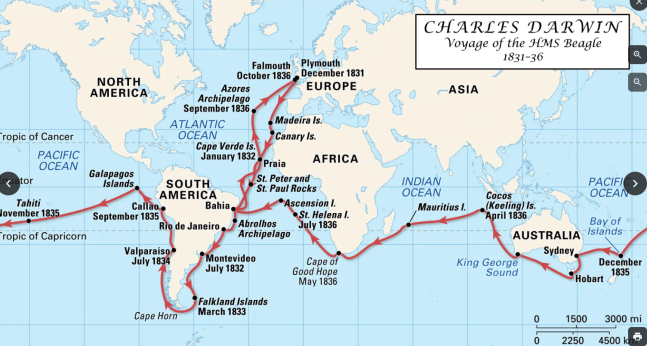
Charles was disappointed to learn that Captain Robert Fitzroy, a hydrographer and meteorologist who created the phrase ‘weather forecast’ and eventually went on to found the Meteorological Office in London, had already offered the position to another man. Reflecting on his family commitments, he eventually declined the offer. Hence Charles Darwin went on the five years surveying voyage mostly around the southern hemisphere setting sail in December 1831 and not returning until 1836.
On Cape Verde, Charles Darwin discovered seashells high up in an escarpment, in South America he found ancient bones that he sent back to England, the Galapagos Islands, a volcanic archipelago in the Pacific, had not only giant tortoises but birds like Finches were different to those in England, all raised questions in his mind.
On his return to England, and later marrying his first cousin Emma Wedgwood, Charles Darwin wrote several books on his findings about botany and zoology that enabled him to be recognised as an authority on his subjects and was elected to prestigious scientific societies.
One book, written anonymously, in 1844, was poorly received as it was based on Darwin’s emerging theory about changes and developments in different parts of the world that raised questions about Archbishop Usher’s declaration about the creation of the earth.
It took the persuasion of scientific colleagues twenty-three years after the voyage of HMS Beagle, for Darwin to write On the Origin of Species in 1859. Written in plain English it was received with a mix of scientific fascination, theological outrage and public curiosity. All 1250 copies were sold on the first day. Darwin published six revised editions up to 1872 and it has never been out of print.
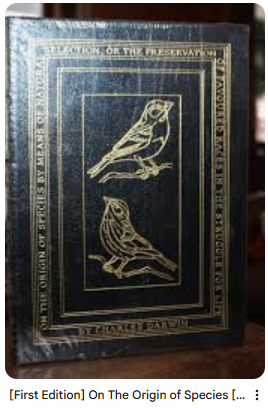
Darwin’s life had been a precursor to the 1998 film, Sliding Doors, the story of parallel lives dependent on whether the main character managed to catch an underground train.
If Charles Darwin had not failed at Shrewsbury school his father would not have sent him to Edinburgh University, if he had succeeded there, he would have become a medical practitioner helping his father.
Instead, he failed and went up to Cambridge to study for a church career but developed his interest in botany and zoology where his friend knew about the planned voyage of HMS Beagle. Had the man originally offered the position taken the role of naturalist Darwin would have probably entered the church. Without any family responsibility and the financial security from his allowance enabled him to take on an unpaid position for five years.
From apparent failure as a son to becoming a world-famous scientist Charles Darwin was so revered that he was buried in 1882 amongst the great and good in Westminster Abbey.














You must be logged in to post a comment.