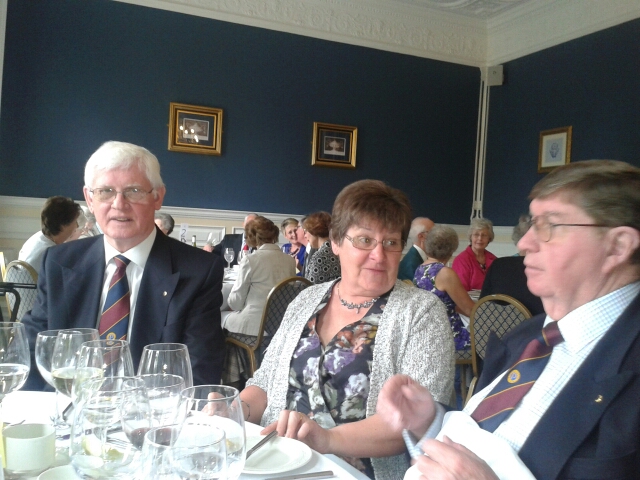
This year the Ladies’ Lunch was held at Oakley Hall the converted Georgian manor house with connections to Jane Austen.
In splendid surroundings even the inclement weather couldn’t put a dampener on the occasion that was enjoyed by members and their wives and partners. Good food, fine wine and great company was complemented with a raffle of various types of alcoholic beverage.
The guest of honour for lunch was Julia Taylor, the President of Ladies’ Probus in Basingstoke.
After lunch Bryan Nagle, one of our members who is also a member of the Jane Austen Society, gave a short address on this famous local authoress. Assisted by his wife Sheila the pair are a veritable fount of knowledge on all things to do with Jane Austen.
Thanks are due to Alan and Liliane May, who as usual, organised everything with precision, ably assisted by Rob Hopkins with support from Richard Stettner.
The funeral service for Hugh Moore took place at Basingstoke Crematorium at 2.00pm on Thursday 9 May .
The club was represented by President Gerry Anslow, Vice President Paul Flint, Secretary Bryan Harvey and Immediate Past President Tony Aichison.
We learned from the eulogy was that it was war service that first took Hugh to South Africa where he became a pilot. While it was always interesting to hear Hugh telling stories of his time in Uganda where he had several altercations with Idi Amin and his henchmen it was for his educational work in that country that he was awarded the M.B.E.
Dean Wall, the Recreation and Visitors Services Manager of the Basingstoke Canal Authority, based at Mytchett, gave an interesting presentation to the group of retired professional and business men at last month’s evening meeting held at Christ Church, Chineham.
With historical records and photographs he was able to show how the original plan was for a canal from the navigable section of the River Wey, that joins the Thames, to pass through Surrey and Hampshire and on to Basingstoke. The aim of the canal was to increase trade between Hampshire and London. Part two of the plan was then to construct a canal from Basingstoke to join the Kennet & Avon canal. This would enlarge the potential commercial traffic but importantly would provide a source of water for the original Basingstoke canal. This never came to fruition and the basin and wharf in Basingstoke became the terminus and is now gone forever within the construction of the Festival Place shopping centre.
Measuring originally 37 miles in length, rising 254 feet from Surrey into Hampshire, it was necessary to build 29 locks. The steepest section at Deepcut (named after the construction) has 11 locks adjacent to the Pirbright army depot. In addition there were 5 lock houses, 69 bridges, a tunnel of 1,230 yards at Greywell, 4 wharves and 3 warehouses. 200 men armed with little more than shovels and wheel barrows took six years to construct this waterway which was fully opened in 1794. The term “navvy” is an abbreviation of the word “navigator” given to the men all those years ago.
Perhaps because the second phase was not built and given the perennial water shortage of the Basingstoke canal which meant that at certain times parts were unnavigable, the canal always struggled to operate on a commercial basis. Materials for the construction of the London to Southampton railway were carried on the canal and once open the railway became an unbeatable competitor. Over the next century the canal slowly fell into a state of dereliction with lock gates rotting, the canal choked with weeds, its towpath overgrown and the collapse of Greywell tunnel. Today 32 miles of it is restored thanks to the formation of the Basingstoke Canal Authority, funded by Hampshire and Surrey together with six borough councils along its route. The canal was re-opened in 1991 and today the Authority employs a team of rangers that carry out maintenance and protects wildlife.
It is estimated that the canal is used by millions of walkers, cyclists, anglers and boaters every year. The Authority manages the balance between recreation and conservation by providing a beautiful facility that offers fantastic opportunities for everyone.
The Probus Club of Basingstoke has a full diary of interesting speakers and potential new members can find out more about the club by looking at their web site http://www.probusbasingstoke.wordpress.com or by phoning their secretary Bryan Harvey on 01256 321473.
(Blinking was quicker than the clicking of the camera)
Barbara Burfoot was the speaker at the evening meeting of the Probus Club of Basingstoke. She is one of the nominated speakers of the R.N.L.I. or to give it its full name, the Royal National Lifeboat Institution. The subject of her talk was its history, development and favourable image within the nation’s psyche to the group of retired professional and business managers held at Christ Church in Chineham.
She has a wealth of experiences having worked as a volunteer within the R.N.L.I. for many years, which continued after the passing of her husband who was the chairman of the Alton branch. Barbara Burfoot became the branch secretary many years ago and is also involved with the promotion of fund raising products for public purchase. Money is clearly a major concern for this Institution as it is run entirely on voluntary contributions, not only from the charity collecting boxes in the shape of a lifeboat, but increasing so from bequests in wills.
The crews of all the lifeboats have traditionally been volunteers but with a changing face of water borne rescues in the River Thames in the London area, where they have four lifeboat stations, it was realised that a different approach was necessary for the three man crews. This was due to the difficulty of getting three volunteers quickly on station with the traffic problems in the capital. They resolved this by employing one or two salaried persons to be permanently on station supported by volunteers, some of whom are resting actors, who can be on station for the whole of a shift. The traditional boom of the maroon signal of an emergency call for the volunteer crews has, these days, been replaced with modern technology of pagers and mobile phones.
The latest expansion of the Institution’s activities is that of flood rescue; something that in recent times has made headline news on many occasions and where several lives have been saved by the crews working in partnership with all the usual emergency services.
The Thames rescue boats are some of the smallest in the range of vessels operated by the R.N.L.I. and are water jet propelled as the use of propellers was considered to be too dangerous when pulling survivors on board. The extensive range of life boats in the fleet has the largest sea going versions costing several million pounds down to the inshore semi – inflatables, with powerful outboard engines, costing tens of thousands. The Institution has recently decided to take up the building of some of the medium sized boat designs after their supplier of hulls went out of business. A factory is being built close by their headquarters in Poole for this project and apprentices are being recruited.
The Poole headquarters has one of the largest water tanks in the world which is used not only for the training of rescue crews with variable conditions making for a completely realistic situation but is also used for film and T.V. location work. The centre is open for visitors including offering overnight accommodation.
The Probus Club of Basingstoke is now in its 34th year and potential members can see more about its activities on their web site http://www.probusbasingstoke.wordpress.com or they can ring their secretary Bryan Harvey on 01256 321473.
The Committee is pleased to announce that John Dunn has been delighted to accept the honour of becoming a Life Member of the Club. He and Kathleen are glad to be with their family in the USA but really do miss their association with Probus. He sends his regards and best wishes to all the members and greatly looks forward to keeping in touch.
On a bright but bitterly cold March day several members of the Probus Club of Basingstoke paid a visit to RAF Odiham. They were part of a privileged small group of people, the others being a helicopter enthusiasts club from the Midlands, who were allowed on the base to get close to one of the Chinook helicopters that fly in the local area.
The trip had been arranged some months ago when one of the Probus Club members, who is a retired RAF Group Captain, contacted the base to see if some of his fellow members could make this visit.
Gerry Anslow the current President of the Probus Club was delighted to go.
“We firstly went to a briefing room where we had a PowerPoint presentation by one of the pilots who showed how the Chinooks were used not only in theatres of war but also in civilian crisis like earthquakes and flooding.”
“The cycle of events leading to posting to Afghanistan was explained and we were amazed to learn that Camp Bastian is the size of Reading. Then we were taken out on to the pan to get a really good look at one of these wonderful machines”
Following an introduction by another pilot of the physical properties of the Mk2 version the visitors were allowed on board where they heard more details of the capabilities of this versatile helicopter. There are upgrades underway to bring all the Chinooks up to the same capability of the latest Mk 4.
One of the club’s members was on a voyage of remembrance. Geoff Twine of Bramley was stationed at RAF Odiham fifty eight years ago when two squadrons of Hawker Hunters were based there.
“It was wonderful to renew my relationship with this base but so much has changed in the intervening half century. It has grown out of all recognition and of course there has been the shift from being a fixed wing jet fighter base to being one of the main Chinook bases in the RAF. And to be able to sit in the cockpit of the Chinook was a great experience.”
The visit concluded with lunch in the Junior Ranks mess with the general opinion that things on the culinary front had also improved significantly since some of the members were in Her Majesty’s forces.
At last month’s evening meeting of the Probus Club of Basingstoke their guest speaker was Commodore Ian Gibb MBE whose talk was entitled “From Cadet to Commodore and Beyond”
Having spent 43 years at sea with the P&O group, and retiring in 1996, Commodore Gibb covered some of the interesting aspects of his career. He told the audience of retired professional and business men that having graduated from the School of Navigation in Southampton he entered the merchant marine as a cadet officer. Initially he was on cargo vessels but through a stroke of good fortune moved into the passenger ships side of P&O just as the market for passenger liners was changing.
The days of carrying mail and emigrants to Australia came to a close but with an eye on changing market conditions P&O recognised that there was growth potential in the holiday cruise market. A different style of vessel was needed so new ships were built. This expansion gave opportunities for advancement and Commodore Gibb became the captain of several well known cruise liners in the company’s fleet. The last one he captained was the Oriana which he had been closely involved in its build having been seconded to the ship yard during construction.
There were amusing anecdotes about life with cruise passengers, with most eating and drinking too much while on board. There was even an amusing side to death at sea when a deceased passenger was given a burial at sea and things went slightly awry. Fortunately the grieving widow was none the wiser.
The following 15 years were spent with the charity Trinity House, which is the organisation responsible for the buoys and light houses around the coast of England and Wales. He graduated to the position of being one of 32 elder brethren, some being members of the royal family, and sitting in its court of judgement to establish blame for maritime collisions.
The Probus Club of Basingstoke has an interesting programme of speakers and events and prospective members can gain more information about the scheduled activities by looking at their web site http://www.probusbasingstoke.wordpress.com or having a chat with their secretary Bryan Harvey on 01256 321473.
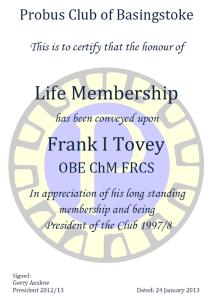
The Probus Club of Basingstoke has conferred a Life Membership on Dr Frank I Tovey OBE, ChM, FRCS as he and his wife Winnie will be leaving their Crossborough Hill home early in February for pastures new in Lymington.
Dr Tovey has been a member of the Probus Club in Basingstoke for many years and was President in 1997/98.
Although the announcement was made at the last evening meeting the presentation of a framed certificate was made at their home by Probus Club President Gerry Anslow. A reporter and photographer from the Basingstoke Gazette were there to capture the event and it is hoped that a feature will appear in the edition to be published on Thursday 7 February, the day before Frank and Winnie leave our town.
Frank Tovey is well known in Basingstoke as for 20 years he was a Consultant Surgeon at the North Hants Hospital, retiring in 1986. Previously he was 16 years at the Holdsworth Memorial Hospital in Mysore, South India and prior to that for over a year at the Methodist Hospital in Zhaotong, Yunnan, south west China. He was appointed OBE in 1966 for services to surgery and leprosy in India.
Other appointments include Honorary Research Fellow in the Department of Surgery, University College Hospital, London and Honorary Senior Research Associate, Department of Surgery and Interventional Science at University College, London. For eleven years he has been a member of the Editorial Board of the World Journal of Gastroenterology where he reviewed submissions of medical papers and published many articles of his own.
We all wish Frank and Winnie well in their new home.
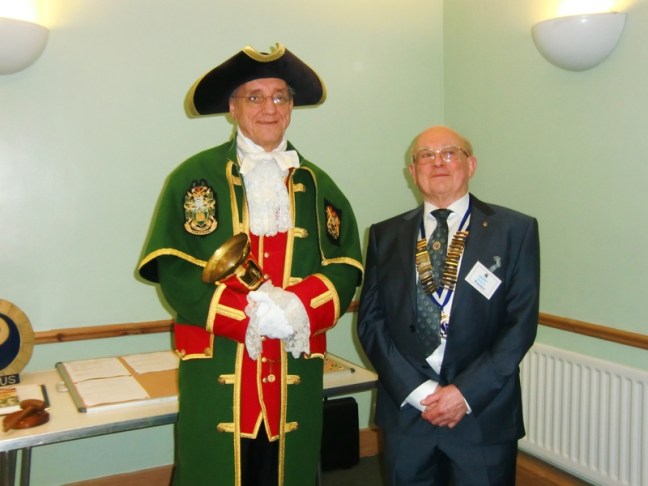
At the first speaker evening meeting of the year 2013, the Probus Club of Basingstoke saw and heard Jonathan Jones giving it loud in his guise of the Town Crier of Farnham.
Arrayed in his splendid regalia Jonathan outlined his various roles to the audience of retired professional and business men who were fascinated to learn that the position of Town Crier goes way back to the Norman Conquest. In those days few people could read and the Town Crier had to impart the latest legislation and news to the populace. The well known opening phrase of “Oh yez, oh yez” can be traced back to Norman French.
The position of the Town Crier of Farnham was resurrected a decade ago when the council set up a competition for the post which carries on honorarium of £500. Having been declared the winner, Jonathan Jones has the security of the position for life or until he resigns.
The Town Crier has specific civic duties in supporting the elected council of Farnham including attending the full council meetings fully attired in his uniform. He is also involved in supporting some local commercial activities and charities. He explained that the uniform can be very hot on some occasions especially outside in the summer where he is often mistakenly identified by young children as a pirate. Although he has a tricorn hat he carries a bell rather than a cutlass.
At the conclusion of his talk Jonathan Jones gave an example of a shout which clearly demonstrated why he won the competition.
The Probus Club of Basingstoke has a full diary of events and interested potential members should initially look at their website http://www.probusbasingstoke.wordpress.com or ring their secretary Bryan Harvey for an informal chat on 01256 321473.
Forty people, consisting of members of the Probus Club of Basingstoke, together with their wives and partners, enjoyed a fascinating guided tour of the Palace of Westminster at the beginning of January.
Alan Porter of Bramley who organises outings for the club, which is now in its 34th year, said
“We had a marvellous time seeing around the mother of Parliaments with its splendid architecture, wonderful statues and paintings. The place has a great sense of history and pageantry which brought back images of famous historical moments and being able to go through all those amazing rooms, including the Lords and Commons chambers, was a great privilege.”
The trip was arranged through Maria Miller MP and her office which meant that two guides were on hand specifically for the Probus Club’s tour.
Alan continued “This outing is typical of the social events we undertake and prospective members can see some of the things we have done and are planned by looking on our website www.probusbasingstoke.wordpress.com ”







 Arrayed in his splendid regalia Jonathan outlined his various roles to the audience of retired professional and business men who were fascinated to learn that the position of Town Crier goes way back to the Norman Conquest. In those days few people could read and the Town Crier had to impart the latest legislation and news to the populace. The well known opening phrase of “Oh yez, oh yez” can be traced back to Norman French.
 Alan Porter of Bramley who organises outings for the club, which is now in its 34th year, said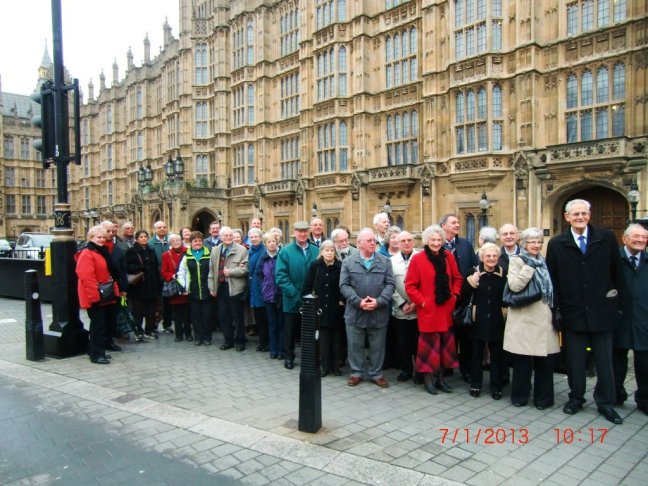
 Probus Club of Basingstoke
You must be logged in to post a comment.