Lifetime Membership for David Carwardine

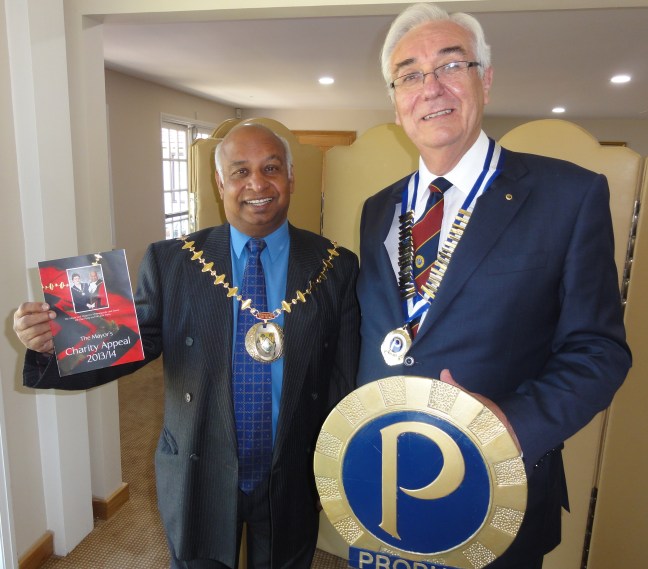
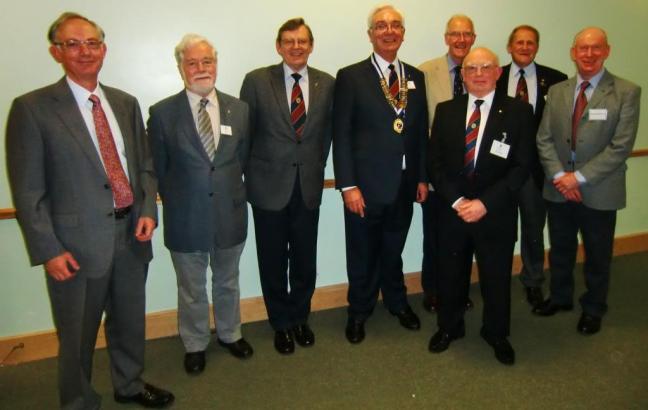
At the lunch on Tuesday 12 November David Carwardine was presented with a framed certificate to mark his appointment as a Life Member of the club. After hearing of his business career from graduate trainee at Vauxhall Motors to main board director at Lansing Bagnell and then as Director of Regional Operations for BIM (British Institute of Management), David then spoke of his 22 years as a member of the Probus Club of Basingstoke. He served as President in 1996/97 introducing several changes to the way the committee was organised and brought in the summer ladies’ pub lunch which continues today.

David and his wife Betty will be leaving Basingstoke early in 2014 to be closer to their family in Wiltshire and Bristol and we offer them our good wishes.

Report on Probus Club of Basingstoke visit to Royal Hospital Chelsea

A party of retired professional and business managers and their wives from the Probus Club of Basingstoke supported by members and wives from Deane Probus had a day’s outing to the Royal Hospital Chelsea, home of the famous Chelsea Pensioners.

The visit was organised by Tony Atchison of St Gabriel’s Lea, Chineham who has been a member of Basingstoke Probus for nine years who commented “we were split into two groups each with a guide for a tour lasting over two hours. We were impressed with the size and grandeur of the hospital. The wonderful dining hall which has featured in Harry Potter films was complemented by the chapel which the architect Sir Christopher Wren insisted had clear glass windows. The statue of the founder, Charles 11, was glorious in gold leaf and the two guides were resplendent in their scarlet great coats”

“We also saw In Pensioners, as they are called, going off to the Albert Hall to rehearse their part in the televised Festival of Remembrance.”

There is an extensive refurbishment programme underway to provide enlarged berths, as each In Pensioner’s room is called, that will include a study area and an en suite wet room. There are 300 In Pensioners but only six are women. The majority are army veterans, with a few from the Marines, Royal Navy and Air Force.

Probus hears town planning didn’t start with the Romans

This is one of the discoveries made at what is commonly called the Silchester dig, at the important Roman town of Calleva Atrebatum, the field research project undertaken by the Archaeology department of Reading University. The director of this annual summer activity since 1997, Amanda Clarke, was the guest speaker at the latest evening meeting of the Probus Club of Basingstoke where she had an attentive audience of retired business managers.

Nearly 1100 first year archaeology students have worked more than 102 weeks on one third of one Roman “insula” or block, an area only 55 x 55 metres, on this site which most people think of as a Roman town. Excavations have shown that the Romans took over an existing large Iron Age town established around 40BC, which had clearly defined buildings in a distinct layout set on the axis of the winter and summer solstices. The Roman grid street pattern was not firmly established until the second half of the first century and the surrounding defensive stone wall, which can be seen today, built in the third century.

Because there was no running water on site both the Iron Age and Roman populations sank wells which the Romans lined with wooden wine barrels. The Iron Age town had trade links with European countries that brought in pottery, olive fruits and exotic seasonings from the Mediterranean area.

The population varied over the centuries and has been calculated that it was at least 3000 and up to several times that figure at its peak. For example the Roman amphitheatre, built outside the wall, could seat 10,000 people.

Apart from the usual physical work with a hand trowel, modern technology is used on the excavation with computer records and hand held tablets that can be read in full sunlight while a drone is used to take aerial photographs of the site. The logistics of housing, feeding and providing for the personal needs of up to two hundred people on site were graphically illustrated especially with the solar showers and fifty seven portaloos.

More information about the activities of the Probus Club of Basingstoke can be seen on their web site http://www.probusbasingstoke.wordpress.com or potential members can phone their secretary Gerry Anslow on 01256 325253.

Ripping Yarn at Probus Club

The adventure of a young RAF Flying Officer was regaled to the audience of retired professional and business men of the Probus Club of Basingstoke. Retired RAF Group Captain Mel Kent, himself a member of the club, enthralled his audience about his experience in the Sudan when disaster struck when he and three other RAF servicemen were passengers on a freight plane heading south out of Khartoum in December 1951.

The Vickers Valetta twin engined plane was designed to fly on one engine, but on this occasion when the port engine stopped the starboard engine just was not man enough to continue the flight and they had to make a forced landing with the undercarriage up. Landing in a swamp there was no real injury to anyone but the plane was damaged with bent propellers and tears to the skin of the fuselage. There were only minimal food rations on board and only a gallon of water so the situation was desperate. The radio didn’t work at ground level but after some days they were eventually spotted by a search plane and supplies were dropped to them. The RAF contacted a local tribe who arrived days later at the crash site complete with long spears. The servicemen initially feared that they were Mau Mau terrorists.

Three days walking and the crew were at the tribe’s village and from there eventually returned to Khartoum where a rescue and repair team was led by Flying Officer Kent back to the crash site. Several trucks carried two new engines, propellers and a host of mechanical aids. Six weeks of hard work later, in late February 1952, the plane being repaired and the swamp having dried out to a hard surface a makeshift runway saw a successful escape flight.

What caused the initial engine shutdown turned out to be that someone had forgotten to refuel the wing tank.

Potential members of the Probus Club of Basingstoke can find out more of its activities by looking on their web site http://www.probusbasingstoke.wordpress.com or can contact their secretary Gerry Anslow on 01256 325253 or email gerry.anslow@talktalk.net.

Summer Pub Lunch August 13 2013

The annual summer pub lunch of the Probus Club was held at the Portsmouth Arms in Hatch Warren when over thirty members/wives/partners enjoyed a convivial occasion as can be seen from these photographs.

One of the highlights was the giant veggie burger enjoyed by Rama Murthy who had devoured most of it before the photograph was taken. Much to the surprise of those on the next table, he consumed the lot with hardly a crumb left on the wooden platter.

Two people were celebrating their birthday, Mike Jarvis and Jay Hudson, but neither chose to disclose their age.

Where was the President, you ask? He was behind the camera as sometimes happens to record the happy scene.

Bishops, Sex and Money at Probus Club

These were some of the subjects talked about by the first guest speaker of the 35th season of the Probus Club of Basingstoke the social club for retired professional and business men. Tony Strafford is a retired Yeoman Warder from the Tower of London and he cut a striking figure resplendent in the “undress uniform” of dark blue with red braid complete with hat, as traditionally seen at the famous castle by the Thames.

An accomplished raconteur, he told fascinating tales about how bishops in the early days held considerable power, prestige and influence on the kings and queens of the day. One king, Charles 11 had twelve or seventeen children, dependent on which record is believed, but none with his wife. When the ravens of the Tower had to have their numbers reduced it was of great concern to ensure that the old prophecy did not come true about the demise of the English throne if they all left the Tower. So six were kept and had their wings clipped. In the wild ravens live for less than ten years but in the Tower they can reach forty.

Although the general impression is that there were many executions at the Tower of London the reality is much different. There were more executions there in the twentieth century than in the preceding seven hundred years. However there were public executions in London, usually beheadings, rather than hangings, for famous people. The public flocked to see them and sometimes the crowds were so large that stands were built to ensure many had a good view of the proceedings. And of course the payment of a bag of gold coins to the axe man by the prisoner ensured that it was a clean chop. Their heads were then placed on a spike on London Bridge.

Many phrases in common parlance can be traced to past times and to hear how they came about was an education in English history and language. When a prisoner was taken by cart from the city of London to Tyburn (now Marble Arch) in Westminster for execution he was given a drink of brandy – One for the road. At the meeting on the boundary of the cities there was a handover of the prisoner at a hostelry where those in charge had a drink of brandy. The prisoner was not permitted to join them – He was on the wagon.

When the Bethlehem hospital in east London then became known as Bedlam for the feeble minded the public were admitted to look at the inmates who would be encouraged to laugh by prodding them with a stick – Poking fun at them. The hospital was out of sight being built around a corner so people transported there were – Sent round the bend.

Mayor at Probus Club Lunch

The first lunch of the 35th season of the Probus Club of Basingstoke had as their guest of honour the Mayor of Basingstoke & Deane, Cllr Dan Putty. Newly elected President, Paul Flint welcomed the Mayor on behalf of the new committee and compared the senior resident of the borough with their members who are retired senior members of the professions, commerce and industry in Basingstoke. He presented a cheque to the Mayor for his charity appeal.

New President & Committee Appointed

President and Executive Committee
Paul Flint has taken over from retiring President Gerry Anslow

At the 34th Annual General Meeting held on 27 June a new President and Executive Committee were elected. Paul Flint has taken over from retiring President Gerry Anslow, to head up the new committee of this social club for retired professional and business executives. Paul, who sold his business in Basingstoke in 2007, now leads this all male organisation as it enters its 35th year of operation. He became a member of the Probus Club in 2009 and has been their Programme Secretary for the last three years being responsible for finding speakers for their monthly meetings. He also manages, with another member, retired GP Dr Raja Cavale, the development of the club’s web site so as to provide a comprehensive overview of the club’s activities to prospective members and he also writes reports on the speaker meetings for publication in local community magazines.

Mr Flint, who moved to Hatch Warren in 1999 from Shinfield with his late wife, has three married children and four grandchildren. Two daughters live in Basingstoke, one in Hatch Warren and the other in Chineham, and his son lives in Swallowfield. He says of his appointment, “Being a member of Probus has had a really positive effect on my life mixing with like minded people in a friendly social environment. Some of today’s members I knew when I was in business and the others make everyone feel welcome; there is great fellowship in this club.”

“Our membership has been around fifty for many years and we are always interested to find new members who can bring creative thinking and dynamism to help the club progress. We have a social programme that involves wives and partners and also outside trips and visits which are greatly enjoyed.”

A Diamond Evening at Probus Club

At the last speaker evening meeting of the current season, members of the Probus Club of Basingstoke had the pleasure of one of their members giving a talk on his experiences as a diamond polisher. Chris Barton, ably assisted on the evening by his wife Jenny, who live in Robin Close, Kempshott, had worked for the Basingstoke company, L M Van Moppes who were then based in Lister Road.

Less than 20% of diamonds are suitable as a girl’s best friend, the majority being used for industrial applications. Originally an engineer for the company making diamond cutting tools, Chris moved into the highly skilled area of diamond polishing. And it was this side of his involvement with this trade that he was able to educate his audience of retired professional and business men at their meeting at Christ Church in Chineham.

To create a diamond normally requires three conditions, those of temperature, pressure and time. The basic material has to have a carbon content which is exposed to 900 – 1300 degrees Centigrade, under pressure of approximately 400 tons per square inch, over 1 – 3.3 billion years. This time period is up to 75% of the age of the Earth. It had also to be in a stable environment below continental plates at a depth of 90 – 120 miles. Eventually as a result of volcanic activity magna was forced to the surface becoming igneous rock containing its precious cargo.

But there is another scenario that has the conditions for the creation of a diamond which is a meteor strike. There is evidence of this in the Russian Popigai crater in Siberia which is the seventh largest verified impact on Earth, occurring approximately 35 million years ago. The impactor was calculated to have been 5 miles in diameter and made a crater 62 miles wide. The shock pressures from the impact instantaneously transformed graphite in the ground into diamonds within a radius of over 8 miles of the impact point. However the diamonds from this area are only suitable for industrial applications and are not fit for the jewellery market.

Pure diamonds are transparent but some are coloured by nitrogen which gives a yellow or brown tinge, or a blue tint caused by baron. Gems are priced according to the 4Cs; carat, cut, colour and clarity. A single cut diamond will have 18 facets while the larger gem stone has 58 facets equally cut above and below its girdle. The final weight of a cut and polished stone is half of its original weight but the residue is saved for industrial use.

Potential members of the Probus Club of Basingstoke, which has been in existence for nearly 35 years, can visit their web site http://www.probusbasingstoke.wordpress.com to see their various activities or call their secretary Bryan Harvey for an informal chat on 01256 321473.

Ladies Lunch 14 May 2013

This year the Ladies’ Lunch was held at Oakley Hall the converted Georgian manor house with connections to Jane Austen.

In splendid surroundings even the inclement weather couldn’t put a dampener on the occasion that was enjoyed by members and their wives and partners. Good food, fine wine and great company was complemented with a raffle of various types of alcoholic beverage.

The guest of honour for lunch was Julia Taylor, the President of Ladies’ Probus in Basingstoke.

After lunch Bryan Nagle, one of our members who is also a member of the Jane Austen Society, gave a short address on this famous local authoress. Assisted by his wife Sheila the pair are a veritable fount of knowledge on all things to do with Jane Austen.

Thanks are due to Alan and Liliane May, who as usual, organised everything with precision, ably assisted by Rob Hopkins with support from Richard Stettner.