History of Magic

John Field, a retired solicitor from Ashstead, gave the Probus Club of Basingstoke an informative insight into the history of magic over the centuries. John has been performing magic for over 40 years and is a member of the prestigious Magic Circle. He has developed his skills to such a high level that in 2005 he was elevated to the exclusive degree of Associate Member of The Inner Magic Circle with Silver Star. Fewer than 350 magicians hold this degree worldwide.
John started with the first known magician, Dedi, in 2700BC. He was famous for cutting the head off a bird – it would fall to the ground – then attaching another one so the bird could fly away. The secret? It’s all to do with the way a bird will tuck its head under a wing. And a second, less fortunate bird. Rumour has it that he tried the same trick with a cow.
Moving along through the ages John described the famous ‘cup and ball’ trick, which is 2,500 years old. “Which walnut has the pea under it” together with the “Find the Lady” card trick are all variations of the same idea. They have one thing in common in that you can never win! Gangs who do this are highly sophisticated and make a good living. Associates planted in the audience appear to win small fortunes with ease, luring onlookers to bet large sums. Despite knowing how the trick is done John described how he lost $14 in less than a minute in Times Square, New York.
On a more serious note, he told of witchcraft trials, where suspected witches were repeatedly pricked with a bodkin – a needle with a small handle. This was to test for the Devil’s mark, a numb spot where the Devil had supposedly kissed the witch. Initially the success rate was minimal, so a bright spark redesigned the bodkin, putting the needle on a spring so it would retract when it touched anything. From that point onwards the fate of hundreds of innocents was sealed.
In early years magicians could be hanged or burnt for witchcraft but, later, magicians made their fortune. He told of William Ellsworth Robinson, who shaved his head, grew a pigtail, dressed in Chinese robes and called himself Chung Ling Soo. His speciality was catching bullets in his teeth, and it paid very well indeed – in 1912 he was earning the equivalent of £31,500 per week – until the day when the trick went wrong and he was killed. Some say it was because special chambers in the gun had corroded; others whisper of suicide – or murder.
John gave a demonstration of his ability to mind-read National Lottery random numbers from the audience, getting all six correct. He finished off, with the help of an audience assistant, in a demonstration of a version of the ‘cup and ball’ trick. Amazingly, even an observation at close quarters could not detect how it was done.
Questions were welcomed at the end but he refused to say how any of his tricks were done.

Spring Ladies’ Lunch


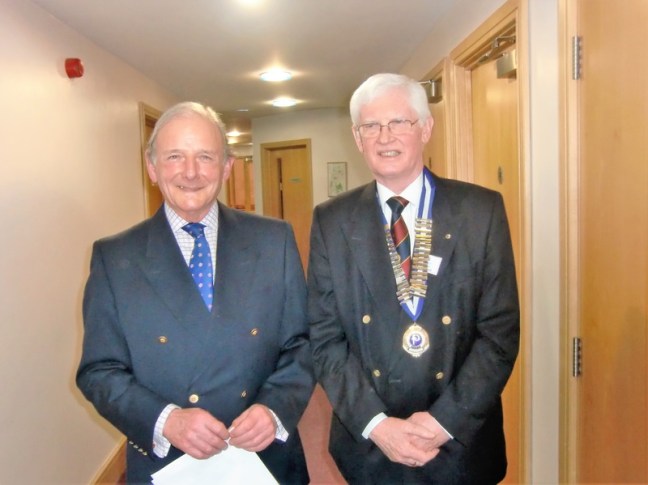
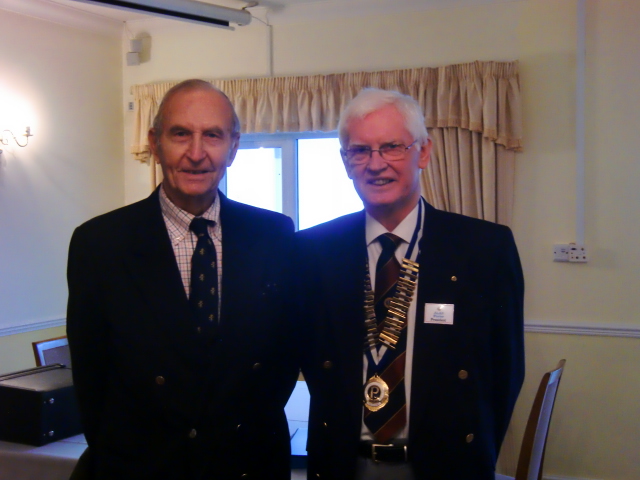
Tuesday 10 May 2016 was the date of the Ladies’ Spring Lunch held at the Test Valley Golf Club near Overton. Forty three sat down for lunch on a very pleasant day with guest of honour Gill Dunn, the President of the Ladies’ Probus Club of Basingstoke (pictured below with our President Alan Porter).

CIMG0526
Gill Dunn, the President of the Ladies’ Probus Club of Basingstoke, with our President Alan Porter

A splendid selection of food, good wine and great company was complemented by an intriging cross word puzzle about members’ names devised by Alan and Liliane May, who once again organised everything to what has become their usual high standard.

CIMG0520
Organisers of our Ladies’ Lunch – Alan & Liliane May


Royal Air Force Mountain Rescue Service

MR Badge
Sleeve badge of Squadron Leader Chris Perkins

Retired Royal Air Force Squadron Leader Chris Perkins from Kempshott, who was awarded the MVO by HM Queen at Windsor Castle last year, enjoyed a varied 35 year career with the boys in blue. He is himself a member of the Probus Club of Basingstoke, the social organisation for retired professional and business managers, and gave an illustrated and entertaining presentation to his colleagues tracing the origins of the Royal Air Force Mountain Rescue Service from its inception to the present day.

“All officers have to undertake a secondary role” Chris explained, “and although I come from Birmingham it was the call of the countryside that led me into the RAF Mountain Rescue Service.” He became so involved with this sector during his time in uniform that he is today the chairman of the RAF Mountain Rescue Reunion Committee for Cymru-Wales.

There are records of ad hoc RAF mountain rescues going right back to 1938. The outbreak of the Second World War, the rapid increase in the size of the RAF and the need to move training stations as far as possible from enemy attack, led to a huge increase in the number of crashes in mountainous areas. The subsequent discovery of an aircraft in such remote places was often a matter of chance and nearby RAF bases were left to make their own arrangements for search parties and used whatever personnel and equipment that were available.

This task had traditionally fallen to the Senior Medical Officer of the nearest RAF station to the accident. Of all those involved, Flight Lieutenant George Graham, the Senior Medical Officer based at RAF Llandwrog outside Caernarvon in North Wales, is credited with taking the most prominent role in the creation of the RAF Mountain Rescue Service. He doggedly bombarded the Air Ministry with requests for equipment and training and his tenacity and persistence resulted in the formal creation of the Service as we know it today in 1943.

By the close of WW2 twenty six teams had been established at RAF stations across the UK. With the decrease over the years in the size of the RAF, only three now remain at Kinloss in Scotland, Valley in North Wales and Leeming in Yorkshire.

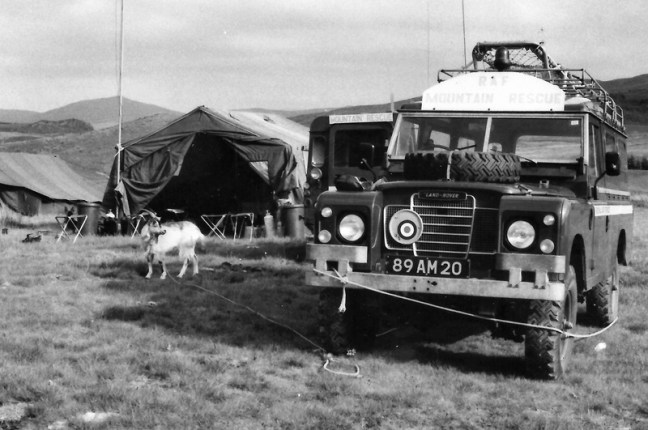
MRT Base Camp C 1980s
Base camp circa 1980

All team members are volunteers. Membership is open to all ranks both male and female. MRT status is independent of rank and relates to mountaineering and rescue experience. Each team consists of 7 full time personnel and up to 30 volunteers. The unpaid volunteers give up their spare time for training on at least two weekends in four, as well as one evening a week.

Modern RAF MRT Kit
Modern day kit

In the earliest days of the MRS, virtually all mountaineers used adapted military equipment, but as the years have gone by and the pace of technology advanced, so has the rescue hardware. All team members are now supplied with state of the art Gore -Tex clothing and up to date satellite navigation and communications kit. The ubiquitous Land Rover has now been replaced by Toyota Hilux 4×4 pickups and Mercedes-Benz Sprinter communications control vehicles. The modern day rescue co-ordinator can actually track the progress of his search parties on the hill by way of a computer link and watch their progress in real time on an electronic ordnance survey map.

“I’ve been extremely privileged to have been closely associated with the organisation over the years and indeed generations” Chris continued, “They have always been the people that go in on foot when the weather is atrocious and everything else has failed. They are dedicated, consummate professionals in their craft.”

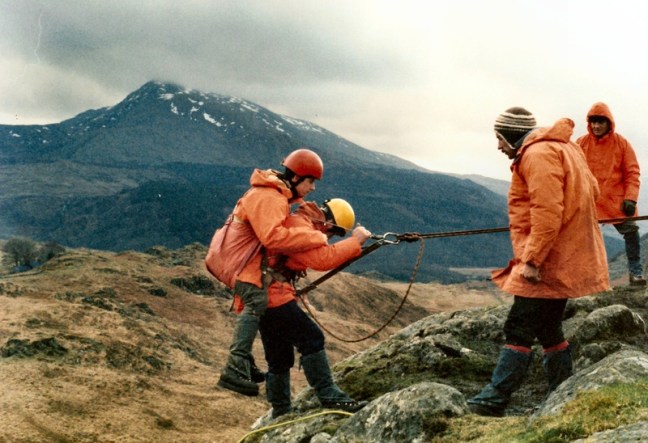
MRT Trg 2
Practice rescue

Shipboard Helicopter Operations

CIMG0500
Retired Royal Navy Captain Mike Sant and Alan Porter

Retired Royal Navy Captain Mike Sant has experienced a full and varied 35 year career on land, sea and in the air. He gave a presentation to the Probus Club of Basingstoke for retired professional and business managers, recounting his flight training and operating helicopters around the globe for the Senior Service.

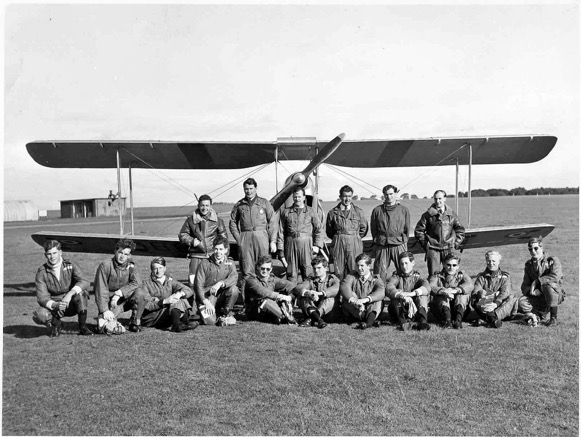
Mike joined the Royal Naval College at Dartmouth in 1958. Initially cutting his teeth training as a young naval officer he spent weekends and summer camps learning to fly the legendary Tiger Moth biplane. This propeller driven aircraft from the 1930s was a basic trainer with an open cockpit and most did not have a radio. It was often described as easy to fly but very difficult to fly well.

Probus Mike Sant talk 1
Tiger Moth Flying Training

Then selected for fixed wing flying training Mike underwent joint service jet instruction with the RAF at their Linton on Ouse base in Lincolnshire, but due to chronic air sickness while instrument flying, was re-streamed to fly helicopters. He attended the elementary Royal Naval helicopter flying school at Culdrose in Cornwall and was awarded his Wings in 1964.

Mike illustrated the basic principles of helicopter aerodynamics and its controls describing the many problems he encountered when learning to fly the early types of single engine machines including how to land the aircraft on engine failure.

Probus Mike Sant talk 2
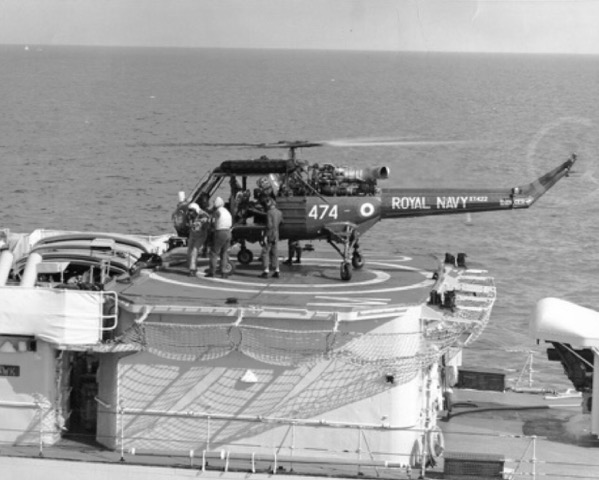
Wasp Landing on HMS Eskimo

Posted for anti-submarine duties flying the then new Wessex helicopter, he was on board the aircraft carrier HMS Victorious in the Far East. The Wessex had a crew of four; two pilots, sonor operator and observer. Operating day and night, he explained how they searched for submarines and what life was like on board an extremely busy, congested ship alongside fast jet aircraft. A Wessex had to be airborne every time a jet took off or landed should one go overboard and the crew needed rescuing.

Promoted to be the Flight Commander on the Frigate HMS Eskimo, Mike and his men flew the single engine Wasp helicopter in the anti-submarine role. Perched precariously on a tiny platform cum hangar at the aft end of the ship, he described operating and managing a team in an inhospitable Arctic Ocean environment.

Probus Mike Sant Talk 3
Wasp on its landing pad on HMS Eskimo

He was promoted to be the Senior pilot of 819 RN Squadron based at Prestwick, positioned on the west coast of Scotland. They were equipped with modern Sea King helicopters, its main role being an anti-submarine aircraft. However, the base was ideally geographically positioned to support the deployment of nuclear submarines from nearby Faslane together with search and rescue emergency cover for both sea and the Scottish mountains. Mike’s last flying job was as Commander (Air) at Portland where he flew Wessex V.

Memorial Service for Dr Raja Ram Cavale

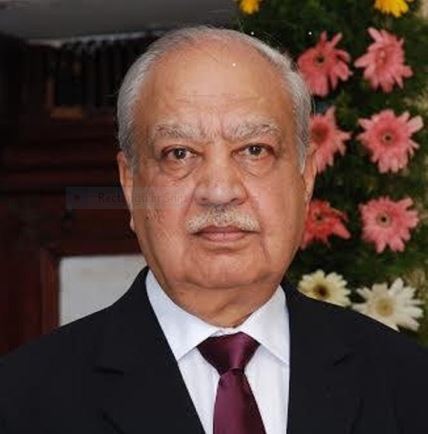
Dr Raja CavaleCapture
Raja Cavale 26th January 1937 – 23rd February 2016

Raja Cavale, who joined the Probus Club of Basingstoke in August 2012, died following a stroke and had a private family funeral service in London. On Sunday 6 March a Memorial Service was held at the Carnival Hall Community Centre in Basingstoke that was attended by over 80 people. With Raja’s wife Padma, son Naveen (a Consultant Plastic & Reconstructive surgeon in London) and daughter Gowri (a Chartered Accountant in New York with Price Waterhouse Coopers) most of the audience were from the Indian community, originally from Bangalore in SE India, who are now spread throughout UK.

The service took the form of reminisces from several attendees of how Raja was deeply involved with their association, Kannada Balaga. Raja was the conduit for all the various forms of communications with the membership, as his interest in technology played a major part in his computer expertise and skills with desk top publishing. It also emerged that after retiring from the NHS he worked for the Citizens’ Advice Bureau for three years but had to study and take a GCSE “A” level in social studies.

The Probus Club was represented at this service by President Alan Porter, Secretary Paul Flint (who spoke on our behalf about Raja’s involvement as the technical expert on our web site and his role as principal photographer) with Richard Wood and Mano Singh. No doubt the fact that this day was Mothering Sunday meant that other Probus Club members who would have normally been present to pay their respects to Raja’s family on a date other than this, were committed to attending lunches and other family matters.

Raja Cavale was a kind, gentle person, who played an important part in the background of the Probus Club of Basingstoke. We shall miss him deeply.

TV Comedy Writer Entertains Us

CIMG0483

Writing “gags” for a living is a cut throat business Brad Ashton explained to the Probus Club of Basingstoke. The club for retired professional and business managers was amazed to hear that he had written over 1500 comedy shows for television over a working lifetime and the names he mentioned were household favourites that the audience recalled with ease.

Since his retirement he has been telling his anecdotal tales to passengers on cruise ships about working with the comedy greats. Ted Ray, Tommy Trinder, Jimmy Edwards, Jon Pertwee, Leslie Phillips, Harry Worth and Dick Emery from the early days; Benny Hill, Tommy Cooper, Les Dawson, Frankie Howerd, Tony Hancock, Ken Dodd, Bob Monkhouse, Bernard Bresslaw, Mike and Bernie Winters, Morecambe & Wise and Little & Large were the British stars. And Brad worked with Groucho Marx for fourteen weeks on a UK tour.

Brad’s first script was broadcast on the wireless on 28 September 1952, but was unable to listen as it was Yom Kippur. “I come from a traditional Jewish family and my father would not let me turn on the radio during Holy Days, which I respected.”

“In the early 50s I found the BBC a bit anti-Semitic so having the Jewish surname of Abrahams did not help, so for professional reasons I changed my name by deed poll.”

Spike Milligan was a witness at Brad’s marriage in 1961 and had an office below Brad’s for 20 years. They would lunch together with Ray Galton and Alan Simpson, Johnny Speight and others. In fact there were 16 of them in the building and if unsure of a gag or routine they would pop into one of the other offices and try it out on each other.

Some comedians were well known for being a little tight over money. Brad gave an example “ I sold a gag to a well known name for £250 but six months later he phoned me to tell me that as he had not used it he wanted his money back.”

Brad was asked by Ned Sherrin at the BBC to help decide between David Frost and Brian Redhead who was to be the anchor man on a new topical show called That Was The Week That Was. Initially Brian Redhead was ahead but then Brad saw David Frost handle a 300 strong audience with top quality political impersonations.

“On the day of the show I would get all the newspapers, sit down by 7.00am and by 3pm I’d have my target of 33 gags. I would read them out to David in his dressing room at the BBC for the show that night and those that excited him, he’d remember. On average he would use at least fifteen in that night’s TW3. He was without doubt the most talented person I ever worked with.”

Les Dawson was another of Brad’s favourites and unbeknown to most, spoke seven languages. At lunch with Brad in a Chinese restaurant Les spoke in Mandarin for twenty minutes with a waiter. He was also a good pianist who by deliberately playing out of tune avoided paying royalties.

Brad went on “Everyone says, having written for all these comedians I must have had an exciting life. I probably did but was too busy to notice as each day I would be at rehearsals and script meetings. I slept at my desk using a satchel as a pillow, but they were marvellous experiences. The best thing about my profession was by not having to be a performer I could watch a good comedian get a laugh, sit back and think, I wrote that!”

My Sister the Code Breaker at Bletchley Park

CIMG0481

John Lidstone has enjoyed a varied and eventful life in business and public service being an internationally recognised broadcaster, public speaker and author of 16 best-selling books on business management. He gave a presentation to the members of the Probus Club of Basingstoke about the Bletchley Park code breaking centre and the secret part played by his elder sister Pamela stationed there.

Until fairly recently, Bletchley Park, or ‘Station X’, has probably been Britain’s best kept secret. This is because all the activities carried on there during World War Two were of vital importance to our national security and ultimate victory. It is estimated that because of their work that the war was shortened by two years and saved 80,000 lives. It was purchased in 1938 for the Government Code and Cypher School and MI6 in the event of hostilities. Its mission was to crack the Nazi codes and ciphers. The most famous of the cipher systems to be broken at Bletchley Park was the Enigma.

Few outside Bletchley knew of its mission, and even fewer, inside or outside, understood the breadth of that mission and the extent of its success. All staff signed the Official Secrets Act and a 1942 security warning emphasised the importance of discretion even within Bletchley itself as people in each working hut were not allowed to discuss their work with people in other huts. Any subsequent breach could have led to 30 years imprisonment or the death penalty.

Debutantes and other high born women, considered capable of being able to keep a secret, were initially recruited for administrative and clerical jobs. Then intelligence became the criterion. Personal networking sought out suitable recruits from Oxford and Cambridge universities as it was recognised that formally trained mathematicians were needed if the enemy’s electromechanical cipher machines, particularly Enigma, were to be cracked. Alan Turing and Gordon Welchman from Cambridge worked alongside other cryptanalysts including a chess champion.

John’s sister Pamela was one such recruit, having graduated from Reading University with a First Class Honours Degree. She was called up for National Service and attended the selection procedure for the Foreign Office part of which was a timed completion of the Daily Telegraph crossword. Most addicts took eleven minutes: Pamela completed the crossword in seven. She was consequently discreetly approached about a particular type of work as a contribution to the war effort.

The first operational break into Enigma came in January 1940. Secrecy shrouded the fact that Enigma had been broken and to hide this information, the reports were given the appearance of coming from an MI6 spy with a network of imaginary agents inside Germany.

Winston Churchill called Bletchley Park his “goose that laid the golden egg and never cackled”. The “golden egg” was nothing less than the ability to decode the secrets of the German war machine. Station X, as it was known, was so efficient it could read coded messages from German generals on the battlefield before they were even seen by Hitler in Berlin.

At the end of the war, Churchill ordered that all records of the place be destroyed and the embargo on Bletchley’s secret work remained until 1976. John only learned of Pamela’s part at her death at 95. She, like many others, never told her family about her work. They thought she had worked for the Foreign Office throughout the war.

Christmas Dinner 2015

Wednesday 9 December 2015 was the night of our Christmas Dinner, held again at the Test Valley Golf Club. And again the food was very much up to par (excuse the golfing pun) with a multiple choice menu that ensured individual decisions had to be selected at the time members made their booking. Nobody was heard to complain that they didn’t receive what they ordered; either that or they simply forgot what they had originally selected.

Forty five sat down and enjoyed music from a singer/keyboardist while dining followed by dancing after dinner. It was good to see widows Jenny Barton, Doreen Davies and Jo Jarvis in attendance. The raffle organised by David and Bridget Tivey raised nearly £100 for the club’s funds and Alan and Liliane’s puzzles on the menu cards ensured many a scratched head (again apologies for another golfing pun). Thanks are due to this intrepid couple who put their heart and soul into organising this event and the Spring Ladies’ Lunch.

Getting your knees brown – advice to the Probus Club

RAF Wardrobe2
Flying Wardrobe Beverly

John Grimwood, a freelance tour guide and military historian, gave an illustrated presentation to the Probus Club of Basingstoke about a period in his early life spent as a young airman in the Middle East. Readily admitting that he did not try hard at his grammar school he was disappointed that the RAF declined to accept him as a possible pilot but instead recruited him as an Administrative Assistant.

In 1965 John received a posting to a place called Salalah on the Arabian Peninsula, partway between Aden and Bahrain. After 12 hours on a nauseous flight in a packed propeller driven RAF Britannia trooping aircraft he arrived at RAF Khormaksar in the Aden protectorate. Then followed a 700 miles flight to Salalah in a Blackburn Beverley ‘flying wardrobe’, a huge four engine aircraft with a cavernous freight bay and ideally suited to short, rough, Arabian dirt airstrips.

RAF Wardrobe2 (1)
RAF Salalah Base

This period of the 1960s heralded the “dying days and end of Empire” and many of our bases were attracting the attention of anti-British guerilla groups or “freedom fighters.” Salalah was situated in an area of counter insurgency warfare but was crucial as an RAF support base during the Dhofar War.

John lived in quarters with anti grenade window shutters yet guarded the base with pick axe handles. While having the basic requirements for the 60 airmen on base it was extremely Spartan by modern standard and had no air conditioning. Uniform consisted of shorts, socks and suede desert boots with no hat or sun cream. There was ample time to get his knees brown as the work routine finished in the lunchtime peak heat of day and afternoons were spent relaxing, playing football or swimming, watching out for sharks on a secluded beach. At the end of the year 10 shillings financed a posting home party with barbecue and plentiful beer and everyone listened to England winning the World Cup.

John returned to service outside London in the ‘Swinging Sixties’. He applied for Aircrew duties spending the next 30 years flying as an Air Loadmaster, Helicopter Crewman, Aircrew Instructor and Technical Author. In all 12,000 flying hours which totals 16 months airborne and never suffered from air sickness again.

Micro Brewery Visit

Saturday 10 October 2015 saw a visit of seventeen consisting of ten members, wives and friends visit the Andwell Brewing Company which is based in Andwell Lane in Andwell near Hook.

It was eight years ago to the day that this micro brewery made its first pint of real ale and since that time has established a reputation for consistently producing beers of the highest quality. It brews five varieties of ale and has won awards in each of the last six years.

The tour was led by Adam Komrower, whose brainchild the brewery was when he achieved his ambition of wanting to be in a manufacturing business. Taking the group through the selection of the ingredients of malted barley, yeast, hops and water the tour lasted one and half hours. We saw all the Bavarian Brewery Technology equipment that produces his range of beers in this 20 barrel brew plant.

The shop sells all the varieties of beers produced on site including versions bottled in an adjacent business. And all on the visit received an Andwell pint glass and several tasters which surprised many of the ladies who had not really previously tried beers.