Probus has a Taste of The Vyne

The history of this local Tudor Palace, situated south of Bramley, and its much publicised roof project were the subject of a talk given by Chris Burrows to the Probus Club of Basingstoke, the social organisation for retired professional and business managers.

Oakley resident Chris, is a member of the Basingstoke Archaeology Society and he has been a volunteer with the National Trust since 1991. He has been involved in previous surveys at The Vyne and once found a flint knife. Earlier surveys had been conducted by the eminent archaeologist Sir Mortimer Wheeler.

Built originally in 1268 the building was added to over the years. Sir William Sandys, despite being a staunch Catholic, managed to hold on to his position as Lord Chamberlain to King Henry V111, after the creation of the Protestant Church of England following the refusal of the Pope to the King’s  divorce of Katherine of Aragon.

Mansion in Tudor times wiv tower 2.03.2018
View of The Vyne at the time of the visit of King Henry V111 in 1535

He had developed the property into a Tudor palace, and had the honour and great cost of being a recipient of the King Henry V111 and Queen Anne Boleyn’s “progress” in 1535. Many portraits of the Tudor period can be seen today in the Oak Gallery.

Also to be seen today in the Stone Gallery is a terracotta plaque of the Roman Emperor Probus who introduced wine making into England. It is thought that it is possible that this plaque was obtained in the 16th century and may have contributed to naming this residence, The Vyne.

DSCF4418
Roman Emperor Probus

Baron Sandys endowed the Holy Ghost chapel in Basingstoke and is buried there. The painted glass windows from the chapel were installed at The Vyne, some of which underwent restoration in 2016.

Chaloner Chute, a lawyer and politician, bought the Tudor palace in 1653 and demolished it in 1665, rebuilding in the Palladium style. In 1767 John Chute began further modernisation and installed the grand staircase that can be seen today. The Chute family continued to own The Vyne, with most male descendents named Chaloner, and was lived in until 1939 when it was taken over by Tomore prep school after it was evacuated from Deal in Kent. It was bequeathed, by Sir Charles Chute, to the National Trust in 1956.

With a building this old there was always plenty of remedial work needed to keep the fabric secure but over the years of patching up the extensive roof it was decided that the complete removal and replacement with modern standard of insulation was the best course of action.

DSCF0624
The roof in 2014 before restoration

The work started in 2014 and is just coming to an end. It has involved the erection of a cover over the whole building including a lift for materials and passengers. Some chimneys were taken down so that a walkway could be constructed around the complex for the use of just under 150,000 visitors. The last visitors were on 28 February 2018 when the walkway was removed so that the original chimneys could be rebuilt.

DSCF7205
The roof during restoration before putting on the tiles

Pre Tudor roofing was discovered, including the use of part of a staircase which proved that recycling was in vogue hundreds of years ago. The lead from the gullies has been reformed and reused and new parapets and finials been carved. Lime mortar has been used throughout the restoration as it will have a longer life than modern day cement. Special provision has been made for the bats so that they can continue to occupy parts of the roof.

70,000 handmade tiles have been used of which nearly 13,000 were bought by visitors in the “Tagatile” scheme allowing personal messages to be written and raising £64,000 toward the cost of this project of £5,400,000.

It will take three months to remove the roof covering and 41 miles of scaffolding to reveal the highly skilled workmanship to the rest of the world. However they will never see the roof from this angle again!

Bringing the Stone Age to Life


Katy England with Nick Waring
Katy England with Dr Nick Waring

Probus members were taken back to pre-historic times at the latest lunch meeting when Katy England from Salisbury museum gave a talk about times in early Britain.

The earliest remains were discovered at Boxgrove near Chichester in the 1990s and consisted of a leg bone, two teeth and other artefacts from which it is calculated that they originated from a 6 feet tall and well built male. It was concluded that these remains are at least 500,000 years old. At that time Britain was connected to Europe and had a climate similar to that enjoyed today in the African savannah. This find however did not show any evidence of clothing, habitation or the use of fire and the conclusion was that things were eaten raw. It did prove that the inhabitants used long wooden spears with flint points and hand held flint hand axes.

Katy England with spear
Hand held flint axe and wooden spear

Experts think that the use of fire developed around 400,000 years ago perhaps coinciding with a change in weather patterns. Over the next 200,000 years, as the weather became colder, the animals changed with woolly mammoths and reindeer roaming freely, the original Boxmore man developed into Neanderthal man. He was shorter and stockier and more able to cope with the colder conditions.

About 50/40,000 years ago another species arrived from Africa that we call Homo Sapiens. There is some DNA evidence that there was some interbreeding but gradually the Neanderthals died out. There was also development of flint and antlers that could be made into tools including needles which allowed animal skins to be sewn together to create clothing as the climate got colder. Cave painting is thought to have started about 30,000 years ago when ochre and charcoal were used as the basis for colour.

The Great Ice Age came 20,000 years ago and after its departure the sea levels rose thereby creating different land masses as the weather improved to be similar to what we enjoy today. Oak trees and Hazel arrived as well as the formation of lakes and rivers. Mammoths and reindeer were no longer to be seen but there was plenty

Katy England with arrow
Arrow with flint tip & swan feathered flight

of deer and wild boar.  All these changes became essential to supporting life and with the invention of a form of glue and the development of the bow with the “string” made from animal sinews and arrows with flint arrow heads and flights made from swan feathers the age of the hunter/gatherer became prevalent.

But there then began a significant change of life style 12/10,000 years ago, in a period known as the Neolithic Stone Age, they became farmers, domesticating plants and animals, created settlements as permanent villages and we see the appearance of crafts such as pottery and weaving. It is recognised that this is the most significant change in all of human history.


Probus visits TAG Aviation Farnborough

Logo-TAG-farnborough-airport_RVB - Copy

IMG_4062
Stephen Thair is behind the camera
Tower Visit 1
Stephen Thair in the Control Tower
Paul IMG_4056
Executive jet anyone?
Paul IMG_4004
See the Control Tower in the background

A chilly but sunny day greeted a privileged group of members of the Probus Club of Basingstoke on what was to be an extremely informative and interesting insight into the modern day VIP operations on this airfield.

Farnborough airfield is perhaps best known for being the venue for the world renowned SBAC (Society of British Aerospace Companies) Farnborough International Air Show.  However, this is a much biased view of what has been one of the most important, albeit non operational, airfields in the UK.  Farnborough’s part in the early development on military aviation and its subsequent involvement with testing and evaluation has secured its place in British aviation heritage.

Farnborough Common was chosen by the British Army in 1905 as a site for His Majesty’s Balloon Factory to manufacture the new dirigible type of balloon.  It had plenty of space and was nearby to existing manufacturing facilities at Aldershot.  An impressive balloon shed was built followed by gas holders and workshops plus the establishment of a balloon school.  The Farnborough Air Sciences Trust (FAST) was established in 1993 and has been instrumental in the preservation and safeguarding of this part of priceless aviation legacy.

It was on the common on 16 October 1908 that saw Samuel Cody achieving the first sustained powered flight in England flying British Army Aeroplane No 1 and in April 1911 the site became the Army Aircraft Factory.  With the expansion of the RFC during WW1 the site became known as the Royal Aircraft Factory (RAF).  The name changed, however, in April 1918 with the formation of the Royal Air Force becoming the Royal Aircraft Establishment (RAE), and it was in this guise of aviation related research and development that Farnborough remained primarily concerned with until 1985.

Encroaching environmental issues with housing and the overcrowded airspace surrounding the airfield had put pressure on military flying research and development activities.  However, a reprieve from total closure was gained because of the site’s value as an ideal venue for the SBAC Show and the lack of an alternative.  Part of the airfield was released by the MOD for general and business aviation use and an aerospace park was established in the 1990s.

Following further closure arguments, due mainly to poor general aviation uptake, it was decided to sell the site.  The company TAG, (Techniques d’Avant Garde), a Luxembourg registered company only formed in 1977, secured the airfield for a multi-million pound price tag. The company had other business interests, formally purchasing the Swiss based Heuer watch company in which they invested significant sums and expanded worldwide sales. The watch retains the name TAG Heuer even though owned today by the luxury brand group LVMH. They also had substantial motorsport interests being a sponsor to the Williams Formula 1 team in the 1980s and today own 25% of the McLaren Group.

Significant capital expenditure was made by the company in landscaping and modernizing the airfield in keeping with bespoke VIP business jet operations and current Civilian Aviation Authority regulations.  These included a new control tower, radar unit, spacious specially designed aircraft maintenance hangars and an extensive aircraft apron for multi jet parking, servicing and operations. The 2440 metres runway was resurfaced. In line with attracting business users TAG also commissioned a luxurious terminal building that provides the very best hospitality in spacious and beautiful lounges for both VIP passengers and Aircraft Crews.  Besides customs, immigration and security facilities passengers may drive directly to their waiting aircraft.  No lengthy and tedious waits here inbound or outbound! Their customers demand and receive high quality and discrete service standards evidenced by the carefully escorted tours enjoyed by aviation enthusiasts.

All are part of a comprehensive bespoke solution encompassing complete aircraft and passenger handling services for business clients on London’s doorstep and very close to a motorway connection.  The TAG operation at Farnborough supports the employment of over 1000 people and 28,000 annual aircraft movements.  This is to be increased to 50,000, gradually being phased in over the forthcoming years.

More photographs were taken but by agreement they had to be approved by TAG before they could be used in our publicity activities. Consequently jets belonging to several well known people cannot be shown. But if you are are a person of significant wealth and own such an aircraft you can keep it dry in one of the hangers for £500 a night.


Funeral of Peter Morley

Peter Morley Capture
14 September 1929 – 24 December 2017

President 2004/05

Friday 19 January was the funeral of past president Peter Morley at the Basingstoke Crematorium. He had been a resident of Crossways  Nursing Home at Up Nately for some time suffering from Alzheimer’s. Peter’s death on Christmas Eve, came only two months after the passing of his wife Muriel.

Peter had been a civil servant all his working life and for twenty years a member of the Basingstoke Male Voice Choir of which one of their recordings was played as the exit music.

The Probus Club was represented by President Dr Nick Waring along with Paul Flint, Fred Locke, David Tivey, Geoff Twine and Jim Wragg.


Probus hears about old Radio Shows

The Probus Club of Basingstoke, the social group for retired professional and business managers, listened with interest about radio broadcasting memories in the era of 1930s – 60s. It was presented by John Pitman, who grew up during WW2 on a farm near Winchester, where the “wireless” was the main form of information and entertainment.

Probus Dr Nick Waring & John Pitman
President Dr Nick Waring &  John Pitman

Like many places in those days his home had no electrical supply and the radio was powered by an accumulator, an early form of battery consisting of glass phials filled with acid and it had to be taken away weekly for recharging. Some readers may remember “crystal sets” which were usually homemade and did not require an electrical supply. However radio broadcasting goes back to the turn of the twentieth century after the invention of valves made it possible to receive electrical signals. The first broadcast took place on Christmas Eve 1906 from the New York Metropolitan Opera House but the only listeners were ships moored in New York harbour.

1920 saw the first radio news broadcast by the Marconi Experimental Station at Writtle near Chelmsford in Essex followed two years later with regular entertainment programmes. The British Broadcasting Company, whose main station was 2LO, morphed into the Corporation in 1926 becoming the BBC.

Many memories were stirred as old radio programmes were recalled, ITMA (It’s that man again – Hitler during the war) with Tommy Handley and Mrs Mop asking “Can I do you now sir” and Worker’s Playtime was broadcast from factory canteens. Have a Go starred Wilfred Pickles with Mabel at the Table and in later series Violet Carson, of Ena Sharples fame, playing the piano.  Ray’s a Laugh with Ted Ray was the fastest joke teller on radio, Much-Binding-in-the-Marsh, with Kenneth Horne and Richard Murdoch was broadcast from a fictitious RAF station. Hi Gang in the war became in peacetime Life with the Lyons with American Ben Lyon with his English wife Bebe Daniels and Vic Oliver. Take it from Here starred “Professor” Jimmy Edwards, Alma Cogan with Dick Bentley and June Whitfield playing the dim witted engaged couple whose famous phrase was “Oooh Ron; yes Eth?”.

Dick Barton Special Agent was on every weekday evening while Journey in to Space with Jet Morgan was on Monday evenings. In Town Tonight was a Saturday teatime current affairs and personality show “We stop the roar of London’s traffic to see who is in town tonight”.  Sunday lunchtimes had Two Way Family Favourites with Cliff Michelmoore in London and Jean Metcalfe in Germany followed by the Billy Cotton Band Show which opened with the phrase “Wakey wakey”.

The Goon Show had Peter Sellers, Spike Milligan, Michael Bentine and Harry Secombe while Round the Horne had Kenneth Horne, Marty Feldman with Kenneth Williams and Hugh Paddick as Julian and his friend Sandy. Mrs Dale’s Diary was always worried about Jim and The Archers the everyday story of country folk is still on air today.

Peter Brough & Archie Andrewsp01hfrrw
Dummy Archie Andrews & Peter Brough

Who would believe that a ventriloquist’s dummy would have a successful radio show called Educating Archie! It couldn’t happen today but stars of the day appeared like Beryl Reid as Monica but introduced herself  in a Brummie accent “Good evening each, my name’s Marlene” and Max Bygraves  had two catch phrases “I’ve arrived and to prove it I’m here” and  “Good idea,son”. The programme had 15 million listeners but was less successful when it transferred to TV, perhaps because viewers could see Peter Brough’s lips move.

The New York Opera still broadcasts on Christmas Eve but today over 300 radio stations around the world carry the programme.


Probus Club Christmas Dinner 2017

clip-art-merry-christmas

A great night was enjoyed by 48 on Wednesday 13 December 2017 at the Probus Club of Basingstoke Christmas Dinner. This black tie event was once again held at the Test Valley Golf Club where two entertainers kept all entranced.

clip-art-christmas-tree (1)

During dinner, Magic Andy, went to all tables and demonstrated his expertise as a close up magician which left everyone mystified and after dinner Billy Clayton gave wonderful renditions of 60s and 70s pop music with the words remembered by most of the attendees. It was also pleasing to see the majority get on the floor and prove that although some time had passed since those days the spirit was willing and even if there was some evidence of “dad dancing” a good time was had by all.

The event was once again superbly organised by Alan and Liliane May  and the raffle run by David and Bridget Tivey netted the sum of £143.50.

CIMG0709
President Dr Nick Waring, Ann Raisin, Liliane & Alan May


In Grandpa’s Footsteps to Shanghai

Liz B & Nick 1a
Speaker Liz Barron OBE with President Dr Nick Waring

“Two first class tickets to Shanghai please” was how Liz Barron OBE and her husband Tony requested the ticket office clerk at Barry in South Wales as they set out on the first stage of an epic train journey to Shanghai.

Liz & Tony Barron at Barry station
Liz & Tony on Barry Station

Liz told the Probus Club of Basingstoke, the social club for retired professional and business managers, about how her grandfather Leslie Pardoe had set out on this journey 100 years before. He was a 21 years old bachelor going to start a new job as the deputy surveyor for the authorities in this Chinese city. Shanghai had become an important trading port where British, French and Americans had established enclaves.

“As a little girl I was fascinated with all the Chinese artefacts in my grandma’s house” Liz explained. ”And when grandpa’s diary came to light and I realised that we were coming up to a century since he made that journey the idea came to mind that maybe we could replicate it.”

Liz and Tony took eleven months to plan their trip to ensure that they were able to stay in the same cities and hotels as Leslie had experienced on this 6000 miles adventure. Although she and Tony live in Southampton they decided to start from Barry just as Leslie Pardoe had done a century before.

Liz Barron's route to Shanghai
6,000 miles rail journey from Barry in south Wales to Shanghai

The route took them on the short stretch to Cardiff and then to London Paddington. They dined that night in the same London restaurant as her grandfather had done and the following day went down to Ramsgate to cross the Channel to Ostend. They had a train journey though northern Europe stopping for short breaks in Brussels, Cologne, Berlin, Warsaw, Minsk and Moscow. Then they had four days and nights on the Trans Siberian railway to Listvyanka on Lake Baikal in Siberia. From there the Trans Manchurian railway took them via Harbin to Changchun in Northern China.

The only change to the route was that her grandfather had taken a three days ferry from Dailen across the East China Sea to Shanghai but the service no longer operates so they completed the final leg by overnight train which passed through Beijing. Leslie’s journey had taken 15 days while the journey for Liz and Tony was longer at 24 days because they wanted to take in some sight-seeing knowing that it was unlikely they would pass this way again.

Ravenscourt Country Club in Shanghai
The Ravenscourt Country Club in Shanghai

The large ex-pat communities in Shanghai enjoyed a good social life with horse racing and the Ravenscourt Country Club being some of the attractions.

John Pardoe honeymoon in Japan
Leslie & Margaret on honeymoon in Japan

Leslie Pardoe met there and married Liz’s grandmother, Margaret. Liz’s father, John, was the youngest of their four children. The family left Shanghai after 27 years when the Japanese took over the city in 1940 and they escaped back to England via Canada.

Leslie Pardoe had travelled first class for £10 7s 3d but it cost Liz and Tony £25,000 to replicate this transit.


Probus visit Wadworth’s Brewery

Probus Devizes Wadworth Brewery - Devizes

Thursday 26 October saw twenty of us consisting of 6 solo members and 7 with partners having an enjoyable coach trip to Devizes in Wiltshire ostensibly to have a guided tour around the Wadworth brewery. It is still family owned since its foundation in 1875. However as it was market day and the tour was scheduled for 2.00 pm there was ample time to wander around this ancient market town, browse the many individual shops and enjoy a spot of lunch.

Some went to look at the Caen Hill rising lock system on the Kennet & Avon canal that runs through the town while others sampled the delights of this old town that houses an impressive indoor market as well as the extensive and what appeared to be attractive value to be had from the outdoor market. There were visits to a museum and flea market before the brewery tour commenced.

Because of the many steep stairs some excused themselves from the brewery tour but joined later to visit the stables and see the shire horses used to pull the drays to the pubs within two miles of the brewery. They also go on display at several shows in the south western region during the summer. All then adjourned to the Harness bar for a free tasting of the ales on display.

probus-devizes-emporer-probus2.jpg
Note the museum exhibit that mentions the Roman Emperor Probus.


Basingstoke to Alton Light Railway

Nick with Dale Greenwood
President Nick Waring with Dale Greenwood

Dale Greenwood, a qualified Blue Badge guide is a man also very much involved in historic railways, gave a talk to the Probus Club of Basingstoke which was about a local subject; the Basingstoke to Alton Light railway.  Most people will have seen the small section of railway track in the centre of the roundabout at Viables on the Harrow Way and possibly wondered about it.Basingstoke - Alton Light Railway lines at Harrow WayCapture

It was laid very close to the original position of the light railway that was opened in 1901 between Basingstoke and Alton. The line was the first to be constructed after a decision in Parliament to allow light railways to be built, with great savings in costs, as a way of increasing economic activity in sparsely populated areas.

The original idea that the London & South Western Railway Company had was to open up a route to Portsmouth. Passengers could travel from Waterloo to Basingstoke, then on the light railway to Alton and thence on to Portsmouth.

Light railways had restrictions, being built, as the name suggests, to a lower standard than traditional routes, which meant that only lighter engines could be used and were restricted to a top speed of 25 mph.Basingstoke - Alton Light Railway EngineCaptureLSWR Co Logo.jpg

Our light railway was mainly single track with, initially, only three trains in each direction daily. Stations were built at Cliddesden, Herriard,  Bentworth & Lasham and Butts Junction outside of Alton. While all the stations had sidings only Herriard had two platforms. The stations were hardly close to their village names and most of the cottages seen today close to them were built for the railway workers. The cost of the venture was £50,000, being a quarter of the typical budget had the line been laid to the usual standard.Basingstoke - Alton Light Railway Cliddesden Station 2Capture

The total distance was only 12 miles and because of the stops and speed restriction the journey would take 45 minutes. During WW1 the tracks were removed for use by the army in France. The company hoped that it would never reopen but due to public Herriard Station Capturepressure the line was relaid and opened in 1924. It was never a commercial success and passenger services ended in 1932 but a goods service continued from Basingstoke as far as Bentworth & Lasham until the line eventually closed in 1936. The whole of the line was dismantled except for short stubbs at either end – from Basingstoke - Alton Light Railway Cliddesden StationCaptureBasingstoke in to the Thorneycroft factory (now the site of Morrisons supermarket) and from Butts Junction to Alton Park, the Treloar Hospital. These short stretches were used for goods traffic until 1967.

The railway was used for the filming of the 1929 film “The Wrecker” and the 1937 film “Oh, Mr Porter” which starred comedian Will Hay and featured Cliddesden station as the fictional Buggleskelly.

Probus Visits Glider Heritage Centre

A party of twenty, consisting of members and some wives/partners had a real treat when they visited the Lasham Gliding Society at Lasham airfield, south of Basingstoke. In the party were two retired RAF officers maintaining their interest in heavier than air machines.

After coffee in the restaurant we were taken to a briefing room where an extensive presentation on all matters connected to gliding brought some interesting facets about early attempts at flying. Many commercial pilots also own a glider and it is reckoned that the plane that came down on the Hudson River in New York was not the disaster it could have been but for the fact that the pilot also flew gliders. Surprisingly it is possible to own a second hand glider and trailer for around £9,000 although the very latest hi-tech version could cost up to £250,000.

Then driving in a slow convoy around the perimeter of the airfield, passing around the hangers where commercial passenger jet aircraft are serviced and on to the south side to where the Gliding Heritage Centre has its own purpose built hanger. A second one is in construction.

The  hanger is chock full of gliders of various vintages clearly showing the evolution of the species from 1932 onwards including two with swastikas and many are still in a flying condition. Every bit of space was filled with these exotic, colourful, little planes hanging from the roof and carefully placed around the floor. This was a visual experience made better by the guide fully explaining the changes to the aircraft on display. Keeping up to date there was even a glider flight simulator.
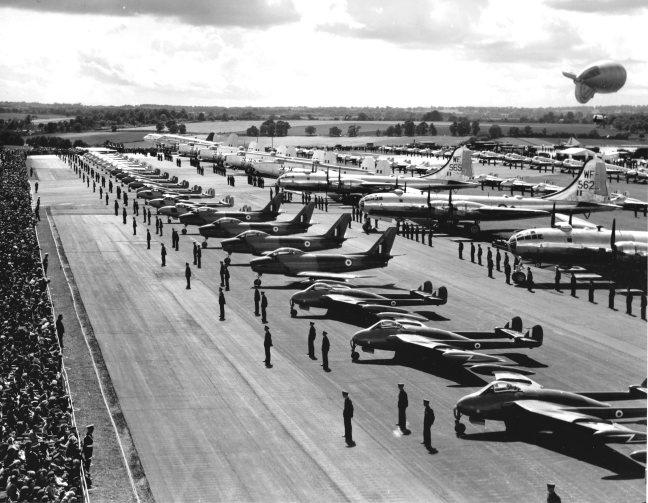
Just to remind us that Lasham is still an operational airfield, during lunch a Norwegian Air Boeing 737 commercial jet came into land on the mile long runway to then taxi round to the service company that rents its space from the gliding society who owns the airfield.

Thanks are due to member Stephen Thair for arranging this visit, who has maintained his interest in avionics since qualifying for his private pilot’s licence some years ago and to Bryan Nagle for supplying some of the photographs.