Geoff Twine flanked by Richard Stettner and Alan May with the winners’ trophy
The annual golf match between Basingstoke Probus and Deane Probus clubs took place on 28th August at Sherfield Oaks Golf Club.
Our team consisted of Geoff Twine, Richard Stettner, Alan May and Phillip Jones and had two guest players, Barry Allard and Phil Stephens. Both teams of six players played three four ball matches. The first match ended in being halved, as did the second match. The overall result was therefore dependent on the last group of four – a cliff hanger!! In the end it was a win for Basingstoke Probus Club. The twelve players then retired to the Club House for a well earned drink and meal.
All agreed that it was a very enjoyable day and played in good spirit.
New President of Probus, David Tivey, being presented with the chain of office by out going president Paul Flint
New President of Probus, David Tivey, being presented with the chain of office by out going president Paul FlintThe Probus Club of Basingstoke has recently entered its 37th year of operation and will be happy to hear from applicants who would like to join this organisation for retired professional and business men.
President David Tivey explains “We are a social club for like minded men that meets twice during most months; for lunch on the second Tuesday at Test Valley golf club and on the evening of the fourth Thursday at Christ Church in Chineham where we have a guest speaker. The subjects are wide ranging, for example during the autumn we shall be having a glimpse of village life in the 1940/50s, followed by military experiences of getting your knees brown and guidance on how to have a happy and wealthy retirement.”
“In addition we have external trips and occasions that involve our wives and partners. We are going to the Kempton Water Works ‘in steam ‘ weekend to see one of their famous engines running and there will be a classic car and motor bike display, we have a trip booked to RAF Hendon museum and then we shall be having our black tie Christmas dinner”
“In the new year we are planning visits to the Marie Rose exhibition, the Supreme Court and a three days trip to the WW1 battlefields”
David Tivey is a retired Government Factory Inspector and previously had never considered himself a “clubby” person but was introduced to Probus by an ex-colleague. He was surprised how quickly he felt at home with men who had such a wide variety of professional and business experiences. Some had worked overseas but the majority had been the movers and shakers in and around Basingstoke.
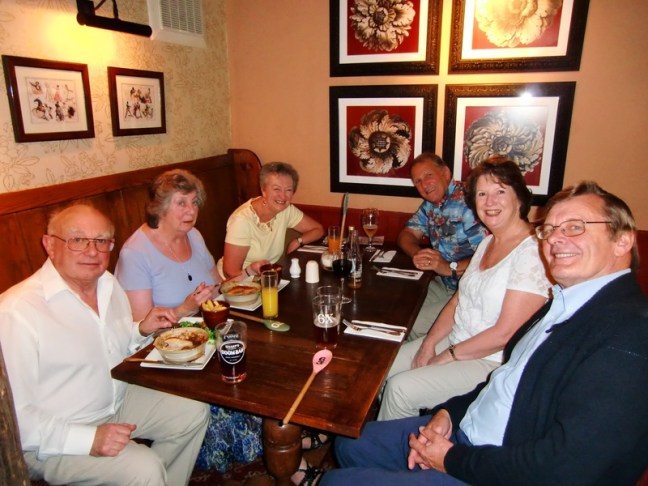
Longbridge Mill at Sherfield on Loddon was the venue for the annual pub lunch of the Probus Club of Basingstoke. A total of 34 members and wives/partners enjoyed a convivial lunch with good food and company. Two potential members were also present.
President David Tivey said “This is one of the social gatherings in our programme which we have held for many years. The incoming president is responsible for choosing the venue and over time we have probably been to most hostelries in the area. I am pleased that despite being in the middle of the traditional holiday season so many of our members attended and it was good to see their wives again.”
The next social outing is planned to be on Sunday 28 September when the club will be going to the Kempton Steam Museum when one of the famous pumping engines will be running, together with a classic car and bike display.
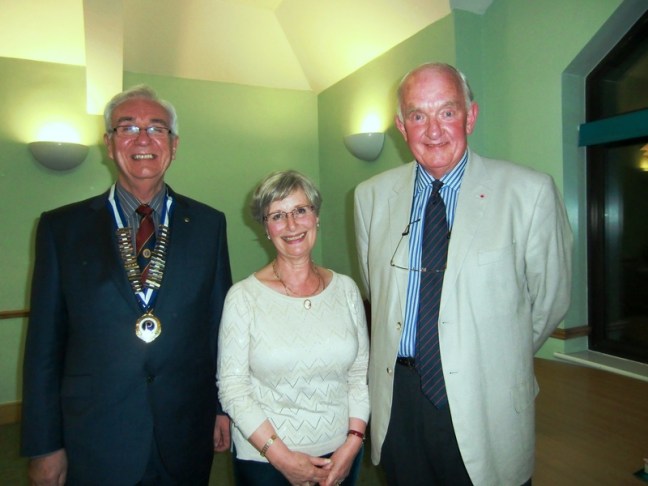
The first speaker of the 36th season for the Probus Club of Basingstoke reassured the audience of retired professional and business men of the high safety standards when travelling by train. The topic “Training the Train Drivers” was expertly covered by Chris Vickers of South West Trains who became a train driver fourteen years ago. For the last seven years he has been a Driver Instructor, including eighteen month’s secondment to the training centre at Basing View in Basingstoke.
There is fierce competition to become a train driver with a waiting list of several years before the applicant gets to the initial interview. Typically, from 350 applicants only one is normally accepted on to the training scheme. Even then there is fall out as a result of candidates failing some of the rigorous examinations during the fourteen months in training.
The curriculum covers every aspect about the tracks, signalling, stations on each line, safety standards and that is before they reach the stage of getting their hands on a real train. Initially they are taught with simulators. The simulators, similar in principle to the ones used to train airline pilots, are based on the Desiro trains used by South West Trains. They are used to assess trainee drivers as well as qualified drivers on their knowledge of the latest rules.
Eventually the trainees are assigned to a Driver Instructor who acts as their mentor and sits with them in the cab whilst gaining experience driving real trains. Having completed all the necessary training they will take a final assessment that lasts for five days. Having passed that hurdle they have to learn the routes that they will drive over. The first time a driver goes solo is something they will never forget. Gaining a train driver’s licence is the fulfilment of the ambition of many but achieved by only a few.
The first lunch of the 36th Probus season was held at Test Valley Golf Club on Tuesday 8th July 2014. Newly elected President David Tivey welcomed the guest of honour, the Worshipful the Mayor of Basingstoke & Deane BC, Cllr Roger Gardiner. The Mayor spoke about the three charities he had selected for his sponsorship during his year of office and President David Tivey presented him with a cheque from our club in support of his target.
This is the third year running that the club has been visited by the mayor at the inaugural lunch.
Despite inconvenient road works close to the golf club which had the potential to cause delays members arrived on time and enjoyed a good lunch.
Thanks are due to Dr Raja Cavale for being behind the camera. More photographs of the lunch can be seen in the Picture Gallery which you will find in the drop down menu MORE.
At the 35th Annual General Meeting of the Probus Club of Basingstoke David Tivey was appointed President for the ensuing year. A retired Factory Inspector, he lives with his wife Bridget in Cliddesden Court near Queen Mary’s College. He moved to Basingstoke from Derbyshire in 1976 with his wife and family. He has two sons, both married and five school age grandchildren, all living in Hampshire.
“I was introduced to Probus by a former colleague but had not regarded myself as a “clubby” person. I found a very warm welcome from a group of men, many of whom had remarkable life experiences and had some great tales to tell. I immediately felt myself at home in their company.”
He went on “I want, in my year of office, to rebuild our membership towards the constitutional figure of 55 and to encourage more members and their wives and partners to join in and enjoy the social programme we arrange.”
The retiring Secretary, Gerry Anslow, from Kempshott, was presented with an engraved glass bowl by the outgoing President Paul Flint, to mark Gerry’s ten years of service on the club’s committee. Paul Flint of Hatch Warren will become the Secretary and Alan Porter of Bramley returns to the committee as Vice President.
Following the meeting the members enjoyed canapés provided by Lesley Atchison, wife of Tony, the Outings Organiser, and wine provided by Gerry Anslow. Lesley was presented with flowers and wine in appreciation of her support during the year.
President Paul Flint with retired Major General Peter Chambers and his wife Valerie
Probus given Further Amusing Glimpses of Army Life
This was the title of the talk given to the Probus Club of Basingstoke by retired Major General Peter Chambers and his wife Valerie. They had previously given a talk to this club for retired business and professional men in October 2012 which was so well received that they were invited to be the last speakers in the current season. This couple rose to the occasion with great aplomb with stories about their experiences as Peter advanced up the ranks to become Deputy Chief of Staff UK Land Forces while Valerie had to cope with the pressures of domestic issues with various postings and housing problems.
Valerie and Peter described various incidents and aspects of life in some of the places they had lived and served. They spoke of amusing and light hearted experiences though occasionally with a serious undertone. They were able to give glimpses of the variety and advantages of service life whilst Peter expressed some concerns about current military capability.
They lived in Germany, on and off, for 12 years during the Cold War. Inevitably therefore, much of their talk was focussed on service life in Germany and in particular on Berlin. They quoted many examples of soldiers’ humour and of the resilience of Army wives, whose husbands spent long periods away from home on operations and training. Valerie described what life was like living in married quarters, a subject she knew something about as they had 26 moves in 33 years service!
They have recently returned from a visit to Moscow. This was essentially an international reunion of officers and civil servants who had attended a year’s course at the London based Royal College of Defence Studies in the 1990s when Peter was the Senior Army Member on the teaching staff. They were in Moscow for the May Day Parade and for the build up to the Victory Day Parade on 9th May and described some aspects of the atmosphere there during this period.
Returning for a second year to Oakley Hall the occasion lived up to expectations with excellent food, good wine and great company of members, wives and friends in splendid surroundings.
The guest of honour was the President of the Ladies’ Probus Club of Basingstoke, Jan Miller, accompanied by her husband Henry, who is one of our past presidents.
Thanks are due to Alan and Liliane May, who, with their expertise gained over the years in organising these evenst and our Christmas dinners ensured that things ran as smooth as silk. They were ably supported by Rob Hopkins who, after lunch, ran the raffle benefiting from the buying prowess of Richard Stettner who obtained a good deal on the prizes.
Thanks also go to Gerry Anslow, the photographer on the day and who is happy to provide any member with the file of any particular shot or can print out a high quality image suitable for framing.
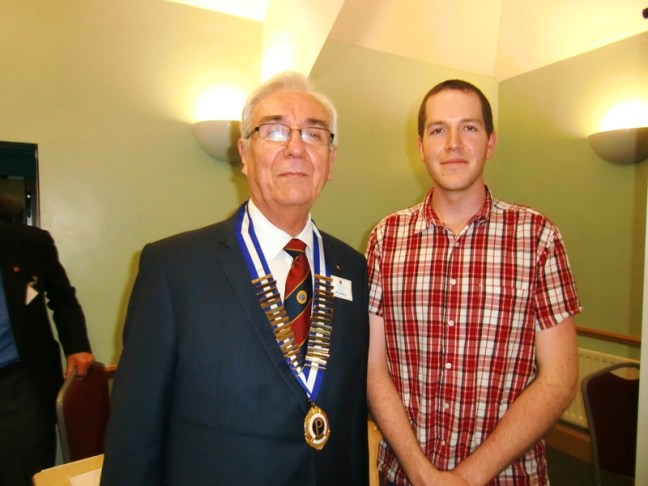
An inspirational illustrated talk by a mountaineer who is raising money for two local charities, St Michael’s Hospice and Marwell Widlife was given to the Probus Club by local man Stephen Court.
Although only twenty seven years old and a serving police officer based in Basingstoke he has been on a mission for several years with £40,000 as his target. He has so far raised over £7,000.
In January this year he went to the south of Argentina to tackle Mount Aconcagua, which at 6,961 metres or 22,837 feet is the world’s second highest mountain. Even in the height of the southern hemisphere’s summer the temperature on the mountain ranged from 30 degrees during the day to minus 10 degrees at night.
This expedition was the culmination of several years’ training by ascending Kilimanjaro in Tanzania, Toubkal in the Atlas Mountains of Morocco; from the peak it was possible to see the Sahara desert to the south and the Mediterranean Sea to the north, and Machu Picchu in Peru. Last October his attempt to ascend Mera Peak in Nepal had to be abandoned due to illness, so it was easy to understand that his efforts have a distinct element of danger.
Altitude sickness can be a common problem along with heart attacks and falls on high mountains and an average of three people die each year on Mount Aconcagua. Despite these dangers the mountain attracts considerable numbers of climbers during the summer season and the rangers, who strictly control matters, have organised permanent camps at different altitudes.
Approximately only 40% of the climbers reach the summit. The rest are thwarted by accidents, illness and weather problems. In fact just as he was about to attempt the final ascent the rangers closed the mountain due to approaching bad weather from the Pacific Ocean. Disappointed, Stephen started the descent when he badly damaged his knee. As a consequence he had to be airlifted off the mountain by helicopter operating close to their maximum height due to the thin air.
Malcolm Collinson, the President of Deane Probus, was the guest of honour at the final lunch at Sandford Springs golf club on Tuesday 8th April after ten years of using this venue. Ironically, most of the reduced attendance of twenty four members agreed that the food on the day was probably the best we have had this year.
After the Ladies’ Spring Lunch at Oakley Hall in May, we shall be moving to Test Valley golf club which is half way between Overton and Micheldever. The first lunch being on Tuesday 3rd June (not 10th – second Tuesday as usual). Thereafter we shall go back to the second Tuesday of each month.




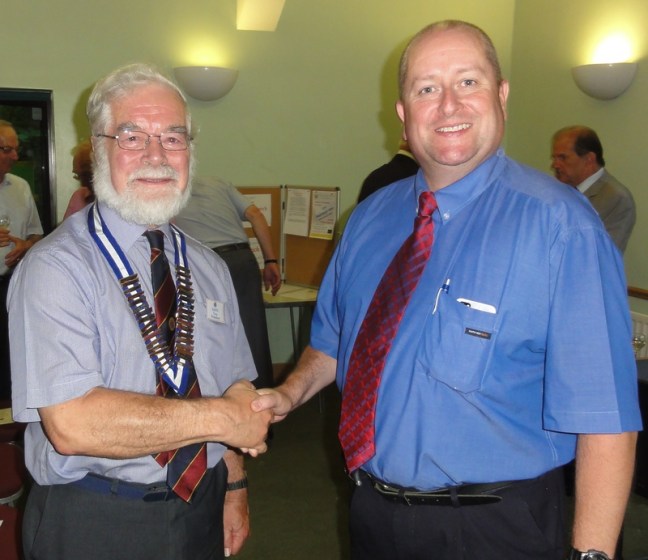 The first speaker of the 36th season for the Probus Club of Basingstoke reassured the audience of retired professional and business men of the high safety standards when travelling by train. The topic “Training the Train Drivers” was expertly covered by Chris Vickers of South West Trains who became a train driver fourteen years ago. For the last seven years he has been a Driver Instructor, including eighteen month’s secondment to the training centre at Basing View in Basingstoke.






You must be logged in to post a comment.