News

Probus hears about the history of RAF Odiham

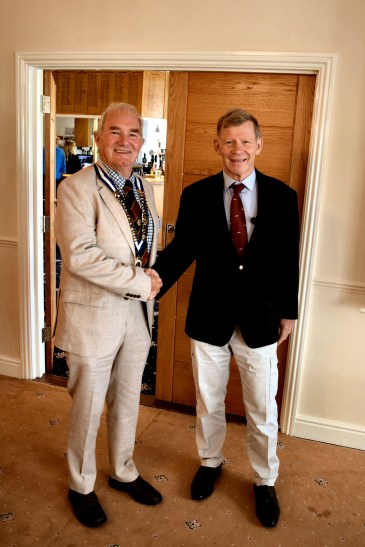
Probus RAF Odiham talk by Chris Perkins image1

On the occasion of his first lunch meeting as the new President, Chris Perkins MVO was also the speaker this day, 10th July 2018. The subject was about the air station where he had been the longest in his service life.

Today the sight and sound of a Chinook helicopter flying across Basingstoke’s sky line is so common that in most cases they are ignored. Yes, we know they are based at RAF Odiham but most know little about our local airfield. Retired RAF Squadron Leader Chris Perkins MVO , from Kempshott,  gave a presentation to our members about the history and changing face of what is now home to the largest deployment of helicopters in the UK.

Chris Perkins served 22 years at RAF Odiham and became interested in its history, although there were little official archives. Just after WW1 the RAF air station at Andover carried out aerial surveys over Odiham Down, seeing potential to expand their activities to be closer to the army base at Aldershot and the important flying centre at Farnborough. In 1925 a summer camp was established and grass runways allowed some flying.

The 1930s saw expansion of RAF Odiham with two tarmac runways needed to handle heavier planes.  The Empire Air Day in 1937 was a great spectacle and interestingly an official visit to the station was conducted by Luftwaffe General Erhard Milch. During WW2 he oversaw aircraft production in Germany.  He was so impressed by RAF Odiham that he earmarked it for his HQ should England be conquered.

Bristol Blenheim at Odiham late 1930s
Bristol Blenheim bombers at RAF Odiham in the late 1930s

Within 10 days of the declaration of war in September 1939 the service men of RAF Odiham with their Lysanders and Blenheims deployed to France engaged in army support roles suffering several losses. They were replaced with RAuxAF Squadrons 613/614 with Hind, Hector and Lysanders together with a detachment of WAAFs filling administrative support posts.  Change continued at Odiham as in 1940 RCAF 110 Squadron arrived with other foreign personnel and the establishment of Belgium/French Flying Training units. They were visited by General De Gaulle.

Two days after Luftwaffe aircraft were spotted carrying out area reconnaissance, RAF Odiham was the target on 12th August 1940 for Junkers 88 of Kampf Geschwadern51 (Bomber Group 51). They were intercepted by Hawker Hurricane fighters of 43 Squadron from RAF Tangmere in West Sussex. On 15th August RAF Odiham was mistaken for the target RAF Andover when a Junkers 88 crew made navigational errors and their bombs killed several in Odiham village. The next attack was on 23rd March 1941 when a Junkers 88 jettisoned 12 bombs in the vicinity of the airfield whilst trying to get away from a persistent Hurricane. Three days later another Luftwaffe bomber was engaged by the station’s defences as it flew over the camp. This was the last recorded incident of the enemy’s  attacks on RAF Odiham in WW2.

Following the formation of the Army Co-operation Command in December 1940, it was decided to replace the aging Lysander with fighter aircraft capable of completing photo reconnaissance missions. The American Curtiss Tomahawk was chosen and in April 1941 the Canadian 100 Squadron, renumbered 400 Squadron at Odiham, began to re-equip. They were joined by 171 Squadron.

May 1942 saw the first of the 1000 bomber raids with five Blenheim Mk 1V of 13 Squadron involved. They went on three such raids with several losses with crews buried in Holland.  August 1942 saw 13 and 613 Squadrons supporting the Dieppe raid.

From November 1942 RAF Odiham experienced a great build up with all types of army co-operation activities besides operational air and shipping support sorties. All were in preparation for the forthcoming invasion of Europe involving many types of fighter aircraft.

Transport Command came in 1945 with 233 and 271 Squadrons of Dakota aircraft and the Canadian Transport Wing formed.

Dakota of 120 Transport Wg RCAF Oct 1945 - Copy
RCAF Douglas DC-3 Dakota at RAF Odiham

There was a ground strafing range in Dogmersfield Park and Lord Haw Haw was returned via Odiham from Germany to face trial as a traitor. There were still many fighter aircraft based here. 54 Squadron with Hawker Tempest Mk11, 130 Squadron with Spitfire Mk1V and 247 was the first Vampire jet unit with 54 and 130 Squadrons converting to Vampires to form the first RAF Vampire wing. In 1947 54 Squadron became the first RAF formation team flying jets.

Atlantic Flyers
de Havilland Vampires first saw service at RAF Odiham

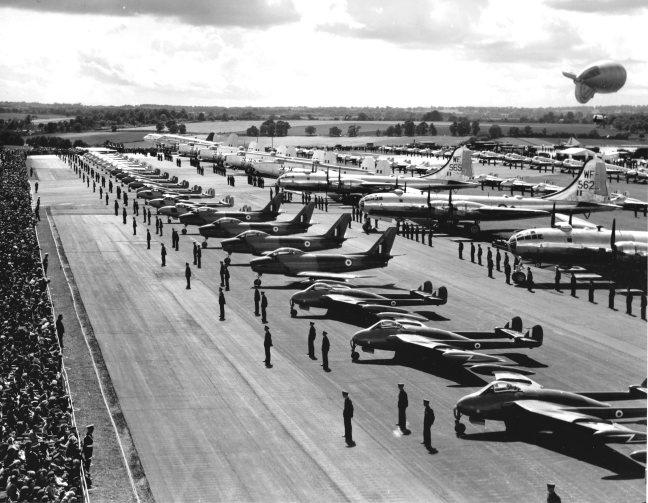
Flying machines had proven their worth in WW1 and became a separate military force in 1918 when the Royal Flying Corps became the Royal Air force. On 10th July this year, its century was celebrated with a large fly past in London. RAF Odiham can beat that with the Coronation Review of the Royal Air Force on 15th July 1953.
Cor Rev 3
Coronation Review of the Royal Air Force at RAF Odiham 15th July 1953

There were 331 planes on the ground and a fly past of 197 piston engined planes and 444 jets. This was, and will probably be, the largest ever collection of RAF planes ever seen.

Mayor Attends Probus Lunch

CIMG0796

The Worshipful the Mayor of Basingstoke & Deane BC, Cllr Sean Keating was guest of honour at the first lunch of the new Probus season on Tuesday 10th July 2018. The new President, Chris Perkins MVO,  presented a cheque on behalf of the club to the Mayor as a small contribution to his charity appeal.
Being a hot day the Mayor used a lightweight version rather than the usual heavy chain of office.

Changes at 39th AGM

CIMG0792
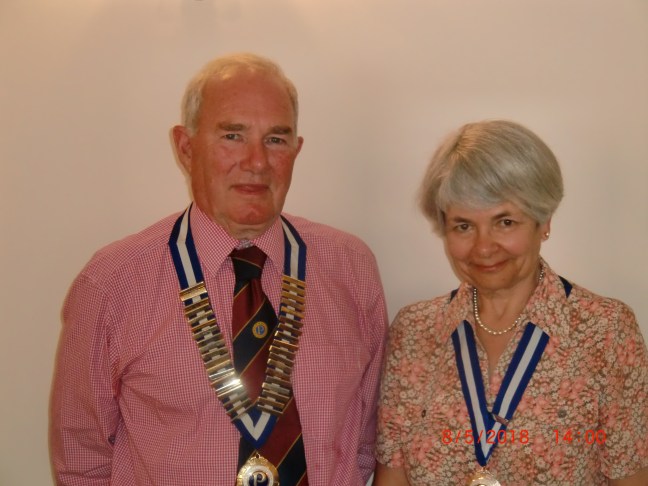
Chris Perkins MVO receives the Probus Presidential Chain of Office from outgoing President Dr Nick Waring

The 39th Annual General Meeting of the Probus Club of Basingstoke had a two part ceremony for the elevation of Chris Perkins MVO to become the President for the coming year. The actual handing over of the Chain of Office took place at the lunch on 12th June as Chris was on holiday on 28th June which was the date of the AGM.
Meanwhile back at the AGM, held at Christ Church in Chineham, after the various reports were presented there came the voting for the Officers and Executive Committee members for the ensuing year. Paul Flint remains as Hon. Secretary (as well as PR Officer) now with assistant Secretary Peter Hayes and Alan May as Hon. Treasurer with assistant Treasurer Dr Jeff Grover. Richard Wood becomes Vice President with the additional, new, role of Welfare Officer. Alex Marianos takes over as Lunch Steward from Stephen Thair who leaves the Committee after four years in that position and Tony Atchison continues as Outings Organiser while David Wickens becomes Programme Secretary now Chris Perkins has taken on the top position.

Dr Nick Waring received the Past President’s tie from Paul Flint. Dr Waring thanked Lesley Atchison for once again producing the nibbles after the meeting and presented her with some orchids.


Colditz Castle PoW Camp

P & N 3
Dr Nick Waring with Col. Piers Storie-Pugh

Built in 1014 as a hunting lodge for the King of Saxony and today a hotel and Youth Hostel, its most famous face was that as a Prisoner of War camp for allied officers in WW2.  Hermann Goering, Hitler’s deputy, in 1939 described the castle as escape proof.

2014-05-13 14.06.36
Colditz Castle Today

Colditz Castle became the most famous PoW camp during the war as it became the last ditch place that persistent escapees from other PoW camps were sent. It was the destination that the father of the speaker at the last meeting of the Probus Club of Basingstoke, the social club for retired professional and business managers, found himself in 1940. Peter Storie-Pugh (later full Colonel CBE MC TD DL) had been captured at a battle near Douthens and had escaped twice before ending up in Colditz Castle the place that ensconced officers from Britain, France and Poland.

2014-05-13 14.30.35
Courtyard of Colditz Castle

His son, also a Colonel, Piers Storie-Pugh, who has a particularly impressive army CV, told of the experiences his father endured during five years of captivity. This started with a march from the station across the Adolf Hitler bridge towards the foreboding castle. There were 400 seasoned troops back from the eastern front set to keep control of 800 prisoners. Despite this ratio and with due respect for the actual position of the castle on a promontory there were 300 attempts to escape of which 130 were successful. There were 33 “home runs” where British officers made it back to UK.

Capt Pat Reid was the initial British Escape Officer who maintained that things ran on strict military lines.  He escaped in 1942 with three others to Switzerland subsequently becoming the consultant to the film The Colditz Story. It was important that British escape plans did not interfere with any from the French or Polish prisoners. It took up to nine months from the inception of a plan to fulfilment during which time it was necessary to create the circumstances to give the escapee the best chance of success. This could include creating suitable clothing to match German military uniforms or ladies’ skirts and blouses as well as forging the necessary documents. They carved tunnels, hid in the laundry, climbed over precipitously high roofs, vaulted over high fences and, of course, made the famous glider. This had been constructed in a supposedly locked loft room made from bed sheets and planks from the stage. It had been calculated that it would fly up to 1000 feet and was kept in reserve in case problems occurred with German troops inside the castle.

2014-05-13 15.13.59
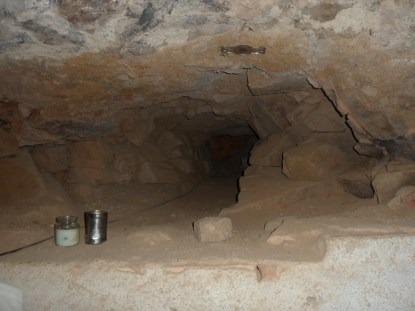
Escape Tunnel

Peter Storie-Pugh was involved in assisting 21 escapes. Some were not successful in that the escapees were recaptured and kept in solitary confinement and fed on bread and water. The first successful escapee was Airey Neave, dressed as a German corporal. He became a barrister, worked for MI9, was elected as a Conservative MP and murdered during the Irish troubles in 1979 when his car was blown up on the ramp from the car park in the House of Commons.

Many rowdy games were played in the castle court yard as well as putting on stage shows that held the attention of the guards and covered up potentially noisy escape workings. In the meantime moral was boosted by a secret radio giving the football scores courtesy of the BBC and receiving coded letters from home and postcards from successful escapees. Peter Storie-Pugh also carried out a correspondence course with Cambridge University and gained a BA while still a prisoner.

This multinational mix of prisoners drawn from all three services from 2/Lt to General cooperated in escapes, shared cold, starvation and frustration, but seldom boredom as they tried every method of escape. But they kept German guards away from fighting against our troops. Colditz Castle was liberated by the US Army on 15th April 1945 but the first person to enter the Castle by Jeep was a delightful young female war correspondent. A very welcome sight for the men of Colditz who should not be compared to today’s lightweight celebrities but were true role models who exhibited the finest personal qualities against a back drop of a world war.


Visit to Exbury Gardens

Thursday 7 June saw 31 souls consisting of members, wives, lady friends and some from the Ladies Probus Club of Basingstoke having a splendid trip by coach to Exbury Gardens.

Situated at the southern end of the New Forest and adjacent to the Beaulieu River the property was bought by the de Rothschild family in 1918. During WW2 the house was used by General Eisenhower, Churchill and General Montgomery to plan the D Day landings.

It has been a lifetime’s work for several generations of the de Rothschild family in creating one of the finest woodland gardens in the country extending to over 250 acres. Described as, ”bankers by hobby, and gardeners by profession” the gardens also include a narrow gauge steam railway conceived in 2000 and taking over two years to bring to fulfilment.

It had been hoped that the rhododendrons would still be in bloom but this year’s spring weather put paid to that although there are a few late varieties still in flower. Our group had the benefit of a guided tour while some less mobile used the services of a golf buggy complete with informative driver. The afternoon encouraged a ride on the steam train which took in parts of the garden not accessible on foot.

Spring Ladies’ Lunch 2018

CIMG0775
President Dr Nick Waring with guest of honour Joy Needham President of the Basingstoke Ladies Probus Club

The annual Spring Ladies’ Lunch of the Probus Club of Basingstoke had as its guest of honour Joy Needham the President of the Basingstoke Ladies Probus Club.

Held at the Test Valley Golf Club this is one of two formal occasions in the year when members of the Probus Club of Basingstoke, the social organisation for retired professional and business managers, are accompanied by the distaff side of the family although there are many social events and pub lunches that couples enjoy.

Thanks are due, once again, to Alan and Liliane May for organising this lunch and paying so much attention to detail to ensure the occasion was very enjoyable.
And the food was excellent too.


My Start in Life as an Apprentice

CIMG0752
President Dr Nick Waring & David Wickens

“Learn a trade, son” was the advice Probus Club member David Wickens received from his father. Like many about to leave school in the Swinging Sixties, he had no clear idea of what to do with the rest of his life. Besides, these were exciting times and there were many distractions.

All around could be seen the Beatles, Elvis Presley, the death of Marilyn Monroe, the assassination of  President Kennedy, James Bond films, Twiggy with miniskirts and men with long hair and flared trousers not forgetting England winning the World Cup. But what to do?

An uncle gave him an insight into high precision engineering by showing him what went on in automatically testing fifty points simultaneously of jet engine fan blades.  An interest was born and the idea of getting an apprenticeship in engineering was forming.

Apprentices have been around for thousands of years as a way of a master craftsmen passing on his secret arts and skills to the next generation. The young person was “indentured” to the master for many years with onerous conditions, any failure of which could have significant repercussions.

Needless to say the restrictions placed on indentured apprentices of yesteryear of not visiting playhouses and taverns, gambling, committing fornication or marrying did not apply to the speaker during his five years with day release at technical college and night school. A company in the Cambridge Instrument group was the benefactor of the speaker’s ambitions having told the managing director at interview, that his job looked attractive.

Like apprentices in all trades he was subject to the usual initiations by the” timed served” tradesmen. Sending him for a tin of elbow grease or a bag of bubbles for the spirit levels, having his tools welded to the bench or having parts of his anatomy painted with marking blue dye was all to be endured. The only consolation was that he could look forward to applying the same rituals to the next incoming apprentice.

To further enhance his appreciation of how the instruments made by his company were used in the wide world visits were arranged to some customers. The David Brown factory in Newport Pagnell, was home of Aston Martin and Lagonda, the super cars of the 60s. Here he heard about the Aston Martin DB5 used by James Bond in the film Goldfinger in 1964 when six body shells were needed for various scenes..

The Royal Small Arms factory in London had produced swords, muskets and from 1895 onwards the famous Lea Enfield rifle which was greatly admired for the interchange ability of parts, its firing range and the competitive cost due to mass production.

The first large scale plant David visited as part of his apprenticeship was to the Dungeness “A” Nuclear Power station. This was a Magnox reactor with a capacity of 500 MW which could power 10% of Britain’s electrical needs.

The Stewart & Lloyd’s steel works at Corby was almost self sufficient from open cast mining of the iron ore using huge excavators with buckets that could carry 11 cubic metres of ore transported to the blast furnaces for ingot production and tube manufacture.

A visit to Heathrow airport to tour the BOAC Pilot Training School allowed him to try out the Boeing 747 – 136 Flight Simulator and visit the hangers to watch aircraft being serviced which demonstrated how they used the instruments David was training to make.

CIMG0751
Hand tools made by David Wickens during his apprenticeship

David Wickens was clearly good at his job, achieving the award of apprentice of the year. To demonstrate some of the skills learned in the early part of his apprenticeship he brought along some of the hand tools he had made in those years

Further experiences were developed in Work Study and Production Engineering, then in the Drawing Office where draughtsmen used pencil and paper well before the advent of CAD technology and eventually into Sales and Marketing. This latter area held him for the rest of his career as he progressed to become Export Manager visiting many manufacturing plants throughout the World.

And it all started the day he saw a fan blade being tested.


Probus has a Taste of The Vyne

The history of this local Tudor Palace, situated south of Bramley, and its much publicised roof project were the subject of a talk given by Chris Burrows to the Probus Club of Basingstoke, the social organisation for retired professional and business managers.

Oakley resident Chris, is a member of the Basingstoke Archaeology Society and he has been a volunteer with the National Trust since 1991. He has been involved in previous surveys at The Vyne and once found a flint knife. Earlier surveys had been conducted by the eminent archaeologist Sir Mortimer Wheeler.

Built originally in 1268 the building was added to over the years. Sir William Sandys, despite being a staunch Catholic, managed to hold on to his position as Lord Chamberlain to King Henry V111, after the creation of the Protestant Church of England following the refusal of the Pope to the King’s  divorce of Katherine of Aragon.

Mansion in Tudor times wiv tower 2.03.2018
View of The Vyne at the time of the visit of King Henry V111 in 1535

He had developed the property into a Tudor palace, and had the honour and great cost of being a recipient of the King Henry V111 and Queen Anne Boleyn’s “progress” in 1535. Many portraits of the Tudor period can be seen today in the Oak Gallery.

Also to be seen today in the Stone Gallery is a terracotta plaque of the Roman Emperor Probus who introduced wine making into England. It is thought that it is possible that this plaque was obtained in the 16th century and may have contributed to naming this residence, The Vyne.

DSCF4418
Roman Emperor Probus

Baron Sandys endowed the Holy Ghost chapel in Basingstoke and is buried there. The painted glass windows from the chapel were installed at The Vyne, some of which underwent restoration in 2016.

Chaloner Chute, a lawyer and politician, bought the Tudor palace in 1653 and demolished it in 1665, rebuilding in the Palladium style. In 1767 John Chute began further modernisation and installed the grand staircase that can be seen today. The Chute family continued to own The Vyne, with most male descendents named Chaloner, and was lived in until 1939 when it was taken over by Tomore prep school after it was evacuated from Deal in Kent. It was bequeathed, by Sir Charles Chute, to the National Trust in 1956.

With a building this old there was always plenty of remedial work needed to keep the fabric secure but over the years of patching up the extensive roof it was decided that the complete removal and replacement with modern standard of insulation was the best course of action.

DSCF0624
The roof in 2014 before restoration

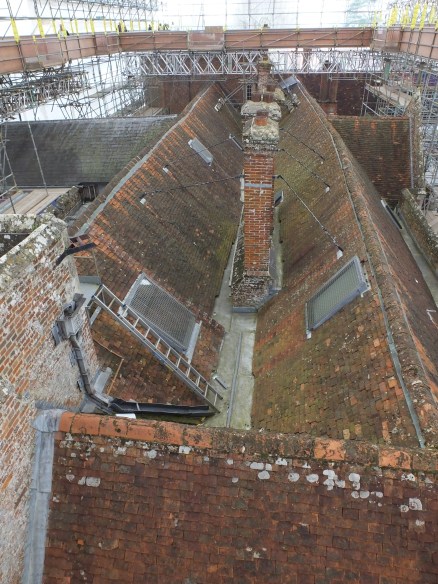
The work started in 2014 and is just coming to an end. It has involved the erection of a cover over the whole building including a lift for materials and passengers. Some chimneys were taken down so that a walkway could be constructed around the complex for the use of just under 150,000 visitors. The last visitors were on 28 February 2018 when the walkway was removed so that the original chimneys could be rebuilt.

DSCF7205
The roof during restoration before putting on the tiles

Pre Tudor roofing was discovered, including the use of part of a staircase which proved that recycling was in vogue hundreds of years ago. The lead from the gullies has been reformed and reused and new parapets and finials been carved. Lime mortar has been used throughout the restoration as it will have a longer life than modern day cement. Special provision has been made for the bats so that they can continue to occupy parts of the roof.

70,000 handmade tiles have been used of which nearly 13,000 were bought by visitors in the “Tagatile” scheme allowing personal messages to be written and raising £64,000 toward the cost of this project of £5,400,000.

It will take three months to remove the roof covering and 41 miles of scaffolding to reveal the highly skilled workmanship to the rest of the world. However they will never see the roof from this angle again!

Bringing the Stone Age to Life


Katy England with Nick Waring
Katy England with Dr Nick Waring

Probus members were taken back to pre-historic times at the latest lunch meeting when Katy England from Salisbury museum gave a talk about times in early Britain.

The earliest remains were discovered at Boxgrove near Chichester in the 1990s and consisted of a leg bone, two teeth and other artefacts from which it is calculated that they originated from a 6 feet tall and well built male. It was concluded that these remains are at least 500,000 years old. At that time Britain was connected to Europe and had a climate similar to that enjoyed today in the African savannah. This find however did not show any evidence of clothing, habitation or the use of fire and the conclusion was that things were eaten raw. It did prove that the inhabitants used long wooden spears with flint points and hand held flint hand axes.

Katy England with spear
Hand held flint axe and wooden spear

Experts think that the use of fire developed around 400,000 years ago perhaps coinciding with a change in weather patterns. Over the next 200,000 years, as the weather became colder, the animals changed with woolly mammoths and reindeer roaming freely, the original Boxmore man developed into Neanderthal man. He was shorter and stockier and more able to cope with the colder conditions.

About 50/40,000 years ago another species arrived from Africa that we call Homo Sapiens. There is some DNA evidence that there was some interbreeding but gradually the Neanderthals died out. There was also development of flint and antlers that could be made into tools including needles which allowed animal skins to be sewn together to create clothing as the climate got colder. Cave painting is thought to have started about 30,000 years ago when ochre and charcoal were used as the basis for colour.

The Great Ice Age came 20,000 years ago and after its departure the sea levels rose thereby creating different land masses as the weather improved to be similar to what we enjoy today. Oak trees and Hazel arrived as well as the formation of lakes and rivers. Mammoths and reindeer were no longer to be seen but there was plenty

Katy England with arrow
Arrow with flint tip & swan feathered flight

of deer and wild boar.  All these changes became essential to supporting life and with the invention of a form of glue and the development of the bow with the “string” made from animal sinews and arrows with flint arrow heads and flights made from swan feathers the age of the hunter/gatherer became prevalent.

But there then began a significant change of life style 12/10,000 years ago, in a period known as the Neolithic Stone Age, they became farmers, domesticating plants and animals, created settlements as permanent villages and we see the appearance of crafts such as pottery and weaving. It is recognised that this is the most significant change in all of human history.


Probus visits TAG Aviation Farnborough

Logo-TAG-farnborough-airport_RVB - Copy

IMG_4062
Stephen Thair is behind the camera
Tower Visit 1
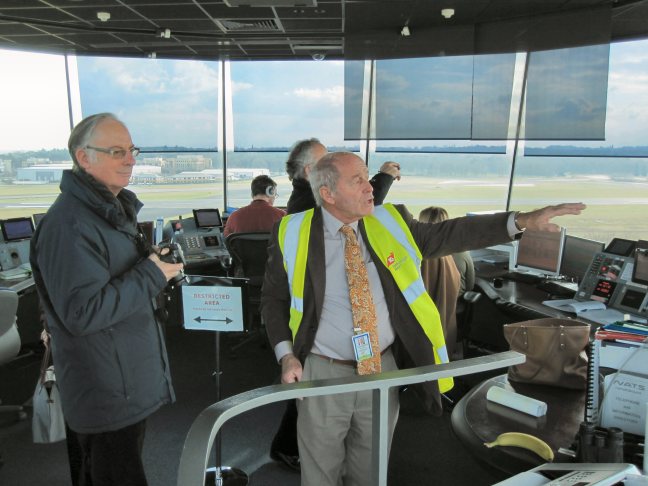
Stephen Thair in the Control Tower
Paul IMG_4056
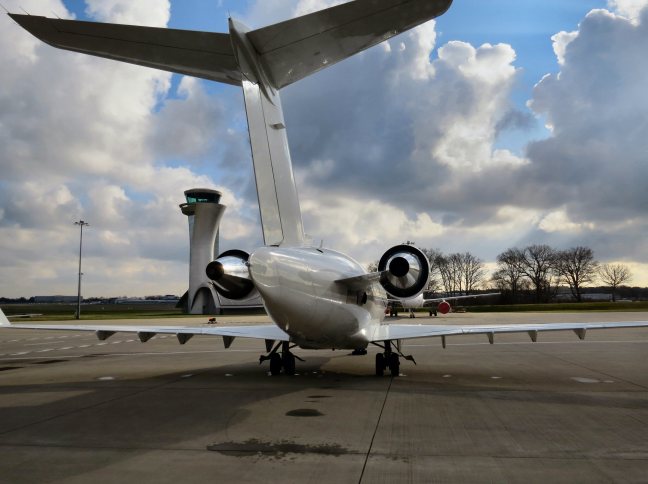
Executive jet anyone?
Paul IMG_4004
See the Control Tower in the background

A chilly but sunny day greeted a privileged group of members of the Probus Club of Basingstoke on what was to be an extremely informative and interesting insight into the modern day VIP operations on this airfield.

Farnborough airfield is perhaps best known for being the venue for the world renowned SBAC (Society of British Aerospace Companies) Farnborough International Air Show.  However, this is a much biased view of what has been one of the most important, albeit non operational, airfields in the UK.  Farnborough’s part in the early development on military aviation and its subsequent involvement with testing and evaluation has secured its place in British aviation heritage.

Farnborough Common was chosen by the British Army in 1905 as a site for His Majesty’s Balloon Factory to manufacture the new dirigible type of balloon.  It had plenty of space and was nearby to existing manufacturing facilities at Aldershot.  An impressive balloon shed was built followed by gas holders and workshops plus the establishment of a balloon school.  The Farnborough Air Sciences Trust (FAST) was established in 1993 and has been instrumental in the preservation and safeguarding of this part of priceless aviation legacy.

It was on the common on 16 October 1908 that saw Samuel Cody achieving the first sustained powered flight in England flying British Army Aeroplane No 1 and in April 1911 the site became the Army Aircraft Factory.  With the expansion of the RFC during WW1 the site became known as the Royal Aircraft Factory (RAF).  The name changed, however, in April 1918 with the formation of the Royal Air Force becoming the Royal Aircraft Establishment (RAE), and it was in this guise of aviation related research and development that Farnborough remained primarily concerned with until 1985.

Encroaching environmental issues with housing and the overcrowded airspace surrounding the airfield had put pressure on military flying research and development activities.  However, a reprieve from total closure was gained because of the site’s value as an ideal venue for the SBAC Show and the lack of an alternative.  Part of the airfield was released by the MOD for general and business aviation use and an aerospace park was established in the 1990s.

Following further closure arguments, due mainly to poor general aviation uptake, it was decided to sell the site.  The company TAG, (Techniques d’Avant Garde), a Luxembourg registered company only formed in 1977, secured the airfield for a multi-million pound price tag. The company had other business interests, formally purchasing the Swiss based Heuer watch company in which they invested significant sums and expanded worldwide sales. The watch retains the name TAG Heuer even though owned today by the luxury brand group LVMH. They also had substantial motorsport interests being a sponsor to the Williams Formula 1 team in the 1980s and today own 25% of the McLaren Group.

Significant capital expenditure was made by the company in landscaping and modernizing the airfield in keeping with bespoke VIP business jet operations and current Civilian Aviation Authority regulations.  These included a new control tower, radar unit, spacious specially designed aircraft maintenance hangars and an extensive aircraft apron for multi jet parking, servicing and operations. The 2440 metres runway was resurfaced. In line with attracting business users TAG also commissioned a luxurious terminal building that provides the very best hospitality in spacious and beautiful lounges for both VIP passengers and Aircraft Crews.  Besides customs, immigration and security facilities passengers may drive directly to their waiting aircraft.  No lengthy and tedious waits here inbound or outbound! Their customers demand and receive high quality and discrete service standards evidenced by the carefully escorted tours enjoyed by aviation enthusiasts.

All are part of a comprehensive bespoke solution encompassing complete aircraft and passenger handling services for business clients on London’s doorstep and very close to a motorway connection.  The TAG operation at Farnborough supports the employment of over 1000 people and 28,000 annual aircraft movements.  This is to be increased to 50,000, gradually being phased in over the forthcoming years.

More photographs were taken but by agreement they had to be approved by TAG before they could be used in our publicity activities. Consequently jets belonging to several well known people cannot be shown. But if you are are a person of significant wealth and own such an aircraft you can keep it dry in one of the hangers for £500 a night.