SELF-DRIVE TRIP TO KINGSTON LACY – Report by Stephen Thair
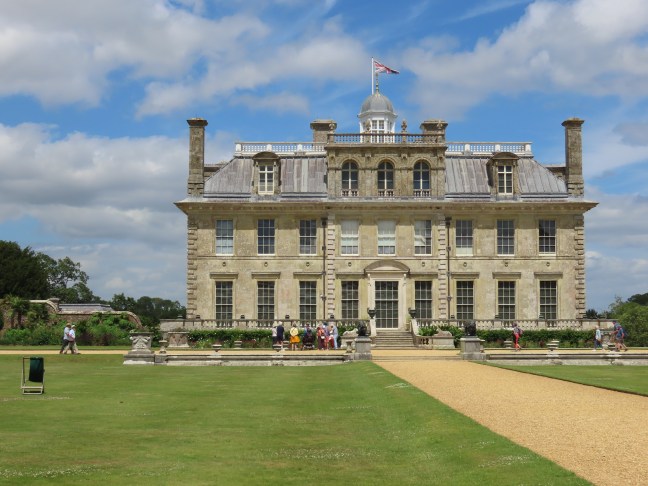
Seventeen members and guests enjoyed an excellent day out to the National Trust property at Kingston Lacy, near Wimborne in Dorset on 26th June. Unfortunately Chris Perkins who had kindly organised the expedition, was indisposed and unable to go.
The House dates mostly from the 1700-1800s and is a “nice size” and set in attractive grounds and gardens. The Bankes family who had owned the estate before donating it to the National Trust had furnished the house with many paintings, including some by Rubens and Titian. One member of the Bankes family had lived in Venice, and sent back paintings and furniture from Italy, including a painted ceiling – the painting (on canvas) dates from the 1600s and was purchased in Italy, taken down from its original location, and shipped to England and then fixed to the ceiling of one of the rooms in the house.
There are two singularly unpleasant paintings each side of the magnificent staircase, which were apparently previously hung in the dining room, and would not have been conducive to enjoyable dining!
Not far from the House is a large stable block which in the best NT tradition, now has the café in it, and some of us gravitated there initially for a coffee.
Lion & Snake Statue
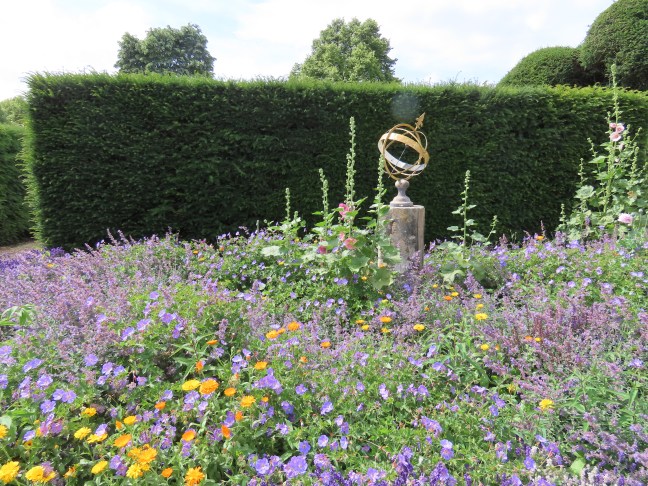
Part of the formal garden
The grounds include a splendid Japanese Garden, which has a Tea Garden within it.
Japanese Garden
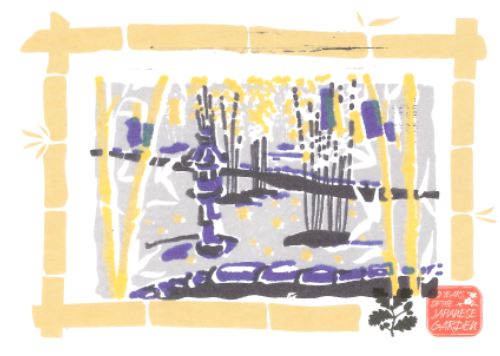
There are four decorated boxes on poles as you go through the garden, and they contain postcards and stamps (not postage) and ink so you can make your own small Japanese-style painting as you proceed through by stamping your card at each box.
Japanese Artwork by Margaret Thair
After passing through the Japanese Garden, you reach the kitchen garden which is very extensive with a lot of greenhouses and a café, and must have produced large quantities of vegetables for the big house in its day.
Enjoying the good weather at Kingston Lacy
There was plenty to see and enjoy and thanks go to Chris Perkins for arranging the trip.
This took place at the Church of St James, Bramley from 1.45 pm following on from a family only cremation. This was a service of remembrance that was attended by 101 people that illustrated how well Fred was known and liked in the village.
Mention was made about Fred’s involvement in the Probus Club and how proud he was to be the president in 2016/17.
Probus members attending were Stephen Thair, Paul Flint & Janet Fagg, Michael & Pam Luck, Alex & Sarah Marianos, Ian & Sandra Nicholson, Chris Perkins, Geoff & Elizabeth Twine, Nick Waring, and Richard Wood.
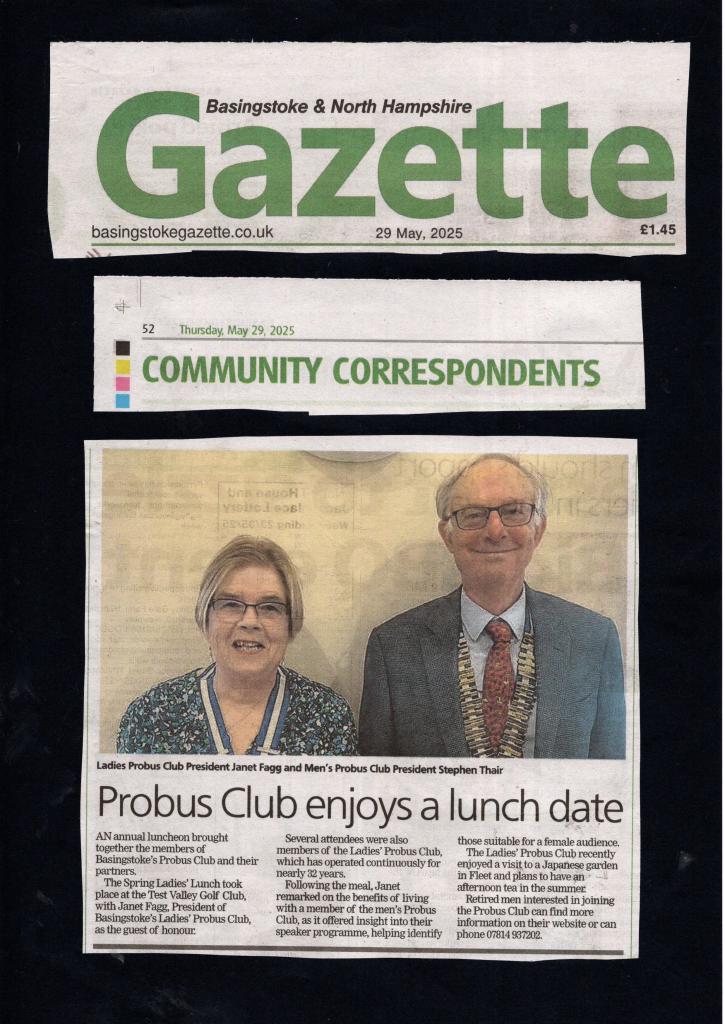
We have received positive feedback from all local magazines that receive our reports, with the exception of the Loddon Valley Link from Sherfield. A rarity was the Basingstoke Gazette carrying our report.
Otherwise, good coverage perhaps because of the two presidents on show which will be welcomed by the Ladies’ Probus Club.
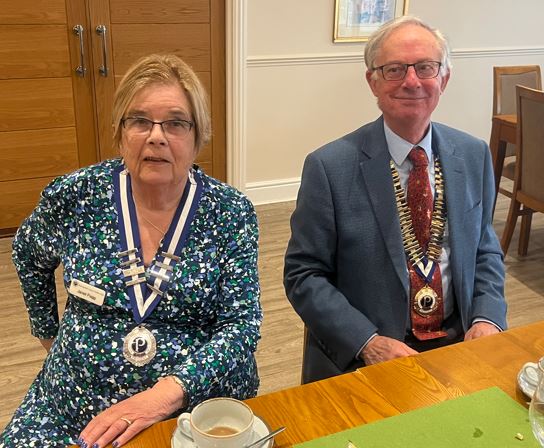
Janet Fagg President of Ladies’ Probus Club with Stephen Thair, President of the Probus Club of Basingstoke
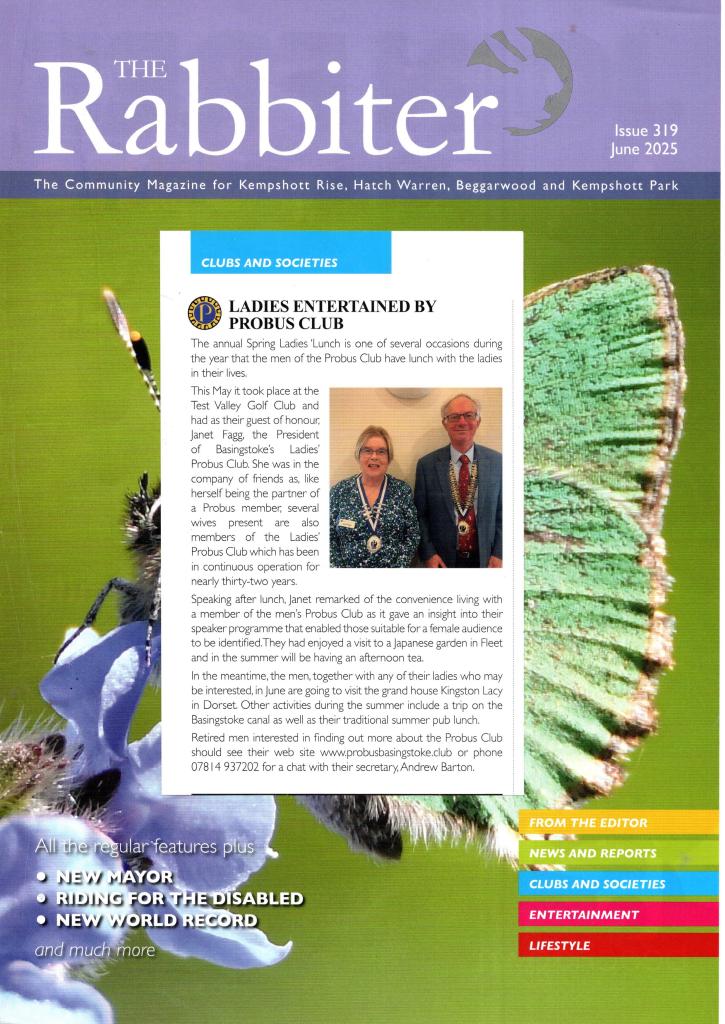
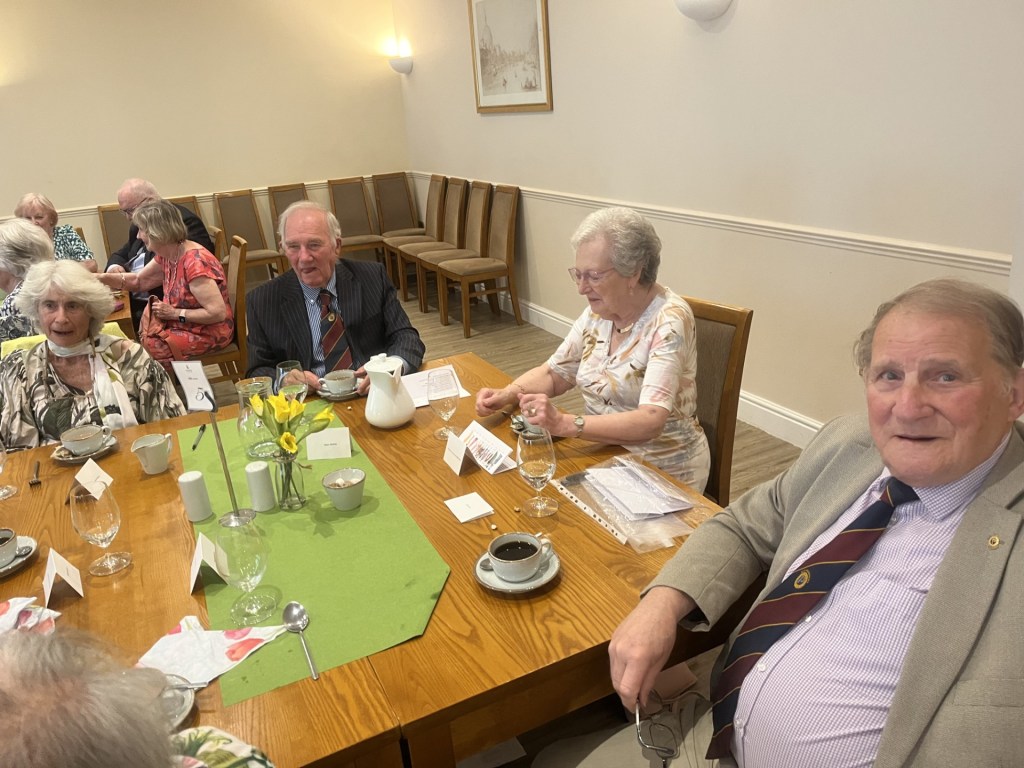
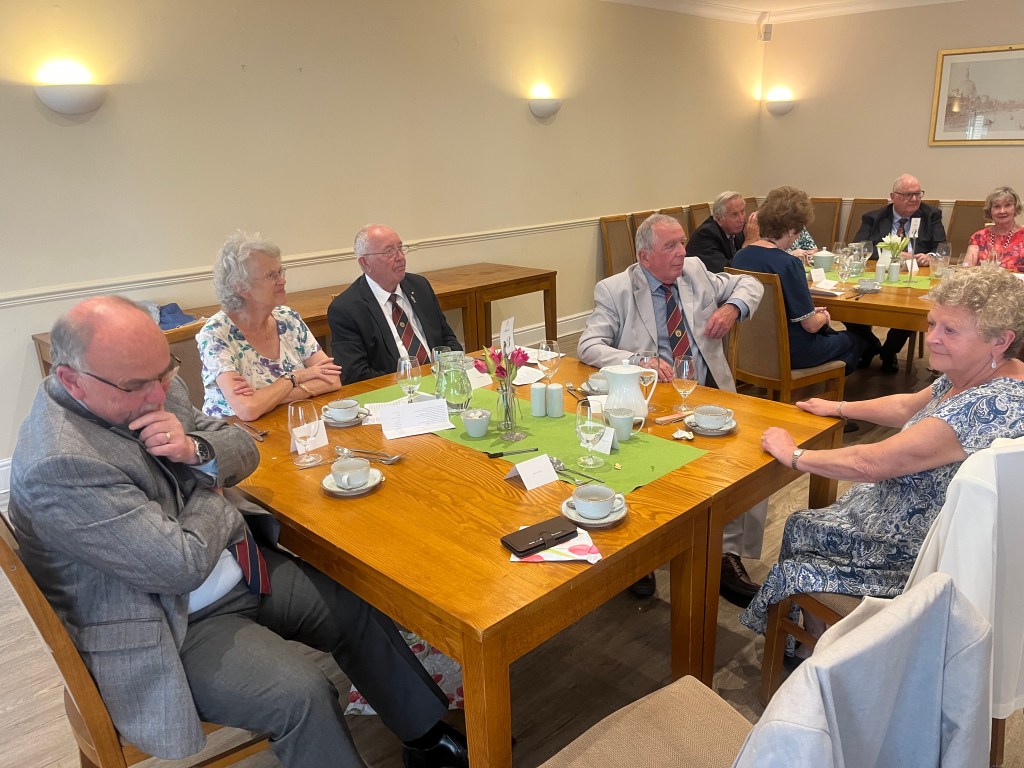
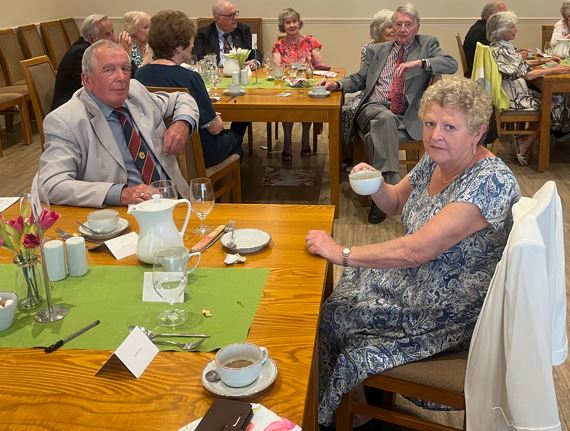
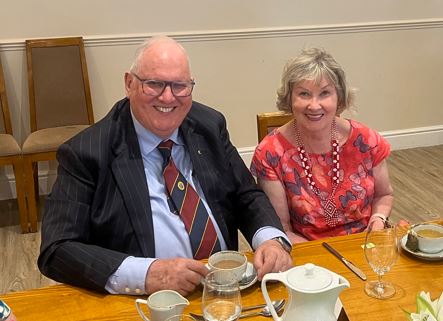
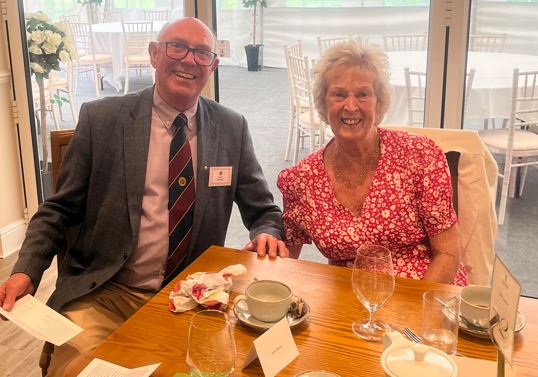
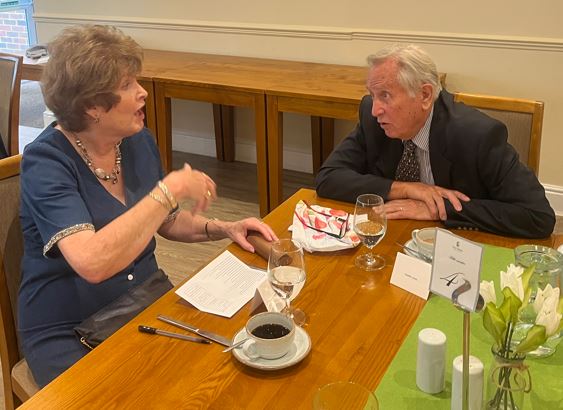
The annual Spring Ladies ‘Lunch is one of several occasions during the year that the men of the Probus Club have lunch with the ladies in their lives.
This May it took place at the Test Valley Golf Club and had as their guest of honour, Janet Fagg, the President of Basingstoke’s Ladies’ Probus Club. She was in the company of friends as, like herself being the partner of a Probus member, several wives present are also members of the Ladies’ Probus Club which has been in continuous operation for nearly thirty-two years.
Speaking after lunch, Janet remarked of the convenience living with a member of the men’s Probus Club as it gave an insight into their speaker programme that enabled those suitable for a female audience could be identified. They had enjoyed a visit to a Japanese garden in Fleet and in the summer will be having an afternoon tea.
In the meantime, the men, together with any of their ladies who may be interested, in June are going to visit the grand house Kingston Lacy in Dorset. Other activities during the summer include a trip on the Basingstoke canal as well as their traditional summer pub lunch.
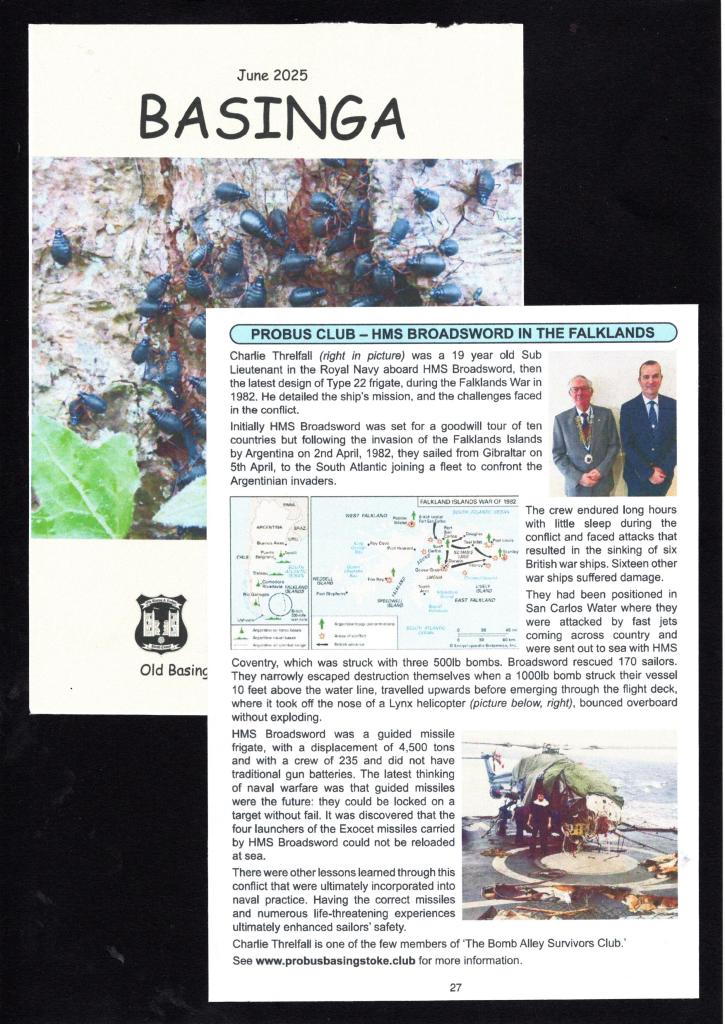
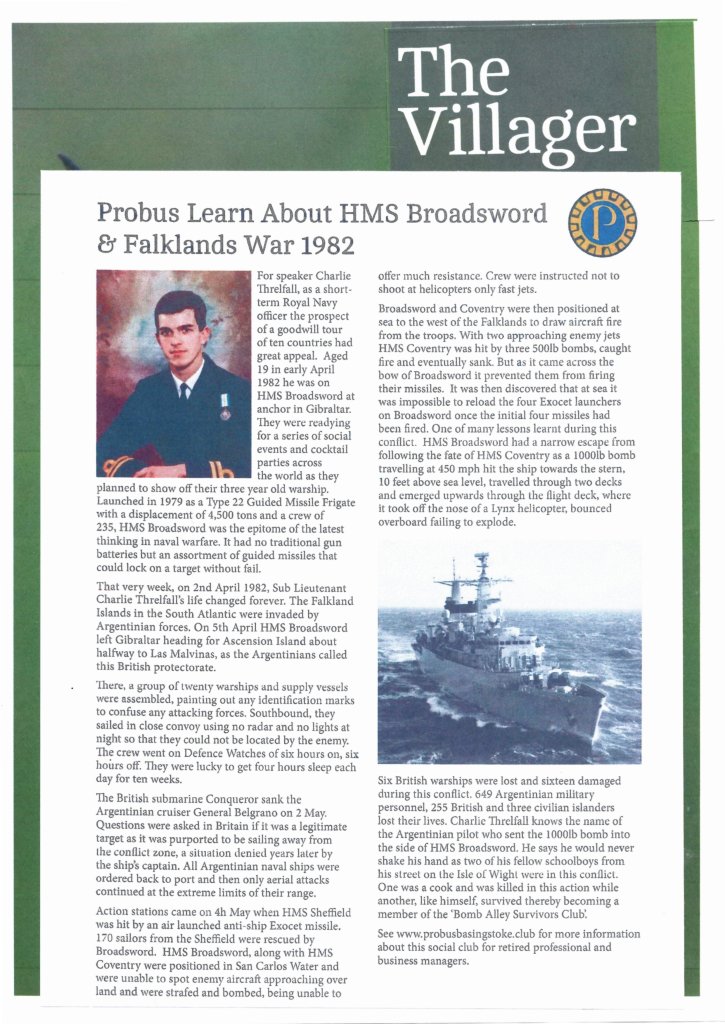
Good coverage in all the local magazines in May and several full pages have had to be reduced to fit on the front covers on our web site. You will see that the Basinga and the Kempshott Kourier carried the Jaguar story while the remainder used the HMS Broadsword report about the 1982 Falklands war.
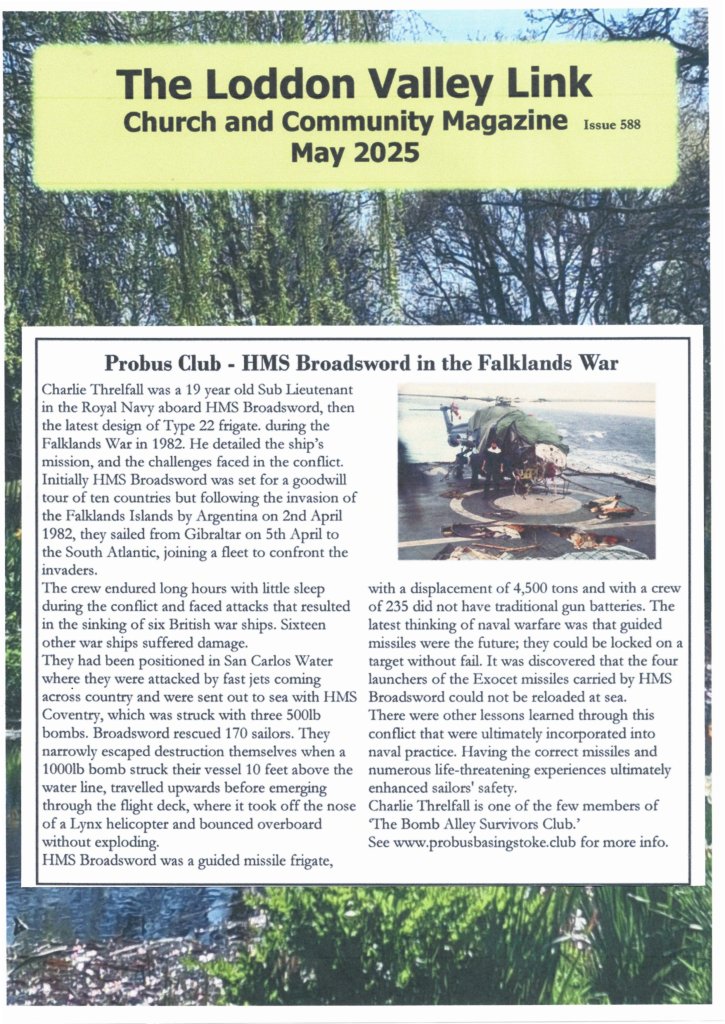
The Loddon Valley Link also joined in with both our HMS Broadsword feature as well as a report about the Ladies’ Probus Club visiting a Japanese garden in Fleet, as did the Rabbiter, Bramley, Villager and the Basingstoke Gazette.
President Stephen Thair with speaker Charlie Threlfall
For speaker Charlie Threlfall, as a short-term Royal Navy officer, the prospect of a goodwill tour of ten countries had great appeal.
Aged 19 in early April 1982 he was on HMS Broadsword at anchor in Gibraltar. They were readying for a series of social events and cocktail parties across the world as they planned to show off their three years old warship. Launched in 1979 as a Type 22 Guided Missile Frigate with a displacement of 4,500 tons and a crew of 235, HMS Broadsword was the epitome of the latest thinking in naval warfare. It had no traditional gun batteries but an assortment of guided missiles that could lock on a target without fail.
HMS Broadsword
That very week, on 2nd April 1982, Sub Lieutenant Charlie Threlfall’s life changed forever. The Falkland Islands in the South Atlantic were invaded by Argentinian forces. On 5th April HMSBroadsword left Gibraltar heading for Ascension Island, about halfway to the Malvinas, as the Argentinians called this British protectorate.
There, a group of twenty war ships and supply vessels was assembled, painting out any identification marks to confuse any attacking forces. Southbound, they sailed in close convoy using no radar and no lights at night so that they could not be located by the enemy. The crew went on Defence Watches of six hours on, six hours off. They were lucky to get four hours sleep each day for ten weeks.
The British submarine Conqueror sank the Argentinian cruiser General Belgrano on 2 May. Questions were asked in Britain if it was a legitimate target as it was purported to be sailing away from the conflict zone, a situation denied years later by the ship’s captain. All Argentinian naval ships were ordered back to port and then only aerial attacks continued at the extreme limits of their range.
Action stations came on 4h May when HMS Sheffield was hit by an air launched anti-ship Exocet missile. 170 sailors from the Sheffield were rescued by Broadsword.
HMS Broadsword, along with HMS Coventry were positioned in San Carlos Water, and were unable to spot enemy aircraft approaching over land, and were strafed and bombed, being unable to offer much resistance. Crew were instructed not to shoot at helicopters only fast jets.
Broadsword and Coventry were then positioned at sea to the west of the Falklands to draw aircraft fire from the troops. With two approaching enemy jets HMS Coventry was hit by three 500lb bombs, caught fire and eventually sank. But as it came across the bow of Broadsword it prevented them from firing their missiles.
It was then discovered that at sea it was impossible to reload the four Exocet launchers on Broadsword once the initial four missiles had been fired. One of many lessons learnt during this conflict and that were eventually incorporated into naval practice. Having the correct missiles and numerous life-threatening experiences ultimately enhanced sailors’ safety.
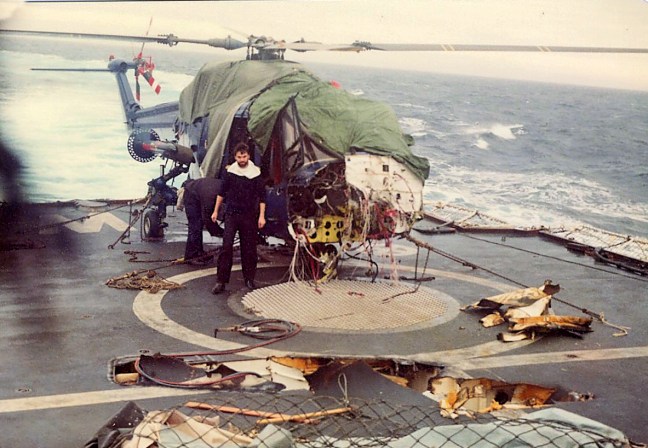
HMS Broadsword had a narrow escape from following the fate of HMS Coventry as a 1000lb bomb travelling at 450 mph hit the ship towards the stern, 10 feet above water level, travelled through two decks and emerged upwards through the flight deck, where it took off the nose of a Lynx helicopter, and bounced overboard, failing to explode.
Lynx Helicopter Missing its Nose
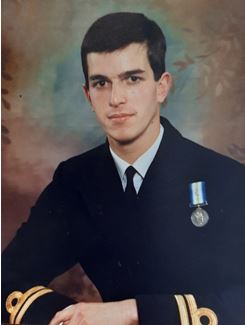
Charlie Threlfall promoted to Lieutenant
Six British war ships were lost and sixteen damaged during this conflict. 649 Argentinian military personnel, 255 British and three civilian islanders lost their lives. Charlie Threlfall knows the name of the Argentinian pilot who sent the 1000lb bomb into the side of HMS Broadsword. He says he would never shake his hand as two of his fellow schoolboys from his street on the Isle of Wight were in this conflict. One was a cook and was killed in this action while another, like himself, survived, thereby becoming a member of the ‘Bomb Alley Survivors Club’
Speaker Nigel Thorley with Probus Vice President John Swain
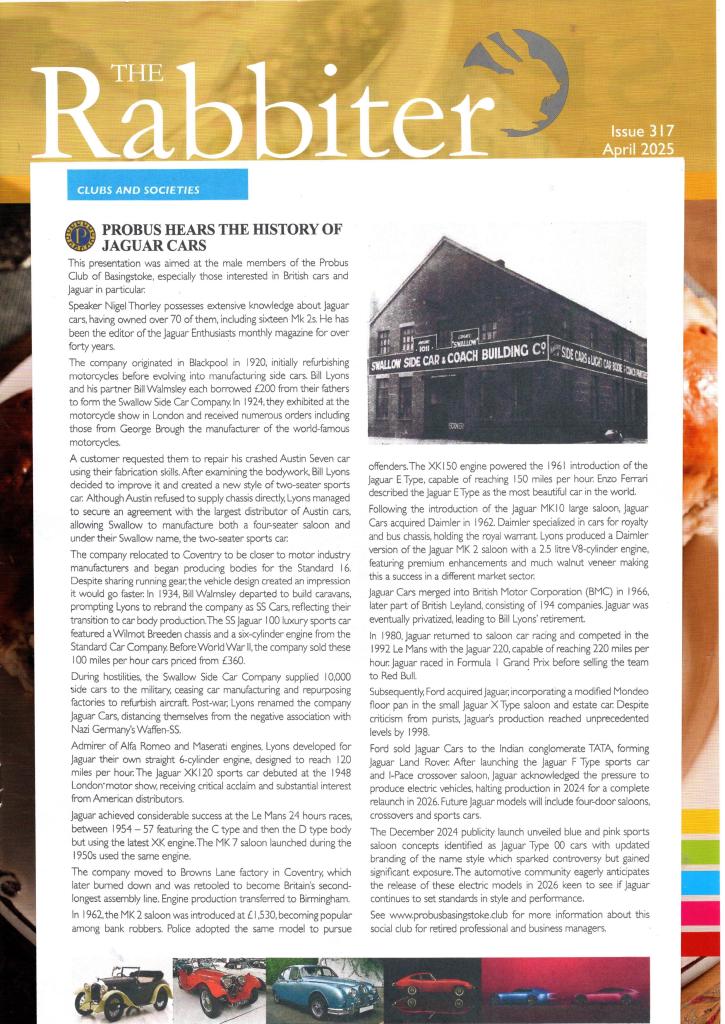
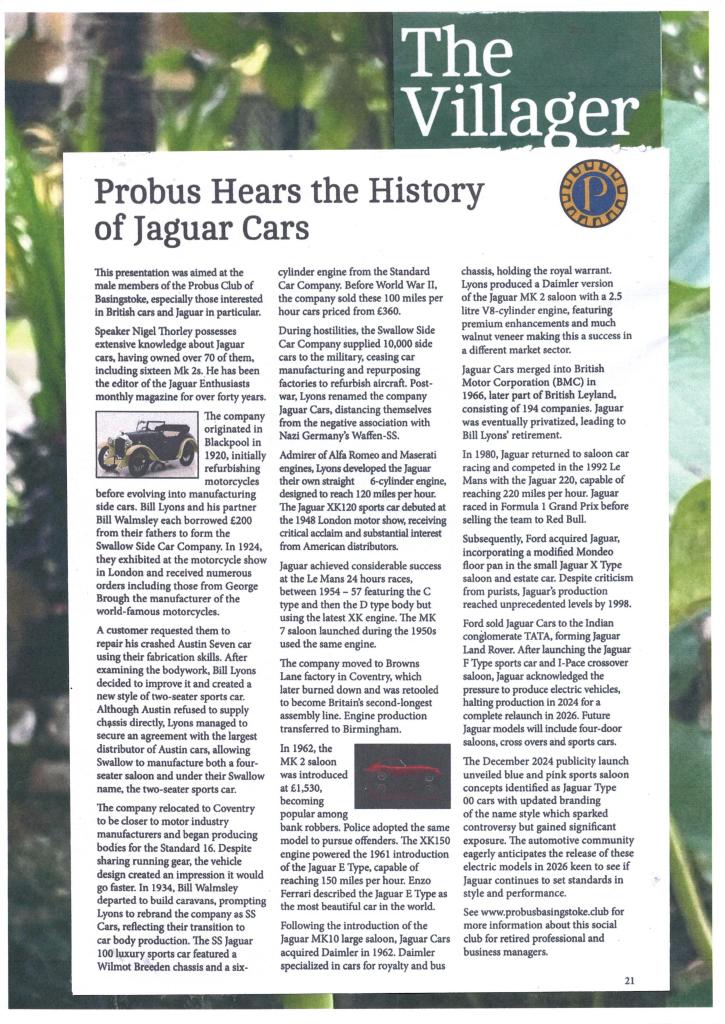
This presentation was aimed at the members of the Probus Club of Basingstoke, especially those interested in British cars and Jaguar in particular.
Speaker Nigel Thorley possesses extensive knowledge about Jaguar cars, having owned over 70 of them, including sixteen Mk 2s. He has been the editor of the Jaguar Enthusiasts monthly magazine for over forty years.
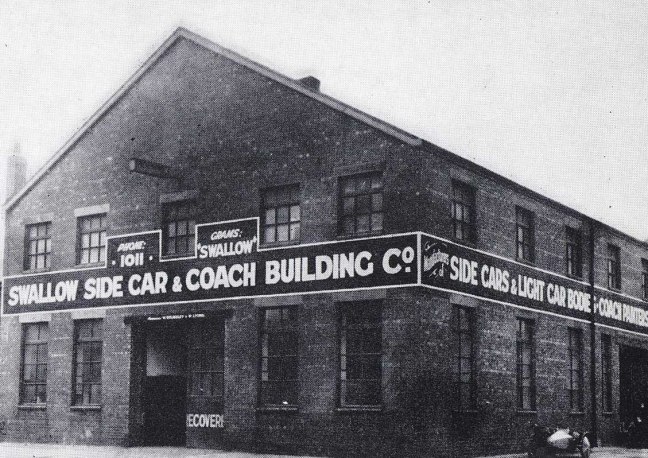
The company originated in Blackpool in 1920, initially refurbishing motorcycles before evolving into manufacturing side cars. Bill Lyons and his partner Bill Walmsley each borrowed £200 from their fathers to form the Swallow Side Car Company.
Original Blackpool Factory
In 1924, they exhibited at the motorcycle show in London and received numerous orders including those from George Brough the manufacturer of the world-famous motorcycles.
A customer requested them to repair his crashed Austin Seven car using their fabrication skills. After examining the bodywork, Bill Lyons decided to improve it and created a new style of two-seater sports car. Although Austin refused to supply chassis directly, Lyons managed to secure an agreement with the largest distributor of Austin cars, allowing Swallow to manufacture both a four-seater saloon and under their Swallow name, the two-seater sports car.
Swallow based on Austin Seven Engine & Chassis
The company relocated to Coventry to be closer to motor industry manufacturers and began producing bodies for the Standard 16. Despite sharing running gear, the vehicle design created an impression it would go faster. In 1934, Bill Walmsley departed to build caravans, prompting Lyons to rebrand the company as SS Cars, reflecting their transition to car body production. The SS Jaguar 100 luxury sports car featured a Wilmot Breeden chassis and a six-cylinder engine from the Standard Car Company. Before World War II, the company sold these 100 miles per hour cars priced from £360.
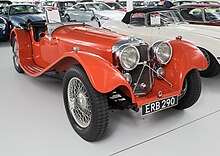
SS Jaguar 100
During hostilities, the Swallow Side Car Company supplied 10,000 side cars to the military, ceasing car manufacturing and repurposing factories to refurbish aircraft. Post-war, Lyons renamed the company Jaguar Cars, distancing themselves from the negative association with Nazi Germany’s Waffen-SS.
Admirer of Alfa Romeo and Maserati engines, Lyons developed their own straight 6-cylinder engine, designed to reach 120 miles per hour. The Jaguar XK120 sports car debuted at the 1948 London motor show, receiving critical acclaim and substantial interest from American distributors.
Jaguar XK120
Jaguar achieved considerable success at the Le Mans 24 hours races, between 1954 – 57 featuring the C type and then the D type body but using the latest XK engine. The MK 7 saloon launched during the 1950s used the same engine.
The company moved to the Browns Lane factory in Coventry, which later burned down and was retooled to become Britain’s second-longest assembly line. Engine production transferred to Birmingham.
In 1962, the MK 2 saloon was introduced at £1,530, becoming popular among bank robbers. Police adopted the same model to pursue offenders.
Jaguar Mk 2
The XK150 engine powered the 1961 introduction of the Jaguar E Type, capable of reaching 150 miles per hour. Enzo Ferrari described the Jaguar E Type as the most beautiful car in the world.
Jaguar E Type
Following the introduction of the Jaguar MK10 large saloon, Jaguar Cars acquired Daimler in 1962. Daimler specialized in cars for royalty and bus chassis, holding the royal warrant. Lyons produced a Daimler version of the Jaguar MK 2 saloon with a 2.5 litre V8-cylinder engine, featuring premium enhancements and much walnut veneer making this a success in a different market sector.
Jaguar Cars merged into British Motor Corporation (BMC) in 1966, later part of British Leyland, consisting of 194 companies. Jaguar was eventually privatized, leading to Bill Lyons’ retirement.
In 1980, Jaguar returned to saloon car racing and competed in the 1992 Le Mans with the Jaguar 220, capable of reaching 220 miles per hour. Jaguar raced in Formula 1 Grand Prix before selling the team to Red Bull.
Subsequently, Ford acquired Jaguar, incorporating a modified Mondeo floor pan in the small Jaguar X Type saloon and estate car. Despite criticism from purists, Jaguar’s production reached unprecedented levels by 1998.
Ford sold Jaguar Cars to the Indian conglomerate TATA, forming Jaguar Land Rover. After launching the Jaguar F Type sports car and I-Pace crossover saloon, Jaguar acknowledged the pressure to produce electric vehicles, halting production in 2024 for a complete relaunch in 2026. Future Jaguar models will include four-door saloons, cross overs and sports cars.
The December 2024 publicity launch unveiled blue and pink sports saloon concepts identified as Jaguar Type 00 cars with updated branding of the name style which sparked controversy but gained significant exposure.
Image of the prototype Jaguar Type00
The automotive community eagerly anticipates the release of these electric models in 2026 keen to see if Jaguar continues to set standards in style and performance.
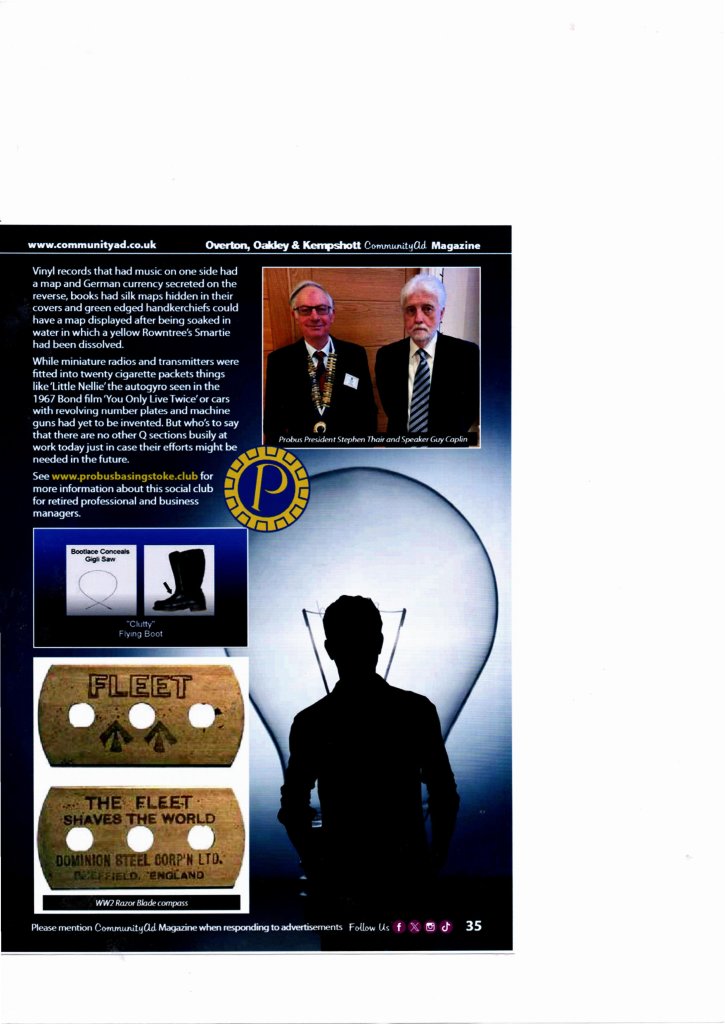
A good month for Probus publicity in the local magazines with “The Man Behind Q” receiving a full page in the Kempshott Kourier, Basinga, and double page spreads in the CommunityAd magazines for Overton, Oakley & Kempshott and the same publisher repeated our report in their publication for Bramley & Sherfield.
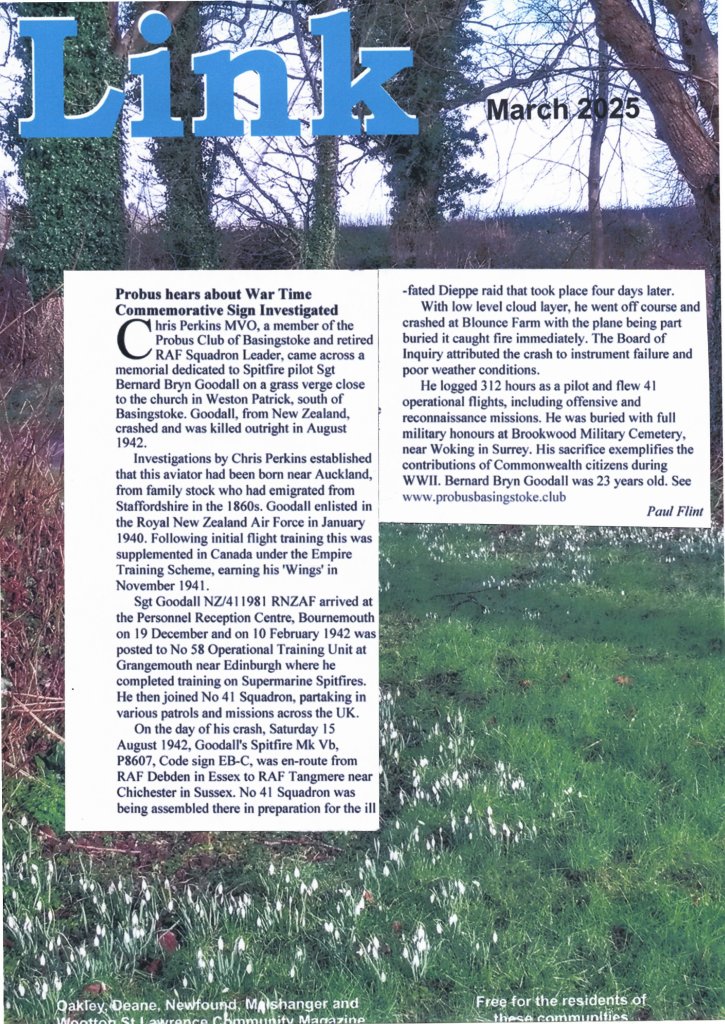
The Kiwi pilot report received a full page in the Rabbiter, a double page spread in the Villager and the shortened version in the Link. As usual the Loddon Valley Link ignored our report as did the Bramley magazine on this occasion
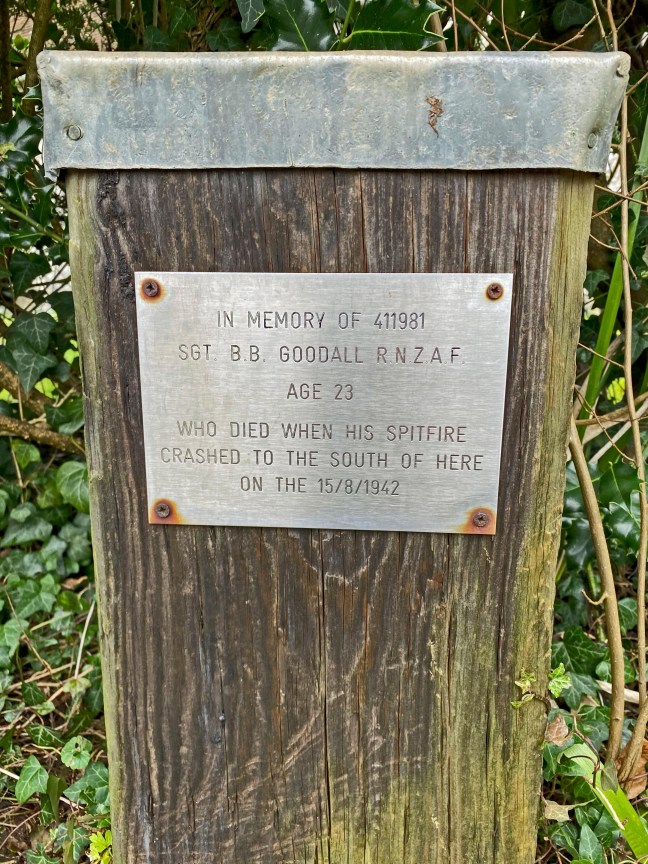
Commemorative sign near to the church in Weston Patrick south of Basingstoke
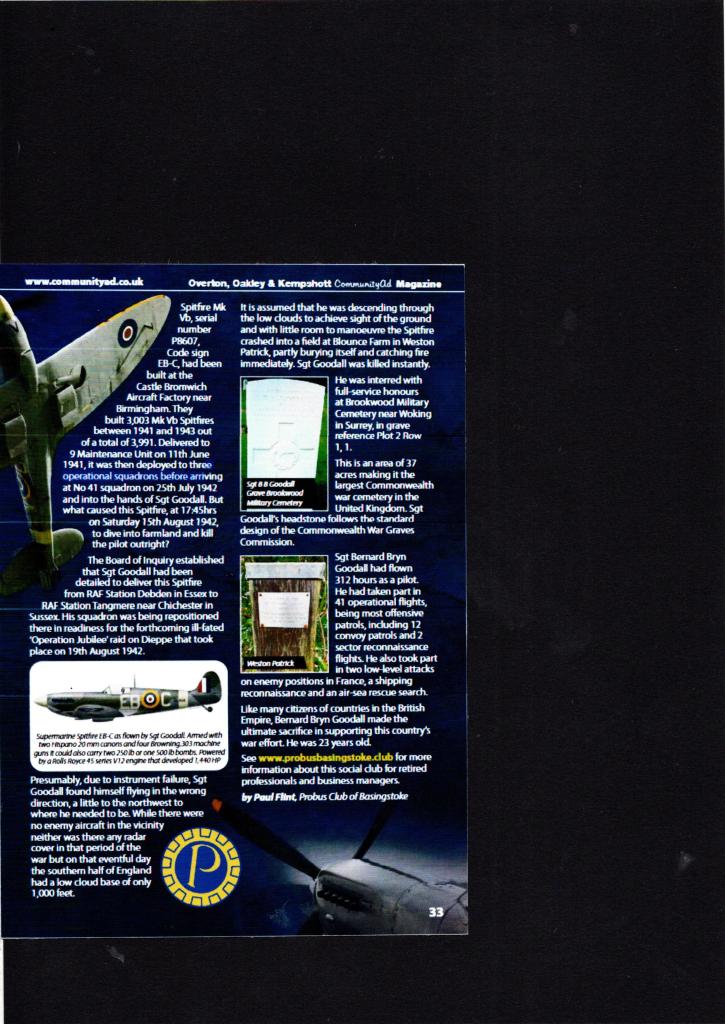
Kempshott resident and Probus Club of Basingstoke member Chris Perkins MVO was on a relaxing walk when he came across an unusual memorial to a crashed Spitfire pilot. The memorial was on a grass verge near to the church in the hamlet of Weston Patrick just south of Basingstoke.
What caused the plane to crash on 15th August 1942? Was it due to enemy action? Who was the aviator, a member of the Royal New Zealand Air Force? Was he another New Zealander who, like so many, had answered the call and had come to support the mother country in its hour of need?
Chris Perkins MVO retired from the RAF with the rank of Squadron Leader and always had a great interest in historical aspects of the RAF and had gained great experience in searching out information about matters that piqued his interest.
And, so it was, when he spotted this memorial.
RAF Lasham, these days the UK’s largest gliding society, created as a wartime airfield, was only a mile away so was this Spitfire heading there? Not so was what Chris discovered as his research took him through the history of this unfortunate accident,
Bernard Bryn Goodall, born near Auckland in New Zealand was descended from a family who had emigrated from Staffordshire in the 1860s. He had been educated at Putaruru High School where he had enjoyed rugby, cricket, tennis and swimming. At the time of applying for war service and joining the Royal New Zealand Air Force in January 1940 he was employed as a ‘Dryerman’ at the Whakatane Paper Mills that had only started manufacturing cardboard in 1939 and continues up to the present day.
Bernard Bryn Goodall in flight training
In March 1941 he enlisted for aircrew training at the Initial Training Wing and then to No 3 Elementary Flying Training School. July 1941 saw him embark for Canada for advanced training under the Empire Training Scheme. In November 1941 he was awarded his ‘Wings’ and promoted to sergeant at No 6 Service Flying Training School, Dunnville, Ontario. A week later he proceeded to No 1 “Y” Depot, Halifax Nova Scotia to await embarkation for the United Kingdom.
Sgt Goodall NZ/411981 RNZAF, arrived at No 3 Personnel Reception Centre, Bournemouth, on 19th December 1941. On 10th February 1942 he was posted to No 58 Operational Training Unit, Grangemouth near Edinburgh, where he completed his training on Supermarine Spitfire aircraft.
Bernard Bryn Goodall on receiving his ‘Wings’ and promoted to sergeant.
On 21st April 1942 he was posted to No 41 Squadron at Herston in Sussex then on to Martlesham Heath in Suffolk, Hawkinge in Kent, Debden in Essex and in August 1942 to Longtown in Cumberland where 41 Squadron carried out ‘offensive sweep patrols’ moving shortly to Llanbedr in Wales to carryout patrols over the Irish sea.
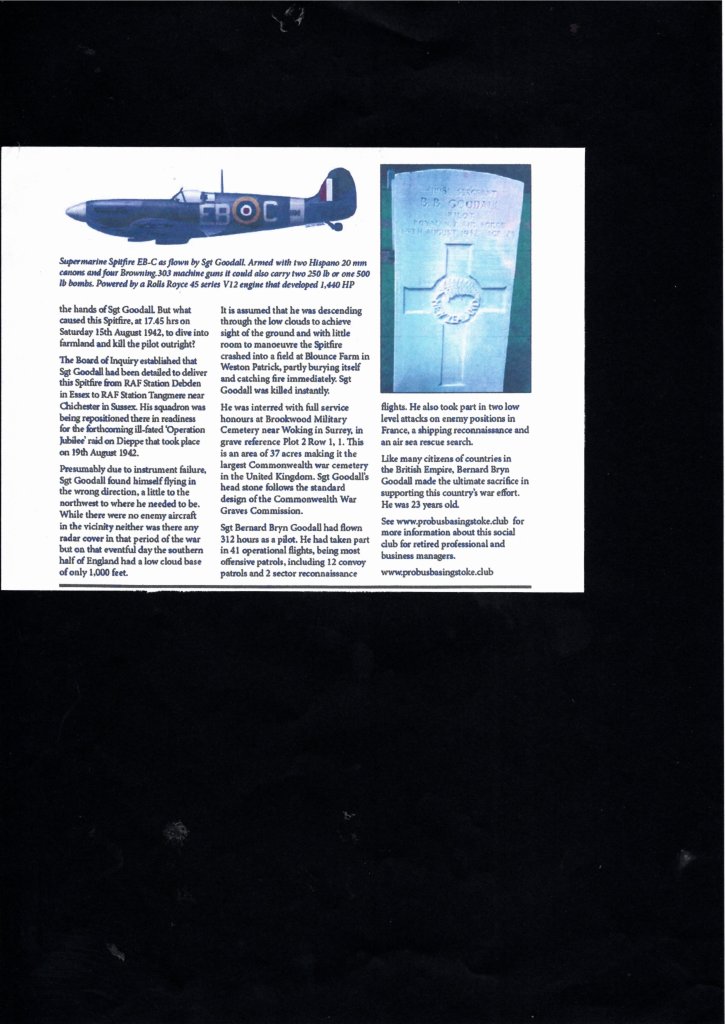
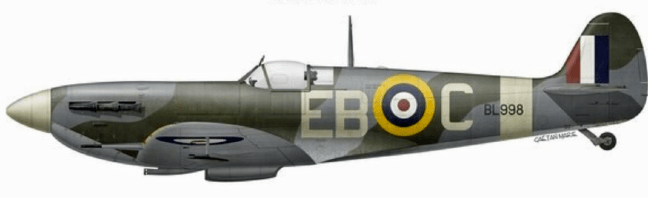
Spitfire Mk Vb, serial number P8607, Code sign EB-C, had been built at the Castle Bromwich Aircraft Factory near Birmingham. They built 3,003 Mk Vb Spitfires between 1941 and 1943 out of a total of 3,991. Delivered to 9 Maintenance Unit on 11th June 1941, it was then deployed to three operational squadrons before arriving at No 41 squadron on 25th July 1942 and into the hands of Sgt Goodall. But what caused this Spitfire, at 17.45 hrs on Saturday 15th August 1942, to dive into farmland and kill the pilot outright?
Supermarine Spitfire Mk Vb Code sign EB-C as flown by Sgt Goodall. Armed with two Hispano 20 mm canons and four Browning.303 machine guns it could also carry two 250 lb or one 500 lb bomb. Powered by a Rolls Royce 45 series V12 engine that developed 1,440 HP
The Board of Inquiry established that Sgt Goodall had been detailed to deliver this Spitfire from RAF Station Debden in Essex to RAF Station Tangmere near Chichester in Sussex. His squadron was being repositioned there in readiness for the forthcoming ill-fated ‘Operation Jubilee’ raid on Dieppe that took place on 19th August 1942.
Presumably due to instrument failure, Sgt Goodall found himself flying in the wrong direction, a little to the northwest to where he needed to be. While there were no enemy aircraft in the vicinity neither was there any radar cover in that period of the war but on that eventful day the southern half of England had a low cloud base of only 1,000 feet.
It is assumed that he was descending through the low clouds to achieve sight of the ground and with little room to manoeuvre the Spitfire crashed into a field at Blounce Farm in Weston Patrick, partly burying itself and catching fire immediately. Sgt Goodall was killed instantly.
He was interred with full service honours at Brookwood Military Cemetery near Woking in Surrey, in grave reference Plot 2 Row 1, 1. This is an area of 37 acres making it the largest Commonwealth war cemetery in the United Kingdom. Sgt Goodall’s head stone follows one of the standard designs of the Commonwealth War Graves Commission.
Sgt Bernard Bryn Goodall had flown 312 hours as a pilot. He had taken part in 41 operational flights, being most offensive patrols, including 12 convoy patrols and 2 sector reconnaissance flights. He also took part in two low level attacks on enemy positions in France, a shipping reconnaissance and an air sea rescue search.
Like many citizens of countries in the British Empire, Bernard Bryn Goodall made the ultimate sacrifice in supporting this country’s war effort. He was 23 years old.


































You must be logged in to post a comment.