Spring Ladies’ Lunch Tuesday 13 May 2014

Returning for a second year to Oakley Hall the occasion lived up to expectations with excellent food, good wine and great company of members, wives and friends in splendid surroundings.

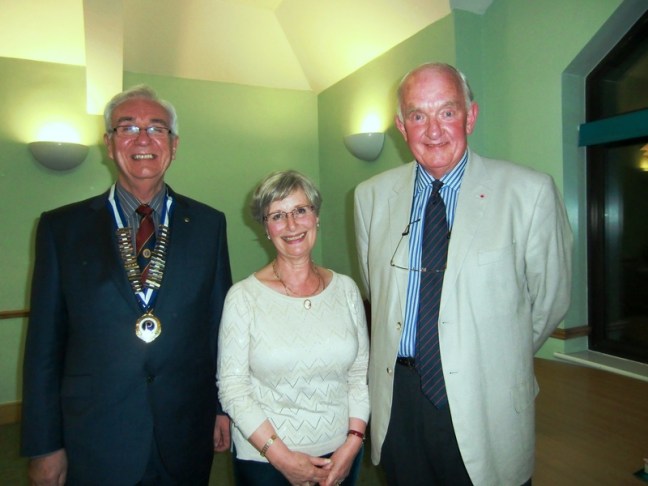
The guest of honour was the President of the Ladies’ Probus Club of Basingstoke, Jan Miller, accompanied by her husband Henry, who is one of our past presidents.

Thanks are due to Alan and Liliane May, who, with their expertise gained over the years in organising these evenst and our Christmas dinners ensured that things ran as smooth as silk. They were ably supported by Rob Hopkins who, after lunch, ran the raffle benefiting from the buying prowess of Richard Stettner who obtained a good deal on the prizes.

Thanks also go to Gerry Anslow, the photographer on the day and who is happy to provide any member with the file of any particular shot or can print out a high quality image suitable for framing.

Climbing for Charity

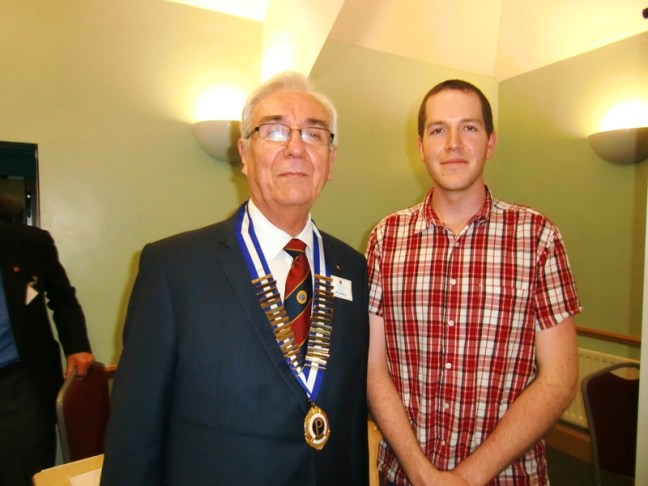
Paul Flint and Stephen Court

An inspirational illustrated talk by a mountaineer who is raising money for two local charities, St Michael’s Hospice and Marwell Widlife was given to the Probus Club by local man Stephen Court.

Although only twenty seven years old and a serving police officer based in Basingstoke he has been on a mission for several years with £40,000 as his target. He has so far raised over £7,000.

In January this year he went to the south of Argentina to tackle Mount Aconcagua, which at 6,961 metres or 22,837 feet is the world’s second highest mountain. Even in the height of the southern hemisphere’s summer the temperature on the mountain ranged from 30 degrees during the day to minus 10 degrees at night.

This expedition was the culmination of several years’ training by ascending Kilimanjaro in Tanzania, Toubkal in the Atlas Mountains of Morocco; from the peak it was possible to see the Sahara desert to the south and the Mediterranean Sea to the north, and Machu Picchu in Peru. Last October his attempt to ascend Mera Peak in Nepal had to be abandoned due to illness, so it was easy to understand that his efforts have a distinct element of danger.

Altitude sickness can be a common problem along with heart attacks and falls on high mountains and an average of three people die each year on Mount Aconcagua. Despite these dangers the mountain attracts considerable numbers of climbers during the summer season and the rangers, who strictly control matters, have organised permanent camps at different altitudes.

Approximately only 40% of the climbers reach the summit. The rest are thwarted by accidents, illness and weather problems. In fact just as he was about to attempt the final ascent the rangers closed the mountain due to approaching bad weather from the Pacific Ocean. Disappointed, Stephen started the descent when he badly damaged his knee. As a consequence he had to be airlifted off the mountain by helicopter operating close to their maximum height due to the thin air.

Final Lunch at Sandford Springs

Malcolm Collinson, the President of Deane Probus, was the guest of honour at the final lunch at Sandford Springs golf club on Tuesday 8th April after ten years of using this venue. Ironically, most of the reduced attendance of twenty four members agreed that the food on the day was probably the best we have had this year.

After the Ladies’ Spring Lunch at Oakley Hall in May, we shall be moving to Test Valley golf club which is half way between Overton and Micheldever. The first lunch being on Tuesday 3rd June (not 10th – second Tuesday as usual). Thereafter we shall go back to the second Tuesday of each month.

Probus Enjoys Wine Tasting

“Different Worlds” was the subject of a wine tasting evening enjoyed by a full house of members, their wives /partners, family and friends held at Christ Church in Chineham.

Helen Malcolm, the Customer Tastings Manager of Laithwaite’s Wines, was the guest presenter. Full of enthusiasm for her subject she has worked for Laithwaite’s for four years since graduating in Hospitality Management from Portsmouth University. Part of her course involved taking the intermediate certificate of the Wine & Educational Trust and her employer has since put her through the advanced course.

She set about educating her audience, who probably had ample experience of wine drinking over the years, that the same grape demonstrates different characteristics when made into wine in either the old or new world. The old world rules and regulations held dear in France are not followed in the new world of Australia and New Zealand. The new world uses large stainless steel vats instead of the expensive small wooden barrels which the French producers consider gives an additional flavour. Not to be outdone the new world wineries today are adding oak chips into the stainless steel vats to see if they can match their European counterparts.

It was the new world that set the precedence for having descriptive labels on the reverse of bottles to aid the purchaser when making their selection. Interestingly this is now being followed in some, but not all instances, in the old world where they have recognised the necessity to help customers make the right choice.

But, of course, it was the actual tasting of the wines during the evening which demonstrated the differences that the presenter had been keen to impart. A Sancerre 2012 from France was compared to a Sauvignon Blanc 2013 from New Zealand. Made from the same grape the French wine did not identify the name to the uninitiated whereas the New Zealand wine made no apology for saying clearly that it was made from the Sauvignon grape. The red Australian Shiraz 2011 (the grape is known as Syrah in France) was then compared to the top Chateauneuf-du-Pape which retails at over twice the price of the Shiraz.

The presenter had previously advised what range of nibbles should accompany each wine to enhance the flavours, which had been made by wives and family of members. It all contributed to a very enjoyable experience.


Last Lunch for David Carwardine

The lunch on Tuesday 11 March 2014 was the final such event for David Carwardine who later this month is moving with Betty to a retirement complex in Wiltshire to be nearer his family. Like all matters concerning property, everything always takes longer than anticipated and David told his audience that he actually placed his deposit for his new apartment in November 2012. He had a buyer for his house shortly thereafter who moved into rented accommodation to await David and Betty’s departure. What it is to have such a desirable property to sell!

David spoke warmly of his 23 years as a member of the Probus Club of Basingstoke, reminiscing about some of the social occasions he and Betty enjoyed. One such was to Bruges where his seventieth birthday was celebrated in a local eatery with the other Probus members on this trip. His joint venture of an investment club along with John Dunn, who is now resident in USA , Mike Jarvis and others actually made some profits but what happened to them was not disclosed.

What David was very sure about was that it was the variety of members’ backgrounds and experiences that made Probus such a pleasant organisation to belong to and he thanked everyone for their friendship over the years.

Mike Jarvis gave a response which incorporated the following aspects of David’s time in Probus.

David was VP when I joined in 1995

During his presidential year he started the practice of quarterly committee meetings prior to the monthly lunches which still endures.

He celebrated his 70th birthday on the outing to Bruges. The meal was memorable, but not the best we’ve had. We still enjoyed the occasion.

With John Dunn and six others we started The Peripatetic Investment Club in 2001. Our monthly meetings were fun and we even made a small profit.

He is moving to Wiltshire, into a retirement village. I well remember that he was responsible for the investment club buying shares in one of the developers of such villages. We made money.

David has been a loyal supporter of Probus throughout his membership. He has never been afraid to let committee members know if something can be improved. His gentle suggestions were always worth listening to. Many in this room will have had their ears bent.

In my experience David is unique. He is already an honorary life member, yet he still has been coming to meetings. Fortunately the committee was sharp enough to get his fee before changing his status.

I am certain you will all join me in wishing David and Betty every happiness in their new home and to say that if he ever wants to visit and attend a meeting he will be most welcome.

Revolution in the Postal Service

58 Million Penny Black Stamps Printed

This was one of the fascinating facts Probus Club members heard from their guest speaker Andrew Goddard, the Commercial Director of TNT Post, who lives in Hatch Warren, when he gave an overview of the history of the postal service in UK. Started as the Royal Mail by King Charles 1 the recipient of the letter had to pay for its delivery and this was changed by Roland Hill in 1840 by the introduction of the prepaid adhesive stamp, the famous Penny Black. In London there were up to four deliveries a day to households and businesses and it was possible within close proximity to have exchanges of several letters on the same day.

The importance of mail reaching its addressee was recognised as a moral boosting element within the British Army and in 1868 the Post Office Rifles was formed to handle the mail to the troops wherever they were in the world. The BFPO today is a much reduced operation as machinery has had such an impact on mail handling that the service has a staff of only 30 service personnel being based at RAF Northolt.

Because of traffic problems in London and the need to get mail to the various sorting offices it was decided to build the Post Office underground railway which was opened in 1927. It ran for over six miles from Whitechapel to Paddington with seven stations between. Closed in 2003, there is very recent news that this long disused line will be reopened to the tourist market.

Since the advent of the telegraph the General Post Office had seen their telephone business expand exponentially and in 1981 was separated into Royal Mail and BT with the telecoms business eventually being privatised. The government retained control of the postal business and has only very recently sold this off with a public share offering being heavily oversubscribed. Those members of the public lucky enough to be allocated shares have seen their value almost double since its flotation.

When the postal market was opened up to full competition in 2006 there were several entries and these days TNT Post is the largest competitor to Royal Mail and yet is also their largest customer. This apparent paradox is due to the fact that the Royal Mail still carries out the final mile to the delivery address. However even this is undergoing change as TNT Post now has its own delivery personnel in two centres in England and wants to grow this aspect of their service offering their business customers proof of delivery of all mail.

Even after the impact of email has been counted today there are still over 13.8 billion letters posted each year in UK. A lot of these are what is known as transactional mail, those utility and credit card bills, direct mail and of course the Christmas card market where UK is the largest sender of these personal greetings.

Funeral of Robert John Hudson

The President Paul Flint represented the Probus Club at the funeral of Rob Hudson held at West Berkshire Crematorium on Monday 10 February 2014. Born in Norfolk on 27 February 1930 Rob died in Basingstoke on 25 January 2014. The service had a Masonic influence with the Holybourne Lodge from Alton strongly in attendance.

Head Teacher Reports to Probus

Roger Busk, a retired junior school head teacher, who these days is chair of governors at a different school, was the speaker at the Probus Club of Basingstoke. His wide experience of teaching in different schools allowed him to cite examples of how things have changed in the educational system.

His career spanned seven prime ministers and fifteen ministers of education with each one having their own views of the educational system of their day. Schools were left to manage their own policies of what and how to teach children. Some were good and others not so good. Much depended on the leadership of each head teacher and whether they were able to inspire their staff.

Some children who had made good progress in a primary school failed to maintain this when they moved to a junior school. Roger is clear that this is due to poor leadership at the new school. His view is that parents should visit the potential new school to see for themselves how things are run and what the atmosphere is like in the classroom. If it fails to impress then parents should look elsewhere if possible.

The introduction of the national curriculum complemented by teacher training has had a significant positive effect on schooling. Inset training, brought in by Kenneth Baker with his Baker days, started to improve how things went on in the classroom and these ensured continued development.

Ofsted inspections are gradually raising the bar so what was considered a satisfactory inspection of a school previously now may require attention to certain aspects. This is not necessarily a case of falling standards but a requirement to keep advancing.

To conclude his talk Roger gave a mental arithmetic test to his audience. This was a standard examination of junior school pupils and to the great relief of the retired professional and business men they got most of the answers right.

Probus Club Christmas Dinner 2013

The annual Christmas Dinner was held on Tuesday 12 December at Sandford Springs Golf Club. Attended by a total of forty six people the evening started with mulled wine followed by choices from four starters, four mains and four desserts, completed with mince pies and coffee.

Entertainment consisted of an impressive close up magician who went to every table amazing everyone with his skills. A Christmas raffle, organised by David and Bridget Tivey, had an extensive array of prizes with the proceeds going to the club’s funds. Then a music hall style entertainer had a wide variety of skits, monologues and songs.

Thanks go to Alan May, supported by his wife Liliane, who once again handled all the arrangements with the venue to ensure that each person had exactly the food and wine they had previously ordered.

Olympic Impressions at Probus Club

John Kynoch, himself a member of the Probus Club of Basingstoke, gave an outline of the history of the Olympic Games and how he became a member of the British team.

Living on a remote sheep farm in New Zealand there was a weekly visit from a neighbouring farmer with his son and the two young boys were taught to shoot by John’s Scottish father who had shot at Bisley, the home of British shooting.  Attending school John joined the shooting section and realised that he had a real skill and beat older boys. When he came to Scotland to work in the family woollen mill he maintained his rifle shooting interest. Eventually attending Bisley he rose to the top and represented Great Britain in several international shooting championships.

At the next Olympic Games in 1972, being held in Munich, a sporting rifle competition was being introduced. At a distance of 50 metres a running boar silhouette would cross a gap of 10 metres in 5 seconds, then 2.5 seconds.  From a standing position the shooter would have 5 shots in each section. Possibly he might be selected for the British team if the qualifying grade was reached; something that had not been achieved in this country previously.

He built a mini gallery in his garage and for the next two years he reckons he put in 2000 hours of training.  He likened this to how a golfer practices his swing without hitting the ball and that only 5% of his training involved firing a shot. At the Olympic trials he produced his best ever score and was selected for the GB team. The feeling was that he might get into the top ten but things turned out differently.

He actually won the bronze medal with a score that a year earlier had been a world record. This was the first medal for rifle shooting won by a Briton since 1924 and was rightly celebrated. However this was the games that became known as Black September as members of the Israeli team were assassinated by Arab terrorists and even after all these years John still finds himself emotionally affected.