Saturday 10 October 2015 saw a visit of seventeen consisting of ten members, wives and friends visit the Andwell Brewing Company which is based in Andwell Lane in Andwell near Hook.
It was eight years ago to the day that this micro brewery made its first pint of real ale and since that time has established a reputation for consistently producing beers of the highest quality. It brews five varieties of ale and has won awards in each of the last six years.
The tour was led by Adam Komrower, whose brainchild the brewery was when he achieved his ambition of wanting to be in a manufacturing business. Taking the group through the selection of the ingredients of malted barley, yeast, hops and water the tour lasted one and half hours. We saw all the Bavarian Brewery Technology equipment that produces his range of beers in this 20 barrel brew plant.
The shop sells all the varieties of beers produced on site including versions bottled in an adjacent business. And all on the visit received an Andwell pint glass and several tasters which surprised many of the ladies who had not really previously tried beers.
Probus Club visits Andwell MIcro Brewery near Hook in Basingstoke
Bramley resident, church warden and member of the parochial church council, Geoff Twine, gave an illustrated talk to the Probus Club of Basingstoke, of which he has been a member for many years, about two years of his life spent in charge of the world’s biggest bomb disposal task. Flight Sergeant Twine, an armourer by trade, had been based at the Bicester RAF Explosives Ordnance Disposals unit when he was given the responsibility for the Llanberis slate quarry project.
Pre-war had seen these disused slate quarries in North Wales, as the main RAF Bomb Storage Unit. They had been converted into huge underground bomb stores and during the war there was considerable activity in despatching all types of ordnance to the airfields throughout the country. Post war the area had been used as a disposal area where Bomber Command despatched thousands of tons of obsolescent and deteriorating stocks of explosives to be made safe or destroyed. It was decided to maintain the area as a storage depot for the bombs probably on the basis that there was nowhere else more suitable. When the RAF moved out in 1956 they attempted to destroy the explosives. Fires burned for days and explosions rocked the area.
The area is a nightmare of crags and quarries linked by tunnels and high mounds of dumped slate fragments. There were quarries 900 feet deep and others with lakes 60 feet deep containing 20 million gallons of water. It was one vast booby trap to the unwary. 10 foot barbed wire fences eventually erected around the site failed to prevent trespassers resulting in some injuries. In view of the upcoming investiture of Prince Charles as the Prince of Wales at nearby Caernarvon castle and the deteriorating situation in Northern Ireland it was decided, a quarter of a century after the end of the war that something needed to be done.
Because of the nature of the site men had to be trained in mountaineering and abseiling as this was the main method of gaining access to the now seriously decaying devices down the sides of the quarries. As they crawled along narrow ledges, some of them hundreds of feet above the bottom of the pits, they used all their skills and iron nerves they possessed to turn any bombs or explosives they found into harmless objects. The passage of time and rock falls meant that bombs were found on ledges or crevices and many now lay exposed on the quarry floors. Divers searched the lakes and discovered considerable numbers of ordnance that although being underwater still had the capability to explode. The lakes were drained before work could be started and the pumps kept going as there was a natural inflow from streams of 170,000 gallons a day.
In a Daily Mirror article published on 5th September 1973 Geoff Twine is quoted “We know what we’re handling and what it is likely to do. On a job like this we’re writing the book as we go…there’s no precedent.” And testament to the high professionalism of Geoff and his small team there was not one fatality during the years it took to make the quarries safe at what had been described as the biggest time bomb in the world.
The Queen’s College Arms on the Aldermaston Road at Pamber End was the venue for this year’s Summer Pub Lunch on Tuesday 11th August. A total of thirty one consisting of members/wives/friends enjoyed a convivial lunch at this annual event which has been on the Probus calendar for many years.
The venue is the choice of the Vice President, made several months before the occasion, and therefore he is already installed as the President at the time of the lunch.
The Chairman of the South of England Group of the Friends of the National Railway Museum, Dr Ian Harrison, gave an illustrated talk to this club for retired professional and business managers at the first speaker meeting of their 37th Probus season.
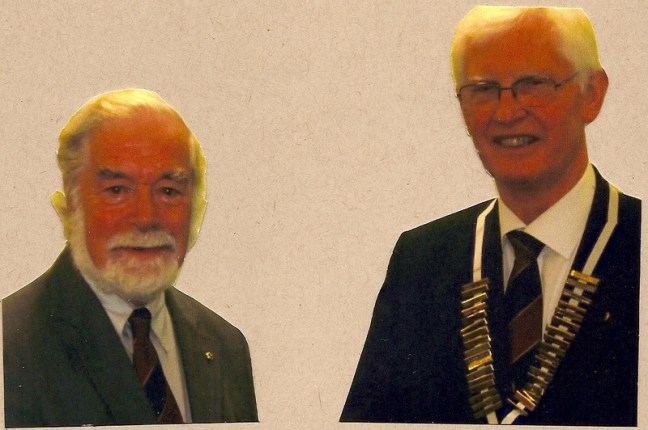
Ian Harrison and Alan Porter
“I didn’t work on the railways but always had a close affinity as my father was a signalman on the Carlisle to Settle railway”, Dr Harrison explained. “He moved to Leeds, where he continued as a signalman, as he recognised that his three children would have greater job opportunities in an industrial centre.”
Dr Harrison talked about the creation of the NRM in 1975 and the problems of running a museum where many of the exhibits are very large! The museum has gathered over a million objects from 300 years of railway history and now has 280 rail vehicles including all manner of locomotives and rolling stock. About a hundred are at York with the rest being shared between the Locomotion Museum at Shildon in County Durham and at many Heritage Railways around the country. In addition it houses an immense collection of railway ephemera including uniforms, trackside equipment, signs, engine nameplates and railway art. Dr Harrison brought several books produced by the Friends of the NRM on railway matters which were available to purchase as part of their fund raising activities.
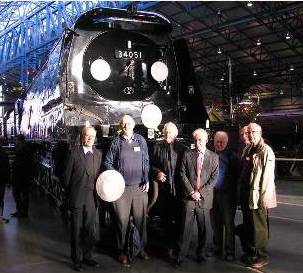
Winston Churchill & The FNRM South of England Group team
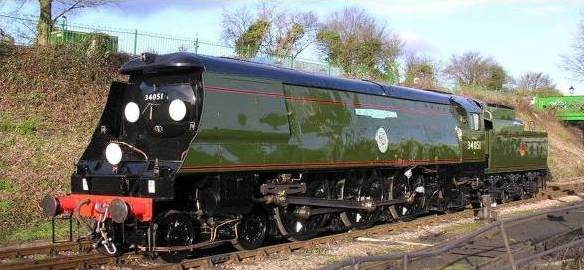
Our local heritage line, the Mid Hants Railway, perhaps more commonly known as the Watercress Line, that runs between Alton and Alresford, has a major repair centre at Ropley (and operates two NRM locomotives – Lord Nelson and Cheltenham). The Mid Hants has played an important role in many restorations over the years. The latest undertaking was the complete cosmetic restoration of the NRM’s locomotive Winston Churchill. This was one of 44 Battle of Britain class locomotives, named after Battle of Britain heroes, RAF stations and squadrons produced by the Southern Railway in 1946. It famously hauled the funeral train of Sir Winston Churchill on 30th January 1965 from Waterloo to Long Hanborough in Oxfordshire. It was taken into the National Collection in September 1965 on withdrawal from service and stored in various locations, suffering the ravages of time before the Friends decided that something needed to be done!
On behalf of the FNRM, Ian’s South of England Group has so far raised £39,000 of the £44,000 target; this allowed the restoration to be completed at Ropley in time for the 50th anniversary of Churchill’s funeral in January this year. The loco was taken back to York where it formed the centre-piece of the National Railway Museum’s exhibition marking this event – the last time a coffin was carried by train.
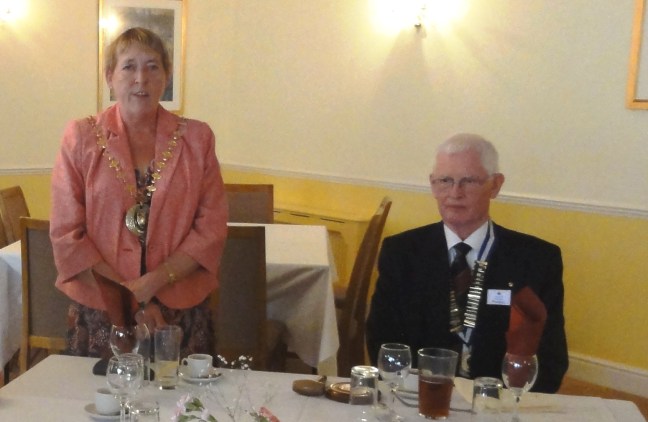
The Worshipful the Mayor of Basingstoke & Deane Cllr Mrs Anne Court
The Worshipful the Mayor of Basingstoke & Deane Cllr Mrs Anne Court was guest of honour at the first lunch of the new Probus Club season. Alan Porter, the newly elected President of the Probus Club of Basingstoke welcomed the senior citizen of the borough to the Test Valley Golf Club on Tuesday 14 July. This was his first official function since being appointed President at their AGM at the end of June in his role as head of this club for retired professional and business managers – hence the name Probus.
There were several club members who were known to the Mayor, one had even worked with her late father when serving in the RAF.
Cllr Court spoke about the three charities she had selected for her mayoral year. Inspero which works with young people to promote healthy eating and living through food growing, baking and cooking programmes, Basingstoke Multicultural Forum selected because of her young life living in many parts of the world which exposed her to a wide array of cultures and the Ark Cancer Charity that is seeking to raise £5million towards a much needed cancer treatment centre to be built locally that will be a beacon facility to deliver cancer care and support that people in Basingstoke & Deane need and deserve.
Alan Porter presented the Mayor with a cheque in support of her charity appeal.
The Probus Club of Basingstoke has been in existence since 1979, the organisation having been formed in Surrey in 1965 by retired members of the Rotary Club. These days most towns have a Probus Club whose diverse membership, many having worked elsewhere but now live locally, bring a wide range of experiences to bear in what is a social organisation for like minded men. Their ladies also join in several times during the year with several lunches, a Christmas dinner and various outside trips. The Club’s web site http://www.probusbasingstoke.wordpress.com provides more information about their activities together with contact details for any men interested in joining.
Thursday 25th June was the 36th Annual General Meeting of the Probus Club of Basingstoke which took place at Christ Church in Chineham.
Alan Porter was elected President with Fred Locke Vice President, returning to the Executive Committee after an absence of five years. The other members are Paul Flint (Hon. Secretary), Alan May (Hon. Treasurer), Chris Perkins (Programme Secretary) and Stephen Thair (Lunch Steward). David Tivey, as the immediate past President, remains on the committee as an ex-officio member. The position of Outings Organiser remains unfilled and the Club seeks any one or more to take on the role of wine steward/s.
Copies of the minutes have been circulated to all members.
Coming face to face with war painted warriors on a tropical island is not within most people’s experience. But this was just one of a series of adventures that Stephen Thair, a retired Old Basing solicitor, imparted to his fellow members of the Probus Club of Basingstoke at their last speaker meeting of their current year.
Stephen and his teacher wife, Margaret, lived and worked in Port Moresby, the capital of Papua New Guinea from 1975 – 78 while it loosened its traditional ties with Australia and achieved self governing independence in September 1975. Stephen worked in the Government Legal Department, part of the Department of Law, which became the Department of Justice on independence, specialising in conveyancing as plantations were bought back using Australian government funds to compensate the previous ex-pat owners. He also acted as a barrister in court on land title disputes brought by local people.
It was his descriptions, supported by photographs, of their trips away from the coastal capital that illustrated the topography and diverse culture of the generic peoples. Because of the difficult terrain, many isolated communities had their own language and over 600 were recognised. The way to reach the villages on the coast was mainly by boat, where houses were built on stilts in the lagoons; inland villages were reached by trekking into the hinterland where the extensive mountain range reached up to 14,793 feet (4,509 metres). Today aircraft and mountain airstrips make life a little easier but the traditional pathways do not zig zag across the mountain sides but go straight up and down, which can be very exhausting for those who are not used to it!
Even where 4×4 vehicles can make some progress there are rivers to ford and the usual style was to ask the passengers to wade into the river to check on its depth before attempting the crossing.
WW2 relics abound as the Japanese conquered part of Papua New Guinea but were strongly resisted by the Australian forces. Plane wrecks, tanks and artillery pieces could be seen although nature was gradually taking over and even live mortar shells could be seen lying on the ground.
The funeral service for John Cator was held at St Joseph’s Roman Catholic Church in St Michael’s Road, South Ham, Basingstoke on Wednesday 13 May 2015 officiated by Fr Benjamin Theobald. This was followed by a celebration of John’s life at Basingstoke Crematorium where his son in law gave the eulogy telling of John’s life initially in Thetford, Norfolk, National Service in the Suffolk Regiment only 12 miles away at Bury St Edmunds and his escape to Norwich working for Post Office Telephones. His career stayed with the Post Office advancing to be the manager of the London Foreign Section and latterly as Head of Operations City District (Square Mile). John took early retirement in 1992 and lived at Reigate in Surrey.
For 13 years John was a Commissioned Officer in the Royal Engineers of the Territorial Army rising to the rank of Major. He also worked for 4 years as a volunteer at his local Citizens Advice Bureau.
Having been a widower since 1984 John moved to Basingstoke in April 2012 to be near his eldest daughter, joining the Probus Club soon after. The club was represented at the funeral by President David Tivey and Hon. Secretary Paul Flint.
Tuesday 12 May 2015 saw the first Spring Ladies’ Lunch at the Test Valley Golf Club, the usual venue for our monthly lunch meetings; our previous venue for the last two years, Oakley Hall, having priced itself out of the market since a revamp. The weather was kind although the terrace ceased being used once the clouds came over but the club came up trumps with a good spread of menu options and room layout.
Alan and Liliane May, once again, were the organisers of the day. They produced all the name cards and menus with photographic quizzes about various scenes around the town in additional to the logistical difficulties in co-ordinating the arrangements with the golf club with our members’ lunch selections. Rob Hopkins had obtained fourteen raffle prizes, mainly of the alcoholic variety with the occasional box of chocolates, which were very well received by the lucky winners.
On Wednesday 6th May the funeral took place at Basingstoke Crematorium of Harold Melville Kent who was known to his friends as Mel.
In September 2013 he gave a presentation to us in the Probus Club of Basingstoke about his exploits in Sudan when as a young RAF officer appointed as Crash Inspector Middle East Air Force he was a passenger in a RAF plane that crash landed in a swamp. Under Mel’s command its subsequent repair and recovery back to Egypt was something akin to a Boys’ Own yarn.
Mel’s rise through the ranks of the RAF included three years in the British Embassy in Washington DC as a military attaché. He retired at 55 with the rank of Group Captain and then spent leisurely years in ocean sailing, skiing, golf, walking, model aircraft building and ballroom dancing which he kept up until last year.
Mel features in the Hobbies section of our web site talking about the radio controlled model aircraft he built and flew.
He never attended our lunches as he and his wife Betty always ate together but until this last Probus year he was a regular at the evening meetings and for several months brought with him his prepared presentation about his Sudan adventure, in case the appointed speaker failed to show up.
Mel had been far from well since before Christmas and was still in hospital when Betty died in February this year which meant he could not attend her funeral.
The Probus Club of Basingstoke was represented at Mel’s funeral by President David Tivey, Vice President Alan Porter, Hon. Secretary Paul Flint and Past President Ron Baxter MBE.




 Probus Club of Basingstoke
You must be logged in to post a comment.