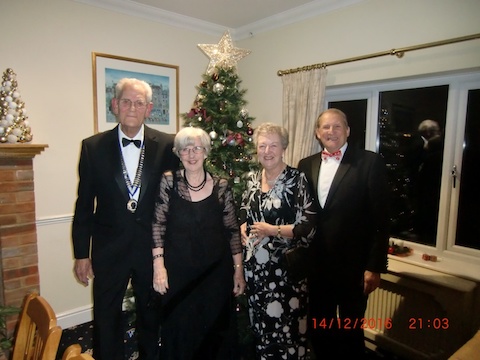
Once again, it was time for the Probus Club Christmas Dinner which took place at the Test Valley Golf Club on Wednesday 14 December. Organised with their usual high skill and aplomb by Alan and Liliane May and hosted by President Fred Locke and his wife Sue, the event was well supported as can be seen from the following photographs. It was heartening to see some widows and equally welcome was seeing our newer members. And for those members who failed to guess the correct answers to the mystery photo quiz on the inside of the menu card, the answers are as follows:
A) Sellotape dispenser
B) Ring pull can
C) Metal tape measure
D) Plastic Zip
E) Microsoft Windows emblem
F) Xmas tree light bulb
G) USB stick
H) Top of Pozidrive screw.
President Fred and Sue Locke with organisers Liliane and Alan May
On the 24th of November, fourteen of us ventured to Cowley to see how MINIs are made. The plant was originally set up by William Morris in 1913 with one of the earliest models being the Morris Oxford, more commonly known as the Bullnose Morris. After WW2 a popular model was the Morris Minor and the original Mini was launched in May 1959 in both Morris Mini and Austin Seven versions.
In later years while under the ownership of the Rover Group the site manufactured the Honda Civic (being similar to one of the smaller Rover designs) and even Rolls Royces before being bought by BMW who invested some £150 million to develop the MINI plant.
We were given an overview of the plant and shown some old models and some specials including one covered in cow skin and some from “The Italian Job”, before being transported in a mini bus with safety glasses and personal audio system (to enable us to hear our guide over the din), to a huge shed where the pressed steel parts were assembled. They were pre coated and silver although referred to as white and the assembly involved about 900 bright orange twisting and nodding robots making 6000 spot welds per car. The large parts seemed to arrive from holes in the ceiling from an upper floor but the smaller pieces were loaded at various stages into hoppers by hand. The pressed metal components were produced by the plant in Swindon or elsewhere and transported here for assembly.
The latest offering from the extensive MINI product range
The Probus group then went in the mini bus again to the main production line where the painted and baked body shells arrived for the fitting of the rear axle, fascia, glass etc. by more robots but also people. Of interest was the fact that each car was made to a specific order so that the production line might have a blue 4 door followed by a yellow 6 door with a sun roof followed by a red 3 door. The engines are produced at Hams Hall in Birmingham and were pushed in from below. Only then was the pre-made front of the car connected. Cowley only has a supply of all major components for two hour’s production at any time so the logistics of “just in time” supply is critical. The seats, trim and eventually wheels were fitted and exactly 11 litres of fuel before each car was thoroughly tested. A car comes off the assembly line every 68 seconds and production continues 24 hours a day. They go straight to car transporters or trains to reduce storage for eventual delivery to over 110 countries
Retired RAF Wing Commander Bryan Jenkins commented, “I am really glad that I went, it was really amazing to see the technology in action. As a Chartered Engineer, I am amazed at how complicated each part of the car is, knowing that each part must be individually designed, manufactured (somewhere) and then assembled into the car to the customer’s specification. In parallel, the car assembly line must also be designed – all 1,000 robots plus a few people and that is even more amazing. So I will look at Minis in a different light now.”
Probus Club Vice President Nick Waring said “The future is here being able to produce cars so efficiently but with even more on the road it doesn’t bode well as this was a good trip spoiled by the horrendous journey home caused by too much traffic”!
Amusing anecdotes kept coming when Susan Howe gave a talk to the Probus Club of Basingstoke, the social club for retired professional and business managers, about what she called her canter through a funny life. This had nothing to do with anything equine but was about her wide experiences of life and with the ability to recall minute details that made the talk so interesting.
She had been working as a cook on a yacht in the Mediterranean in the 60s when she met Bridget Bardot’s ex-husband, Gunter Sachs, who was one of the original playboys. She went to work for him and his celebrity guests in his chalet in St Moritz. During her time there she met several well known people including the Formula 1 World Champion, Jackie Stewart, the film director, Roman Polanski, several members of the Bismarck family and the last king of Morocco. Susan admitted “I couldn’t really cook but the good thing about very rich people is that they dine out a lot.”
In the early 70s Susan worked for Sir John Betjeman, soon to become Poet Laureate. She stood in for his long-standing PA for a year and met his famous teddy bear, Archie and Jumbo the toy elephant. A well known eccentric, John Betjeman had many visitors including Mary Wilson, wife of Prime Minister Harold Wilson, who herself was a published poet. Barrie Humphries, of characters Dame Edna Everage and Sir Les Patterson fame, was a regular caller.
Various men of the cloth came seeking financial support for their particular church. If they were from what he considered to be the lower sects of religion, Methodists or Baptists, he would not let Archie sit in on their discussions in case it affected its thinking. On another occasion Susan recalled that the great poet had made a theatre booking with pre-performance supper for himself and Archie. That night he didn’t think that Archie was feeling up to sitting through a three act play after dining so Susan had to change the bookings.
When John Betjeman got married he arrived, on his wedding night, at his bedroom door wearing a long nightshirt and carrying Archie and Jumbo under each arm. When his new bride commented about what she saw he made it very clear to her that she was very much in fourth position in his life. When Susan left his employment he bade her farewell with “Gosh we’ve had fun – what a shame you couldn’t type!”
During this time she shared a flat in London with Jan who was the daughter of a vet in Thirsk called Donald Sinclair. He was the partner of the vet who used the pen name James Herriot to write “All Creatures Great and Small” that became a successful TV series. Apparently Jan knew he was so incensed by the character Siegfried Farndon, played by Robert Hardy, that he refused to watch the programme.
After completing the notoriously demanding two years course she passed the exam set by the London Tourist Board, qualifying as a Blue Badge Guide which enabled her to guide at all the major London sites. London Blue Badge guides can also guide in other parts of UK which meant she could be away for up to three weeks. She accompanied an amazing array of specialist groups ranging from Hymnologists studying hymn writers to Mills & Boon authors specialising in the Regency period, and from Debt Collectors to the American Bar Association and the 200 strong Yale Alumni choir. Immediately prior to her visit to Probus she had accompanied the Bishop of North Dakota around London.
Not content with acting as a guide in Britain she has taken painting tours to Zanzibar, riding tours in the Rockies, wildlife tours in Africa and tiger tours in the jungles of India.
Her wide interests match the experiences of the members of the Probus Club of Basingstoke.
Four hand built models of the Royal State coaches housed at Buckingham Palace and one of Prince Phillip’s “Eventing” carriages were demonstrated to the Probus Club of Basingstoke by expert model maker Peter Smith. He is a member of the Guild of Model Wheelwrights that although based in Britain has many overseas members, and has been presented with a Gold Award for his outstanding quality of craftsmanship. In twenty years of entering his models in competitions under the auspices of the Model Engineering Exhibition he has achieved nineteen medals and one highly commended certificate.
This slideshow requires JavaScript.
The models displayed are part of ten precision models he has made of the coaches held in the Royal Mews. They are unique in being the only set of scratch built 1/8 scale (1 ½ inches to one foot) models ever made of the State coaches and only came about after Peter was initially granted permission to take the measurements from the 1838 State Landau at Windsor Castle. When the model was completed he took it back to show the staff at Windsor Castle. They were so impressed at the quality of workmanship that he was summoned to show the model to the Crown Equerry who subsequently gave Peter permission to go to the Royal Mews.
HRH The Prince Phillip no longer uses his “Eventing” carriage in competitions but is today used for shooting parties in Windsor Great Park and at Royal Ascot. Peter took 15 months to make this model but it was the door opener to him being able to make what he describes as his Royal Collection.
The Scottish State coach was built in 1850 and is used by HM The Queen and the Duke of Edinburgh. The model took about sixteen months to make of which about a quarter of this time was used in its painting.
The Queen Alexandra State coach is used for the State Opening of Parliament. Whenever HM The Queen uses it then only Windsor Grey horses are used. The model has bevelled glass windows that fully open.
King Edward V11 had a landau built in 1902 as a town coach made to suit his bulky size but he died before it was completed. It has been used for the wedding of HRH The Prince Charles and Lady Diana Spencer and more recently for the marriage of HRH The Prince William and Miss Kate Middleton. The model took twenty months to complete and had five coats of paint and six of varnish. Each layer was rubbed down with the smoothest emery paper with each coat left to harden for at least a week.
The Irish State coach was built in 1838. A quotation had been issued for £850 and even though Buckingham Palace had not responded the carriage manufacturer in Dublin proceeded thinking that the quotation had been accepted. When the finished result was seen by the representatives of the Royal household they decided to pay the quoted price. Peter made 40 pages of detailed drawing and measurements before then taking six weeks to make the final detailed working drawing. The model took two years to make and has been valued at £50,000. The National Trust valuer described it not as a model but as a “Fine Work of Art”.
In fact the ten models in the Royal Collection have a value of £300,000 and have been seen by the Queen, Prince Phillip, and Princess Anne while on display at the Royal Windsor Horse Show. They have featured on TV and in numerous magazines and newspaper articles. However the stipulation from Buckingham Palace is that the models in the Royal Collection cannot be sold but must be bequeathed to the Royal Household when Peter passes away.
Peter lives in Bourne End in Buckinghamshire and is a carpenter by trade. He started making model horse drawn vehicles in 1977 and worked his way through sixteen of the Guild’s plans before developing his own measured models.
The Guild of Model Wheelwrights, whose patron is HRH The Prince Phillip, Duke of Edinburgh KG KT, is a group of enthusiasts who are devoted to the construction and promotion of precision scale models of all types of horse drawn vehicles. The range includes agricultural machinery, carts and wagons, light and heavy commercial vehicles, passenger and road vehicles, gypsy caravans and many little known but fascinating vehicles that are of great historical interest.
The funeral of Ron Goodacre took place on Thursday 15th September 2016 at St James’s church Bramley. The Probus Club of Basingstoke was represented by President Fred Locke, Alan Porter, Geoff Twine, Dennis Freeman, Jim Wragg, Richard Wood and Alex Marianos. The service was well attended including eight ex-work colleagues from Linde (Lansing Bagnell) where Ron had worked for 35 years.
After the service the family travelled to the Crematorium for a final farewell to Ron.
Ron joined the Probus Club of Basingstoke in 1995 and enjoyed being a wine steward for several years.
Edward Cecil Johnson 10 February 1931 – August 2016
The funeral of past member Edward Johnson took place at Trinity Methodist Church, Sarum Hill, Basingstoke on Friday 9th September 2016.
He resigned from the club in 2011 as his Alzheimer’s disease progressed which meant he had to go into a care home where he resided until his passing.
The funeral was well attended and President Fred Locke and Secretary Paul Flint represented our club. After the church service the immediate family went to the Crematorium for a final farewell to Edward. We learnt that as well as his extensive sporting interests that Edward had been one of the original Street Pastors that serve the town at night time. He leaves second wife Barbara, a son and daughter from his first marriage, grand children and great grand children.
The annual Probus Club of Basingstoke Summer Pub lunch took place at the Swan Inn, Sherborne St John on Tuesday 9th August. It was attended by thirty six people, consisting of members, wives/lady friends and friends who had an enjoyable lunch time with with quality food and wide menu choice.
The choice of venue was made by Fred Locke in the spring, while still Vice President – it was his selection of this hostelry that made it the success it was on the day.
While the photographs show the attendees it is slightly bemusing that several of the “couples” don’t appear in the same photograph as their other half – there are no prizes for identifying who belongs to whom! And sincere apologies are offered to Lesley Atchison who is missing off the photograph that contains Rob Hopkins and her photo bombing husband Tony Atchison. Even deeper apologies are offered to Nick Waring and his lady, Ann, who didn’t get photographed at all. They shared a table with Tony and Lesley Atchison and it must have been the standing presence of Rob Hopkins who threw a wobbly at the man behind the camera. A pity that these days he can’t blame the last frame on the film being used before he reached their table. He does suggest that on the next occasion any one should shout out if they do not get photographed.
Richard Tanner, a retired head teacher from North Waltham, gave the Probus Club of Basingstoke an informative insight into the ancient Incense Routes that were so important to the Middle East well before and after Christ. The nativity story of the baby Jesus receiving gifts from the three Kings of gold, frankincense and myrrh is well known. To hear that incense had a value, weight for weight, greater than gold puts some perspective to the importance of this commodity. How was incense produced and where did it come from? And the Queen of Sheba comes into the story too.
Richard’s interest in the topic came whilst he was teaching geography at the ‘Royal’ school in Amman, Jordan. This teaching post gave him the opportunity to travel throughout the region.
The term incense, that includes both frankincense and myrrh, refers to a substance that emits a fragrant aroma when burned. Resins are collected from certain tree barks during winter which were found only in the arid regions of Southern Arabia and to a lesser degree in Eastern Africa. As early as the 8th century BC, incense was popular across the ancient world for sanctifying religious ceremonies and masking the pungent odours of burned flesh – from cremations and human sacrifices – and sewage.
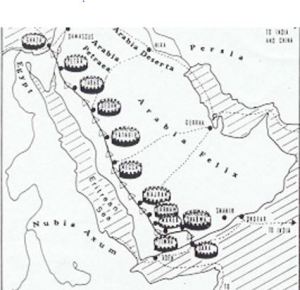
Richard described the route taken by incense traders, at first by sea along the coast of Dhofar to the port of Qana in Yemen. The prospect of continuing by boat up the Red Sea was dismissed due to difficult wind patterns and the threat of pirates. The inland route chosen, using camel trains, had extremely difficult terrain with robbers determined to get their hands on the valuable cargo. .For some 1500 miles it followed a route parallel with the Red Sea through Medina and on to Petra, thence to Gaza on the Mediterranean coast.
The inhabitants along the route were Nabataeans. They were experts in trading and desert agriculture with skill in water management with its collection and storage in reservoirs. They played a central role in controlling the incense trade route. They built 65 fortresses and resting stations in strategic points along the route to serve and protect the convoys set at a distance of a day’s walk, while the journey could take three months.
The ‘Incense Route’ reached its peak during the 2nd Century AD. At this time the Romans had succeeded in sailing directly down the Red Sea to Southern Arabia. From the 4th century AD when Christianity became the official religion, the practice of sacrifice and cremations was avoided and there was a return to ordinary burials leading to a significant reduction in the demand for incense. Finally, following the Moslem conquest of the area in the 2nd half of the 7th century, heralding a further decline in the demand for incense, the trade route died out and the resting stations along the route gradually fell into decay and were deserted.
And the Queen of Sheba? She came from the kingdom of Saba, in present day Yemen. Legend has it that she travelled up the Incense route to Jerusalem to seek the Wisdom of Solomon. And she brought the same gifts the Magi afterwards brought to the infant Jesus.
The Mayor of Basingstoke & Deane, Cllr Jane Frankum was guest of honour with her son, the Deputy Mayor, Cllr Paul Frankum at the first lunch of the new Probus Club season. Fred Locke, the newly-elected President of the Probus Club of Basingstoke – a club for retired professionals and businessmen – welcomed the Mayor to the lunch at the Test Valley Golf Club on Tuesday 12th July. This was his first official function since being appointed President at the Club’s recent AGM.
Cllr Jane Frankum told the Club how she was working as a hospital cleaner when she was first elected as a Popley councillor in 1998, and gave an outline of her work as a councillor, both on Basingstoke & Deane Borough Council, and also on Hampshire County Council.
She gave details of her charity – the Mayor’s Community Chest 2016-2017 – which is administered by Basingstoke Voluntary Action, with the aim of providing support to small groups working in the community. She also encourages people to donate their time in volunteering, as well as donating money. When she attended the lunch, she had been Mayor for about 9 weeks, and explained that she has already had success in encouraging youngsters to volunteer, a project to which she attaches great importance, particularly to facilitate communication between the young and old. Fred Locke thanked the Mayor and Cllr Paul Frankum for attending the lunch, and was pleased to present a cheque to the Mayor in support of her charity, on behalf of the Probus Club.
The Probus Club of Basingstoke had been in existence since 1979, the organisation having been formed in Surrey in 1965 by retired members of the Rotary Club. These days most towns have a Probus Club whose diverse membership brings a wide range of experiences to bear in what is a social organisation for like-minded men. The ladies also join in several times during the year at lunches, the Christmas dinner, and various outside trips.
The very recent 37th Annual General Meeting of the Probus Club of Basingstoke saw a change at the top of this social organisation for retired professional and business managers. Fred Locke of Bramley was appointed President for the ensuing year by the outing holder Alan Porter, also of Bramley.
“It is a coincidence” said Fred,” that we both live in the same village, but many of our members live in Bramley so it’s really no surprise that this has happened. However the new Vice President, Nick Waring, lives in Oakley so next year when he becomes the President will ensure there is a geographical shift to the west of Basingstoke.”
Except for Tony Atchison of Chineham, who returns as the Outings Organiser, the other members of the Executive Committee are unchanged which gives great continuity as the club moves into its 38th year of existence.
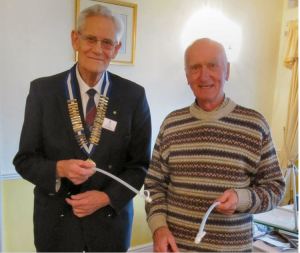
Fred Locke receives the President’s chain of office from immediate past President Alan PorterAlan Porter receives the Past President’s tie, lapel and name badge from Secretary Paul Flint
You must be logged in to post a comment.