Probus hears about Thornycroft in Basingstoke

CIMG0856
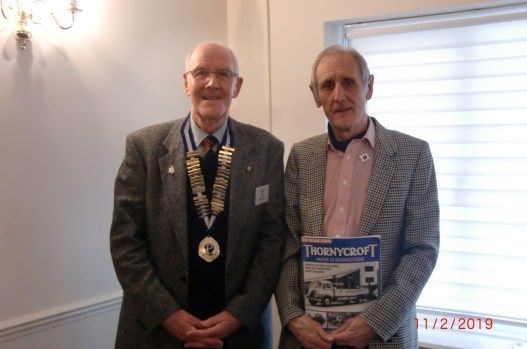
President Chris Perkins MVO with speaker Garry Bone

In the 19th century Thornycroft had been successful boat builders and marine engineers based on the river Thames at Chiswick. Steam power was the means of propulsion for paddle steamers and boats for the Admiralty, including torpedo boats. One such Thornycroft torpedo boat featured in the film The African Queen enacting historical fact where the German vessel that had been controlling Lake Tanganyika was eventually sunk. Other torpedo boats were successful in sinking part of the Russian Red fleet during the Bolshevik revolution. The company expanded with a yard in Southampton and eventually in Singapore and Australia.

It was the repeal of the red flag act in 1896 that had required someone to walk in front of a vehicle waving a red flag at a maximum speed of 6 mph that prompted Thornycroft to realise the potential for self propelled road vehicles. They were already making steam driven vans but clearly needed new premises to expand production. Thornycroft settled on Basingstoke because the town had good road and rail links.

The company moved to Basingstoke in 1898 where they established their works on a 16 acre site  on the Worting Road. Eventually Thornycroft became the town’s largest employer. Today Morrison’s supermarket occupies part of this acreage. The roundabout at the junction of Churchill Way West  and the Ringway carries the name of Thornycroft as a lasting reminder of the importance  this company made to the rising fortunes of Basingstoke.

Thornycroft Society Logo Capture

Garry Bone was a long serving employee of Thornycroft and is a founding member and director of the Thornycroft Society and gave an insight of the changing fortunes of Thornycroft in a presentation to the Probus Club of Basingstoke.

Thornycroft Steam Van
An early Thornycroft steam van produced at Chiswick

Steam powered lorries were supplied to the British Army from the Boer War onwards, with commercial vehicles supplied to many retail customers. London’s first steam powered bus was a Thornycroft double decker and overseas companies were regular customers, as were many UK bus companies. Petrol vehicles were introduced in the early 1900s which saw Thornycroft making a series of cars until 1913 when they decided to concentrate on lorry production.

Thornycroft car
One of a range of Thornycroft cars made in Basingstoke

The outbreak of WW1 saw an immediate requirement for lorries and Thornycroft was tasked to deliver as many as possible. They concentrated on their J Type lorry and many chassis were fitted with anti tank guns, mobile aircraft guns, ammunition carriers and as general transport vehicles. Over 5,000 were delivered during this conflict during which time 35% of the workforce were women.

Other war supplies made by Thornycroft in Basingstoke were marine engines, trench mortars, over 3,000 depth charge throwers for the Admiralty and thousands of shells.

Post war saw a reduction in the fortunes of Thornycroft as surplus military vehicles were available at a quarter of the price of new vehicles but by the mid 1920s the company was rising again with the introduction of the Lightening coach that was capable of carrying its full load of passengers at 50 mph. Other orders were placed by railway companies for lorries and buses and by this time about half of the output was exported.

By the 1930s the loss making Thornycroft was criticised by its bank for having too many models on offer and poor senior management that needed to grasp the realities of the market. As well as making buses and coaches they were making eleven types of lorries. In 1930 they had 1800 employees which reduced to 731 by 1936 by which time the firm returned to profitability.

WW2 saw a massive improvement of the order book. The firm worked 24 hours a day with 2,500 employees, over 800 being women. As well as munitions the company made over 8,000 Bren gun carriers some with floatation gear to cross canals and rivers under their own power, 13,000 wheeled vehicles including mobile cranes, others with generating sets, 670 two-pounder guns, 1,700 17–pounder guns and 15,000 sets of torpedo parts. In addition Thornycroft made nearly 2,000 Nippy and Sturdy lorries for essential civilian work. There were huge numbers of parts made for various military and marine engines.

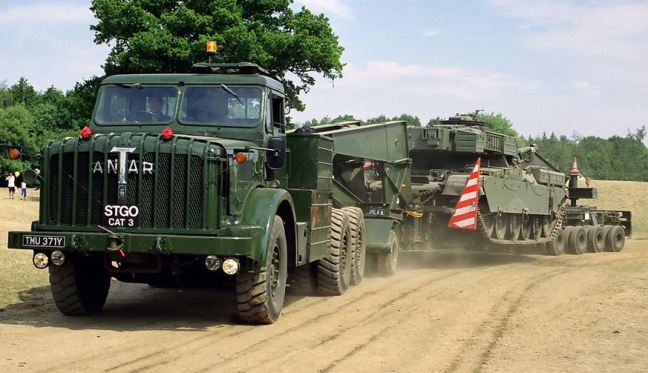
1948 saw the vehicle and engine manufacturing formed into the subsidiary company Transport Equipment (Thornycroft) Ltd.  TET announced in 1949 that the Iraq Petroleum Company had placed a large order for Mighty Antar lorries to carry pipe lines across the desert. This was followed over many years by the UK military using this vehicle in many guises as its main heavy transporter.
Mighty Antar Tank Transporter Capture
A Thornycroft  Mighty Antar as a tank transporter

TET was sold in 1961 to Associated Commercial Vehicles (ACV) announcing that the Basingstoke works would concentrate on the Mighty Antar, Big Ben and Nubian heavy duty vehicles while other parts of the group would be responsible for mass produced vehicles. June 1962 saw ACV becoming part of the Leyland Group, whose subsidiary, Scammell, also produced specialised lorries which led to reducing orders for Basingstoke.

In 1972 British Leyland sold the Basingstoke works to the Eaton Corporation of Ohio. The work force was reduced from 1,100 to 738 with the pledge to employ them in its transmission business. This did not last long as the last lorry was built in 1972 and the works sold on 14 January 1973 although Eaton carried on locally. So ended 74 years’ connection between Thornycroft and Basingstoke where thousands of commercial vehicles had been made with great numbers of a highly skilled labour force. With its highs and lows of commercial endeavour, war work, and successful heavy duty vehicle manufacturing it had brought the benefit of employment to thousands of Basingstoke folk who regard their time there fondly.

(Bob Clarke is acknowledged as providing many of the above statistics)


Probus hears about NATO

president chris perkins with paul miller
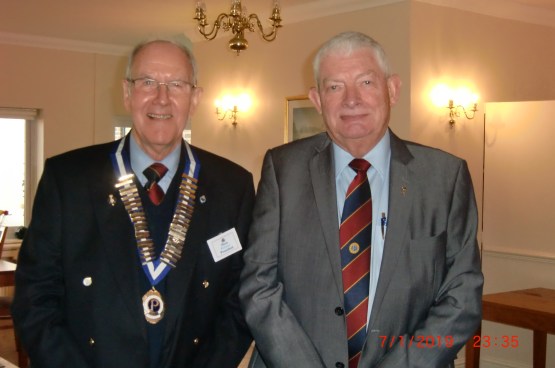
President Chris Perkins MVO with Paul Miller

Just about everyone has heard of NATO (the North Atlantic Treaty Organisation) but very few recall that it was founded in 1948 and enlarged in 1949 to a total of 12 countries bordering the North Atlantic. It was formed because of the perceived threat from Russia following their land blockade of West Berlin which caused the airlift to operate for eight months to ensure the western sector of the city could be supplied with everything necessary to sustain life.

The key criterion of NATO membership was that any armed attack on any member country in Europe and North America would constitute an attack on them all.

nato flag capture
NATO logo

All this and much more was explained by Probus member and Basingstoke borough councillor Paul Miller who outlined his personal involvement in this international defence structure over four decades which included the cold war and then the Bosnian and Kosovo difficulties and several other campaigns. As an officer in the RAF and then latterly as a civilian he rose within NATO eventually based at their headquarters in Belgium.

Member countries agree to assign assets in the form of military hardware and personnel to NATO and are managed in all operational roles by NATO staff. As such they have been involved in many conflict zones and incidents during this time many of which have not been reported in the free press.

With the fall of the Berlin wall in 1989 there was great excitement as other former communist countries threw off the yoke of the old USSR and embraced social change and democracy. However this brought up several concerns – would a unified Germany remain neutral and what would happen to the nuclear weapons held in the old communist countries?  It also brought up the question of whether there still existed a future need of NATO but other events only served to confirm that it was indeed still needed.

In fact today the membership has grown to 29 countries. Many newer members of NATO were originally eastern bloc countries that formed the basis of the Warsaw Pact organisation set up by Russia in response to West Germany joining NATO in 1955.

The Balkans crisis starting in 1989 which included the Bosnian and Kosovo campaigns were only as successful as they were due to the cooperation of the former communist countries of the Czech Republic, Poland and Hungary who allowed their airfields to be used by NATO forces. In return they hoped that it would create a favourable climate to their subsequent applications to join the EC.

nato aircraft capture
NATO fighters supporting an AWAC surveillance plane

It was complicated by the fact that the old Yugoslavia was a member of Eurocontrol which coordinated civilian air traffic which had increased considerably in recent years with tourist expansion on the Dalmation coast. The NATO air forces needed to have surveillance and operational access to this airspace and eventually ran an air campaign over 78 days involving 38,000 sorties which allowed in a multinational peacekeeping force which brought an end to ethnic cleansing.

Today NATO has become a Crisis Management organisation as its forces continue to lead the way in Kosovo, Afghanistan, in the Mediterranean and several other places including Iraq where it is carrying out training of national forces. It is also helping the African Union and in the Gulf of Aden guarding against Somali pirates.  NATO is carrying out work on the European migrant crisis and has 20,000 troops in action around Europe and elsewhere.

nato headquarters belgium capture
NATO headquarters in Belgium

The United Nations does not recognise NATO, only Nation States but fully appreciates the role played by this military cooperative of North American and European countries in striving to maintain peace in this troublesome world. It does however involve its organisation UNHCR, based in Geneva, to become incorporated with NATO actions in various humanitarian projects.


Probus Club Christmas Dinner 2018

Merry_Christmas_Red_Transparent_PNG_Clip_Art [267x195]

Yet again another calendar year comes to an end and it was celebrated with the annual Christmas dinner of the Probus Club of Basingstoke held at the Test Valley Golf Club on Wednesday 12 December 2018.

President Chris Perkins MVO with wife Carolyn welcomed each couple on arrival.  Chris also gave a speech after the meal thanking all those involved in the preparation of the night’s activities and made special mention of the work that Alan and Liliane May had put in. They were not present this evening as they were away on a cruise but they had prepared everything in advance with the creation of all the printed matter needed. Where do they find all the quiz questions?  And the individual place cards contained flags of nations all of which takes considerable research time and effort. Most importantly they liaised with the chef to ensure everyone received their particular meal selection – no mean feat.
David and Bridget Tivey once again organised the raffle which successfully netted £130 for the club funds.

Ladies resplendent in their finery and the men in black tie this is one of the two formal events of the year when the ladies are made welcome – the other being the Spring Ladies’ Lunch in May. There are, of course, many social occasions during the year that our wives/partners are encouraged to attend.

IMG_1543
President Chris Perkins MVO and wife Carolyn welcomed all the guests

candle_bow_holly [267x189]


Theatre Visit to the Mill at Sonning

IMG_1364

A party of 16 members and their spouses/partners enjoyed an excellent evening out at the Mill theatre at Sonning on 8th November. As it was dark, the views of the attractive old buildings were somewhat limited, but inside there is a very cosy bar, and an upstairs dining area, from which there is easy access into the rather intimate auditorium. The low ceilings and wooden beams give an indication of the age of the buildings which date from the 1700s and 1800s, but there is a mention of mills at Sonning in the Domesday Book so the site has a long history. The mill closed as a flour mill in 1969, and it was purchased and converted into a theatre by the Richards family who reopened it as a theatre in 1982.

The evening started with a drink at the bar and we then went for an excellent buffet-style meal before the performance. The highlight of the meal for some of us was the bread and butter pudding and custard.

A Night in Provence is a comedy written by Robin Hawdon about an English couple who have booked a luxury villa for a 2-week summer holiday, only to find that there has been a mix-up by the agents who had not told the owners about the booking. The trouble – or entertainment – starts when the owners arrive from Paris expecting to use the villa for their own holiday. Shortly after they arrive, the English couple’s Irish friends turn up as well. They all decide that they will have to share the villa, and the play is about the stresses and strains that this causes – a heady mixture of champagne, (misdirected) sexual attraction, and cultural differences.

The play is very well cast, and the actors all performed enthusiastically and with good comic timing. This is perhaps just as well, as the “stage” is effectively a pit, with the audience in a semi-circle looking down on them, rather like a classical Roman or Greek theatre. The play is in some ways something of a Gladiatorial combat, so may be the setting is appropriate!

Our thanks to Tony Atchison for organising a very enjoyable evening.


The Man Who Made Meccano (& Hornby Dublo trains and Dinky Toys)

CIMG0842
President Chris Perkins with speaker John Hollands

Everyone in the room put their hands up to the question – who had played with some of the brand names in this heading?

The man behind such world famous products, Frank Hornby, was the subject of a talk given by John Hollands to the Probus Club of Basingstoke. A teacher for over thirty years and then involved with museums, he is today one of the volunteers at the Willis Museum in the Market Place. He has been an active collector of Hornby trains for many years.

Frank Hornby was born in 1863 and was the 7th child of 8 children.  Liverpool was his lifelong home ending up as Conservative MP for Everton. He started as a cashier for a wholesale food business and had a small workshop at home that allowed him to progress some of his ideas. Having been impressed by a book about inventors and their many failures before successfully achieving their aim, Frank Hornby appreciated that perseverance was the key to eventual success.

He founded a branch of the Band of Hope around 1900. This was a temperance organisation with several million members throughout the country. He wanted boys to take up useful trades and started to develop a construction kit which he patented in 1901. By showing interest in construction he hoped it would encourage boys to find suitable engineering employment locally and in the ship building industry on the Mersey.

Initially called Mechanics Made Easy the name changed to Meccano in 1907 and by around this time it was exported to over 40 countries. Perhaps it was because of his early involvement with wholesalers that he also sold directly to retailers, and some were not obvious outlets for his toys. The manufacture of Meccano kits had initially been outsourced. They were of plain metal and not finished to the highest quality. Eventually the product was refined and then painted red and green then blue and yellow. Supplementary kits made it possible to expand a specific set to the next level.

Starting production himself and after moving into two larger work units it became clear that because of the success of Meccano that even larger premises were needed. The famous Binns Road factory in Liverpool was opened in 1914 employing up to 2000, mainly women. After WW1 Hornby introduced model trains to compete against resurgent German toy manufacturers. The locomotives were driven by clockwork motors and then by 1925 mains electricity. Export markets had decals on the trucks and passenger coaches pertinent to their own countries.

CIMG0841
Examples of Meccano, a Meccano Instruction book, clockwork Locomotives and some Dinky Toys brought by the speaker

So successful were overseas markets that manufacturing plants were set up in France and eventually after a nine years legal case to protect his patents in America, Frank Hornby opened a factory in New Jersey.  Over the years some assembly also took place in Hong Kong, South Africa and Chile to overcome restrictive import tariffs on completed products.

Meccano magazines became required reading. Published monthly and originally aimed at boy Meccano builders they featured articles on Meccano construction and new Meccano developments. Frank Hornby was the editor for many years. Over time Meccano Magazine became a general hobby magazine aimed at “boys of all ages”. Aside from Meccano related articles, they also featured Hornby trains, Dinky Toys and other products of Meccano Ltd, plus a wide variety of general interest articles, including, engineering, aircraft, trains, modelling, camping, photography and philately.

The factory started to make model figures and equipment to complement the train sets. Built to the same scale as the trains they were called Dinky Toys. Road vehicles were added to add authenticity to the railway layouts and thus began the third string of this toy manufacturer. No doubt every boy of a certain age, and many girls, enjoyed playing with Dinky Toys.

Increasing competition in the 1960s and 70s for die cast toys came from Mettoy’s Corgi in Northampton and from Match Box toys made by Lesney Products in East London. Over one million Match Box toys were made weekly which sold for the pocket money level of only 2 shillings each. Mattel developed their “Hot Wheels” which with thin axels made for easy and fast running. Dinky Toys partly responded by introducing their Dinky Supertoys range which included the Mighty Antar transporter made by Thornycroft in Basingstoke.

Meccano Ltd was taken over by Lines Bros in 1964 with Hornby Dublo trains sets combing with the Triang name and production was moved to Margate in Kent where it continues to this day.

The high cost of manufacturing in Britain took its toll and the Binns Road address closed in November 1979. Within a few years their competitors suffered the same fate.

Today Dinky Toys, especially with original boxes, command extraordinary prices at auction.


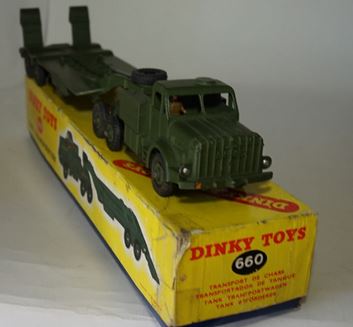
Dinky Mighty Antar
Thornycroft of Basingstoke Dinky Supertoy Mighty Antar with original “yellow” box prior to the adoption of the thin blue striped box. Asking price today – £100
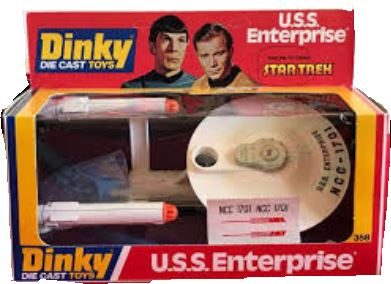
Dinky USS Enterprise Capture
Star Trek’s USS Enterprise in the later windowed display carton produced by the writer’s company in the late 1970s

Rescue Drama of Illegal Immigrants on High Seas

IMG_1150
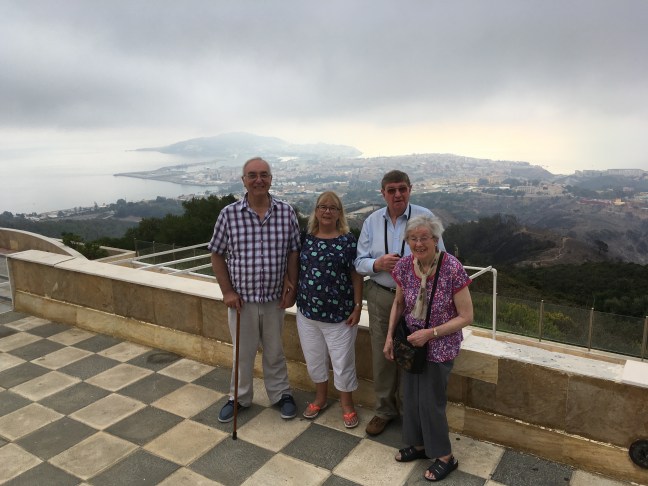
Paul Flint & partner Janet Fagg with Richard & Sibyl Wood on Ceuta (Spanish Morocco) in the afternoon prior to the rescue.

Two members of the Probus Club of Basingstoke, Secretary Paul Flint with partner Janet Fagg and Vice President Richard and Sibyl Wood, witnessed a rescue of over 50 people from a rubber dinghy in the darkness as their cruise ship Sapphire Princess made progress from Ceuta in Spanish Morocco en route to Lisbon.

Paul explained “We were in the theatre when an announcement from the captain around 8.15pm advised that they has spotted a small stationary vessel and following Maritime Law had to stop and check on the situation. Our ship’s position was approximately 30 miles south of the Spanish port of Cadiz and it was clear that the small vessel had no lights and did not appear to be capable of making progress.”

“I presume the small vessel had set out from somewhere in North Africa and was trying to reach Spain and if so they had a long way to go in the darkness.”

Looking later from their adjacent room balconies close to the stern they were able to watch as the Sapphire Princess (116,000 tons) prevented itself from drifting into the rubber dinghy where people were frantically baling and their outboard engine was not running. The ship used its bow and stern thrusters to maintain a steady position and because of its vast bulk it created a lea shelter from the prevailing wind which made for a much calmer surface.

The dinghy had come alongside and was secured by a rope while the ship’s crew threw life jackets and blankets to the immigrants huddled together for shelter.

CIMG0834

The captain had decided that as there was no imminent danger to life that he would maintain a sheltering position and contacted the Spanish coastal authorities for assistance. They sent out a rescue boat with powerful searchlights which came up to the stern of the cruise ship and then manoeuvred to a position approximately 100 yards to the side of the Sapphire Princess. This was presumably to ensure that there could be no dangerous physical contact between all three vessels.

At this stage the dinghy was cast off from the Sapphire Princess and it drifted towards the Spanish rescue ship. The immigrants could be heard shouting and using their whistles and lights from their life jackets as they drifted away from the cruise ship. All fifty or so were safely transferred to the Spanish vessel which it is believed would take them to the Spanish mainland after which they would be returned to the port from which they departed in north Africa.

The operation lasted just over two hours. The captain said that over the past ten years the crews and ships of the Princess Cruise Lines have participated in over 30 such rescues.

img023


The Architects of Remembrance


Vice President Richard Wood (L) with Rhydian Vaughan

November sees the centenary of the end of the Great War, the war to end all wars in which the dead from British and Empire forces reached 1,244,000 with more than another 2,000,000 wounded. Many have travelled to see the battlefields to gain a sense of what their forefathers endured during this appalling period in history which cost the lives of nearly 20,000,000 and 23,500,000 injured from all sides over four years.

Even on the morning of 11th November 1918, 853 Allies and 3000 Americans were killed or wounded before the cease fire at 11.00 am.

As well as seeing evidence of trench warfare, visitors have seen the War graves, those silent battalions who lie in such tranquillity. Fewer people realise how these outstanding scenes came about and who were responsible for those temples of serenity so admired today.

Flat Iron Copse Cemetery on the Somme designed by Baker

Rhydian Vaughan, who is Vice President of the Bramley Royal British Legion, a village just north of Basingstoke in Hampshire, has been Battlefield Guiding since 2000 with eclectic groups, large and small, old and young. Passion is his driving force and bringing history to life: his strap line is “Without a passionate Guide a battlefield is just a field.”

The Probus Club of Basingstoke was enlightened to hear about how Sir Fabian Ware, who at 45 was too old to enlist, was, in 1915, leading a Red Cross unit in France. He recognised that no system or process existed for registering the dead who were buried in unconstructed graves near to where they fell. He anticipated future concerns would be expressed by a grateful nation at the lack of respect for the men who had made the ultimate sacrifice. Well connected he was able to influence the establishment of the Graves Registration and Enquiries Commission so early in the war.

By 1917 significant progress had been made and the organisation was renamed the Imperial War Graves Commission. Rather than repatriate the dead it was considered better that they were looked after in local cemeteries in individual graves. Until this time the war dead were often interred in mass graves. It set about planning for the creation of hundreds of cemeteries across all the countries where conflict had occurred.

It was felt that because the sacrifice had been in common, the memorial should be in common also. Whatever their military rank or position in civil life, they should have equal treatment in their graves. This brought about considerable consternation that families could not repatriate their loved ones for private memorials to be constructed.

Serre Road No 2 Cemetery on the Somme designed by Lutyens
Serre Road No 2 on the Somme designed by Lutyens

Three great British architects were selected to lead the artistic interpretation necessary to overcome this antipathy. They were Lutyens, Blomfield and Baker, who headed up teams of younger architects. The teams would be men who had served and would understand the solemnity needed to carry out this task.

The Commission decided that the headstone would be a uniform height of 2 feet 6 inches and 1 foot 3 inches wide and made of white Portland stone. Simple inscriptions would contain the name, rank, number and date killed while regimental symbols allowed for some variation. Each team was responsible for subtle design differences between sites while conforming to the brief of creating the inspiring formation of headstones, memorials and buildings to be seen today.

The memorials have the inscribed names of around half a million missing who have no known grave. These include the famous Thiepval Memorial on the Somme and the Menin Gate, Ypres, where tonight, as on every night at 8.00 pm, buglers from the local Fire Brigade play The Last Post.

Thiepval Memorial designed by Lutyens
Theipval Memorial designed by Lutyens
OLYMPUS DIGITAL CAMERA
Menin Gate, Ypres designed by Blomfield

Kew Gardens had input on the style of the ground work of the cemeteries. It was decided that the individual headstones should appear to be set on flat turf rather than individual mounds. The garden designer Gertrude Jeckyll, was part of the committee as was the poet and writer Rudyard Kipling whose only son was killed in the war.

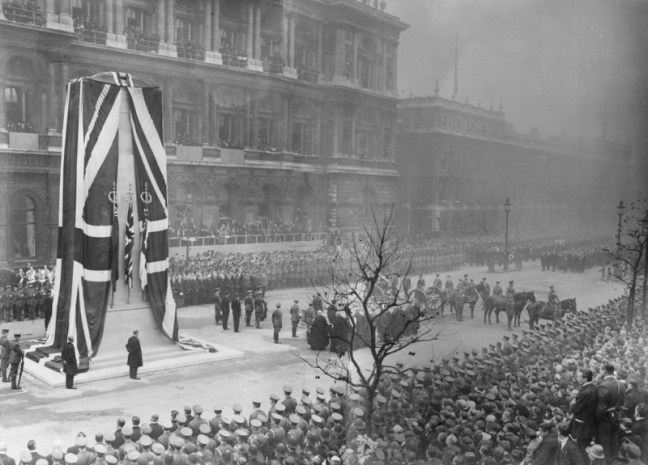
Cenotaph Unveiling in Whitehall designed by Lutyens

The Imperial War Graves Commission is today called the Commonwealth War Graves Commission whose headquarters are in Maidenhead. Regional offices are France, Belgium, Cyprus, Canada, Australia, New Zealand and South Africa. They have research facilities that aid investigation by families making enquiries about the burial site of relatives who lost their lives in the service of this country.

See www.cwgc.org


Summer Pub Lunch 2018

Poacher Inn South WarnbofroughCapture

As usual at this time of year the annual Summer Pub lunch of the Probus Club of Basingstoke took place. On this occasion it was at The Poacher Inn in South Warnborough which is situated on the Alton road south of Odiham.  Chris Perkins MVO, of Kempshott, being the newly appointed president, selected the hostelry ensuring not to replicate past venues.

This is an attractive and welcoming pub with a modern accommodation block, offering good pub food and the party of thirty six, consisting of members and their spouses/partners, enjoyed their time together.

During World War Two, the pub, then called The Plough Inn, was a popular off duty “watering hole” for all manner of air and ground crews from the nearby aerodrome. These not only included the Royal Air Force, but personnel from Canadian fighter squadrons together with Belgian and Free-French trainee pilots from the newly formed Elementary Flying School on the base. Today, renamed The Poacher Inn, it continues to be a popular haunt for many of the helicopter squadrons. The landlady and her team go to great lengths to offer their hospitality to all and have endeavoured to integrate the pub with the local community by providing an ideal venue for meetings and functions.

Chris commented, “As I served for many years at RAF Odiham meant that I was familiar with this establishment and confident that the licencee would be able to cope with such numbers arriving on their doorstep.”

He was not wrong. It was a splendid choice and the range of food and drinks on offer were of high quality and competitively priced.

Now in its fortieth year, the Probus Club of Basingstoke has a full programme of activities with monthly speaker lunches for members, who are all retired professional and business managers, with a variety of social outings that always involve the ladies.

CIMG0810
President Chris Perkins MVO and wife Carolyn hosted the Summer Pub Lunch


Probus Golf Match

Probus Golf July 2018 IMG_1501
Jeff Grover, David Wickens, Alan May, Geoff Twine, John Swain & Richard Stettner

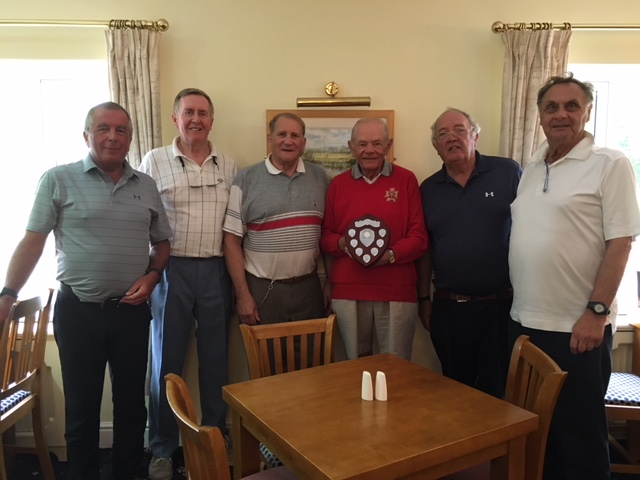
The second annual golf tournament for Probus Club of Basingstoke members to compete for the “Shield” took place on Monday 30 July at the Test Valley Golf Club. It was a Stableford competition and for those non-golfers a simplistic description of the rules of play can be seen in the report about last year’s game on this web site in August 2017 so there is no need to repeat them here.

Apparently this year it was a close game with the winner being Geoff Twine on 32 points, second was Richard Stettner with 31, John Swain coming third had 30, fourth was shared by Alan May and Jeff Grover on 28 while David Wickens qualified for the wooden spoon with 20 points.

As the shield was donated originally by Geoff Twine it is only right and proper that he can take it home for the next year. The numbers being down on last year’s competition perhaps the newer members might have a golfer or two in their ranks who would like to make up the numbers next year. If so they should make themselves known to Alan May.

Probus hears about the history of RAF Odiham

Probus RAF Odiham talk by Chris Perkins image1

On the occasion of his first lunch meeting as the new President, Chris Perkins MVO was also the speaker this day, 10th July 2018. The subject was about the air station where he had been the longest in his service life.

Today the sight and sound of a Chinook helicopter flying across Basingstoke’s sky line is so common that in most cases they are ignored. Yes, we know they are based at RAF Odiham but most know little about our local airfield. Retired RAF Squadron Leader Chris Perkins MVO , from Kempshott,  gave a presentation to our members about the history and changing face of what is now home to the largest deployment of helicopters in the UK.

Chris Perkins served 22 years at RAF Odiham and became interested in its history, although there were little official archives. Just after WW1 the RAF air station at Andover carried out aerial surveys over Odiham Down, seeing potential to expand their activities to be closer to the army base at Aldershot and the important flying centre at Farnborough. In 1925 a summer camp was established and grass runways allowed some flying.

The 1930s saw expansion of RAF Odiham with two tarmac runways needed to handle heavier planes.  The Empire Air Day in 1937 was a great spectacle and interestingly an official visit to the station was conducted by Luftwaffe General Erhard Milch. During WW2 he oversaw aircraft production in Germany.  He was so impressed by RAF Odiham that he earmarked it for his HQ should England be conquered.

Bristol Blenheim at Odiham late 1930s
Bristol Blenheim bombers at RAF Odiham in the late 1930s

Within 10 days of the declaration of war in September 1939 the service men of RAF Odiham with their Lysanders and Blenheims deployed to France engaged in army support roles suffering several losses. They were replaced with RAuxAF Squadrons 613/614 with Hind, Hector and Lysanders together with a detachment of WAAFs filling administrative support posts.  Change continued at Odiham as in 1940 RCAF 110 Squadron arrived with other foreign personnel and the establishment of Belgium/French Flying Training units. They were visited by General De Gaulle.

Two days after Luftwaffe aircraft were spotted carrying out area reconnaissance, RAF Odiham was the target on 12th August 1940 for Junkers 88 of Kampf Geschwadern51 (Bomber Group 51). They were intercepted by Hawker Hurricane fighters of 43 Squadron from RAF Tangmere in West Sussex. On 15th August RAF Odiham was mistaken for the target RAF Andover when a Junkers 88 crew made navigational errors and their bombs killed several in Odiham village. The next attack was on 23rd March 1941 when a Junkers 88 jettisoned 12 bombs in the vicinity of the airfield whilst trying to get away from a persistent Hurricane. Three days later another Luftwaffe bomber was engaged by the station’s defences as it flew over the camp. This was the last recorded incident of the enemy’s  attacks on RAF Odiham in WW2.

Following the formation of the Army Co-operation Command in December 1940, it was decided to replace the aging Lysander with fighter aircraft capable of completing photo reconnaissance missions. The American Curtiss Tomahawk was chosen and in April 1941 the Canadian 100 Squadron, renumbered 400 Squadron at Odiham, began to re-equip. They were joined by 171 Squadron.

May 1942 saw the first of the 1000 bomber raids with five Blenheim Mk 1V of 13 Squadron involved. They went on three such raids with several losses with crews buried in Holland.  August 1942 saw 13 and 613 Squadrons supporting the Dieppe raid.

From November 1942 RAF Odiham experienced a great build up with all types of army co-operation activities besides operational air and shipping support sorties. All were in preparation for the forthcoming invasion of Europe involving many types of fighter aircraft.

Transport Command came in 1945 with 233 and 271 Squadrons of Dakota aircraft and the Canadian Transport Wing formed.

Dakota of 120 Transport Wg RCAF Oct 1945 - Copy
RCAF Douglas DC-3 Dakota at RAF Odiham

There was a ground strafing range in Dogmersfield Park and Lord Haw Haw was returned via Odiham from Germany to face trial as a traitor. There were still many fighter aircraft based here. 54 Squadron with Hawker Tempest Mk11, 130 Squadron with Spitfire Mk1V and 247 was the first Vampire jet unit with 54 and 130 Squadrons converting to Vampires to form the first RAF Vampire wing. In 1947 54 Squadron became the first RAF formation team flying jets.

Atlantic Flyers
de Havilland Vampires first saw service at RAF Odiham

Flying machines had proven their worth in WW1 and became a separate military force in 1918 when the Royal Flying Corps became the Royal Air force. On 10th July this year, its century was celebrated with a large fly past in London. RAF Odiham can beat that with the Coronation Review of the Royal Air Force on 15th July 1953.

Cor Rev 3
Coronation Review of the Royal Air Force at RAF Odiham 15th July 1953

There were 331 planes on the ground and a fly past of 197 piston engined planes and 444 jets. This was, and will probably be, the largest ever collection of RAF planes ever seen.