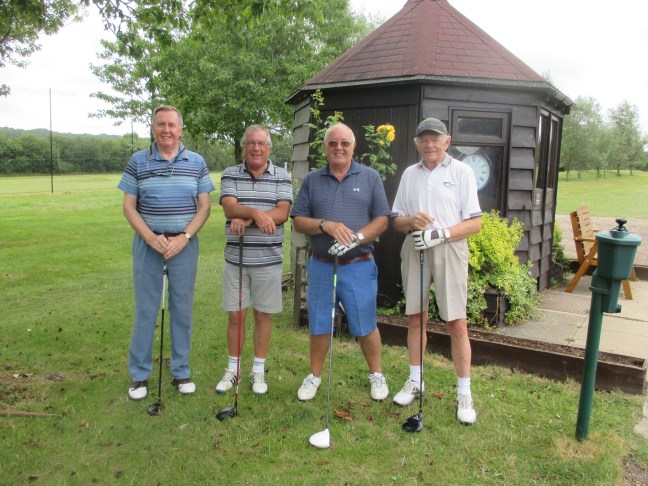
Alan May, Bryan Nagle & Richard StettnerDavid Wickens, Jeff Grover ,John Swain & Geoff Twine
Geoff Twine (as the current holder of the Shield) organised this event and 7 members attended. Geoff Twine, Bryan Nagle, Alan May, Richard Stettner, Jeff Grover, David Wickens and John Swain all battled it out for the 2019 honours in this Stableford Competition. This means that points are awarded on completion of each hole depending on how many shots it took and what handicap you are playing off. The person with the most points is declared the winner.
The day was just right for a game of golf after the preceding days had been quite rainy. We all posed for our photos at the first tee before setting off at 10 am. In the first group was Bryan Nagle and Alan May in a buggy together with Richard Stettner.
Creative photographic shot of Bryan Nagle
The other four all played together and Geoff Twine is seen putting on the 18th green.
Geoff Twine on the 18th watched by David Wickens
As usual it was a day of some good shots and some bad and after all the scores were in and checked it was surprising that very few points separated all 7 players but the winner by 1 point was Richard Stettner who was presented with the Shield by Geoff Twine.
Winner Richard Stettner being presented with the Shield by Geoff Twine
Everyone enjoyed an excellent golfer’s meal of ham, egg and chips together with a small libation and plenty of chat about what had gone on throughout the day.
Let’s hope that Richard can organise another super day out next year.
Tuesday 13 August was the date for the annual Probus Summer Pub lunch and this year Barton’s Mill in Old Basing was the chosen venue. Thirty six arrived simultaneously at the appointed hour of 12 noon that at first glance appeared to cause difficulties for the bar and kitchen staff as there was some rumour that it could be anything between 45 minutes and one hour to get our food.
Reality proved better than the forecast and although there was a crush at the bar placing orders the food arrived in the sort of time usually seen in such establishments.
The weather turned out pleasant and sixteen sat outside and twenty in the heavily beamed room slightly in the dark but it is possibly very welcoming in the winter when the fire is lit.
What a day to remember! It had been over a year since booking our place but a party of 29 consisting of members and their wives/partners of the Probus Club had a wonderful experience as they were present at the Commandant’s Parade at the world famous Royal Military Academy in Sandhurst.
The whole day was one to remember of history, pageantry and military precision. The proceedings took place in and around the Old College building and on the parade ground outside. Starting with coffee in the Indian Room, with wonderful stained glass windows depicting British military history, the party, along with around 2,000 other guests, went outside where two large stands had been constructed completely under canvas. Between them was the dias for the salute to be taken by the Commandant as he reviewed the parade of the Officer Cadets, some third of whom were at the end of 12 months training before commissioning as an officer in today’s army.
While the majority were British, there were several foreign nations on parade as Sandhurst is recognised as one of the world’s premier officer training institutions. One American cadet had previously stated that while West Point in Virginia is a university Sandhurst is the place to go to learn to be a military officer. There are typically over 90 Overseas Officer Cadets from up to 40 different nations at Sandhurst at any time. Since 1947, over 4,800 young people from 120 different countries have trained alongside British Officer Cadets, reinforcing the ties between the British Army and the Armies of our friends and allies.
At this Parade, of four top awards two were for Overseas Officer Cadets – the International Sword was presented to a Cadet from Ukraine and the International award went to a Cadet from USA. The recipients are clearly heading for high office. We were told that there are today twelve world leaders, either political or royal heads of state who had attended the Royal Military Academy, Sandhurst.
The breakdown of those at the academy has 12% female, 80% graduates and 70% public school where the tradition of the army cadet force generates interest in following a military career. Many of the tutors are NCOs who bring real army experience and were visible on parade in charge of the various sections as they marched past the saluting dias of the Reviewing Officer. The band of the Parachute Regiment provided a varied programme of music throughout the Parade.
The audience had to stand on several occasions as certain parts of the Parade dictated which gave a feeling of being involved in the proceedings. Gentlemen had to remove their hats and any in uniform had to salute. The Commandant and his party inspected the Parade and the Sovereign’s Platoon presented Arms following which they trooped the Sovereign’s Banner. The Parade marched past in slow and quick time and then in review order. The Commandant addressed the Parade and then presented the awards.
At the end of the Parade and when all the Cadets had marched off the Commandant and his party walked across the parade ground and after thanking the band went up the steps and through the portico entrance into the Old College. The Adjutant who had been on horseback throughout the proceedings most impressively rode his horse across the parade ground and up the steps and through the large doorway of the Old College a tradition started in the nineteenth century.
Afterwards the Probus party had lunch in one of the many restaurants used by the troops before being taken on a guided tour of the various rooms in the Old College and later outside to visit the Church of England chapel in the grounds. This contained many wall plaque memorials to fallen officers in WW1. Modern casualties were commemorated with carved wooden displays.
This had been a full day revealing many aspects of the history and tradition that lies behind the training of an officer in today’s army. The discipline and skill shown on the parade ground will leave an abiding memory.
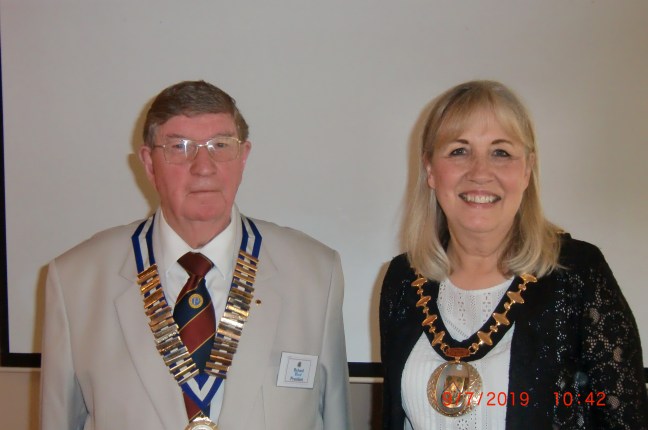
Presidnt Richard Wood with Mayor Cllr Diane Taylor
At the first meeting of the new Probus year the new President Richard Wood of Bramley,welcomed two ladies to their initial meeting of their 41st year. The Worshipful the Mayor of Basingstoke & Deane, Cllr Diane Taylor, was their guest of honour. She was presented with cheque by Richard Wood as a contribution towards her charity appeal.
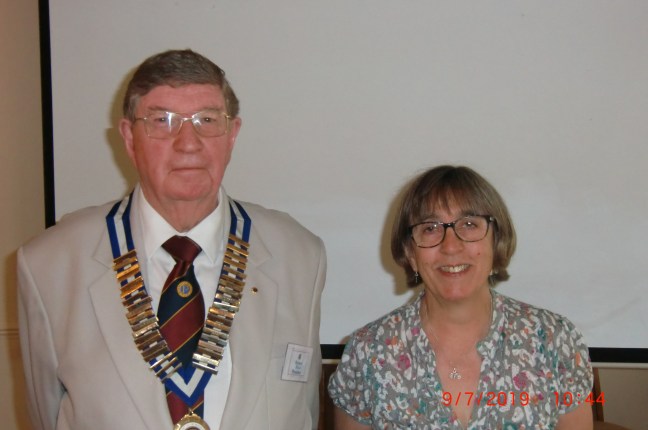
The speaker was round the world cyclist Barbara Cummings. Not one to sit at home and lose physical and mental resilience after being made redundant from the NHS, Barbara, from Old Basing, decided to retire in 2012 and embarked on what has become a series of long distance cycle rides.
President Richard Wood with speaker Barbara Cummings
Her thinking was very simple – going north was up hill while going south was down hill. With that simple philosophy she decided that her first long distance ride was down the east coast of America as it had a “Greenway” path from north to the south. With a stop off in Iceland she saw a sculpture put up by an American benefactor which claimed to have a similar one in Florida. That became a target – to see the one near Key West. That trip was 2,500 miles but had not been too difficult.
After that her cycling adventures multiplied with one from the Russian border near St Petersburg which took two months, and another across France from the east coast to the Mediterranean. A four months trip in Australia and New Zealand was completed by visiting Fiji and Hawaii. India was next, followed by North Africa.
In a few months Barbara will be tackling the USA Pacific coast, and like all her trips she travels alone. Never being concerned about being a single woman on a camp site she has been overwhelmed by the kindness of strangers who have given her soap powder, a luminous watch so that she could see the time at night in her tent, given her lifts to a country’s border and even taken her into their homes with overnight accommodation.
She has now cycled in 24 countries and during that time only suffered three punctures, and that was on her east coast trip in USA. She has cycled on every continent except Antarctica but even that is planned for 2021.
She self finances all her trips but gives talks about what she has seen as a means of raising funds for two charities, Headway, where she is a trustee, and Asthma UK.
Richard Wood receives the presidential chain of office from retiring secretary Paul Flint
“The underlying ethos of providing an important avenue of welcome interest and stimulus for those in retirement applies today just as it did over forty years ago when the Probus Club of Basingstoke was formed.”
This was the view of the club’s outgoing President, Chris Perkins MVO, in his report to members of this social organisation for retired professional and business managers at its 40th Annual General Meeting on 27 June. It was held at Christ Church in Chineham which for many years hosted their speaker events.
Today the club meets at the Test Valley Golf club on the second Tuesday of most months with a guest speaker and lunch followed by some business discussions. There is also a social pub lunch every month and there are outings and visits during the year which include the wives and partners of members. The next formal visit, which had to be booked over a year ago, is to the Commandant’s Parade at the Royal Military Academy Sandhurst in August.
Richard Wood, of Bramley, was installed as their new President by outgoing Secretary, Paul Flint, of Kempshott. Also retiring, after each had served for more than a decade, was Treasurer Alan May of Oakley and Outings Organiser, Tony Atchison, of Chineham. The newly appointed Secretary is Peter Hayes, along with Dr Jeff Grover as Treasurer, both from Bramley. David Wickens, a recent mover from Chineham to Newbury, was elected as Vice President while maintaining his role as the Programme Secretary being responsible for arranging the wide array of interesting guest speakers. Outgoing President, Chris Perkins MVO, of Kempshott, will now become the Outings Organiser while Alex Marianos, also a Bramley resident, continues as Dining Steward and Paul Flint continues in his role of Publicity Officer.
Lesley Atchison receives a bouquet from new president Richard Wood to thank her for arranging the canapes and drinks after the AGM
The first Probus Club was founded in 1965 in Caterham, Surrey, and in those days consisted of mainly retired members of Rotary. Today its members are from a wide background of professional and business managers as well as the military. There are Probus clubs in most towns with in excess of 180,000 members in UK and extends throughout the English speaking world.
President Chris Perkins MVO with speaker Jenny Mallin
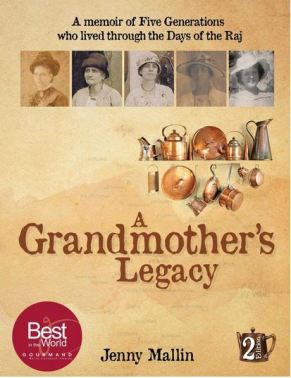
Jenny Mallin, who gave a talk to the Probus Club of Basingstoke, is rightly proud of her five generations of women of British ancestry in India from the days of the Empire to the present day. Although based on her great great great grandmother’s hand written recipes she has written and published a charming book which is not just a collection of cookery expertise but it encompasses the life and times of Anglo-Indians during the prime days of the Raj spanning the 19th and 20th centuries.
Army service took the first generation from Mirfield in Yorkshire to India in the late 1700s and she has established a family tree to the present day. During this time each generation of women added to the original cookbook which formed the basis of her talk.
She covers the railways which grew from 25,000 miles to over 41,000 miles with one grandfather a train driver. Another was a teacher who with the Maharaja of Mysore founded a school that today is the Mysore University, another antecedent became Postmaster General and yet another was the governess to sixteen years old Benazir Bhutto, who became prime minister of Pakistan on two occasions.
She talked about her parents marrying in the Andaman islands, the Indian expedition to Mesopotamia during World War 1, the Victorian style of dressing in the 19th century, Eventide homes in Bangalore, Poonas’s military station, of hunting trips and the 1,000 miles walk back from Burma during World War 2. The Imperial Civil Service had 1000 people administering a country of over 300 million inhabitants and many bungalows were built to house the travelling administrators. Jenny Mallin has every reason to call her book a memoir instead of a cook book, though fans of cooking will find it a treasure trove.
A practical chef she has been a tutor at many prestigious culinary centres including in our area the Newlyn’s Farm Cookery School near Odiham and at Lainston House hotel near Winchester.
Vice President Richard Wood with Janet Fagg the President of Basingstoke Ladies Probus Club
The annual Spring Ladies’ lunch was the latest formal gathering of the Probus Club of Basingstoke, the social club for retired professional and business managers. Organised once again by Alan and Liliane May they came up with the goods when they arranged this occasion for members and their spouses. It was held at the Test Valley Golf Club. By working closely with the chef they ensured that all forty one attendees received their pre-ordered food – there were four selections available from three courses – and they produced all the printed menus and table name cards as well as the information sheets after they devised two separate quizzes. And if that wasn’t enough that also ran the raffle.
Alan has been the Honorary Treasurer of the Probus Club of Basingstoke for over a decade. In that time he and Liliane have become experts at successfully arranging not only this lunch but also the club’s Christmas dinner. While these are the two formal events to which wives/lady friends are invited there are many other social occasions during the year when the distaff side of the family are involved.
Guest of honour was Janet Fagg, the President of Basingstoke Ladies’ Probus Club, who was welcomed by Vice President Richard Wood. She was equally at home on this occasion as the wives of some members of the men’s club belong to the Ladies’ Probus Club.
For more information about the Probus Club of Basingstoke see their web site http://www.probusbasingstoke.wordpress.com or for an informal chat contact their Secretary, Paul Flint, on 07770 886521. For enquiries about Basingstoke Ladies’ Probus Club contact Janet Fagg on 07986 133382.
Peter Cross with his late wife as shown on the back page of his Funeral Order of Service.
7th September 1928 – 5th April 2019
The funeral took place on Wednesday 1st May 2019 of Peter Cross at Basingstoke Crematorium. The roundal of the Royal Air Force Ensign was draped on his coffin to represent his service in the RAF where he has been an armaments specialist working on Scimitar jets. He served in Hong Kong, Singapore and Scotland as well as in England. He had been married to his late wife Brenda for 58 years and they had four children, five grandchildren and six great grandchildren.
Peter joined Probus on 10th June 2008 and was a regular attendee at our meetings and on various coach outings. He resigned through ill health in June 2018.
Our Probus Club was represented by Paul Flint, Gerry and Joan Anslow and Rob Hopkins.
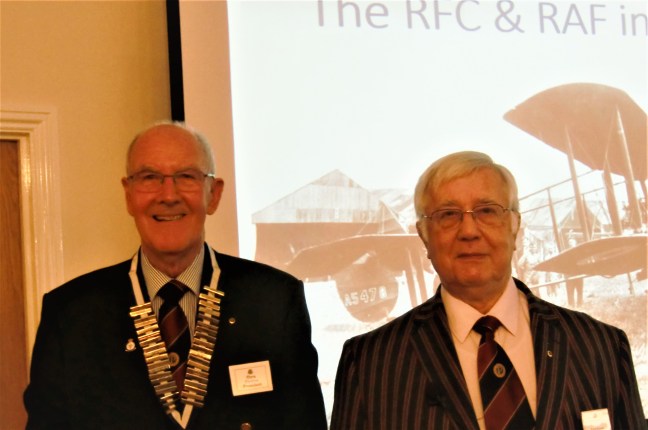
President Chris Perkins MVO and speaker rtd RAF Wing Commander Bryan Jenkins
Probus Club member, retired RAF Wing Commander Bryan Jenkins, gave a presentation to this social club for retired professional and business managers about the foundation of the Royal Flying Corps at the outbreak of the Great War. The corps was viewed by the generals as there to serve the needs of the army.
Bleriot flying across the English Channel in 1910 caused military chiefs to rethink the previous year’s philosophy that aeroplanes could have no use in war. Aviation, in order to progress for military use, had to rethink its design and production. There were no real manufacturing facilities, no aircraft engine industry with much reliance on French aircraft and engines. There were no aircrew training schools and initial thoughts were that pilots should not be aware of the physical limits of their planes as it would impact on their confidence.
Thinking changed from General Haig’s comments in July 1914 that aeroplanes could not be usefully employed in reconnaissance, this was the cavalry’s role; to September that year when aerial reconnaissance enabled the British Expeditionary Force win the battle known as “Miracle of the Marne”. Such flight information enabled the Generals to deploy their forces to maximum effect.
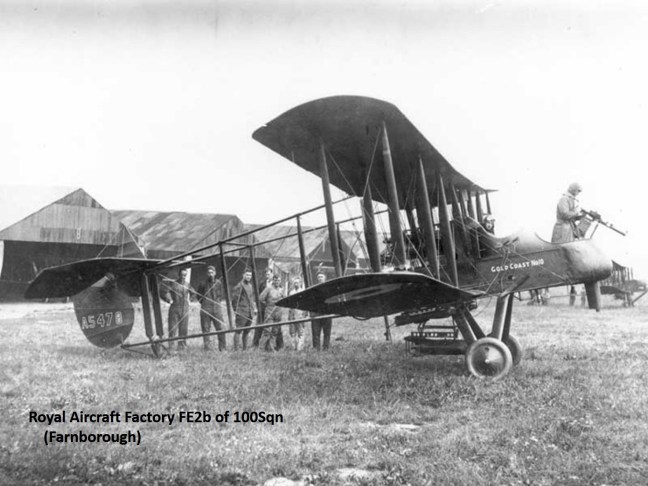
Technical difficulties had to be overcome such as being able to fire guns through the propeller. Initially, this was overcome by having the propeller at the rear of the pilot.
Pusher type propeller with separate air gunner who had no harness or parachute
By 1915 the German Fokker Eindecker monoplane was able to fire through the propeller and had superior aerial performance than any British design. Fokker continued with bi-plane and tri-plane designs, the latter made famous by Manfred von Richthofen who was credited with 80 “kills” and became known as the Red Baron.
Early aerial battles against enemy aircraft were not successful. RFC planes strafed enemy infantry and bombed airfields, factories and transportation facilities. The bombs being hand held over the side of the plane as had been the early cameras used in photographic missions although bigger and heavier cameras became fixed to the side of the fuselage.
Training gradually improved, as it needed to be, since the average life expectancy of a pilot on the Western Front was only 23 days. Some pilots only survived for three days. Of 10,000 RFC airmen who lost their lives, 4,000 died in training, 4,000 in post training and only 2,000 killed as a result of enemy action.
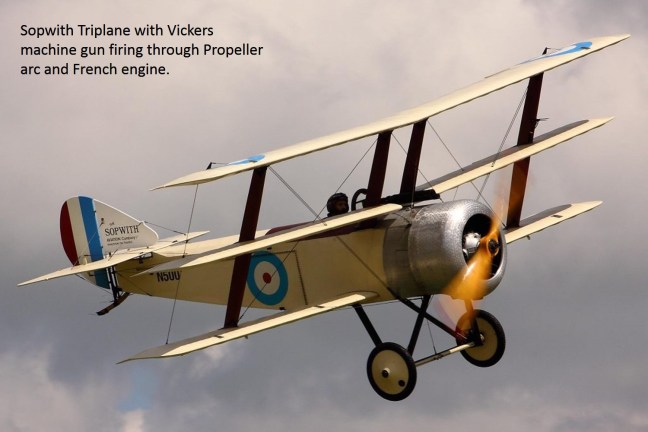
Problem solved being able to fire a machine gun through the propeller arc.
Aircraft production was ramped up with the creation of aircraft manufacturing factories but the front line was always waiting for replacements. The main problem was insufficient engines and by 1918 there were over 4,000 planes in storage waiting for an engine.
After starting the Royal Flying Corps in 1914 with 2073 personnel, by the beginning of 1919 there were 114,000 personnel and 4,000 planes in some 150 squadrons. Some 900,000 flying hours had been logged during the war and almost 7,000 tons of bombs had been dropped on enemy positions. Eleven members of the RFC were awarded the Victoria Cross.
This design was copied by Fokker and made successful by the Red Baron
John Moore- Brabazon , who had been the first Englishman to fly a heavier than air machine on British soil in 1909 and who became responsible for aircraft production in WW2, summed up the progress made.
“We started the Kaiser war with very little equipment, and not very good equipment at that. Many of the RFC squadrons were equipped with French aircraft. There was, however, during the war an immense concentration upon producing better engines and better machines than anyone else. We ended up that war absolutely supreme throughout the world. We had better machines, better engines and better pilots than existed anywhere in the world”.
As a result of its success the RFC became a fully independent third military sector of UK defence forces and on 1st April 1918 it merged with the Royal Naval Air Service to become the Royal Air Force.
Once again it was the annual quiz night organised by Deane Probus and held at Basingstoke Golf Club. Our members “swept the board” not only winning the lion’s share of raffle prizes but one of our tables won the quiz. Modestly I identify that table of Paul Flint and Janet Fagg, David and Pat Rawden and Paul’s son Mark and daughter in law Fiona who gamely made up our numbers. The prize for coming first was a £10 voucher for each member of the team.
Those members and their partners attending the event had a really enjoyable time.
It was a very entertaining evening which included a fish and chip supper with stiff competetion. Provided such a quiz evening is organised next year we shall attend determined to defend our superior position.






 She covers the railways which grew from 25,000 miles to over 41,000 miles with one grandfather a train driver. Another was a teacher who with the Maharaja of Mysore founded a school that today is the Mysore University, another antecedent became Postmaster General and yet another was the governess to sixteen years old Benazir Bhutto, who became prime minister of Pakistan on two occasions.




 Probus Club of Basingstoke
You must be logged in to post a comment.