That Faded Snapshot

It happened just a few weeks ago now, a chance glimpse of a small insignificant fading snapshot of a young WW2 bomber crew, attached to which was a sellotaped fading biro written note.  At least it credited their names and a date, but what initially intrigued Probus Club member, retired RAF Squadron Leader Chris Perkins MVO, was the connection with the ‘legless WW2 fighter ace’ Douglas Bader.  Seeing this old black and white photograph was on a quick visit to his old RAF Station Odiham carrying out research into the helicopter era of the 1970s and 80s concerning 18 Squadron.  What follows is yet another tale that should never be forgotten.
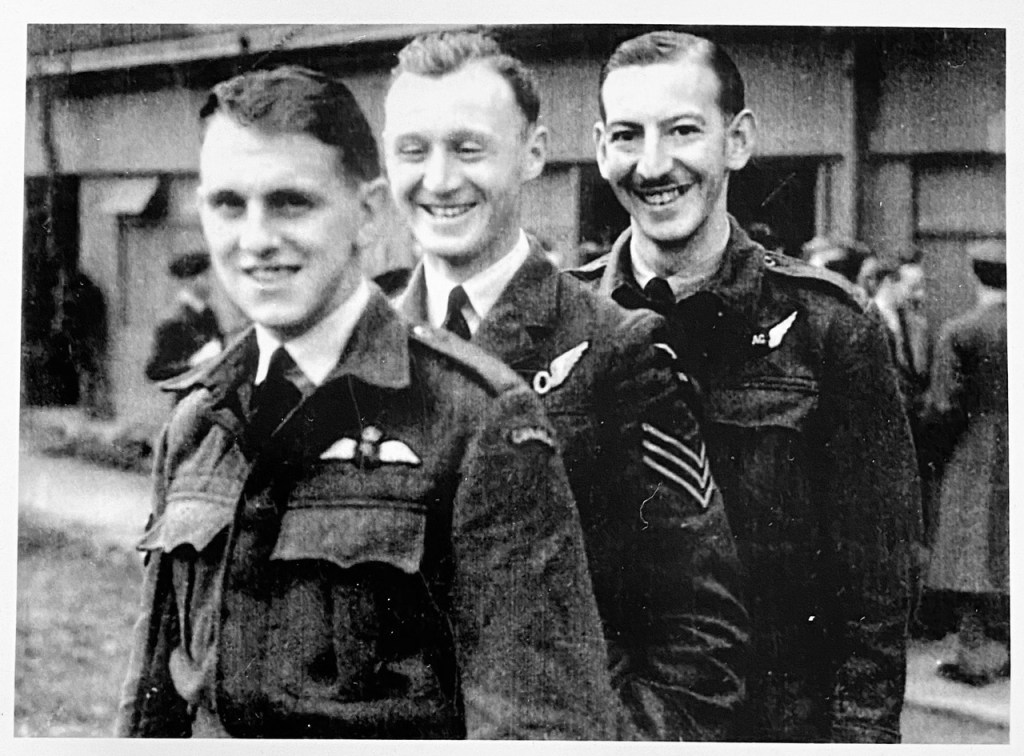
The Nickleson Crew


The 18 Squadron crew pictured comprised of Pilot, Jack Nickleson from Toronto Canada, Observer, Walter Meadows from Askrigg in Yorkshire and Air Gunner, John Pearson from Birmingham.  Walter and John were in their 20s, but their ‘Skipper’ Jack, was just 19 years old.  All were Non-Commissioned Sergeant Aircrew and had been on the squadron barely a month.  Sadly, their Operational Tour was to last just eleven missions and their names are listed amongst the 55,000 plus other airmen lost in Bomber Command during WW2.

To those of us growing up in the ‘black and white’ years of the 1950s, the wartime exploits of Bader, as portrayed magnificently by actor Kenneth Moore in the film ‘Reach For The Sky’, were very familiar.  It will be eighty years ago this August, that, on 9 August 1941 Wing Commander Douglas Bader, leading his Spitfire Wing from RAF Tangmere, was shot down over German occupied France.  He ‘bailed out’ minus his prosthetic right leg, which had become jammed by the rudder pedals during combat.  Thankfully, a leather retaining strap eventually broke allowing him to exit the aircraft.  Knocked unconscious on landing, he was taken to a Luftwaffe hospital in St Omer.

Wing Commander Douglas Bader

The battered artificial leg was subsequently recovered from the Spitfire wreckage and a temporary repair was carried out before being returned to him.  Bader was delighted!  It meant that he now had the mobility means to try an engineer an escape before being transported under escort to more a permanent incarceration in Germany.  In the meantime, however, the German Authorities had signalled the RAF reporting his ‘safe arrival’ and status as a POW and requesting that a replacement leg be delivered.  Safe passage for that aircraft by the Luftwaffe would be guaranteed.

Although the RAF were willing to devise a means of delivery, they were unwilling to offer a propaganda opportunity to the Germans by means of the ‘safe passage’ option.  It was therefore decided to parachute drop the replacement leg by an aircraft involved in a bombing operation nearby.  No 18 Squadron operating from a forward operating base at RAF Manston were allocated the task with six Blenheim light bombers and escorted, appropriately, by Spitfires of Bader’s Tangmere Wing.

Sgt Jack Nickleson and crew were chosen to deliver the box with replacement limb.  At that time, there was no devised procedure for dropping cargo from RAF Blenheim bombers and automatically deploy a suitable parachute. It was decided that the ‘best option’ would be to attach the box, ‘somehow’, to a standard partially opened crew parachute and ‘throw’ it out of the aircraft!  In theory this was a simple solution, but in practise it fell far short.

Once the crate containing the leg was delivered to the 18 Squadron at RAF Manston in Kent, Jack, Walter and John realised the enormity of their task.  To manhandle and dispatch the bulky crate attached to a partially opened cumbersome parachute out of a small escape hatch, was not going to be easy.  All this and bouncing around at 10,000 feet in formation with other aircraft and from the extremely cramped interior of the bomber.  But this they did and very successfully.  Needless to say, a following press release on the operation at the time, in typical fashion, falsely reported Bader’s leg as being delivered by ‘Our Fighter Boys’!    

Crate addressed to Wing Commander Douglas Bader a patient in the Luftwaffe hospital at St Omer in France
The replacement prothesis safely received at St Omer before passing to the POW patient

The ‘Nickleson Crew’ survived operations until 20th September 1941.  As part of an eight 18 Squadron aircraft low level mission to attack shipping off the Dutch coast, they were hit by anti-aircraft fire.  Their aircraft was seen to crash into the sea with the starboard engine on fire.  The bodies of Sgt Walter Meadows and Sgt John Pearson were both washed ashore during the weeks following the crash and they lie in Commonwealth War Graves Cemeteries.  The body of the young Sgt Jack Nickleson, Royal Canadian Air Force from Toronto, Canada was never found.  At 18 he had enlisted straight from high school in July the previous year and his flying career had spanned but a short, active but nevertheless eventful fourteen months.

The Nickleson crew in front of a Blenheim light bomber

ADDENDUM

Runnymede Memorial

The Air Forces Memorial

The Air Forces Memorial at Runnymede commemorates by name over 20,000 men and women of the air forces, who were lost in the Second World War during operations from bases in the United Kingdom and North and Western Europe, and who have no known graves.  They served in Bomber, Coastal, Fighter, Transport, Flying Training and Maintenance Commands.  They came from all parts of the Commonwealth plus countries in Europe that had been overrun, their airmen continuing to fight the enemy from the ranks of the Royal Air Force.

The Memorial stands upon the crest of Coopers Hill overlooking the River Thames and the fields of Runnymede, where in 1215 King John signed the Magna Carta thus sealing that document to the cause of English libertyIt is a fitting and hallowed place, therefore, to commemorate the ultimate sacrifice made by all those servicemen and women.  Unveiled by Her Majesty, Queen Elizabeth on 17 October 1953, it was designed by Sir Edward Maufe, the Commonwealth War Grave Commission’s Principal Architect responsible for the United Kingdom after World War Two.  His main aim was to create an atmosphere of quiet intimacy for all those coming to remember the missing.
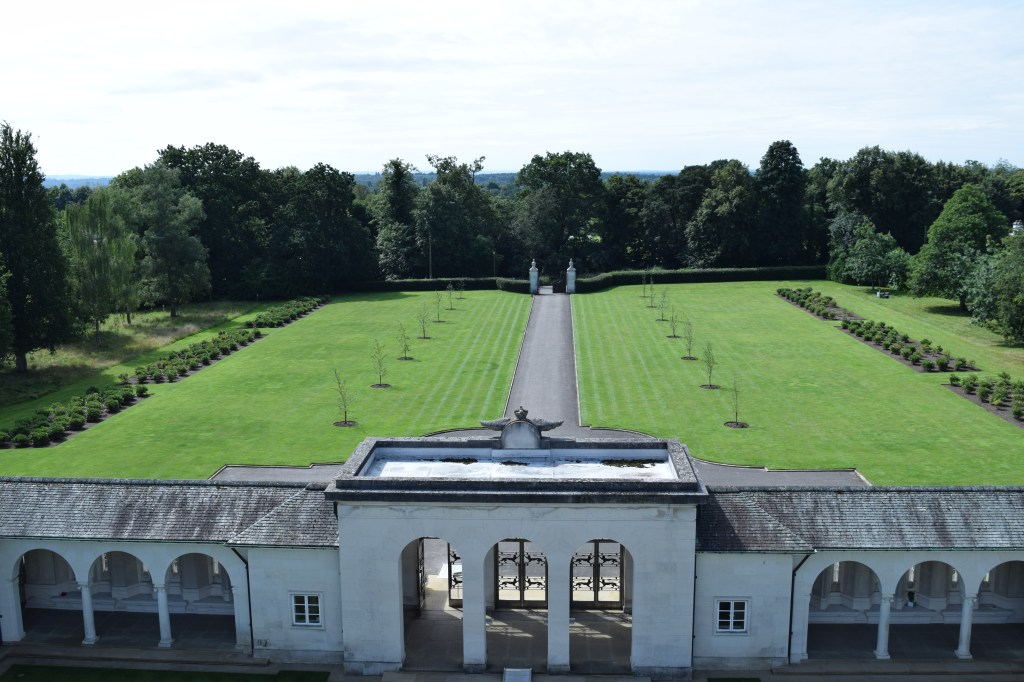
The memorial site certainly lived up to all expectations on the day of my visit with perfect summer weather and clear warm conditions to take in the gleaming splendour of the architecture and quietly contemplate the multitude of names arranged in the cloistered panels within. My aim on the 19th of August was to seek out the name of a Flight Sergeant Jack Nickleson, the Captain of an 18 Squadron Blenheim bomber aircraft tasked with successfully delivering a replacement prosthetic limb to the renowned Wing Commander Douglas Bader, incarcerated as a POW by the German Luftwaffe at St Omer in Northern France.

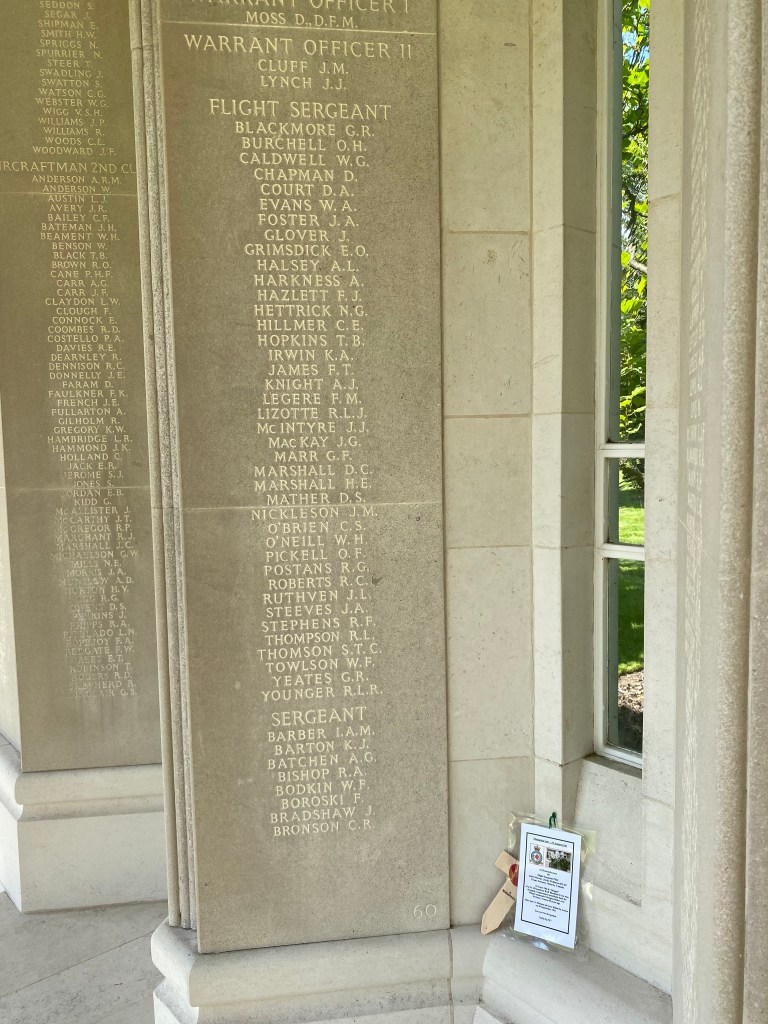
Jack’s name is to be located on panel 60 of the memorial cloisters with all of of the Royal Canadian Air Force Airmen who gave their lives for our freedom in 1941.  It indeed was a privilege to pay my respects and place the small memorial cross and card below his name.  He is not forgotten and neither are his other crew members.  Sgt Walter Meadows, Observer/Bomb Aimer, is buried in Bergen-Op-Zoom and Sgt John Pearson, Air Gunner, in the military plot of Amsterdam New Eastern Cemetery.  Hopefully, with the lifting of continental travel restrictions, I’ll be able to accord them both the same recognition in my forthcoming battlefield tour activities.


Publicity During Covid Lockdown – 17

Come the month of August and most of the local magazines do not publish. It is disappointing therefore that even one that does, the Link, in Oakley, unfortunately, and rarely, did not include our piece. This can be perhaps put down to the fact that since resuming their printed editions they are now a free issue publication which means that advertising pays for the printing costs. Previously they made a charge to receive the magazine. The net result is that the pagination has reduced accordingly to match the paid for pages with editorial decisions having to be made about what is included or excluded from each edition.

The Loddon Valley Link, as previously mentioned, is tricky to gain a place in each printed edition and made more difficult because of their rotating editor policy. Our most supportive editor has now resigned and a new one has been installed but it may take time for a relationship to be built up so that the Probus Club reports become a standard feature.

The Chineham Chat still does not publish but they have maintained their “blog” type news site and we are successful with our press releases. The Kempshott Kourier sails on regardless of what happens to other publications although the editor has admitted that they have lost a couple of advertisers which makes it difficult to cover their costs.

Click on any image to enlarge

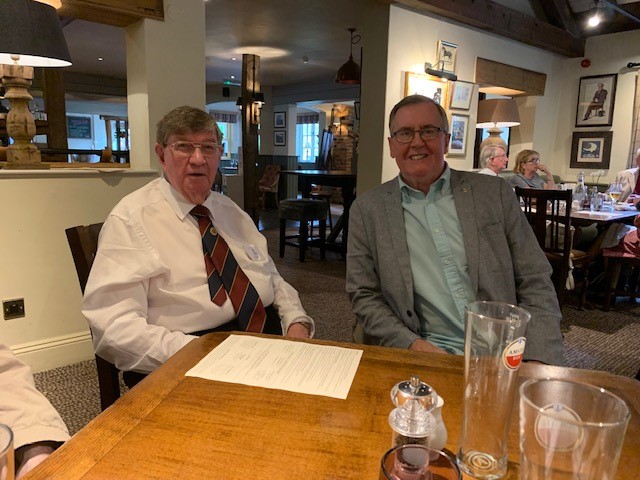
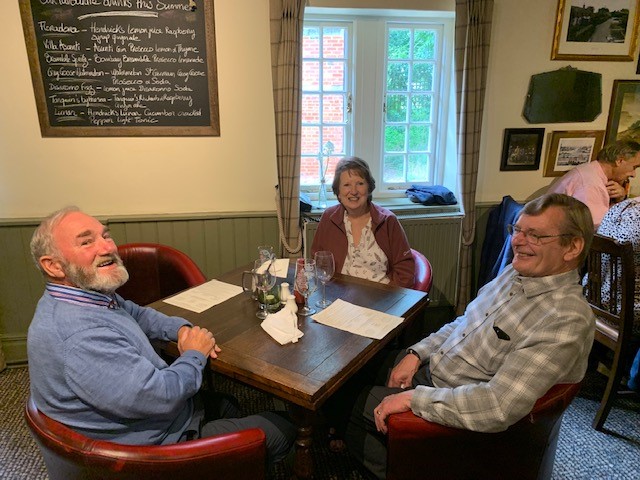
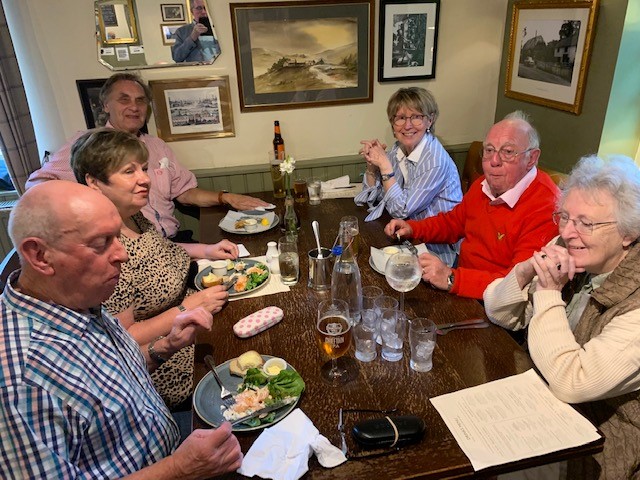
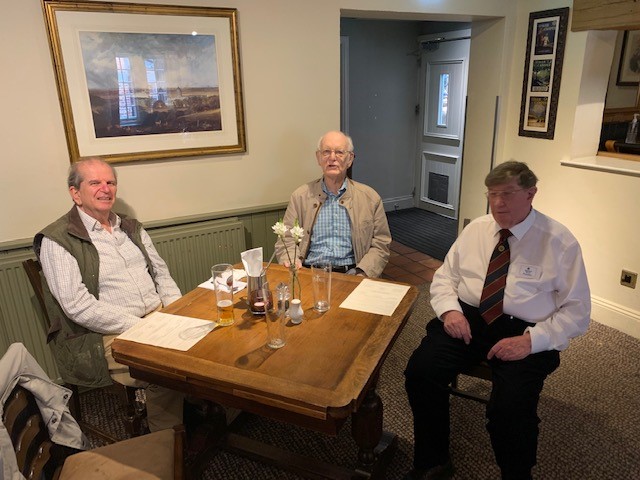
Summer Pub Lunch 12 August 2021

The first social get together for members of the Probus Club of Basingstoke, together with their spouses, in over eighteen months took place at the Longbridge Mill, Sherfield on Loddon.

Plenty of chatter filled the air as everyone had much to say after such a long absence due to the Covid pandemic. And yet It almost felt as though there had not been such a long absence from meeting together, perhaps, down to being such close relationships built solidly over many years.

There were good reasons for notable absences with holidays, clash of dates, family visitors from overseas and medical appointments and of course the sad loss of two members, and also the passing in recent months of the wives of two members.

We can now look forward to the resumption of the typical Probus Club activities starting with the delayed AGM in September.

Publicity During Covid Lockdown – 16

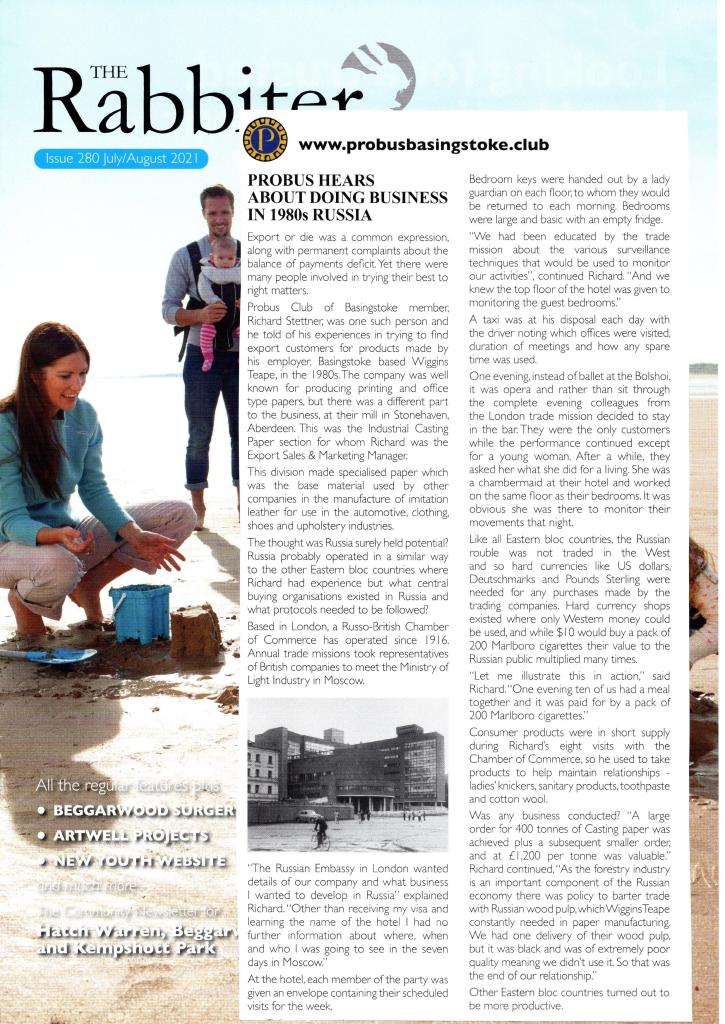
July proved to be a good month for magazine publicity despite the loss of the Chineham Chat and Popley Matters and for some reason the Link (Oakley & surrounds) for once, did not include our report about Richard Stettner doing business in Russia. However four magazines did us proud and the Basinga Extra carried the short version on their web site.

There was an element of calendar variances as three of the quarterlies caught up with our previous reports – the Winklebury Way used Stephen Thair’s report about meeting Prince Philip and two CommunityAd magazines – Bramley & Sherfield also had the Prince Philip meeting and the Old Basing & Lychpit Parish Council Community Newsletter ran with Chris Perkins’ Pyrean adventures.

Funeral of Sibyl Wood


The funeral of Sibyl Wood, wife of our president Richard Wood, took place on Monday 12 July.

A celebration of Sibyl’s life was held at St James’s church in Bramley and afterwards there was a private family cremation.

Current regulations restricted the congregation at the church to less than fifty with everyone spaced out on different pews. Probus Club members attending were Geoff and Ann Twine, Fred and Susan Locke, Alan and Anne Porter and Paul Flint with Janet Fagg who also represented the Ladies Probus Club.  

The Russian Business Revelation in the 1980s by Richard Stettner

Export or die was a common expression, along with permanent complaints by Government ministers about the balance of payments deficit. Yet there were many people involved in trying their best to right matters.

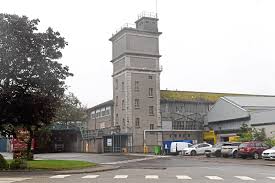
Probus Club of Basingstoke member, Richard Stettner, was one such person and he told of his experiences in trying to find export customers for products made by his employer, Basingstoke based Wiggins Teape in the 1980s. While most will know the company for producing printing and office type papers like the famous Conqueror range, there was a different part to the business that had specific industrial applications made by their mill in Stonehaven near Aberdeen. This was the Industrial Casting Paper section for whom Richard was the Export Sales & Marketing Manager.

The Wiggins Teape paper mill at Stonehaven Aberdeen

This division made specialised paper which was the base material used by other companies in the manufacture of imitation leather for use in the automotive, clothing, shoes, fashion and upholstery industries.

Already doing business with some Eastern bloc countries, the thought was Russia surely had some potential?  But where to find customers in such a vast country? It seemed logical that Russia operated in a similar way to the other Eastern bloc countries where Richard had wide experience. In these countries state trading organisations had the responsibility of buying goods and services needed by companies in these centrally controlled economies. What central buying organisations existed in Russia and what protocols needed to be followed?
Based in London, a Russo-British Chamber of Commerce has operated since 1916. Prince Michael of Kent has been its patron for many years being related through his grandmother to Tsar Nicholas 11.  Annual trade missions took representatives of British companies to meet the Ministry of Light Industry in Moscow.

“Firstly, I had to submit to the Russian Embassy in London, details of our company and what business I wanted to develop in Russia” explained Richard. “Once accepted, other than receiving my visa and learning the name of the hotel I had no further information about who, when and where I was going to see in the seven days in Moscow.”

St Basil’s Cathedral in Moscow

On the first occasion, arriving in Moscow there was no customs control at the airport, purely passport control, with the party’s luggage put into the coach to take to the hotel. Their travel guide explained how things would operate during the week’s visit. At the hotel, each member of the party was given an envelope containing their scheduled visits for the week.

Bedroom keys were handed out by a lady guardian on each floor, to whom they would be returned to each morning. Bedrooms were large and basic with an empty fridge.

“We had been educated by the trade mission about the various surveillance techniques that would be used to monitor our activities”, continued Richard. “The whole top floor of the hotel was given to monitoring the guest bedrooms so it was clear that while away during the day my room would be searched to provide some evidence of private activity that might be used as leverage against me at some future date.”

Each morning every delegate was allocated a taxi for use for the whole day, irrespective of the length of each business meeting. The driver would take notes of which offices were visited, the duration of meetings and how any spare time was used.

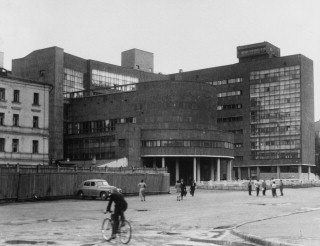
The Ministry of Light Industry Moscow

Like all Eastern bloc countries, the Russian currency of the Rouble was not traded in the West and so hard currencies like US dollars, Deutschmarks and Pounds Sterling were needed for any purchases made by the trading companies. Hard currency shops existed where only Western money could be used, and while $10 would buy a pack of 200 Marlboro cigarettes their value to the Russian public multiplied many times.

 “Let me illustrate this in action,” said Richard. “One evening ten of us had a meal together and it was paid for by a pack of 200 Marlboro cigarettes.”

Consumer products were in short supply in Russia during Richard’s eight visits with the Chamber of Commerce, so he used to take products in his luggage to help maintain smooth relationships. Ladies’ knickers, sanitary products, toothpaste and cotton wool.

A further example of the surveillance techniques he encountered was the night he and two others went to the Bolshoi. That evening, instead of ballet, it was opera and rather than sit through the complete evening they decided to stay in the bar for a few drinks. They were the only customers while the performance continued except for a young woman across the bar. After a while, they asked her what she did for a living. She was a chambermaid at their hotel and worked on the same floor as their bedrooms. With the entrance to the Bolshoi priced in US dollars, meant few Russians had the currency to pay for the tickets and certainly unlikely for a lowly chambermaid. It was evident she had been set up to monitor their movements that night.

Was any business conducted? “A large order for 400 tonnes of Casting paper was achieved plus a subsequent smaller order, and at £1,200 per tonne was valuable.” Richard continued, “But as the forestry industry is an important component of the Russian economy and it made wood pulp, which Wiggins Teape constantly needed in paper manufacturing, there was an attempt to barter trade. We had one delivery of their wood pulp, but it was black and was of extremely poor quality meaning we didn’t use it. So that was the end of our relationship.”

Other Eastern bloc countries turned out to be more productive.

Publicity During Covid Lockdown -Part 15

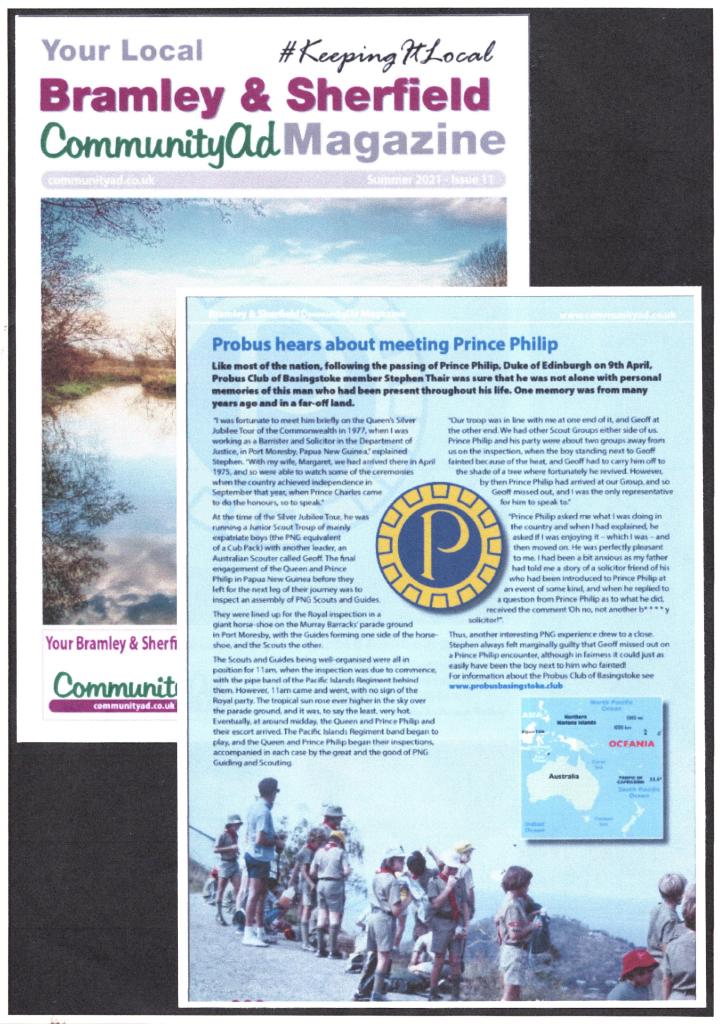
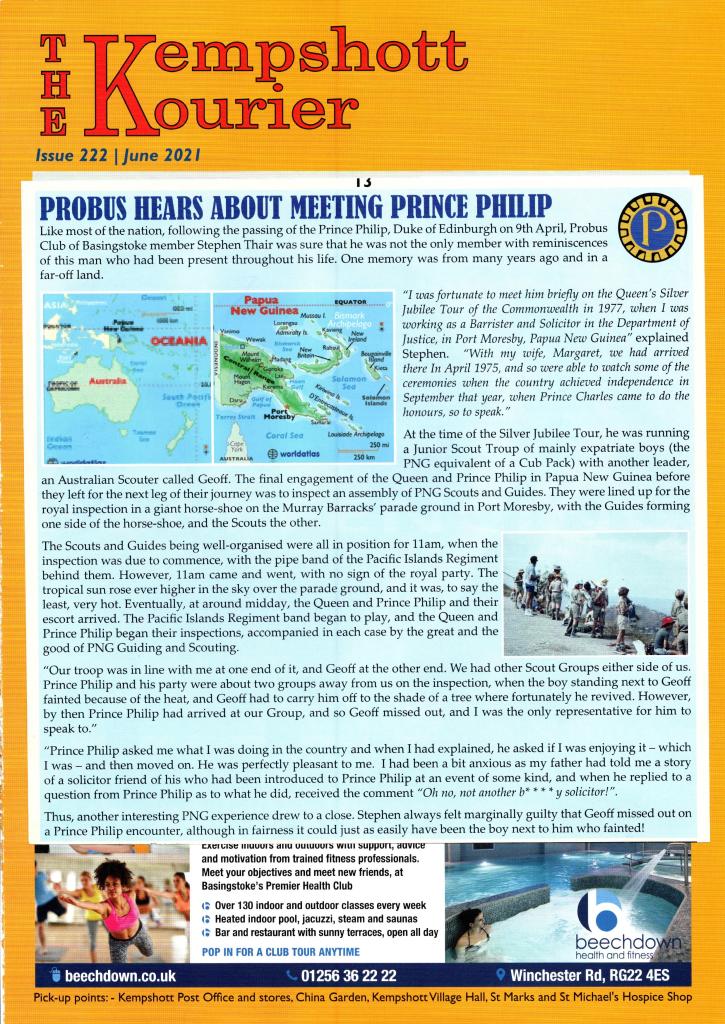
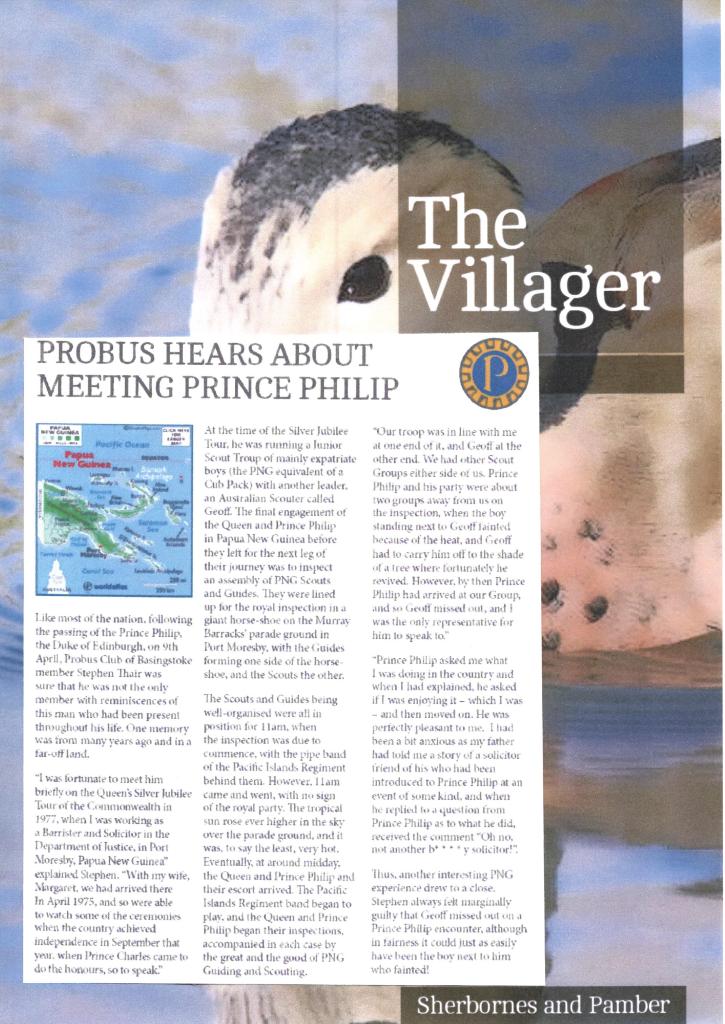
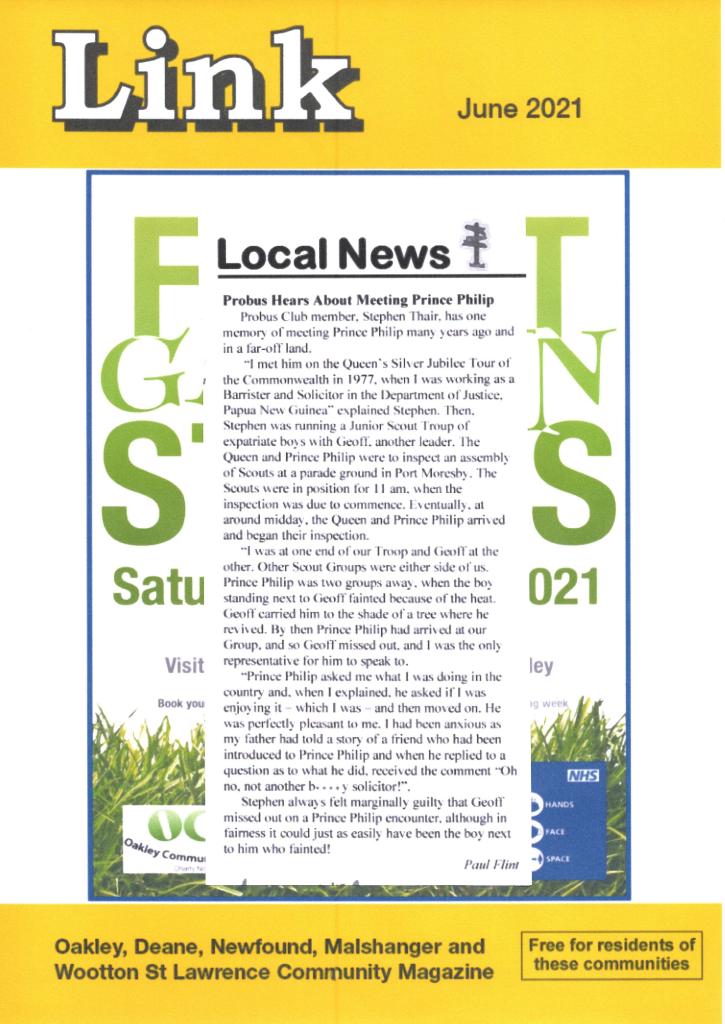
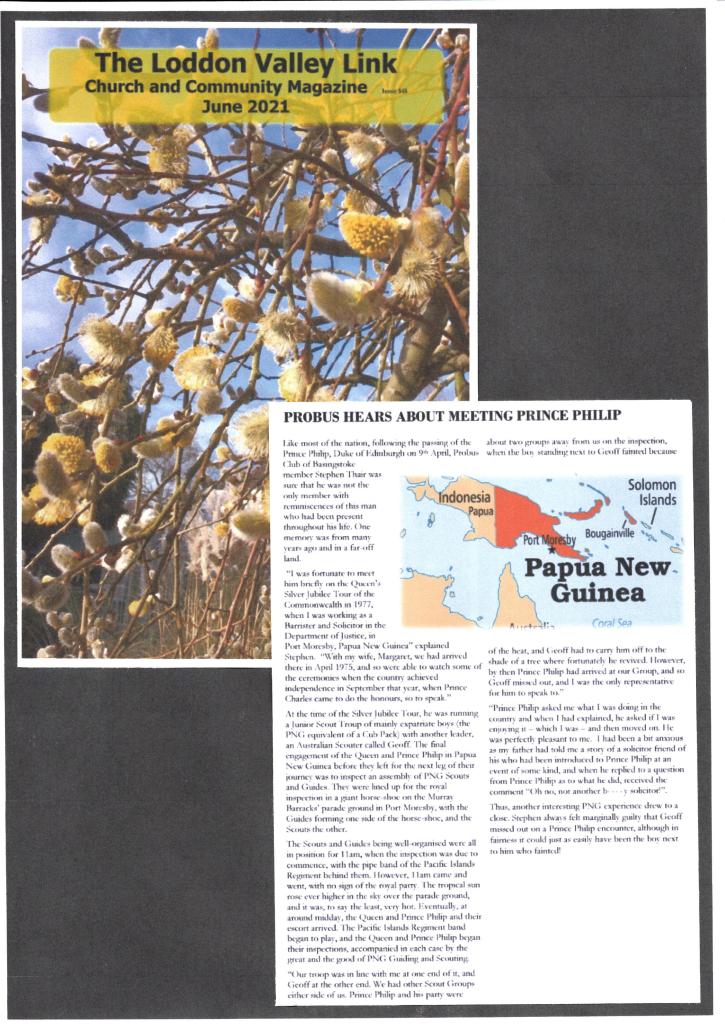
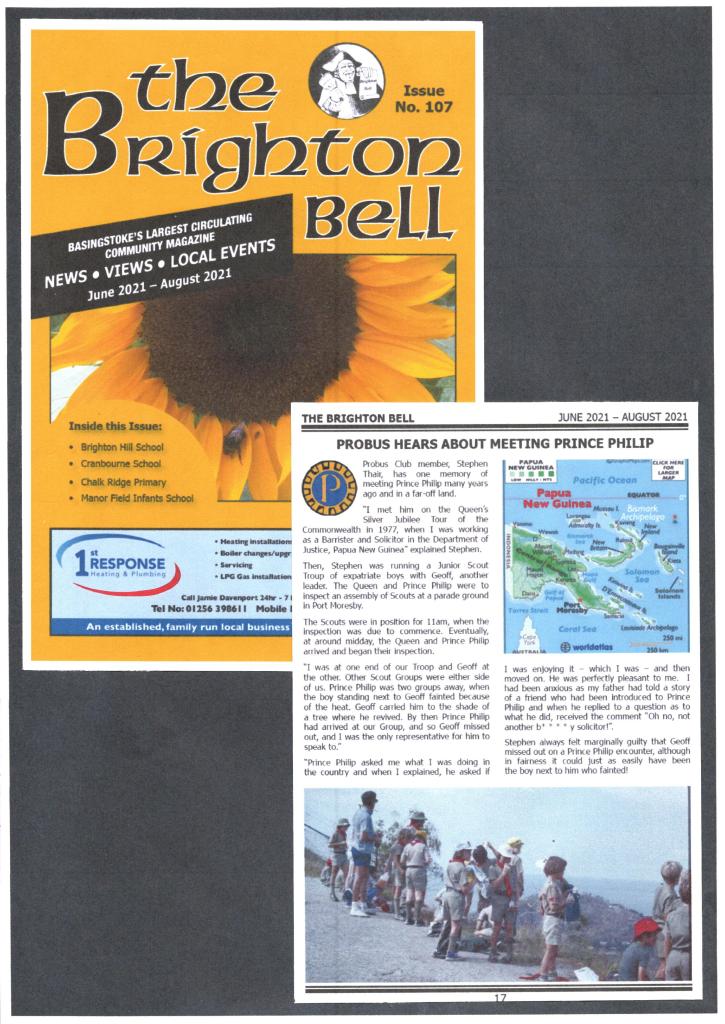
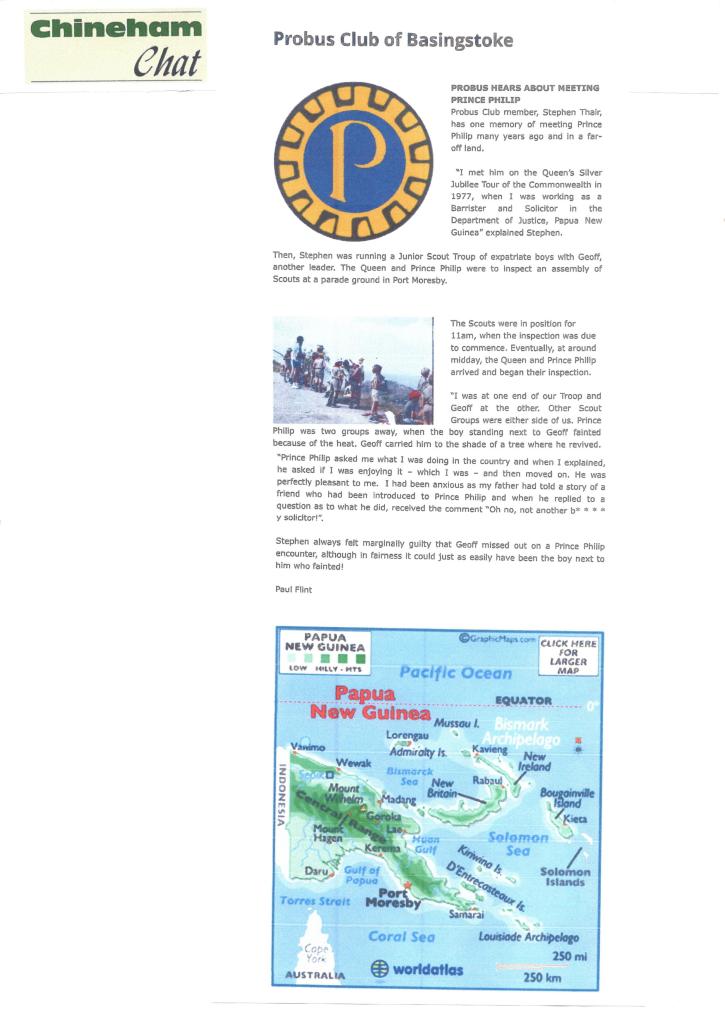
A full house for the June local magazines. All featured the story of Stephen Thair meeting Prince Philip in Papua New Guinea in 1977. Clearly the recent passing of the Duke of Edinburgh was the catalyst for the editors seeing this report as being pertinent for their readership.

My Memory of Meeting Prince Philip
by Stephen Thair

Like most of the nation, following the passing of the Prince Philip, Duke of Edinburgh on 9th April, Probus Club of Basingstoke member Stephen Thair was sure that he was not the only member with reminiscences of this man who had been present throughout his life. One memory was from many years ago and in a far-off land.

 “I was fortunate to meet him briefly on the Queen’s Silver Jubilee Tour of the Commonwealth in 1977, when I was working as a Barrister and Solicitor in the Department of Justice, in Port Moresby, Papua New Guinea” explained Stephen.  “With my wife, Margaret, we had arrived there In April 1975, and so were able to watch some of the ceremonies when the country achieved independence in September that year, when Prince Charles came to do the honours, so to speak.”

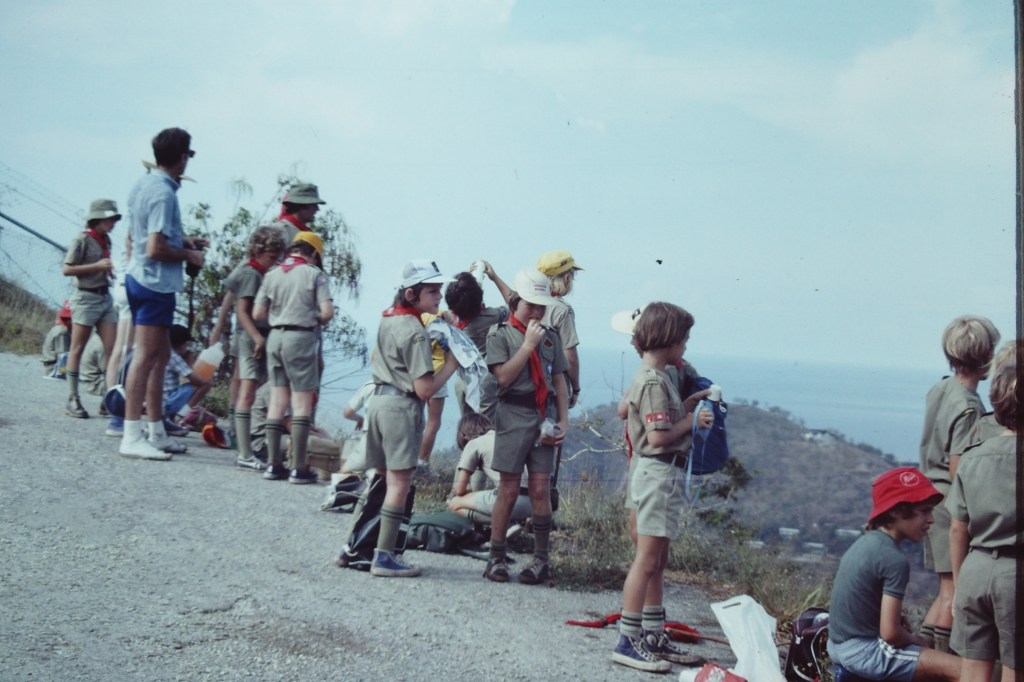
At the time of the Silver Jubilee Tour, he was running a Junior Scout Troup of mainly expatriate boys (the PNG equivalent of a Cub Pack) with another leader, an Australian Scouter called Geoff. The final engagement of the Queen and Prince Philip in Papua New Guinea before they left for the next leg of their journey was to inspect an assembly of PNG Scouts and Guides. They were lined up for the royal inspection in a giant horse-shoe on the Murray Barracks’ parade ground in Port Moresby, with the Guides forming one side of the horse-shoe, and the Scouts the other.

The Scouts and Guides being well-organised were all in position for 11am, when the inspection was due to commence, with the pipe band of the Pacific Islands Regiment behind them. However, 11am came and went, with no sign of the royal party. The tropical sun rose ever higher in the sky over the parade ground, and it was, to say the least, very hot. Eventually, at around midday, the Queen and Prince Philip and their escort arrived. The Pacific Islands Regiment band began to play, and the Queen and Prince Philip began their inspections, accompanied in each case by the great and the good of PNG Guiding and Scouting.

“Our troop was in line with me at one end of it, and Geoff at the other end. We had other Scout Groups either side of us. Prince Philip and his party were about two groups away from us on the inspection, when the boy standing next to Geoff fainted because of the heat, and Geoff had to carry him off to the shade of a tree where fortunately he revived. However, by then Prince Philip had arrived at our Group, and so Geoff missed out, and I was the only representative for him to speak to.”

1st Boroko Scouts at Burn’s Peak Port Moresby October 1976

“Prince Philip asked me what I was doing in the country and when I had explained, he asked if I was enjoying it – which I was – and then moved on. He was perfectly pleasant to me.  I had been a bit anxious as my father had told me a story of a solicitor friend of his who had been introduced to Prince Philip at an event of some kind, and when he replied to a question from Prince Philip as to what he did, received the comment “Oh no, not another b* * * * y solicitor!”. 

Thus, another interesting PNG experience drew to a close. Stephen always felt marginally guilty that Geoff missed out on a Prince Philip encounter, although in fairness it could just as easily have been the boy next to him who fainted!

Publicity During Covid Lockdown – part 14

Here are the results of our publicity in the local magazines for May.

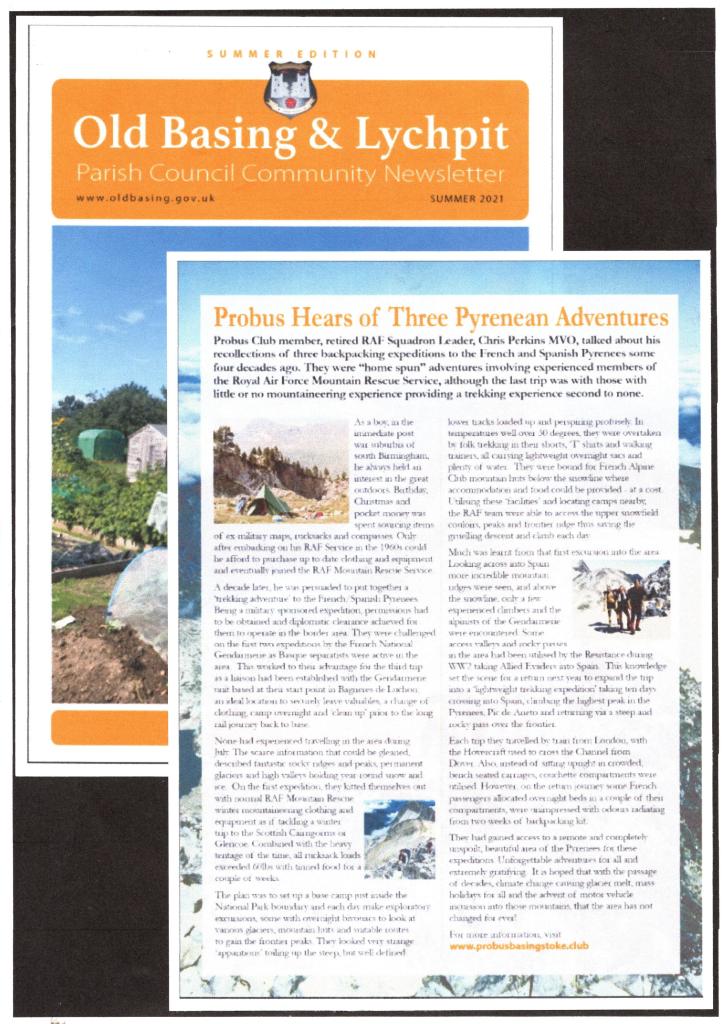
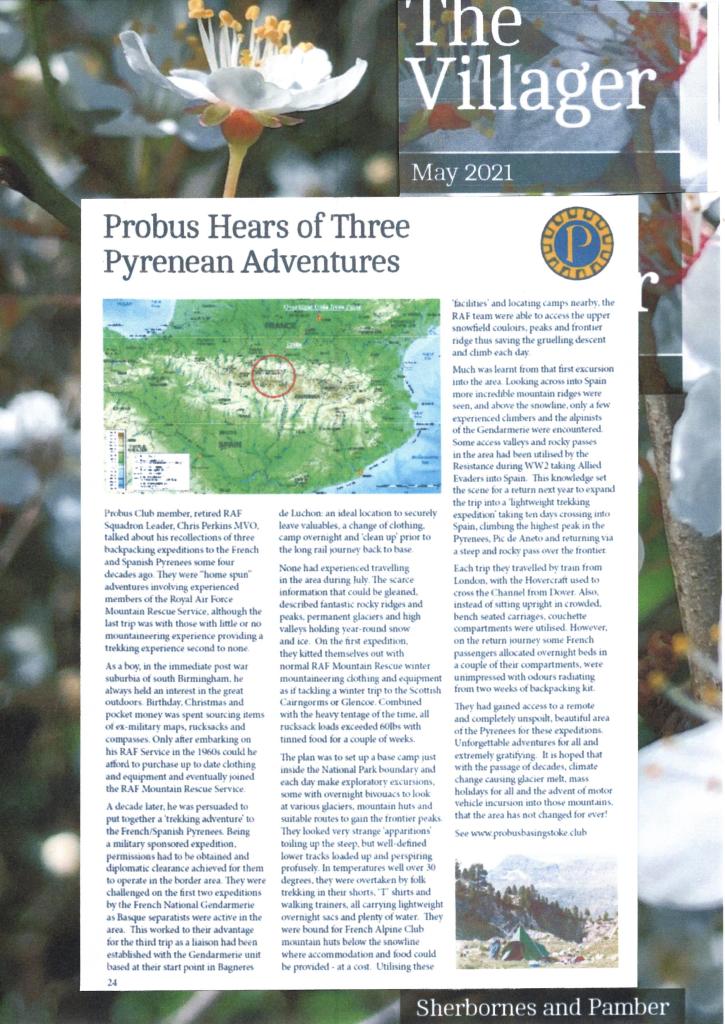
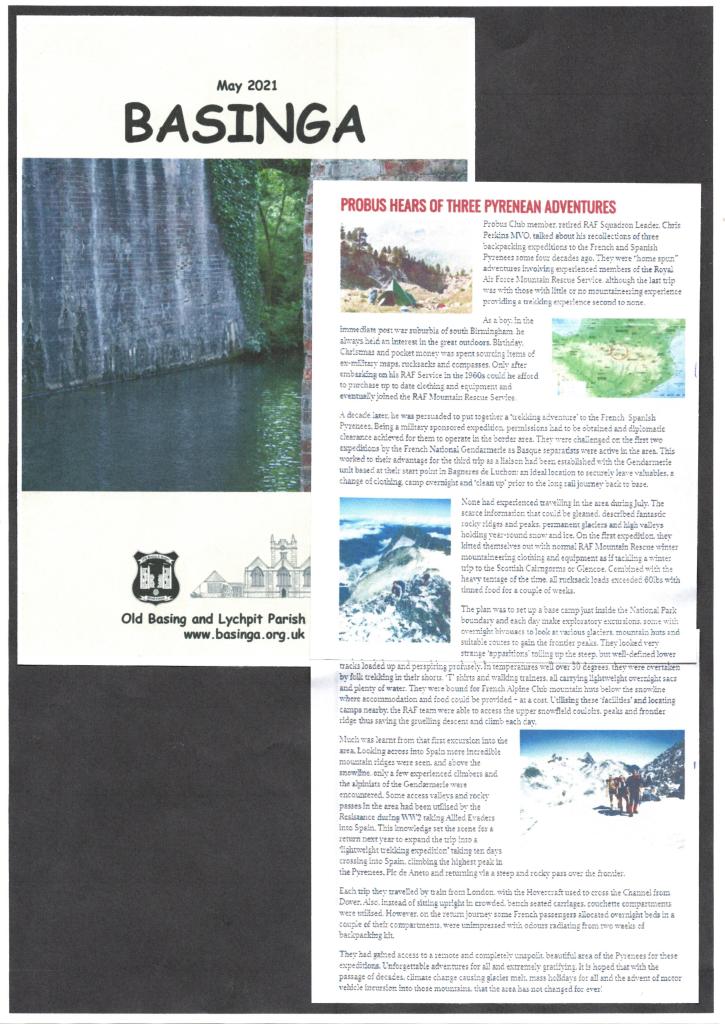
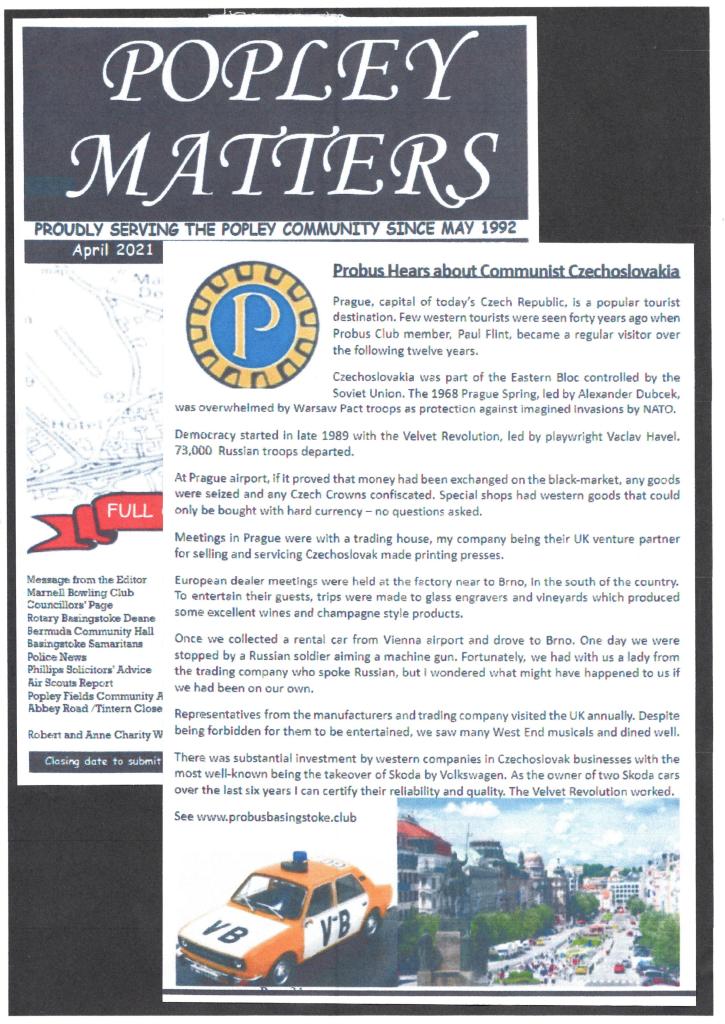
The subject was the report by Chris Perkins about three mountaineering trips to the Pyrenees and full pages were given by the Rabbiter, Kempshott Kourier and Villager while the others used the short version. The Basinga featured the full report in their Extra web pages as did the Chineham Blog. We did not feature (again) in the Loddon Valley Link but we did appear in the CommunityAd magazine for Overton & Oakley. There is also a Popley Matters that was missed last month that features the report about Communist Czechoslovakia. This magazine has now ceased publishing due to the editor and her assistant, Cllrs Jane and Paul Frankum,  not standing again in the recent elections.

Click on any magazine to enlarge so as to be able to read the text.

Three Pyrenean Adventures

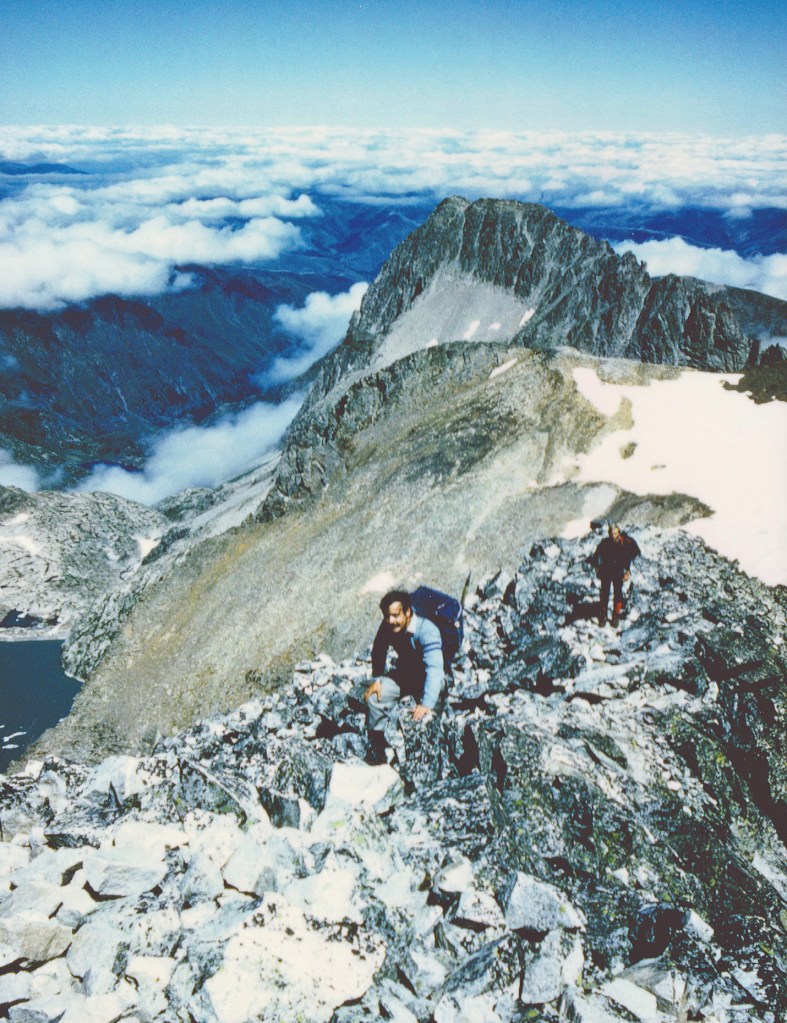
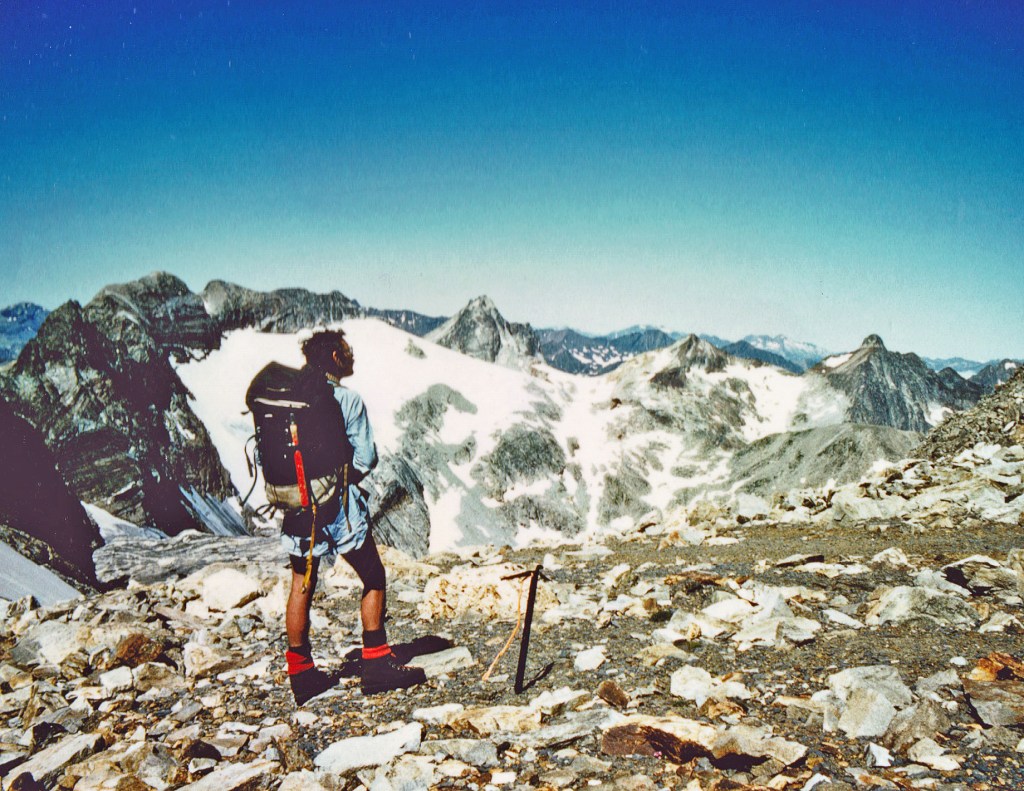
Probus Club member, retired RAF Squadron Leader, Chris Perkins MVO, talked about his recollections of three backpacking expeditions to the French and Spanish Pyrenees some four decades ago. They were “home spun” adventures involving experienced members of the Royal Air Force Mountain Rescue Service, although the last trip was with those with little or no mountaineering experience providing a trekking experience second to none.

As a boy, in the immediate post war suburbia of south Birmingham, he always held an interest in the great outdoors. Birthday, Christmas and pocket money was spent sourcing items of ex-military maps, rucksacks and compasses. Only after embarking on his RAF Service in the 1960s could he afford to purchase up to date clothing and equipment and eventually joined the RAF Mountain Rescue Service.

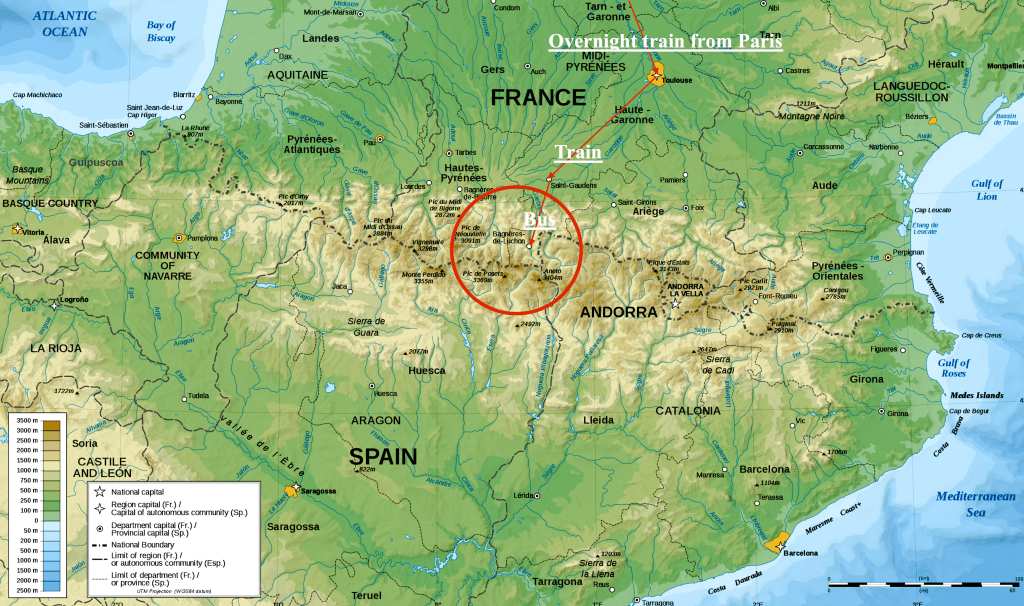
A decade later, he was persuaded to put together a ‘trekking adventure’ to the French/Spanish Pyrenees. Being a military sponsored expedition, permissions had to be obtained and diplomatic clearance achieved for them to operate in the border area. They were challenged on the first two expeditions by the French National Gendarmerie as Basque separatists were active in the area.  This worked to their advantage for the third trip as a liaison had been established with the Gendarmerie unit based at their start point in Bagneres de Luchon: an ideal location to securely leave valuables, a change of clothing, camp overnight and ‘clean up’ prior to the long rail journey back to base.                  

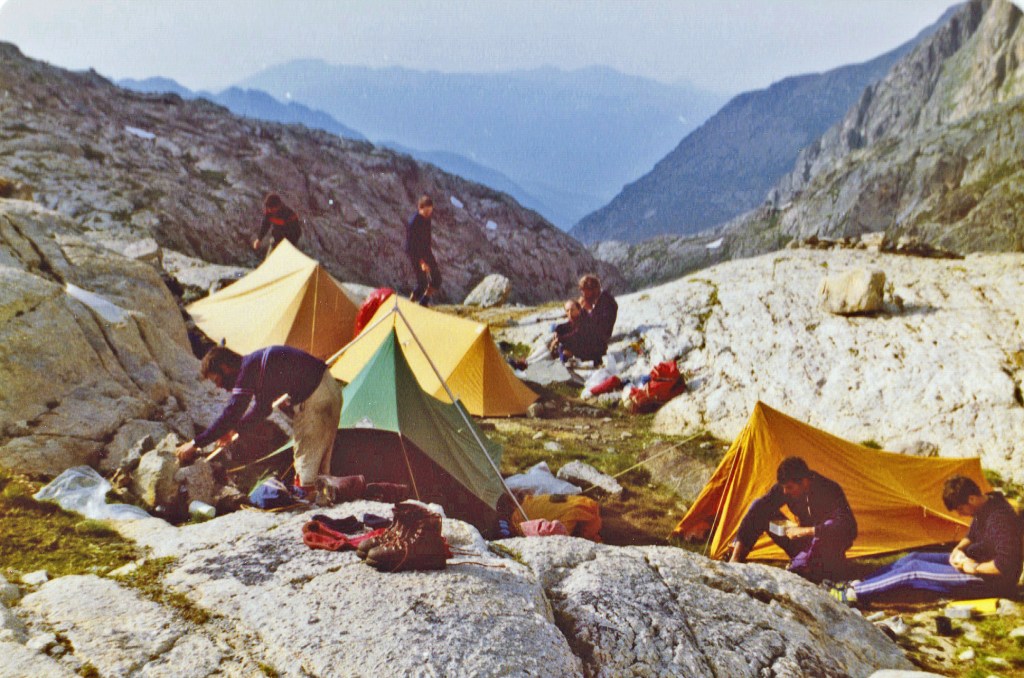
None had experienced travelling in the area during July. The scarce information that could be gleaned, described fantastic rocky ridges and peaks, permanent glaciers and high valleys holding year-round snow and ice.  On the first expedition, they kitted themselves out with normal RAF Mountain Rescue winter mountaineering clothing and equipment as if tackling a winter trip to the Scottish Cairngorms or Glencoe. Combined with the heavy tentage of the time, all rucksack loads exceeded 60lbs with tinned food for a couple of weeks. 

The plan was to set up a base camp just inside the National Park boundary and each day make exploratory excursions, some with overnight bivouacs to look at various glaciers, mountain huts and suitable routes to gain the frontier peaks. They looked very strange ‘apparitions’ toiling up the steep, but well-defined lower tracks loaded up and perspiring profusely. In temperatures well over 30 degrees, they were overtaken by folk trekking in their shorts, ‘T’ shirts and walking trainers, all carrying lightweight overnight sacs and plenty of water.  They were bound for French Alpine Club mountain huts below the snowline where accommodation and food could be provided – at a cost.  Utilising these ‘facilities’ and locating camps nearby, the RAF team were able to access the upper snowfield couloirs, peaks and frontier ridge thus saving the gruelling descent and climb each day.

Much was learnt from that first excursion into the area. Looking across into Spain more incredible mountain ridges were seen, and above the snowline, only a few experienced climbers and the alpinists of the Gendarmerie were encountered. Some access valleys and rocky passes in the area had been utilised by the Resistance during WW2 taking Allied Evaders into Spain.  This knowledge set the scene for a return next year to expand the trip into a ‘lightweight trekking expedition’ taking ten days crossing into Spain, climbing the highest peak in the Pyrenees, Pic de Aneto and returning via a steep and rocky pass over the frontier.

Each trip they travelled by train from London, with the Hovercraft used to cross the Channel from Dover. Also, instead of sitting upright in crowded, bench seated carriages, couchette compartments were utilised. However, on the return journey some French passengers allocated overnight beds in a couple of their compartments, were unimpressed with odours radiating from two weeks of backpacking kit. 

They had gained access to a remote and completely unspoilt, beautiful area of the Pyrenees for these expeditions. Unforgettable adventures for all and extremely gratifying.  It is hoped that with the passage of decades, climate change causing glacier melt, mass holidays for all and the advent of motor vehicle incursion into those mountains, that the area has not changed for ever!