The report on the talk by our Hon Secretary, Stephen Thair, about Creatures Great and Small was received well by the local magazines.
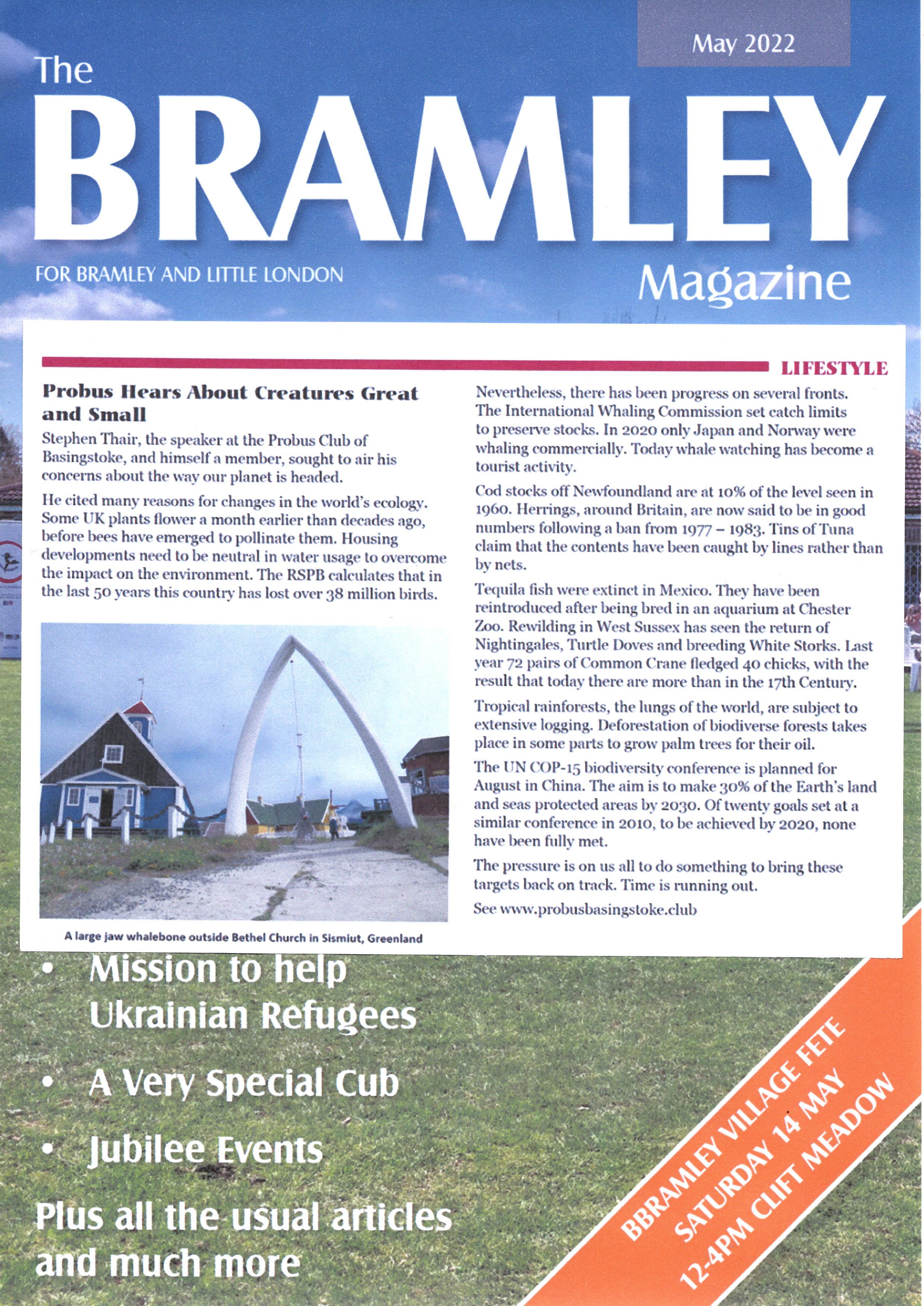
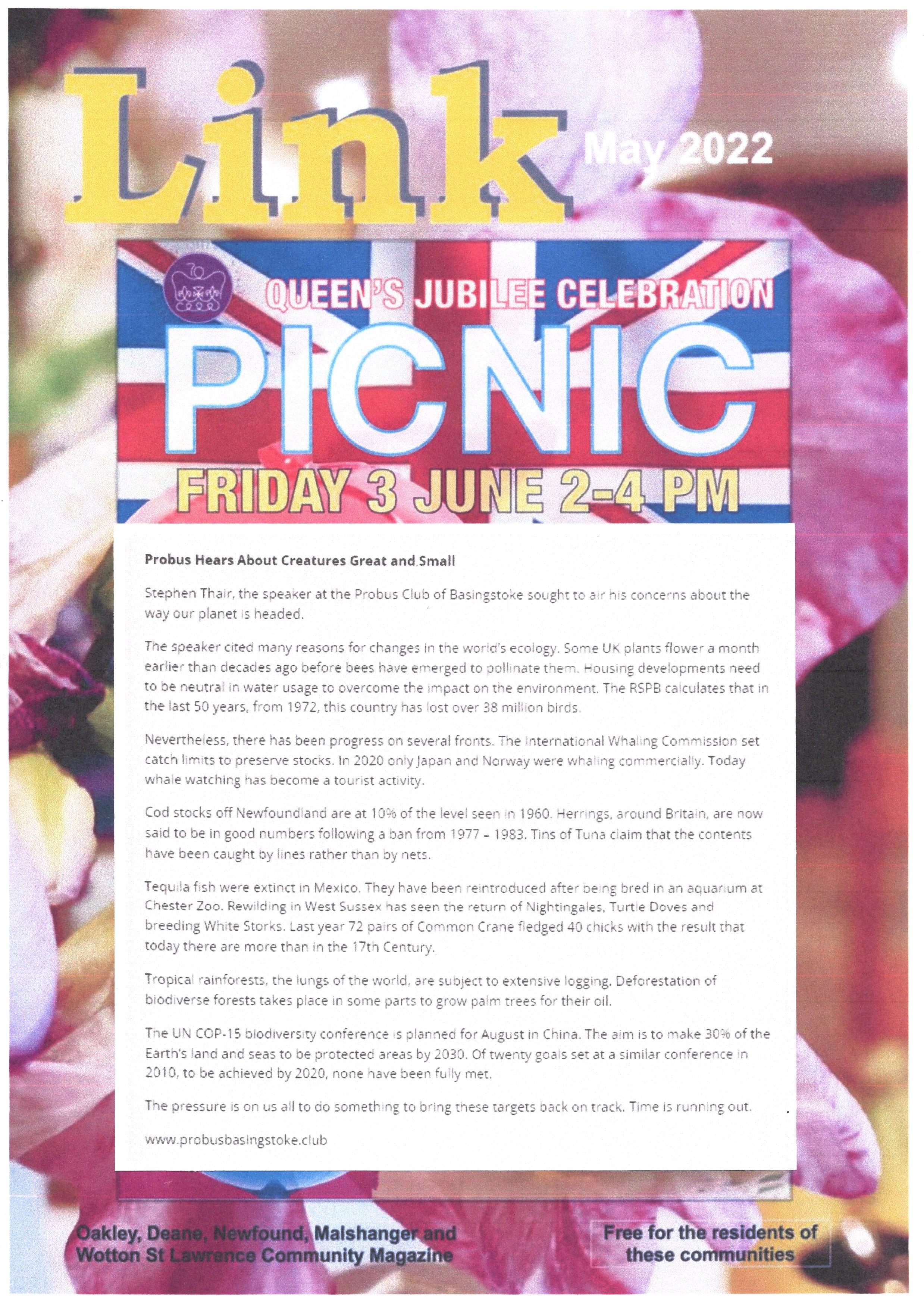
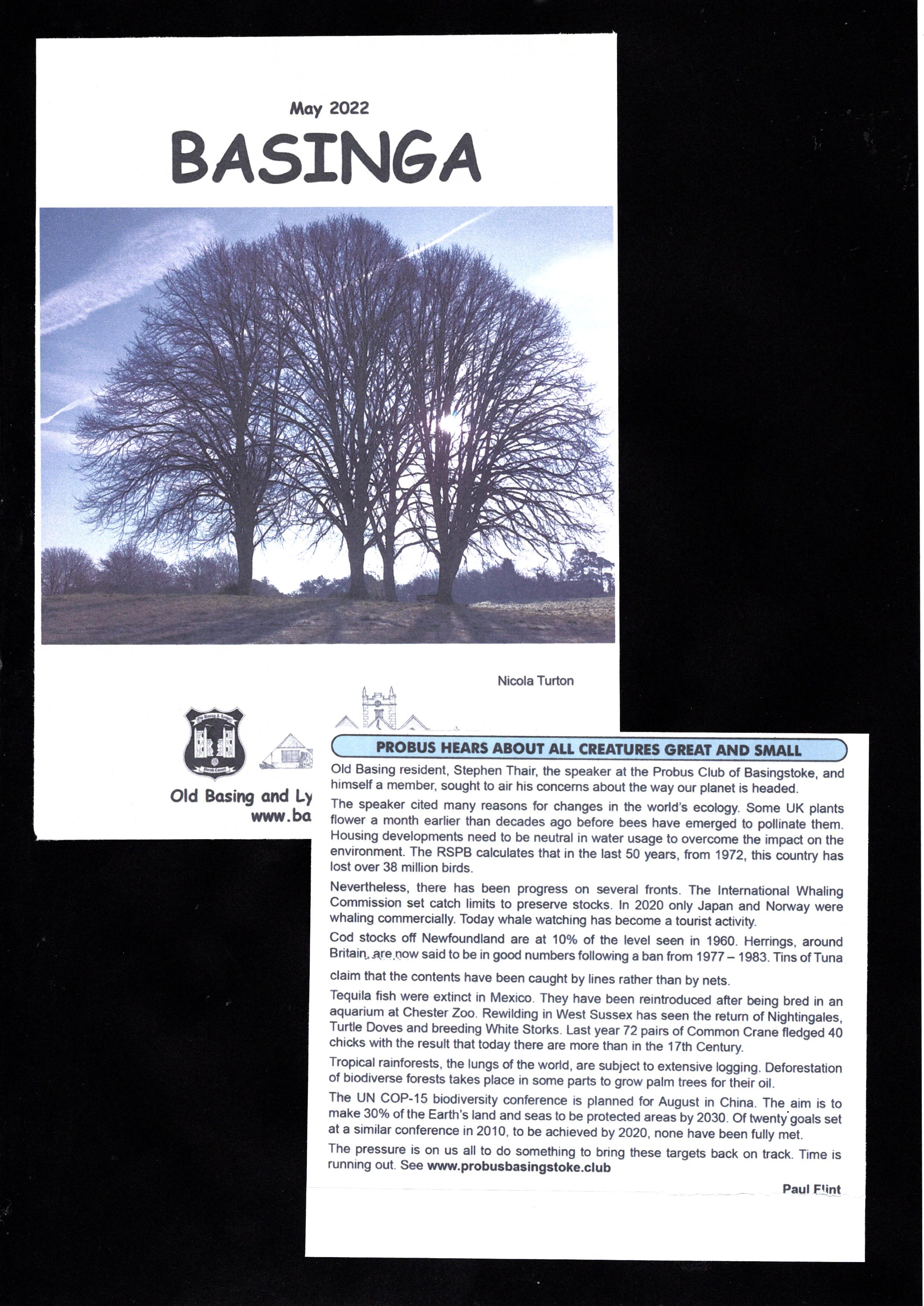
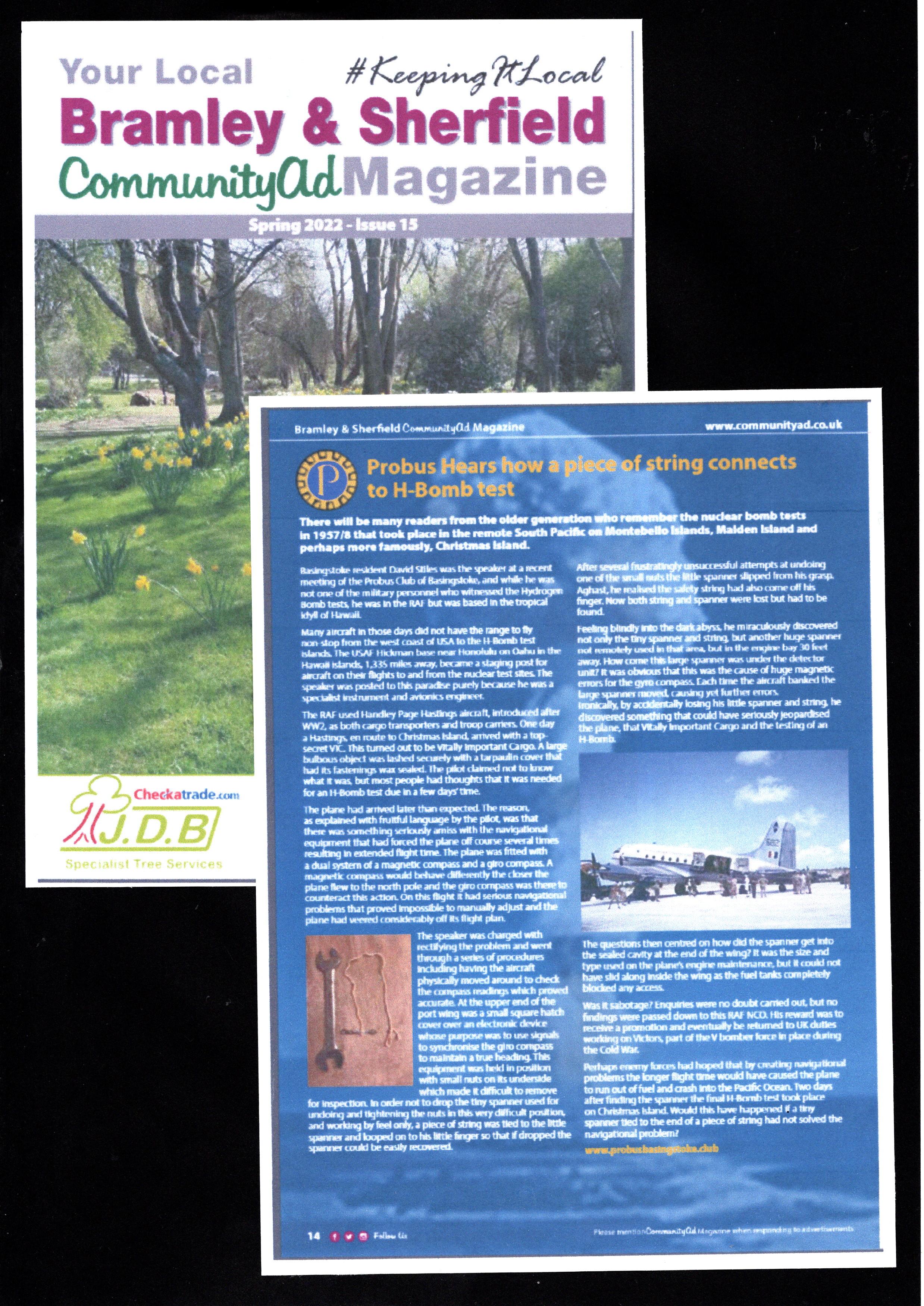
The full report was featured by the Rabbiter and Kempshott Kourier while the short version was published in the Bramley, Basinga and on the web site of the Link. The CommunityAd magazine for Bramley & Sherfield features the older report about the atom bomb and a piece of string.
While not unusual in failing to feature in the Loddon Valley Link magazine, for once, and for an unknown reason, our report did not feature in the Villager magazine.
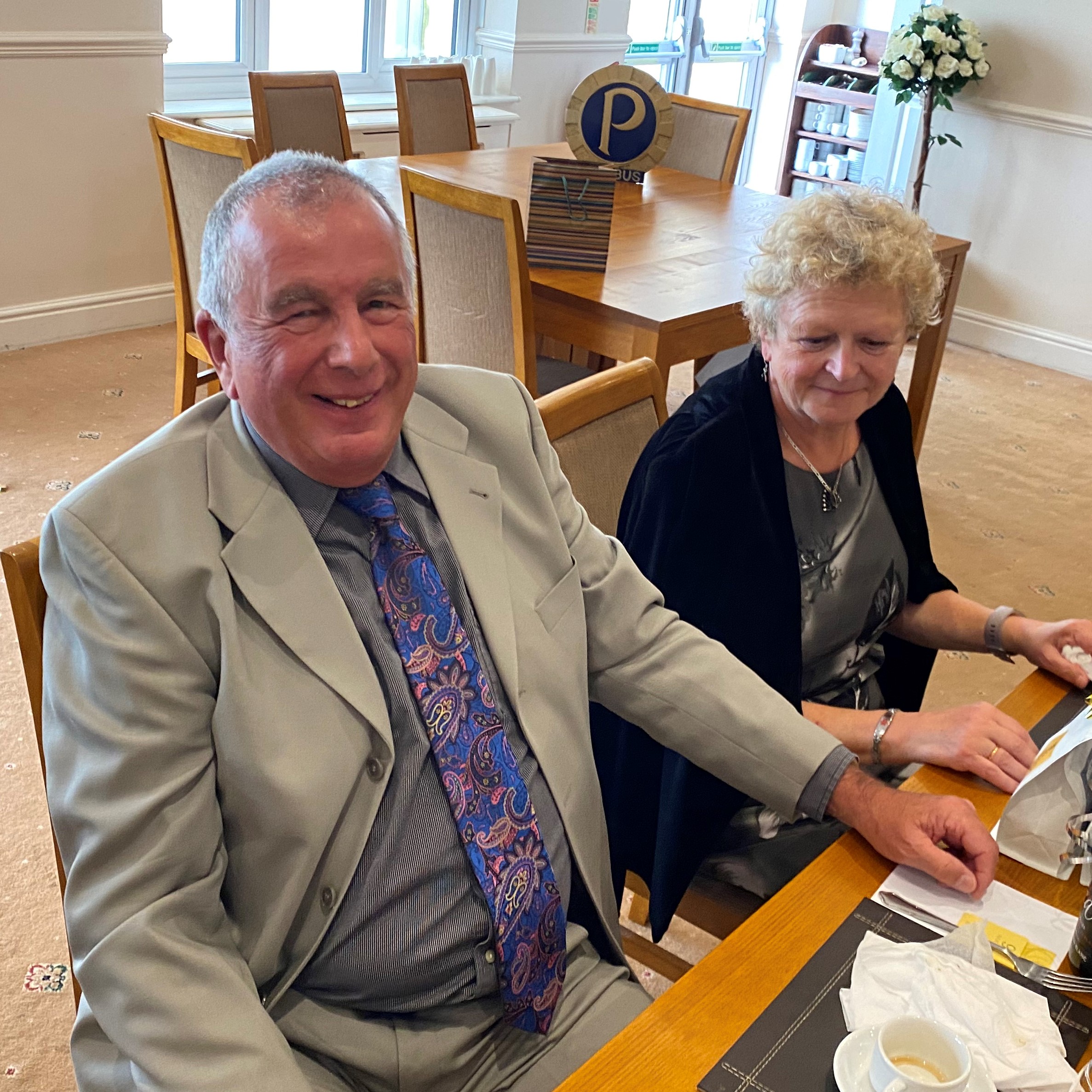
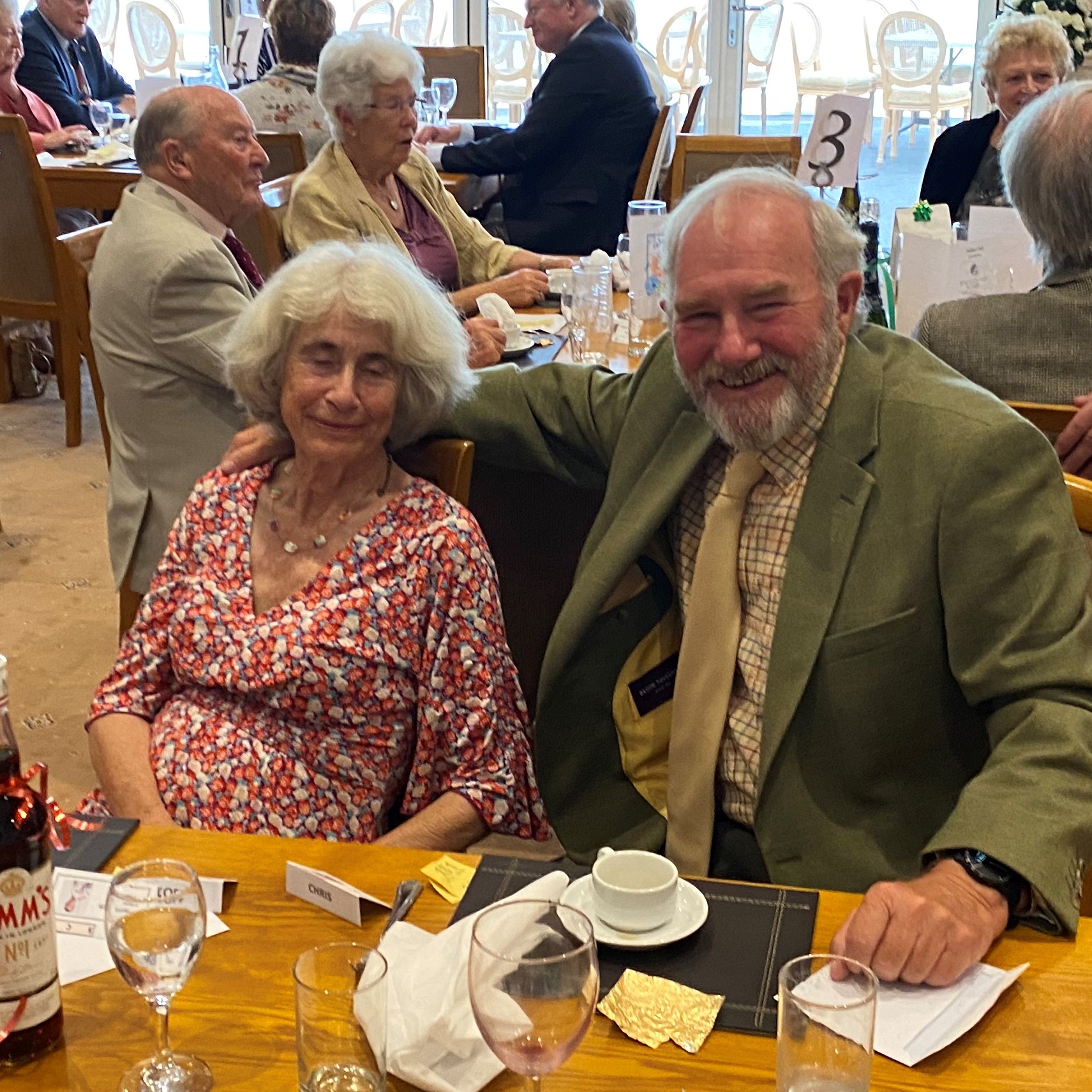
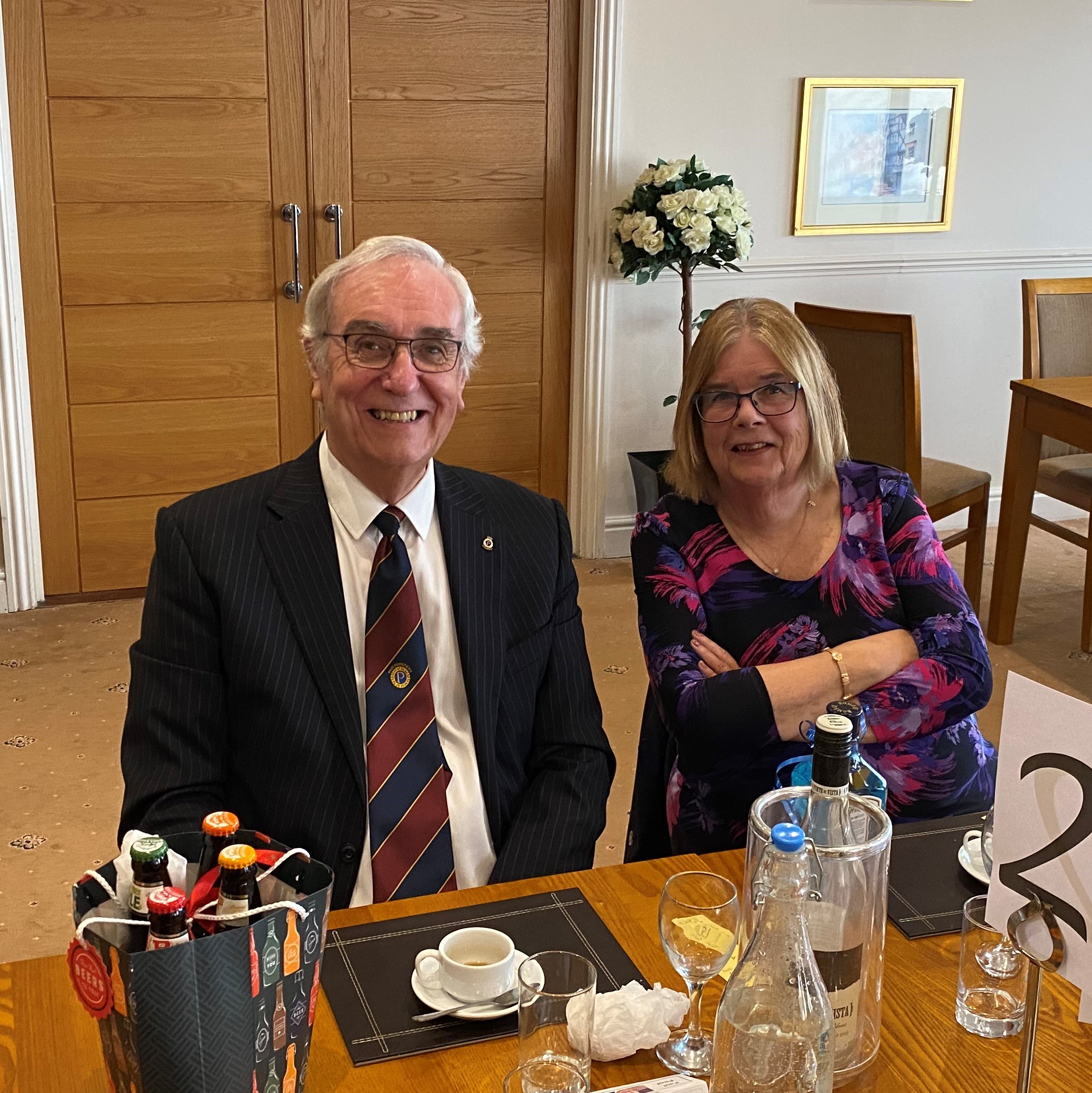
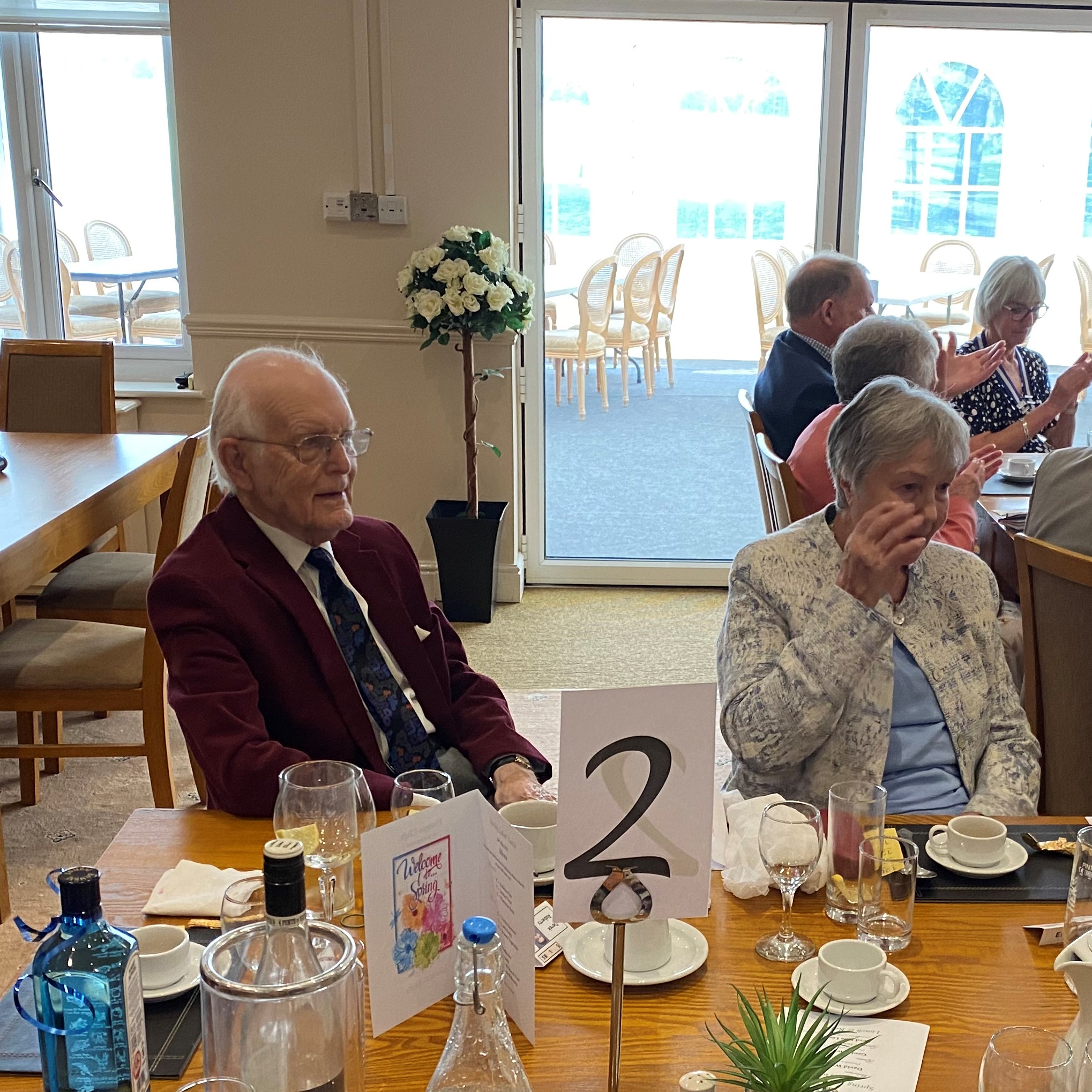
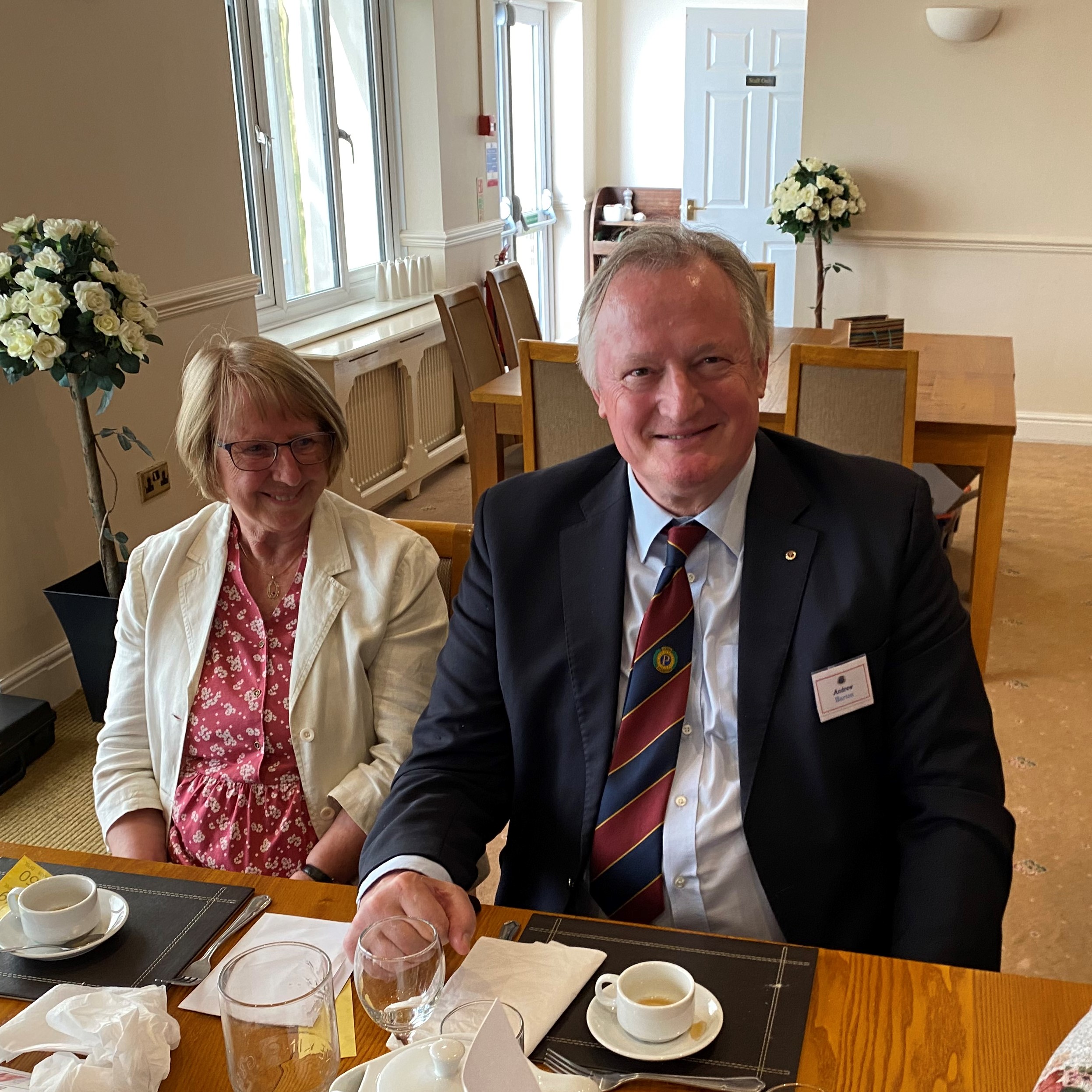
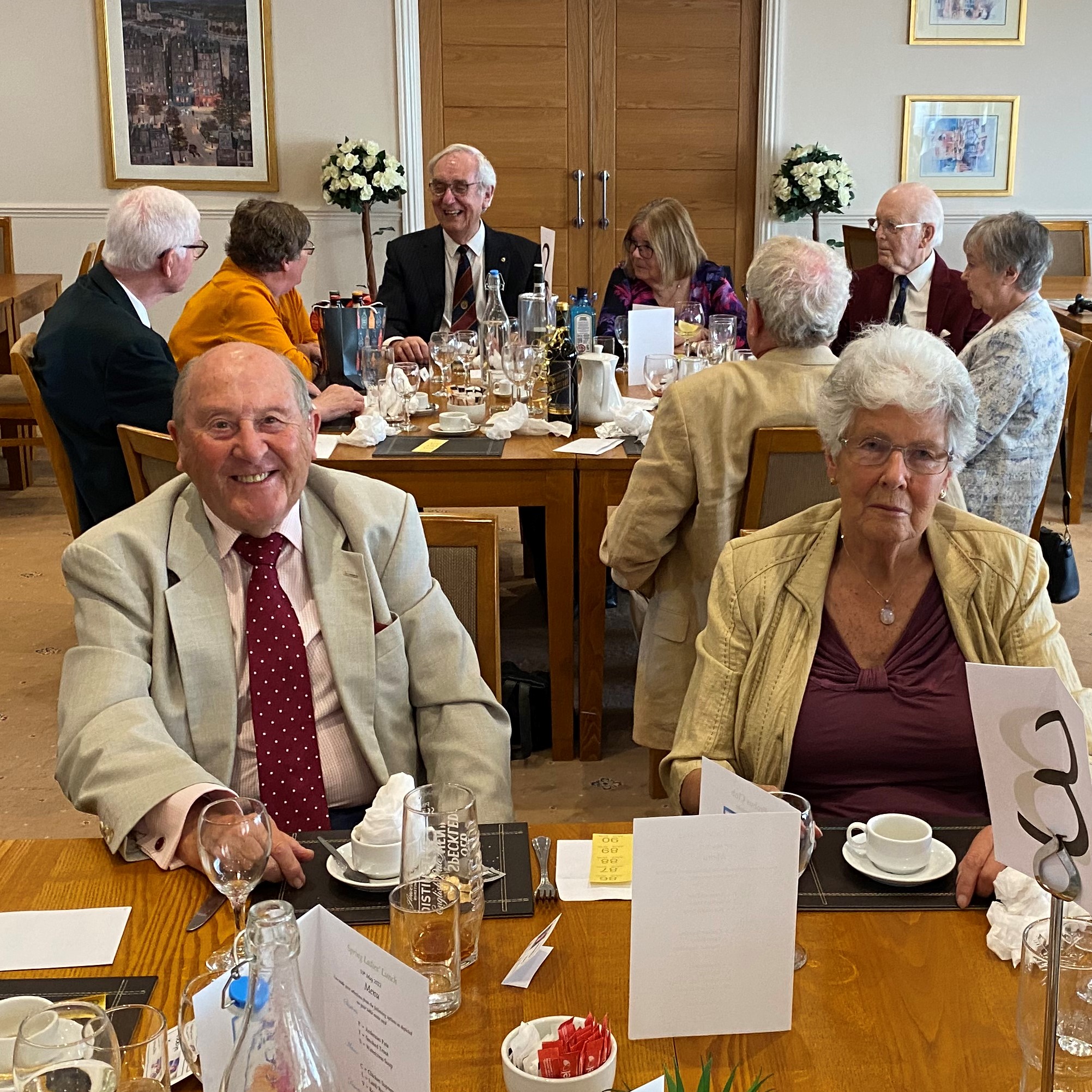
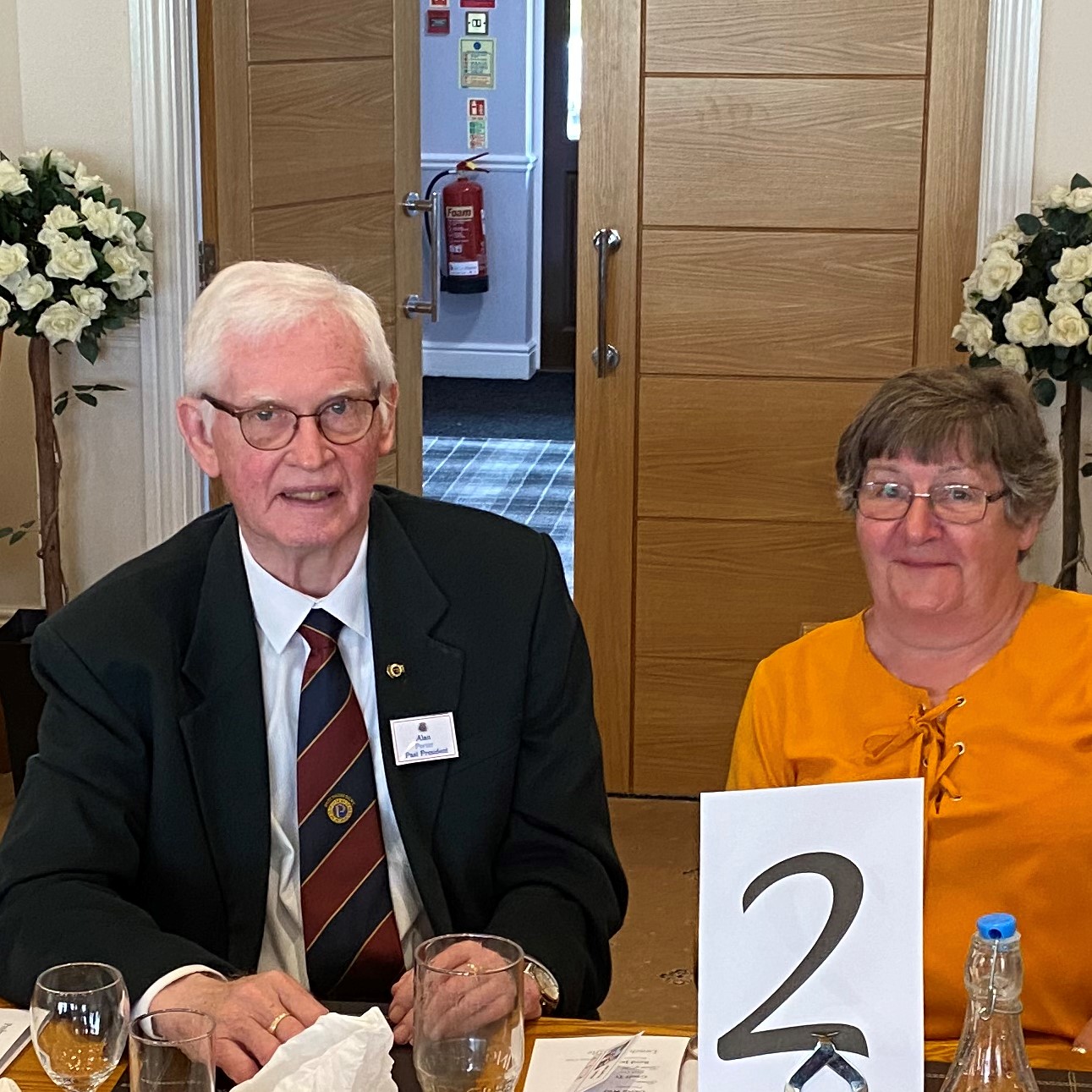
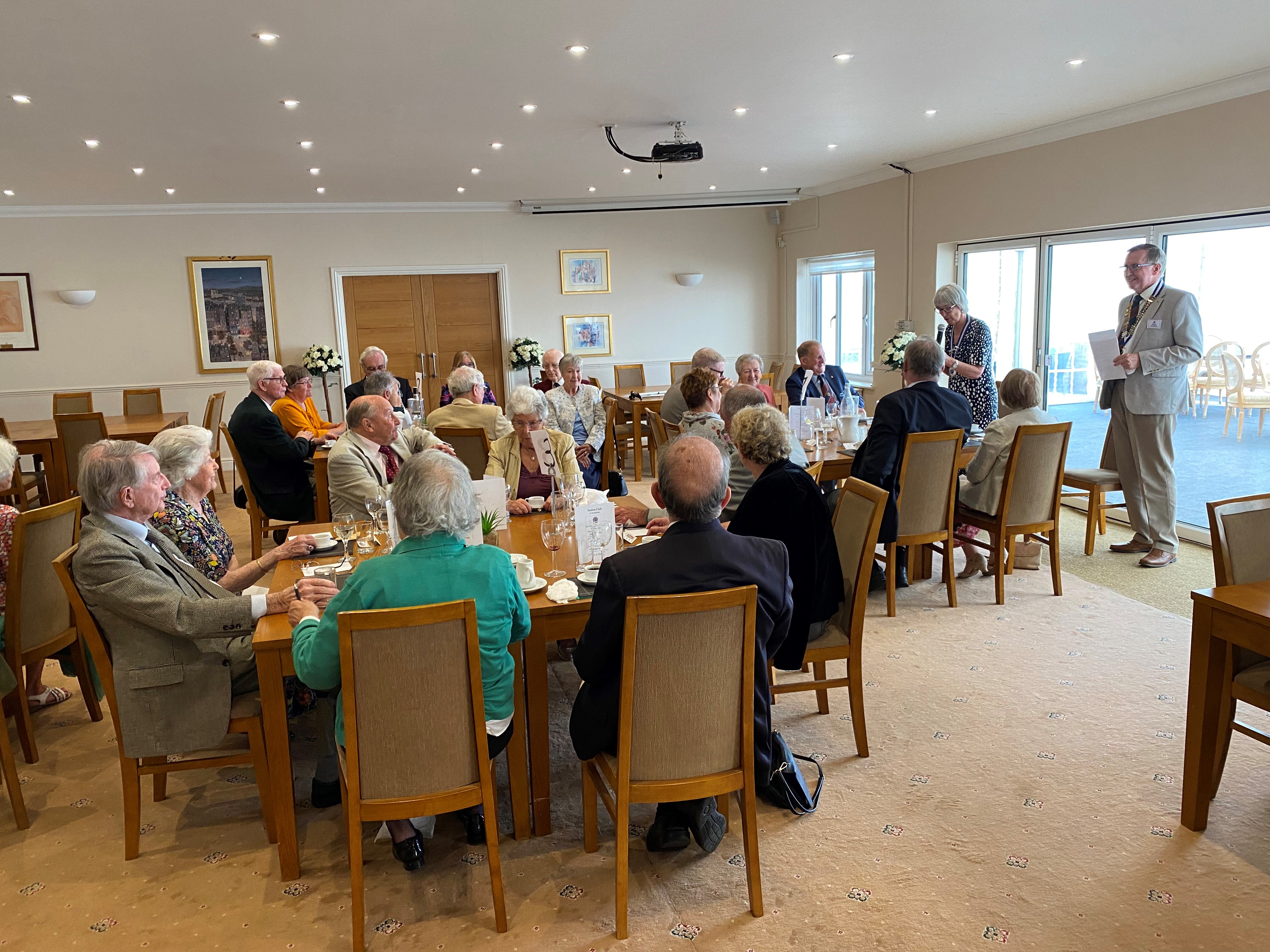
Despite all the concerning, recent changes at the Test Valley Golf Club the Spring Ladies’ Lunch was a complete success. The new chef produced excellent food on the day, and it appears that all 32 attendees are carnivores since no one selected the main course option of roasted vegetables.
The members on the table with your correspondent had every option available and all were very complimentary about the quality of the food.
Revd Jane Leese, president of the Ladies’ Probus Club of Basingstoke, was the guest of honour and gave an outline of her move from being a teacher into church ministry only two years after the ordination of women priests was allowed.
Guest of Honour Revd Jane Leese, President of the Basingstoke Ladies’ Probus Club with President David Wickens
Unfortunately it did not prove possible to take a photograph of Michael & Pam Luck or that of Dave Kitson with Hilary Shopland. Apologies are offered to all concerned.
The benefits of having an arranged trip to Salisbury Cathedral manifests themselves with small nuggets of information that evade the casual visitor. Such things came to the fore when members and wives/partners of the Probus Club of Basingstoke visited Salisbury Cathedral and to Arundells, situated in Cathedral Close, the home of the ex-prime minister Sir Edward Heath who is buried in the cathedral.
A guided tour of the cathedral was only able to gloss over the surface, but it was enthralling learning about the foundation of what has become known as the cathedral that moved. The original cathedral shared space with the local garrison but relations soured so much that the Pope gave permission to build a new place of worship. An arrow was fired and where it landed would be the site, but it hit a deer that eventually died where the cathedral now stands.
The foundation stone was laid in 1220 but the eight hundredth anniversary could not be celebrated as the building was a vaccination centre during the Covid-19 pandemic.
The dimensions and logistics are extraordinary. It took only 38 years to build and used 60,000 tons of stone, 2,800 tons of oak and 420 tons of lead and all this sits on foundations of only four feet.
The Nave. The dark columns are polishedstone
Several rivers pass beneath the building and the presence of water maintains the firmness of the ground. The water level is regularly checked with a dip stick.
Demonstrating the water level dip stick
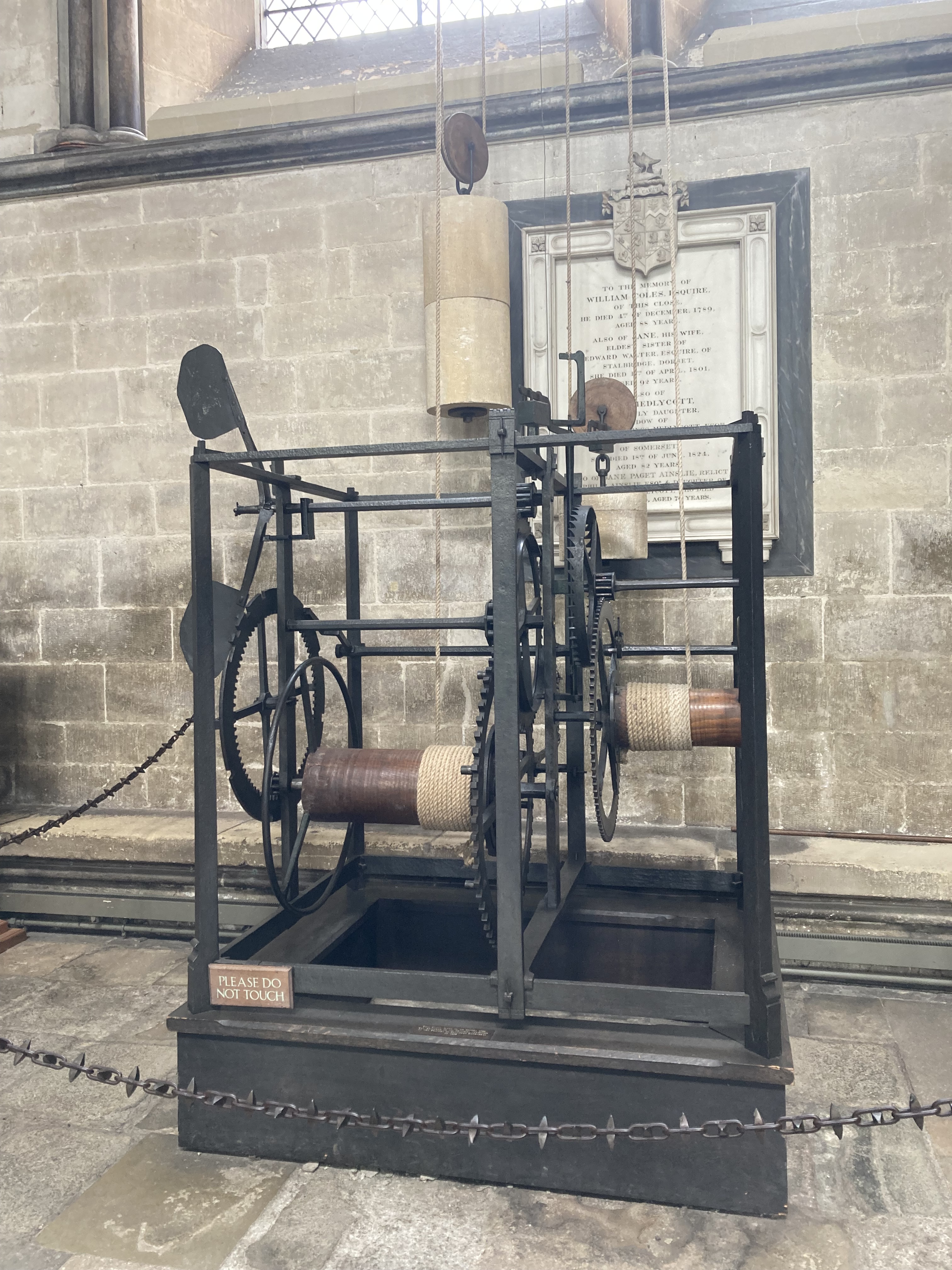
This constant supply of water is used in the modern font which is over ten feet across and has overflowing spouts at four corners clearly demonstrating the style of infinity pools. In opposition to this is the world’s oldest working mechanical clock which has no dials but rings the hours. For a church of such size the cathedral does not possess a change ring of bells typically seen in our churches.
The 14th century choir (or quire) that today has a membership of girls with the traditional boys
Salisbury Cathedral houses what is claimed to be the finest of the four remaining copies of the Magna Carta, signed by King John in 1215. This is on permanent display in the Chapter House. Photography not permitted.
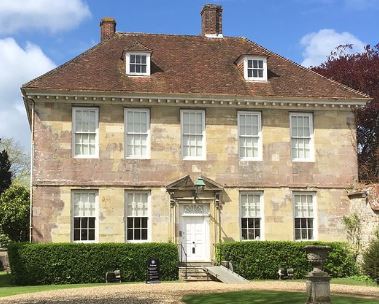
A short stroll diagonally across Cathedral Close sits Arundells, now known as the Prime Minister’s home. It was home for the last twenty years of ex-prime minister Sir Edward Heath and was bequeathed to a charitable foundation set up in Sir Edward’s name following his death in 2005.
Arundells the home of Sir Edward Heath
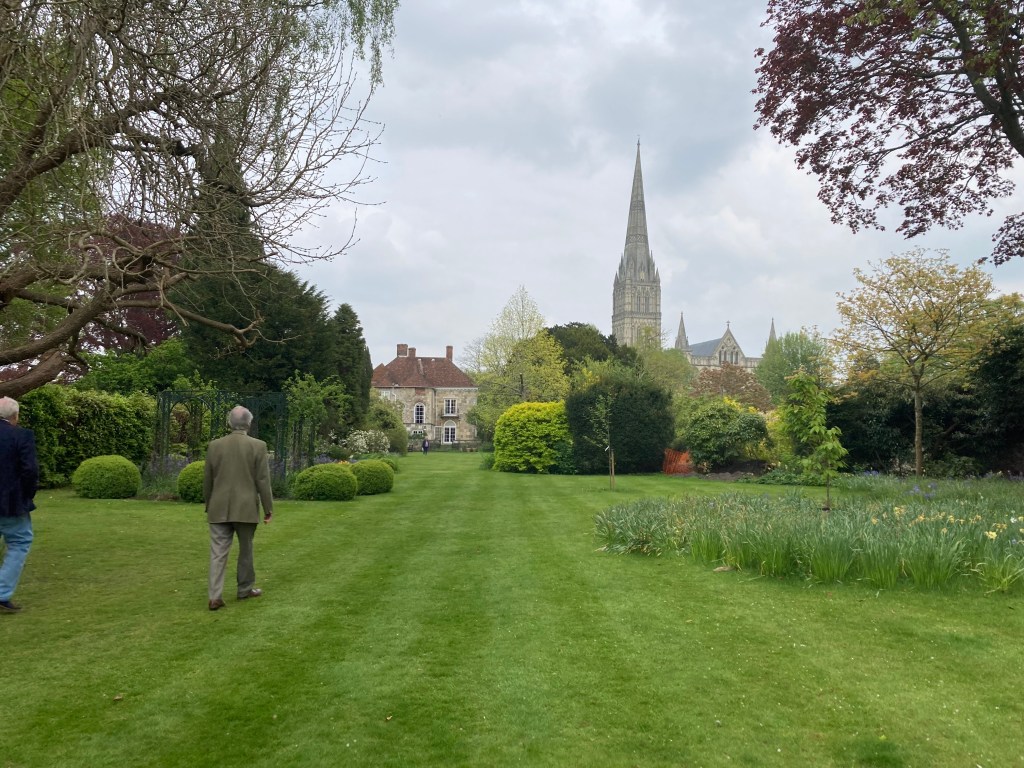
Parts of the house go back to the 13th century and six architectural periods are visible and it is set in a two-acre walled garden that stretches down to the confluence of the rivers Avon and Nadder, with amazing views back towards the spire of Salisbury Cathedral.
Inside the house has been largely left as it was when Sir Edward lived here with gifts displayed from world leaders such as Richard Nixon, Chairman Moa and Fidel Castro and many photographs depicting a life spent in politics.
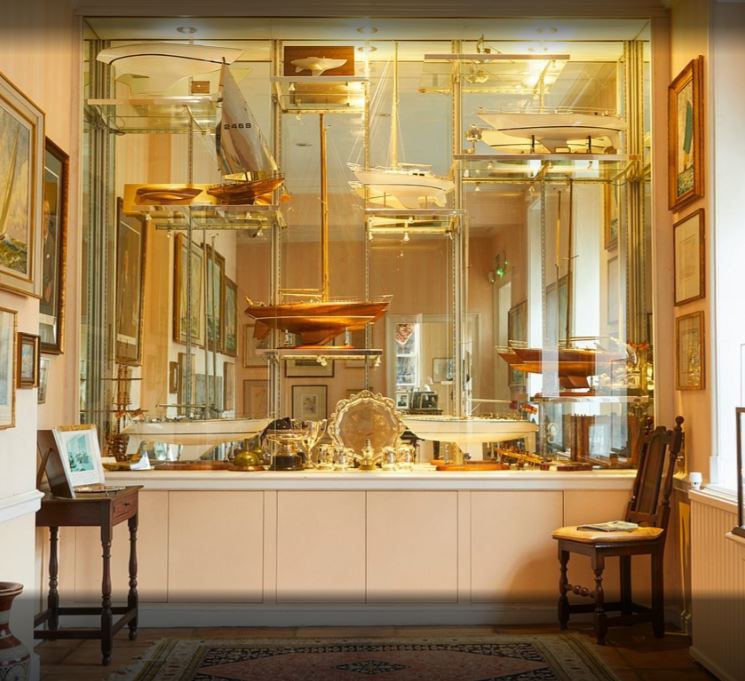
Display case showing models of the five versions of Morning Cloud yachts
Only taking up sailing at the age of 50 Sir Edward became a successful sportsman. There is a collection of models of Morning Cloud yachts, which is the name most people remember when Sir Edward was the owner and skipper of the winning British crew of the Sydney to Hobart yacht race. Because the sail number 2468 was allowed to be transferred, Sir Edward named four subsequent boats to also be called Morning Cloud.
As well as paintings of his boats the house is decorated throughout with original paintings, some by famous artists including two by Sir Winston Churchill, L S Lowry and Augustus John. There are beautiful collections of ceramics, glassware and sculptures and treasures from the Far East – including hand painted Chinese wallpaper, and a stunning collection of Japanese woodblock prints.
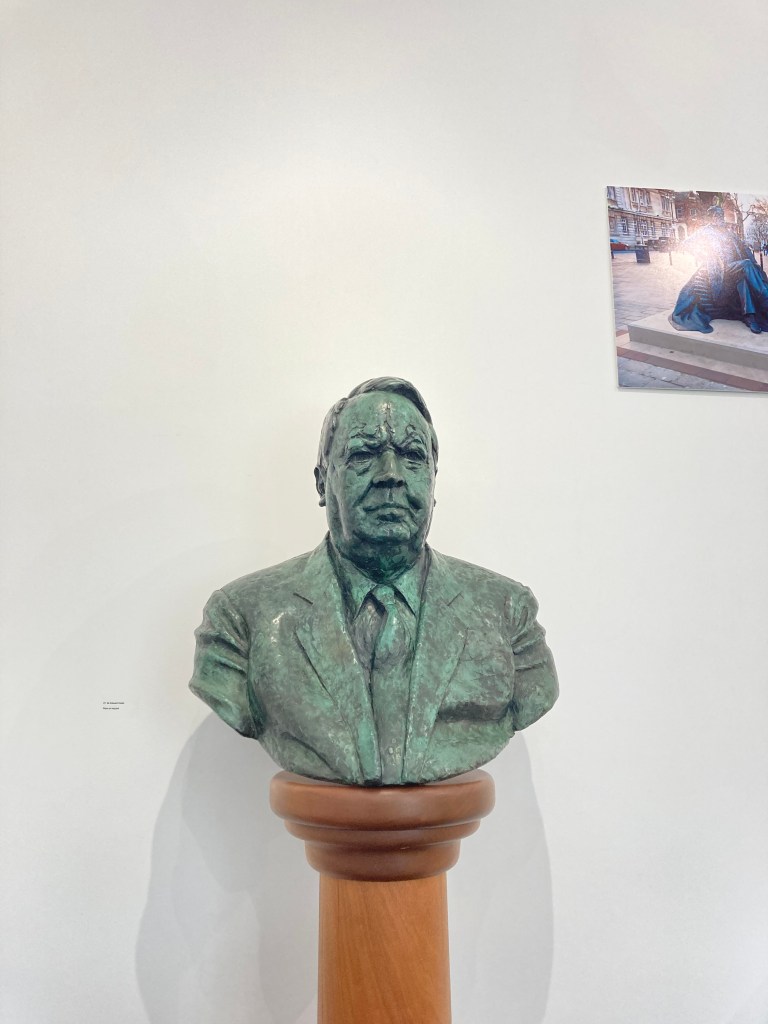
Life size bronze bust of Sir Edward Heath
Many bronze sculptures can be seen in an adjoining building with life size busts of Sir Edward Heath and HM Queen Elizabeth the Queen Mother. Some depicting other famous people are available to buy but need a fat wallet.
The house is open from the middle of March to 1st November this year, with guided tours on Tuesdays which provide the visitor with a greater sense, not only about its last inhabitant, but also the great history of this house so connected to Salisbury Cathedral.
Garden of Arundells with its view of the spire of Salisbury Cathedral
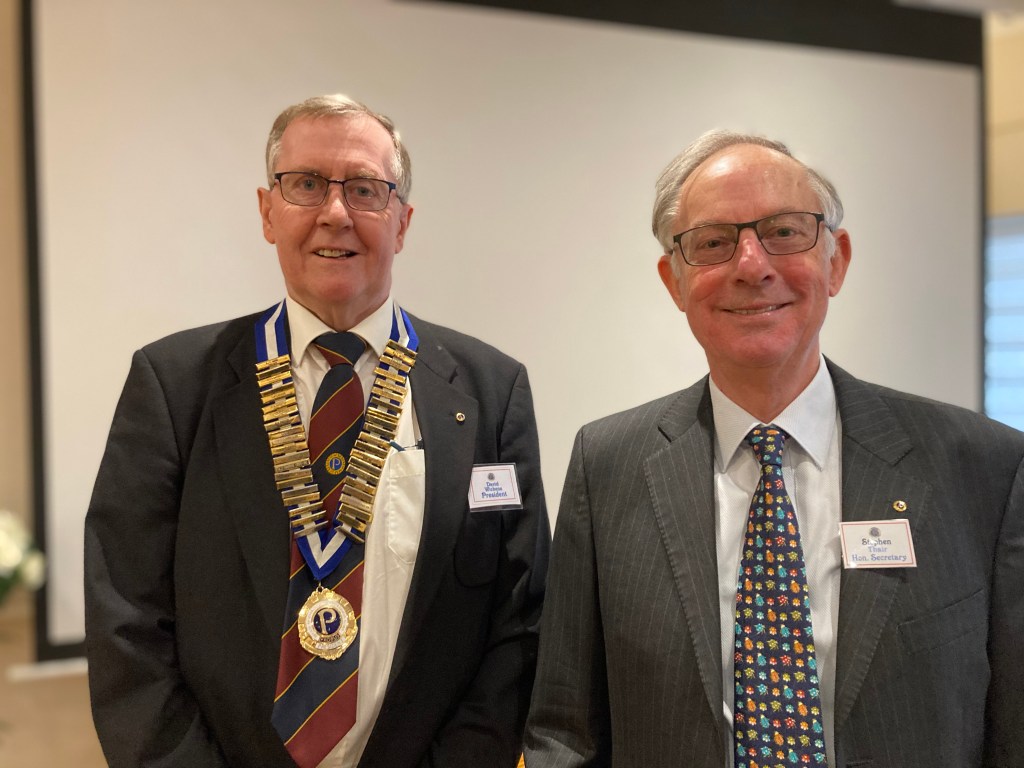
President David Wickens with Speaker Stephen Thair
Most of the senior readers will remember times during the 1950s when the only “foreign” animals school children would see were either those lucky enough to visit a zoo or see Tarzan films at the cinema or on small black and white televisions in programmes such as David Attenborough’s Zoo Quest and those of intrepid explorers Armand and Michaela Dennis and under water film makers Hans and Lotte Hass.
Hans & Lotte Hass
Today, it is a different situation with both the increase in foreign travel that allow face to face experiences with exotic creatures and locations but also for the considerable amount of television programmes that these days highlight concerns about global warming with its danger to animals, plants and humankind.
The speaker, Stephen Thair, himself a member of the Probus Club of Basingstoke, sought to bring his concerns about the way our planet is heading at the latest meeting of this club for retired professional and business managers.
The RSPB’s recent Big Garden Birdwatch had over 700,000 participants and spotted 11 million birds. This may sound a lot, and there have been some increases in certain species, but the organisation calculates that in the last 50 years, from 1972, this country has lost over 38 million birds. Having said that, and because they are more house types of birds, you will probably see more species in your back garden than on a walk in the Hampshire countryside.
The speaker cited many reasons for changes in the world’s ecology. Global warming has meant that in the UK plants are flowering a month earlier than they used to. Animals operate by day length which means that orchids now flower before bees have emerged to pollinate them. Increased rainfall brings planned housing developments into question with either dangers of building on traditional flood plains or as is happening close by in the Arun valley existing water extraction may be having an impact on the environment and any new developments need to be neutral in the consumption of water.
Spain has severe water shortages and strawberry growers in Andalucía have been illegally tapping water for some time. This has now been regularised by the regional government due to a combination of political and commercial pressures.
Whale Bone Arch in Greenland – one exists in Whitby in recognition of their whaling fleet
Over the years there has been progress on several fronts. Whaling was a substantial industry, including in Britain where a large fleet was based in Whitby, but these days the International Whaling Commission set catch limits to preserve stocks. In 2020 only Japan and Norway were whaling commercially although four countries conducted aboriginal subsistence hunts. Today whale watching has become a tourist activity..
WHALE MEAT ON SALE IN GREENLAND THIS IS WHALE MEAT NOT STEAK
Reductions in many fishing fleets throughout the world have been necessary as several varieties have been fished out and Cod stocks in the Grand Banks off Newfoundland are still only at 10% of the level seen in 1960. Herrings, around Britain, are now said to be in good numbers following a ban from 1977 – 1983.
Tins of Tuna now claim that the contents have for some years been caught by lines rather than by nets but even this method attracts criticism from the RSPB as Albatrosses are sometimes themselves caught on these long lines.
A success story has been the Tequila fish that was extinct in the wild in Mexico. It has been reintroduced to its native area after being bred in an aquarium at Chester Zoo. Rewilding at the Knepp Estate in West Sussex has seen the return of Nightingales, Turtle Doves and breeding White Storks. And last year at another English site 72 pairs of Common Crane fledged 40 chicks with the result that today there are more in this country than in the 17th Century.
CRANES IN FLIGHT – THEY GROW UP TO FOUR FEET HIGH
Tropical rainforests, known as the lungs of the world, are subject to extensive logging activity. Extensive deforestation of biodiverse forests takes place in parts of the world to grow palm trees for their oil, destroying the habitats of already endangered species like the Orangutan, pygmy elephant and Sumatran rhino. Civilisation is relentlessly advancing towards them so that today 70% of rain forests have a road within one mile.
The UN COP-15 conference about biodiversity was held remotely in October 2021 due to Covid. The follow-on COP-15 part 2 due at the end of August at Kunming in China to review progress and finalise the post 2020 biodiversity framework has been postponed due to Covid. The key aim is to make 30% of the Earth’s land and seas to be protected areas by 2030. Alarmingly none of the twenty goals set by governments at a similar conference in 2010, to be achieved by 2020, have been fully met.
The pressure is on us all to do something to bring these targets back on track. Time is running out.
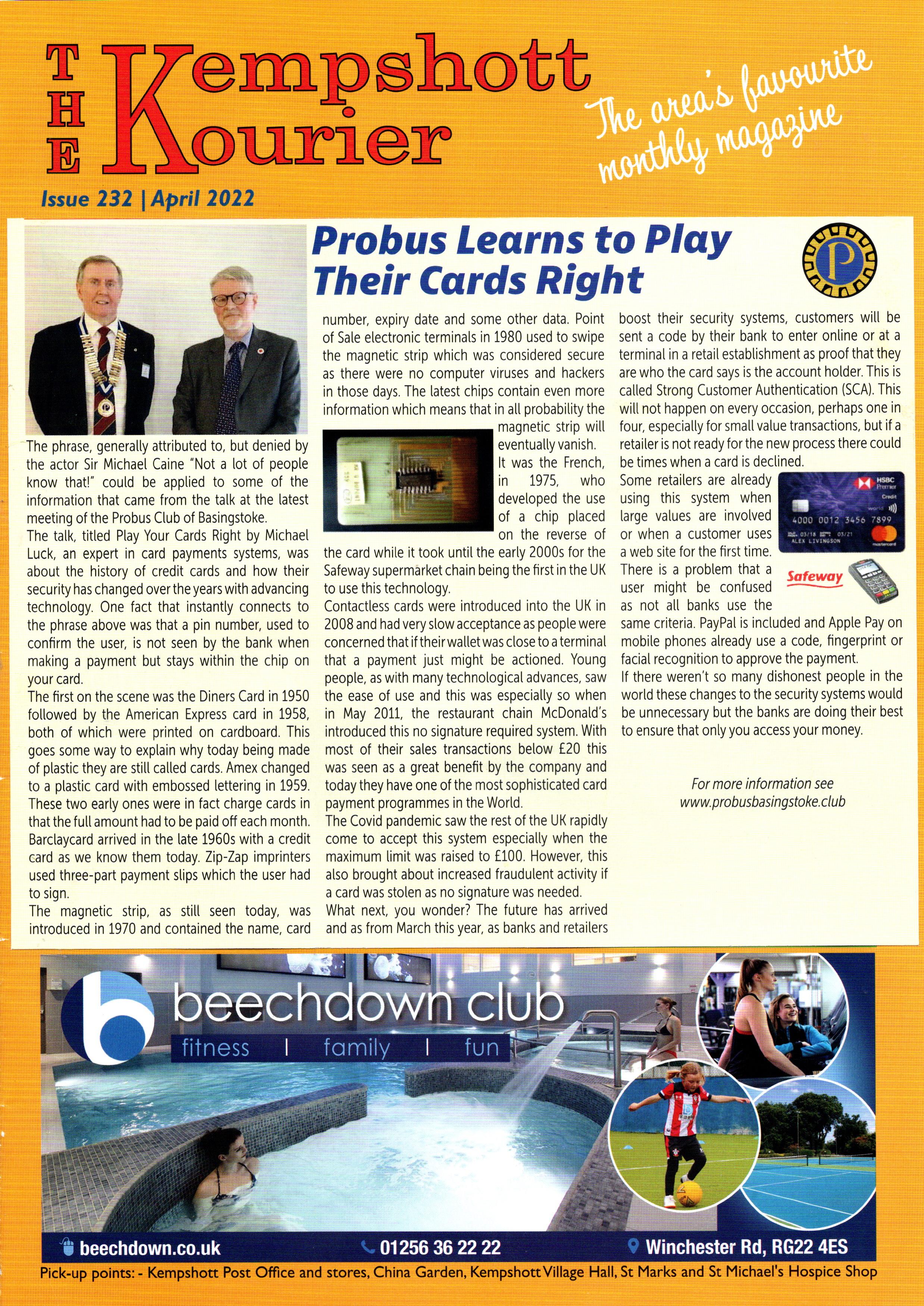
A good month for our publicity in the April local magazines. Except for the Link (Oakley) not featuring our report, the remainder carried the report on the talk given by our new member, Michael Luck, about credit cards. Clearly a timely piece in view of the latest security activities by the banks to ensure that only the named card holder has access to their funds.
The CommunityAd publishers used a report for their Old Basing & Lychpit Community Newsletter, previously used in their magazine for Bramley & Sherfield, which is why the Eurovision Song Contest report is shown.
The phrase, generally attributed to, but denied by the actor Sir Michael Caine “Not a lot of people know that!” could be applied to some of the information that came from the talk at the latest meeting of the Probus Club of Basingstoke.
The talk, titled Play Your Cards Right by Bramley resident Michael Luck, an expert in card payments systems, was about the history of credit cards and how their security has changed over the years with advancing technology. One fact that instantly connects to the phrase above was that a pin number, used to confirm the user, is not seen by the bank when making a payment but stays within the chip on your card.
The first on the scene was the Diners Card in 1950 followed by the American Express card in 1958, both of which were printed on cardboard. This goes some way to explain why today being made of plastic they are still called cards. Amex changed to a plastic card with embossed lettering in 1959. These two early ones were in fact charge cards in that the full amount had to be paid off each month.
Diners Club Card 1950
Barclaycard arrived in the late 1960s with a credit card as we know them today. Zip-Zap imprinters used three-part payment slips which the user had to sign.
The magnetic strip, as still seen today, was introduced in 1970 and contained the name, card number, expiry date and some other data. Point of Sale electronic terminals in 1980 used to swipe the magnetic strip which was considered secure as there were no computer viruses and hackers in those days. The latest chips contain even more information which means that in all probability the magnetic strip will eventually vanish.
It was the French, in 1975, who developed the use of a chip placed on the reverse of the card while it took until the early 2000s for the Safeway supermarket chain being the first in the UK to use this technology.
First French Card With Chip
Contactless cards were introduced into the UK in 2008 and had very slow acceptance as people were concerned that if their wallet was close to a terminal that a payment just might be actioned. Young people, as with many technological advances, saw the ease of use and this was especially so when in May 2011, the restaurant chain McDonald’s introduced this no signature required system. With most of their sales transactions below £20 this was seen as a great benefit by the company and today they have one of the most sophisticated card payment programmes in the World.
The Covid pandemic saw the rest of the UK rapidly come to accept this system especially when the maximum limit was raised to £100. However, this also brought about increased fraudulent activity if a card was stolen as no signature was needed.
What next, you wonder? The future has arrived and as from March this year, as banks and retailers boost their security systems, customers will be sent a code by their bank to enter online or at a terminal in a retail establishment as proof that they are who the card says is the account holder. This is called Strong Customer Authentication (SCA). This will not happen on every occasion, perhaps one in four, especially for small value transactions, but if a retailer is not ready for the new process there could be times when a card is declined.
Some retailers are already using this system when large values are involved or when a customer uses a web site for the first time. There is a problem that a user might be confused as not all banks use the same criteria. PayPal is included and Apple Pay on mobile phones already use a code, fingerprint or facial recognition to approve the payment.
If there weren’t so many dishonest people in the world these changes to the security systems would be unnecessary but the banks are doing their best to ensure that only you access your money.
President of the Probus Club of Basingstoke 1988/89
The funeral service for Dennis Freeman was held on Tuesday 8th March 2022 at All Saints’ Church, Fairfields, Basingstoke followed by interment at Worting Road Cemetery.
Dennis had been President of the Probus Club of Basingstoke 1988/89 and must have been one of the youngest holders of that position probably helped by retiring at the age of only fifty-five in 1980.
He had left school at 14 and studied to become a draughtsman. He wanted to become a pilot during WW2 but was rejected because he was colour blind. Instead, he trained people in aircraft recognition at Biggin Hill.
Dennis joined Lansing Bagnall as a draughtsman and designer, becoming a senior consultant with LB Technical Services, which was then spun off as Modern Materials Management in which Dennis served as a director.
With his wife, Dorothy, who predeceased him in 2013, they enjoyed a long retirement engaging in various activities including travelling to Australia where one of their daughters lives and who came to the funeral. The service was well attended by his family and friends and by some of the regular congregation of All Saints’ Church where Dennis was a member.
He had been a regular attendee at the Probus evening meetings at the church in Chineham and then for a while at our combined meetings at the Test Valley Golf Club. During the last couple of years when his health deteriorated, he enjoyed attending the Memory Club in Basingstoke.
Our club was represented by Honorary Secretary, Stephen Thair and Ron Baxter MBE, who had been President 2005/06.
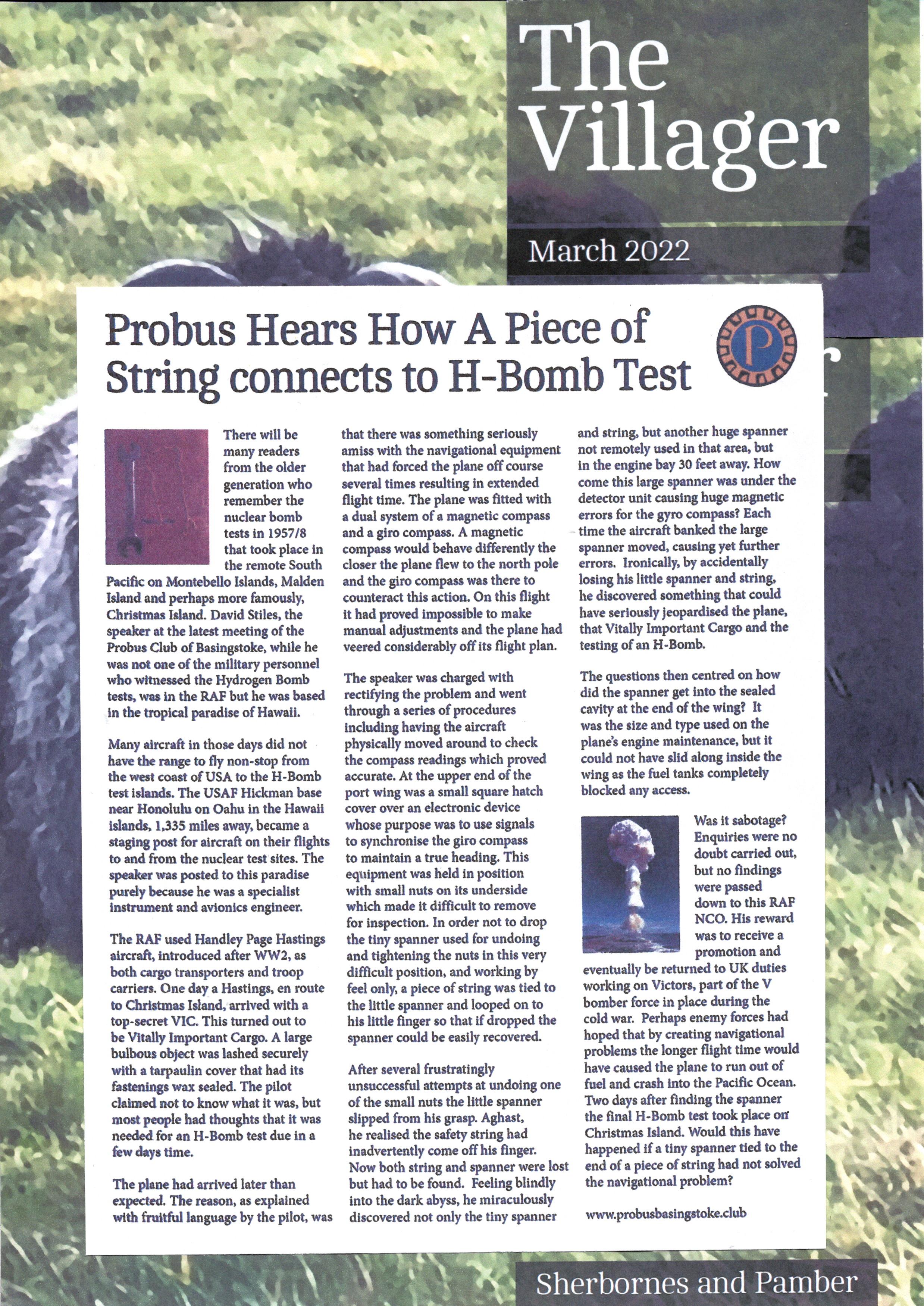
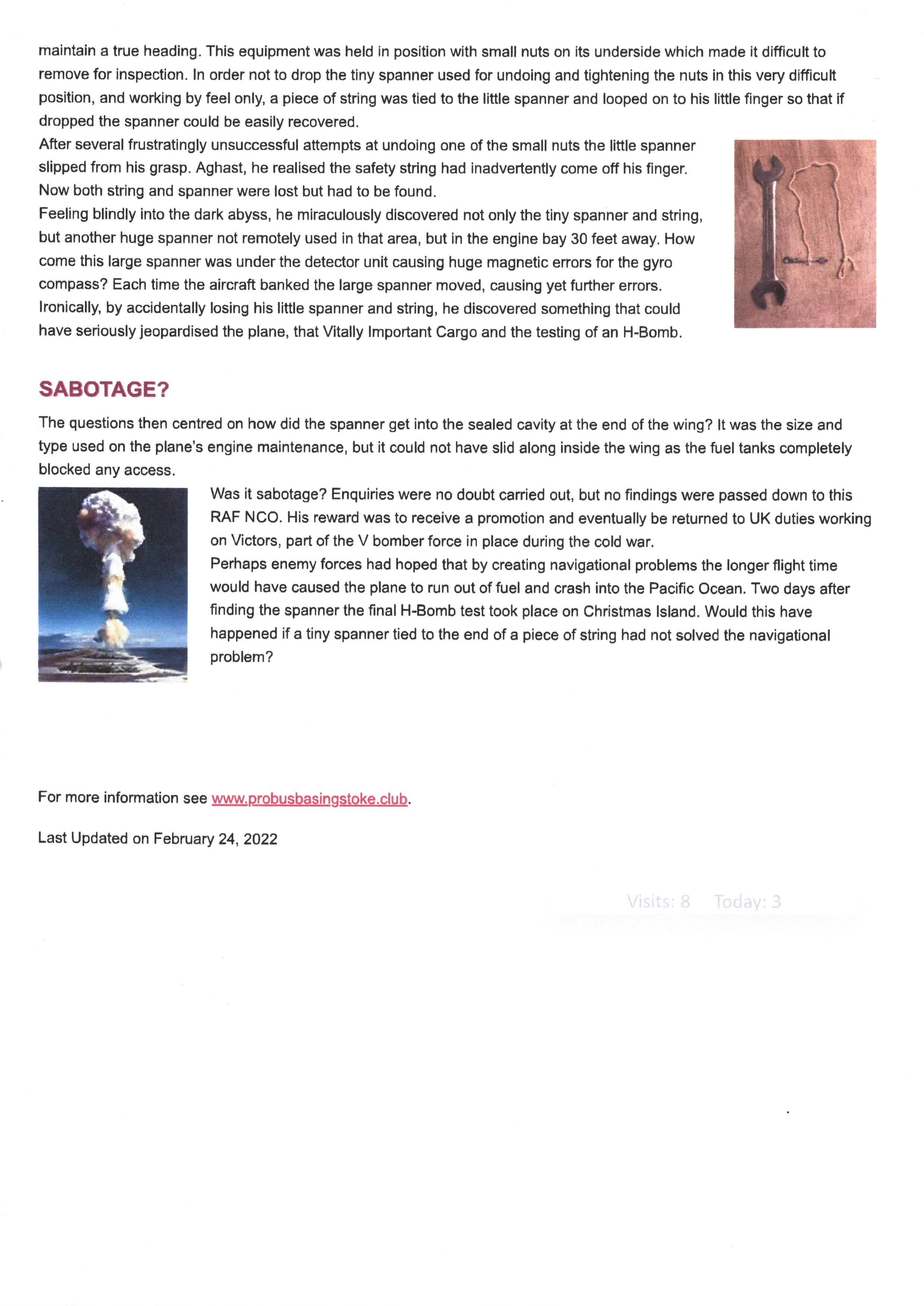
A good result in the local March magazines for the H-Bomb story which appeared in the Rabbiter, Kempshott Kourier, Bramley Mag, the Villager, Loddon Valley Link and on the web site Basinga Extra.
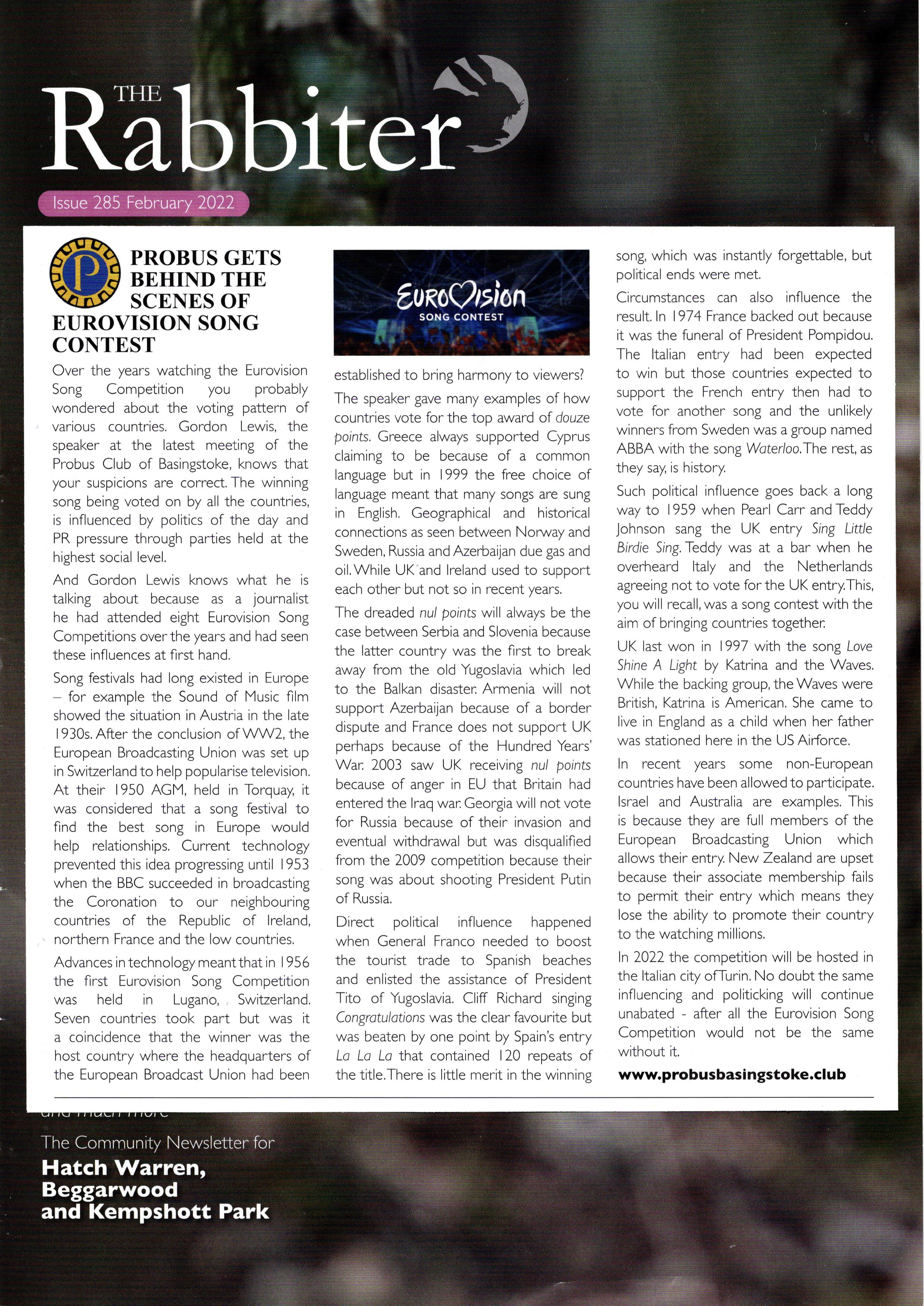
There was also success in the CommunityAd magazine for Bramley & Sherfield who ran the report about the Eurovision Song Contest. Things that I send to this publisher are dependent on them requesting a report as they need to fill a page before they go to print. And as they tend to publish their range of magazines around every three months, or so, I send them what I have instantly available.
We did not appear in the March Link (for Oakley) or in the two quarterlies of the Brighton Bell and Winklebury Way. It is the usual situation with these magazines that they want to use local reports and our Probus reports are considered general interest and therefore are useful as a fill in.
There will be many readers from the older generation who remember the nuclear bomb tests in 1957/8 that took place in the remote South Pacific on Montebello Islands, Malden Island and perhaps more famously, Christmas Island. David Stiles, the speaker at the latest meeting of the Probus Club of Basingstoke, while he was not one of the military personnel who witnessed the Hydrogen Bomb tests, was in the RAF but he was based in the tropical paradise of Hawaii.
Mushroom Cloud from Nuclear Test
Many aircraft in those days did not have the range to fly none-stop from the west coast of USA to the H-Bomb test islands. The USAF Hickman base near Honolulu on Oahu in the Hawaii islands, 1,335 miles away, became a staging post for aircraft on their flights to and from the nuclear test sites. The speaker was posted to this paradise purely because he was a specialist instrument and avionics engineer.
The RAF used Handley Page Hastings aircraft, introduced after WW2, as both cargo transporters and troop carriers. One day a Hastings, en route to Christmas Island, arrived with a top-secret VIC. This turned out to be Vitally Important Cargo. A large bulbous object was lashed securely with a tarpaulin cover that had its fastenings wax sealed. The pilot claimed not to know what it was, but most people had thoughts that it was needed for an H-Bomb test due in a few days’ time.
The plane had arrived later than expected. The reason, as explained with fruitful language by the pilot, was that there was something seriously amiss with the navigational equipment that had forced the plane off course several times resulting in extended flight time. The plane was fitted with a dual system of a magnetic compass and a giro compass. A magnetic compass would behave differently the closer the plane flew to the north pole and the giro compass was there to counteract this action. On this flight it had proved impossible to make manual adjustments and the plane had veered considerably off its flight plan.
Handley Page Hastings at Christmas Island
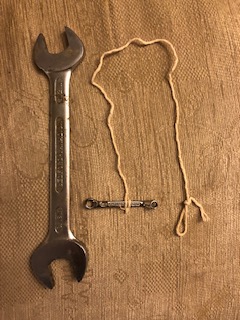
The speaker was charged with rectifying the problem and went through a series of procedures including having the aircraft physically moved around to check the compass readings which proved accurate. At the upper end of the port wing was a small square hatch cover over an electronic device whose purpose was to use signals to synchronise the giro compass to maintain a true heading. This equipment was held in position with small nuts on its underside which made it difficult to remove for inspection. In order not to drop the tiny spanner used for undoing and tightening the nuts in this very difficult position, and working by feel only, a piece of string was tied to the little spanner and looped on to his little finger so that if dropped the spanner could be easily recovered.
After several frustratingly unsuccessful attempts at undoing one of the small nuts the little spanner slipped from his grasp. Aghast, he realised the safety string had inadvertently come off his finger. Now both string and spanner were lost but had to be found.
Feeling blindly into the dark abyss, he miraculously discovered not only the tiny spanner and string, but another huge spanner not remotely used in that area, but in the engine bay 30 feet away. How come this large spanner was under the detector unit causing huge magnetic errors for the gyro compass? Each time the aircraft banked the large spanner moved, causing yet further errors.
Ironically, by accidentally losing his little spanner and string, he discovered something that could have seriously jeopardised the plane, that Vitally Important Cargo and the testing of an H-Bomb.
The large spanner located because the small spanner and string had been dropped
The questions then centred on how did the spanner get into the sealed cavity at the end of the wing? It was the size and type used on the plane’s engine maintenance, but it could not have slid along inside the wing as the fuel tanks completely blocked any access.
Was it sabotage? Enquiries were no doubt carried out, but no findings were passed down to this RAF NCO. His reward was to receive a promotion and eventually be returned to UK duties working on Victors, part of the V bomber force in place during the cold war.
Perhaps enemy forces had hoped that by creating navigational problems the longer flight time would have caused the plane to run out of fuel and crash into the Pacific Ocean. Two days after finding the spanner the final H-Bomb test took place on Christmas Island. Would this have happened if a tiny spanner tied to the end of a piece of string had not solved the navigational problem?
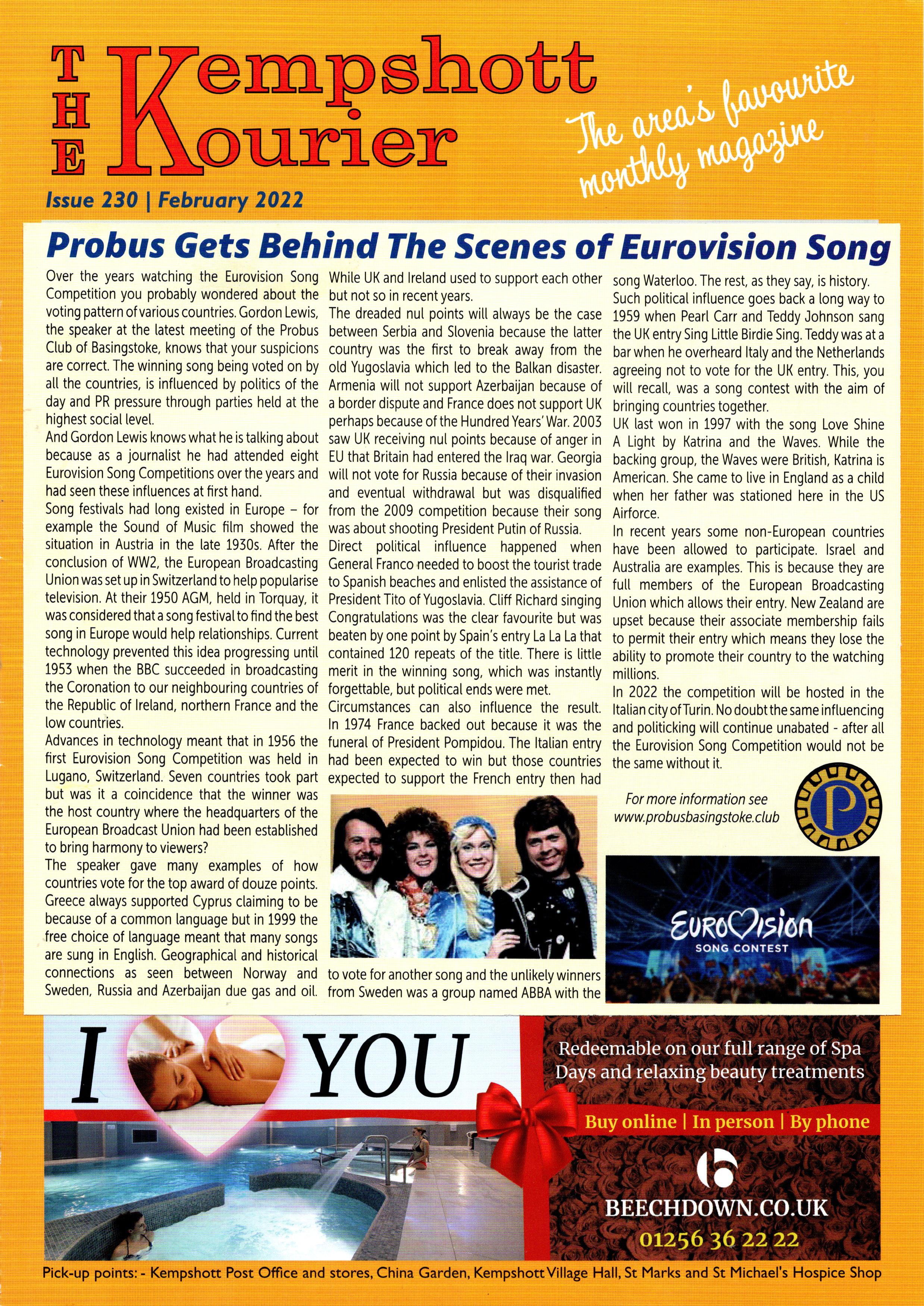
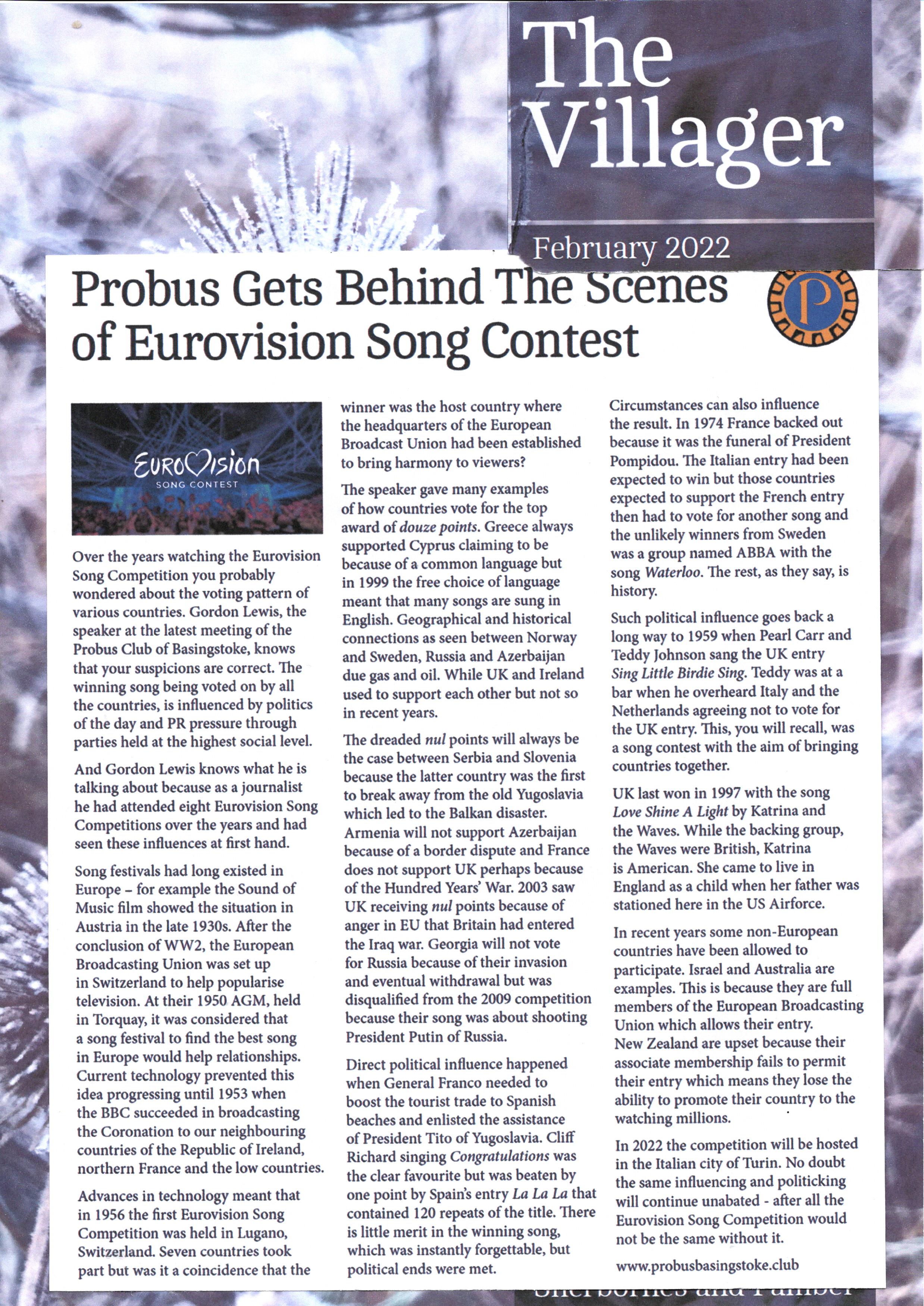
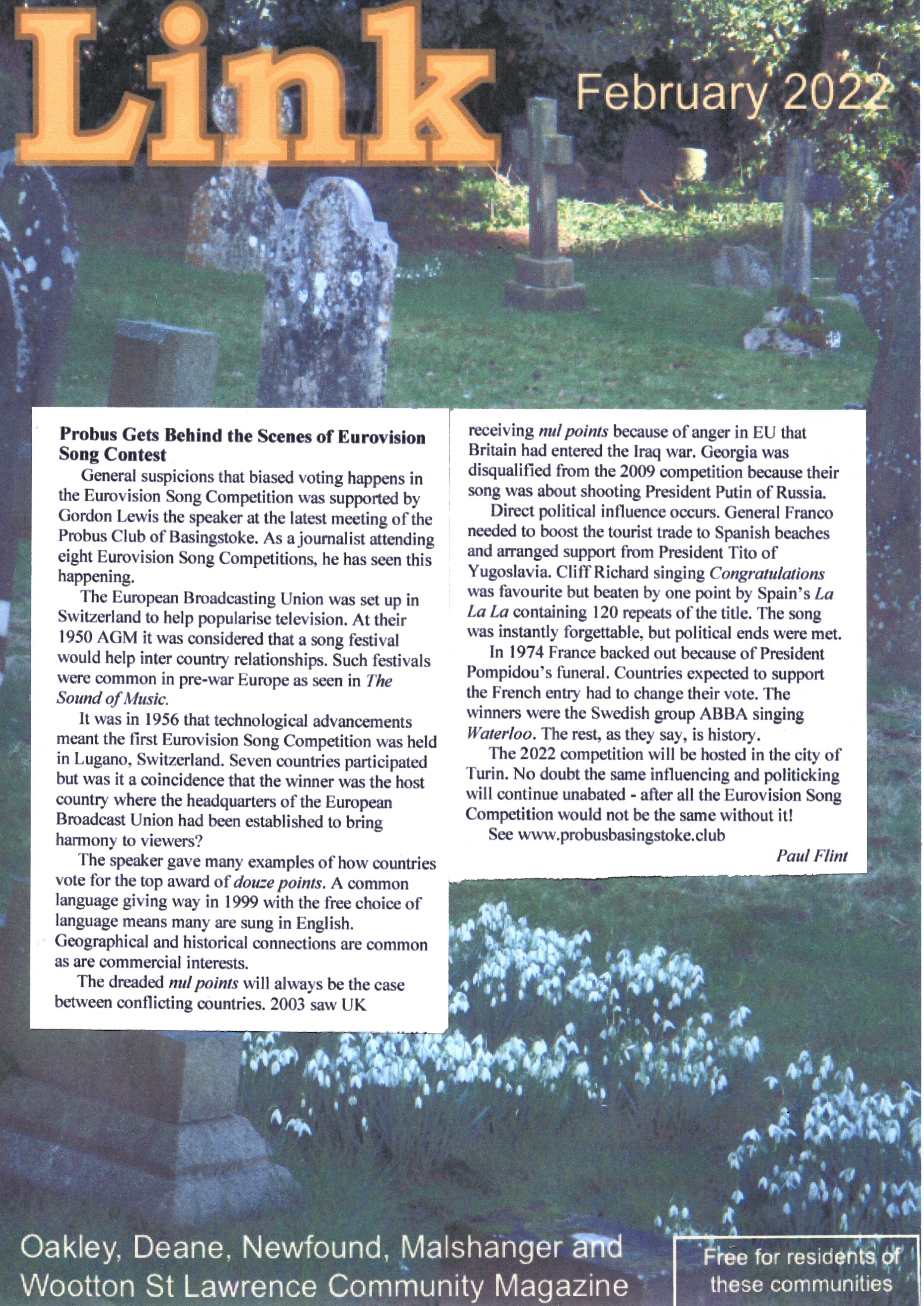
The report about the talk on the Eurovision Song Contest was carried by all the February magazines. There was one exception. The Basinga gave it full coverage in their EXTRA web site – hence why there are two pages on display.
Because of timing differences, I also sent this report to the two quarterlies, Brighton Bell and Winklebury Way – both edited by the Labour group leader on Basingstoke council, Andrew McCormick, and publication will probably appear at the beginning of March. It was also sent to the CommunityAd magazine for Bramley & Sherfield and their magazine is expected at the end of February. Hopefully I shall be able to show these results in my report in March.



























 Probus Club of Basingstoke
You must be logged in to post a comment.