Three of our members visited the Light Aircraft Fly-In at Popham airfield on Saturday 19 August – Chris Perkins MVO, Stephen Thair and Dave Kitson. While the first two had flying experiences, with Chris having spent many years in the RAF, and Stephen having held a private pilot’s licence, it has to be assumed that Dave’s claim to having interests in aviation lies in the fact that he had flown in Concorde.
All three declared the outing to be very enjoyable, as well as can be seen from the following two photographs where they are also enjoying an ice cream.
August is a quiet month as some magazines take a break, but we managed to gain some space in the Kempshott Kourier, Villager, CommunityAd for Overton, Oakley & Kempshott and in the Basinga Extra web site.
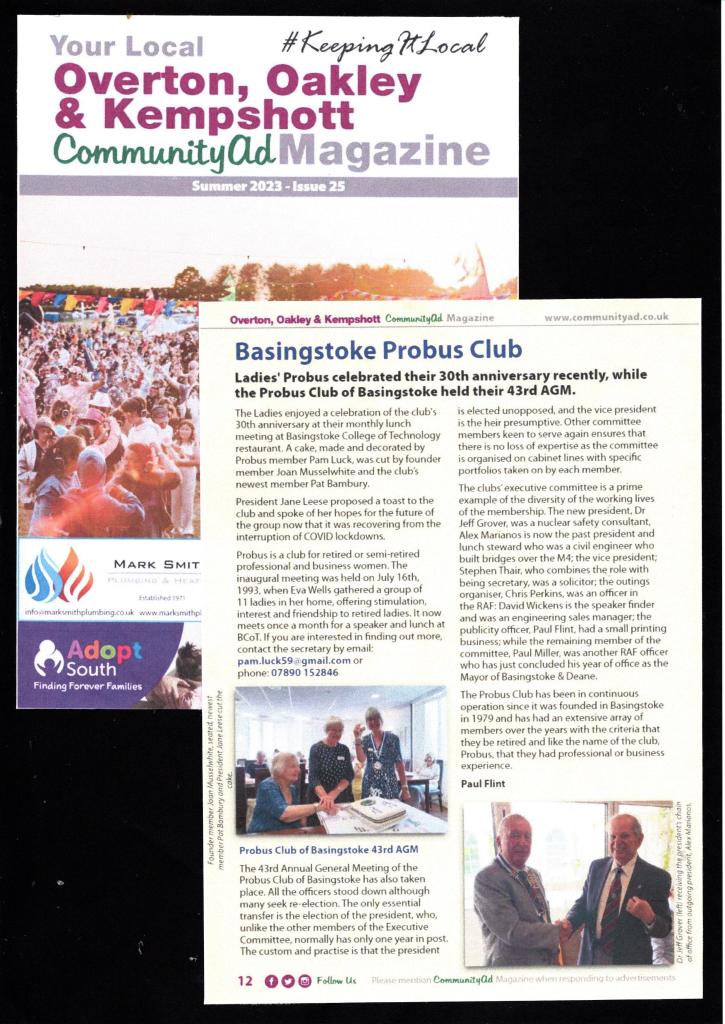
Keen eyed readers will see that the CommunityAd magazine devoted a page to the Ladies Probus and their thirtieth birthday celebrations while the majority of the page was about our 43rd AGM.
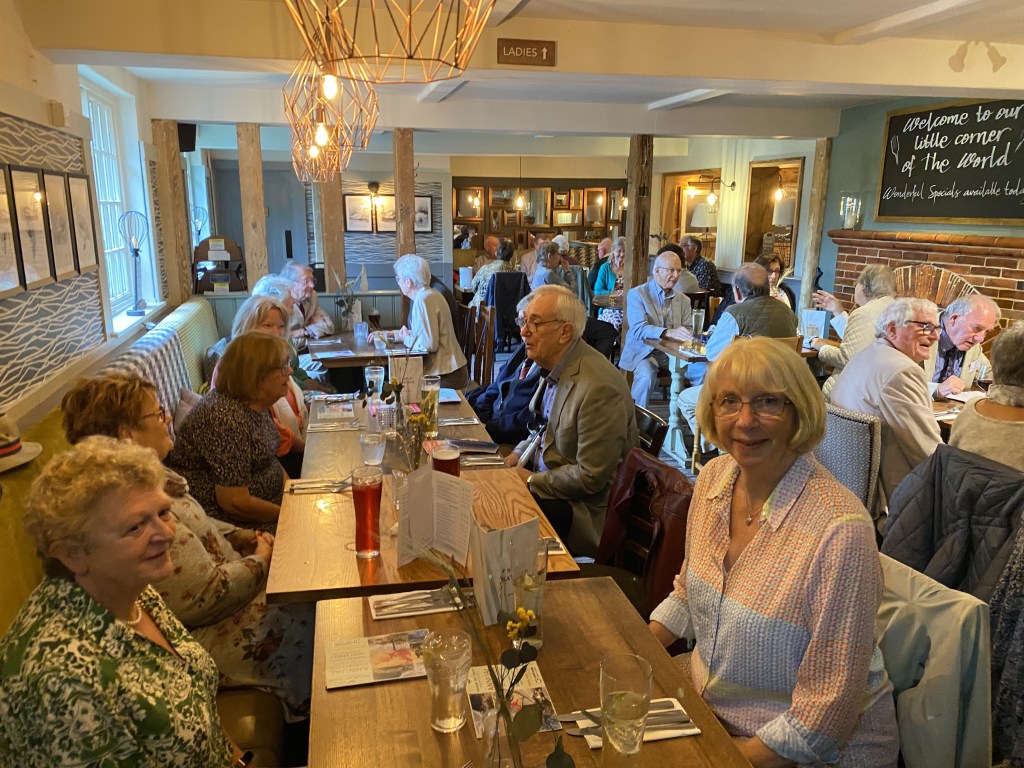
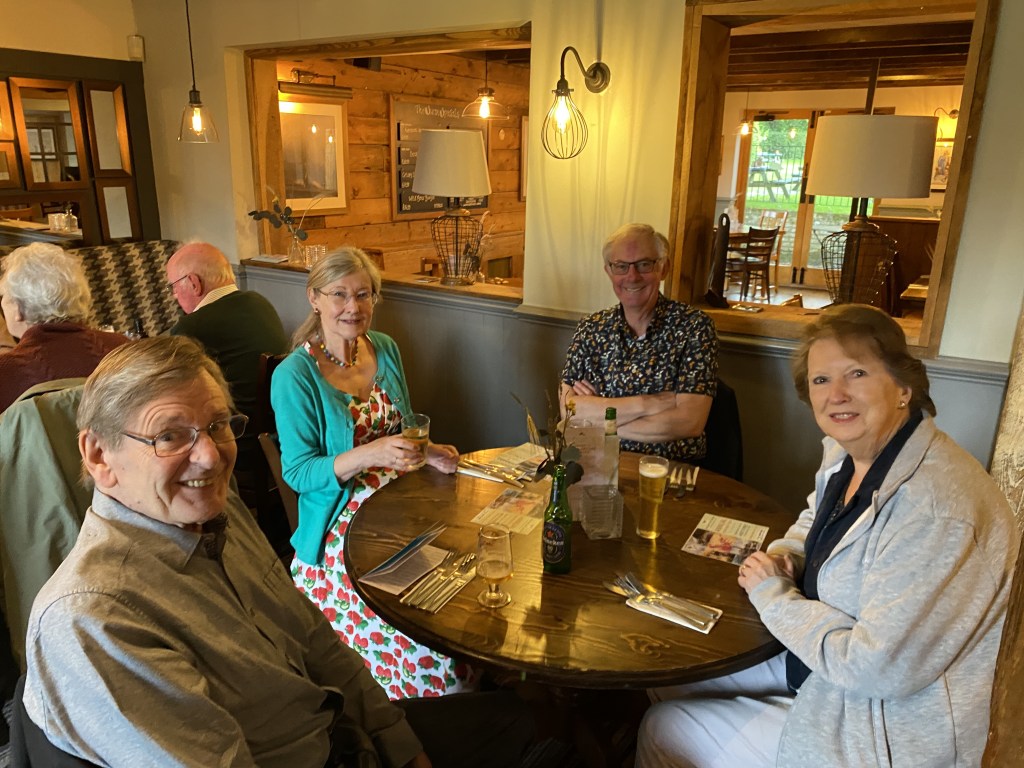
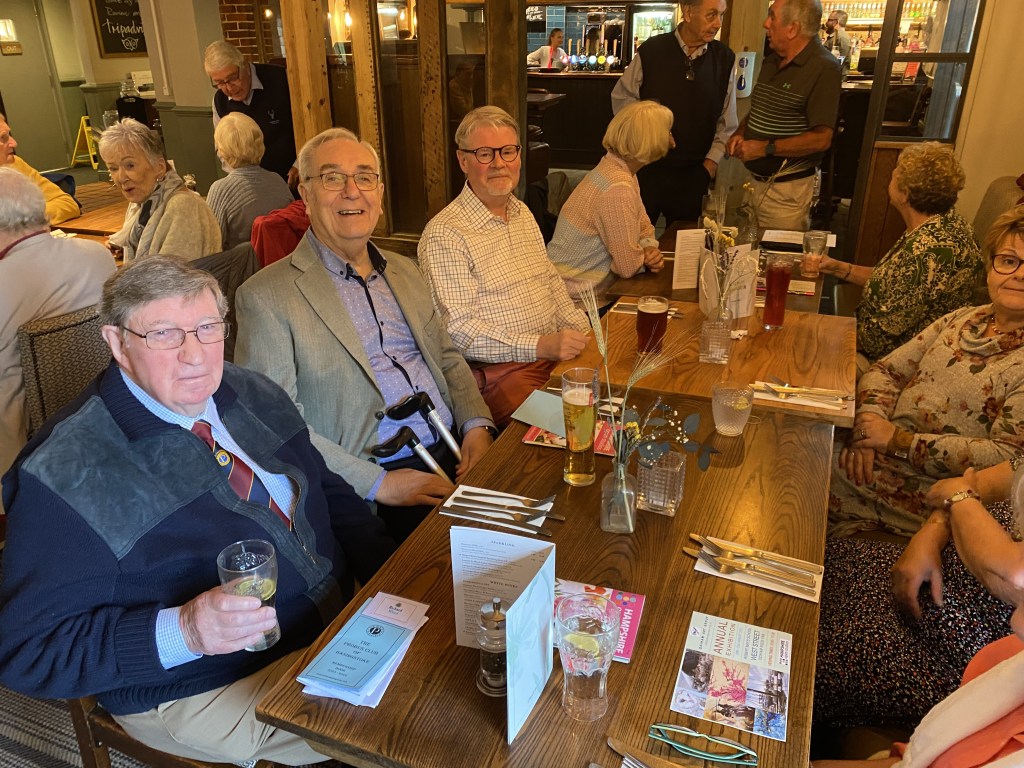
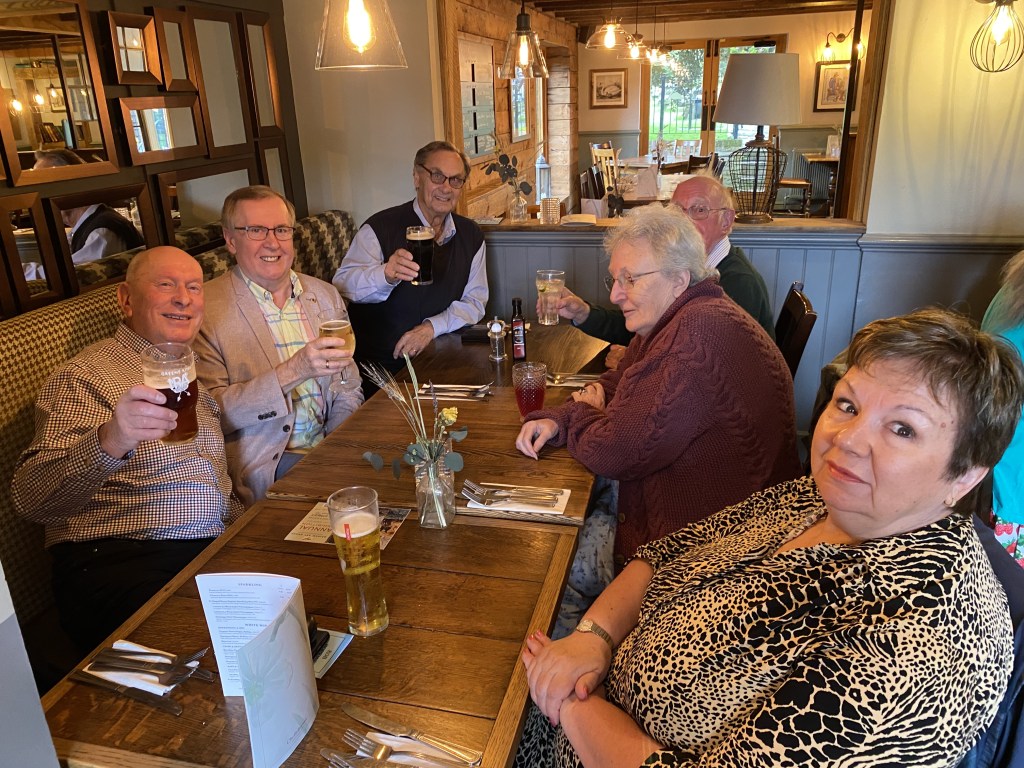
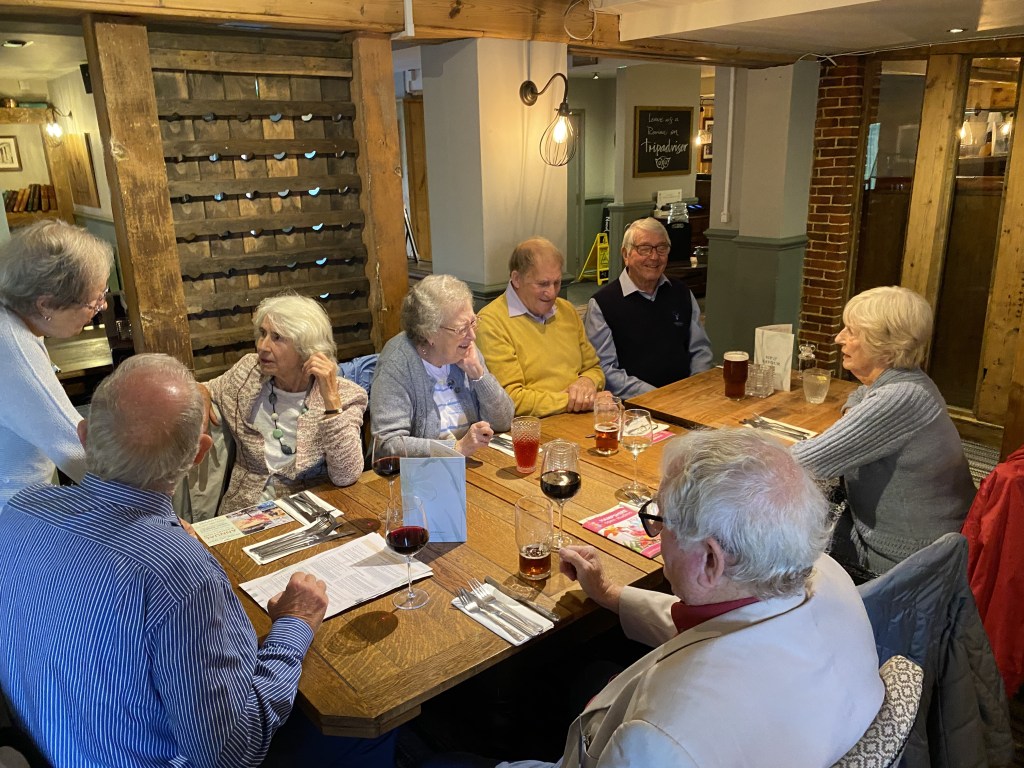
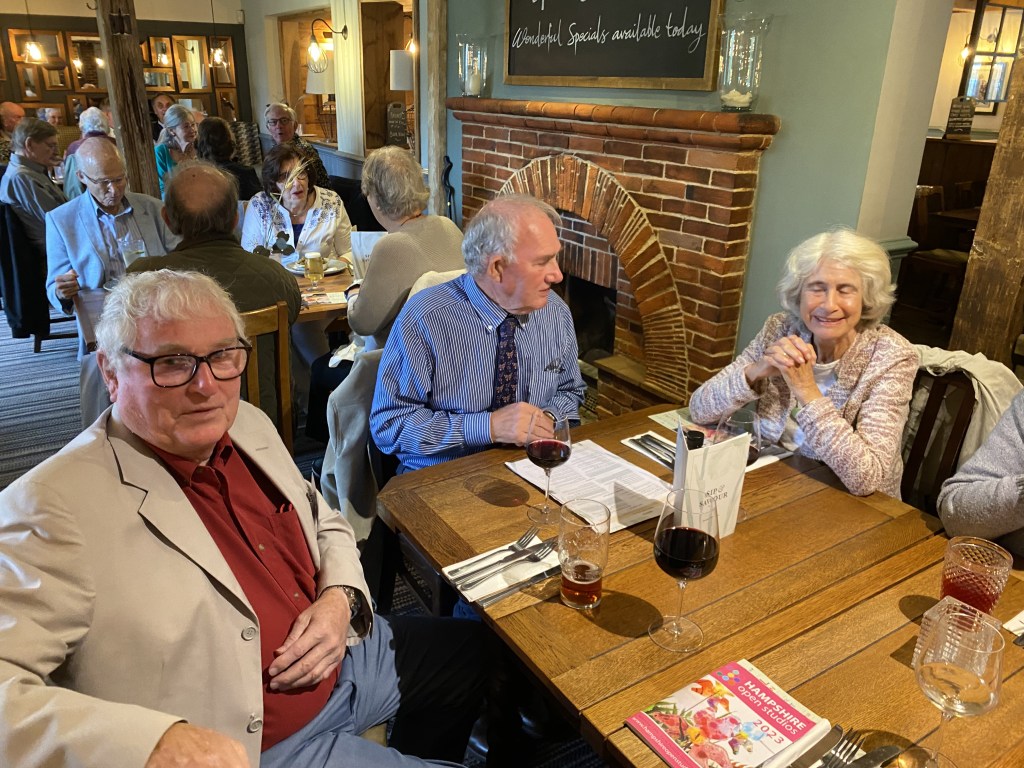
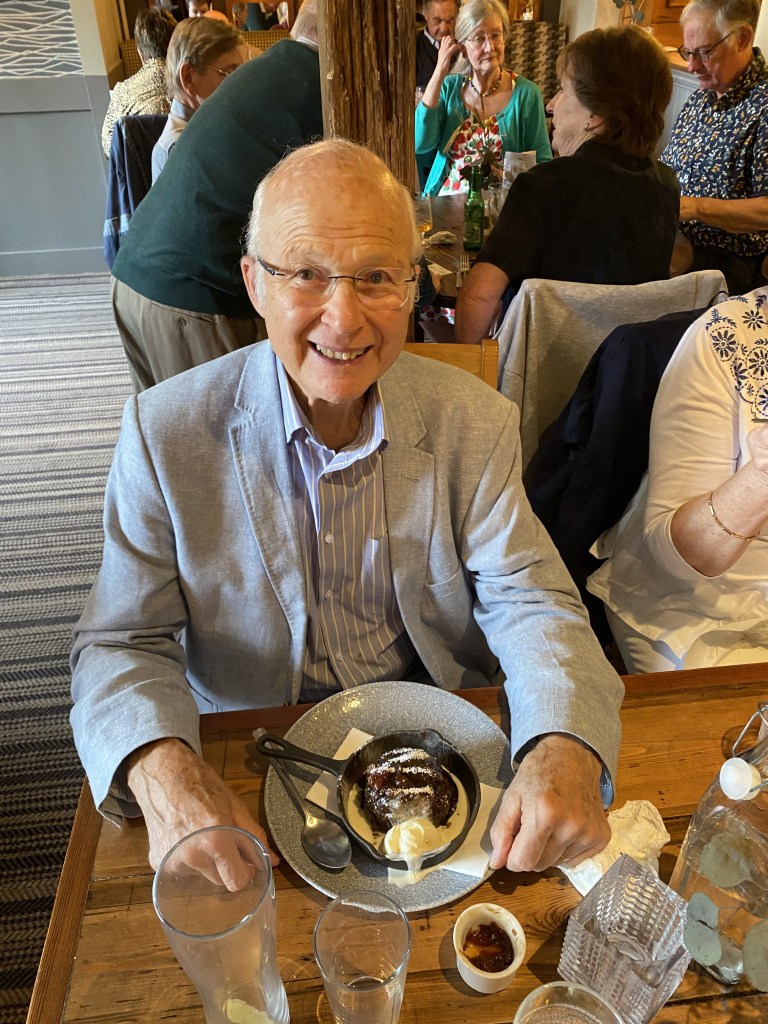
It was back in 2016 when the then President Fred Locke selected the Swan at Sherborne St John for the Probus summer pub lunch and going back this time was the choice of our current President Dr Jeff Grover. Perhaps the fact that they both live down the road in Bramley may have influenced their choice, but it turned out very satisfactorily in the event.
In the intervening years the quality of the food offering has improved with the selection this time probably suiting the 34 attendees with some having one course, some two courses and a few having three courses and coffee. And a drink from the bar. And good conversations were had all round.
Even though it had been necessary to tell Jeff in advance of our menu selections, always provided that one’s memory was able to recall what had been ordered the wiser members had a note with them when confirming and paying for their lunch at the bar.
President Dr Jeff Grover with speaker Heather Wylde
This was the true story about a girl and two brothers during WW2 that involved the trio in love, honour, bravery and tragedy as told by guest speaker, Heather Wylde.
It only came to light following the passing of the speaker’s mother, Viv. Her father, having previously passed away it was necessary to sort through her mother’s effects. Some items were packed off to her brother in Australia and some, including an old diary, were put in a case and consigned to her loft. In a phone call from her brother, he encouraged the speaker to read the diary wherein she discovered a record of the misfortunes of war during 1941.
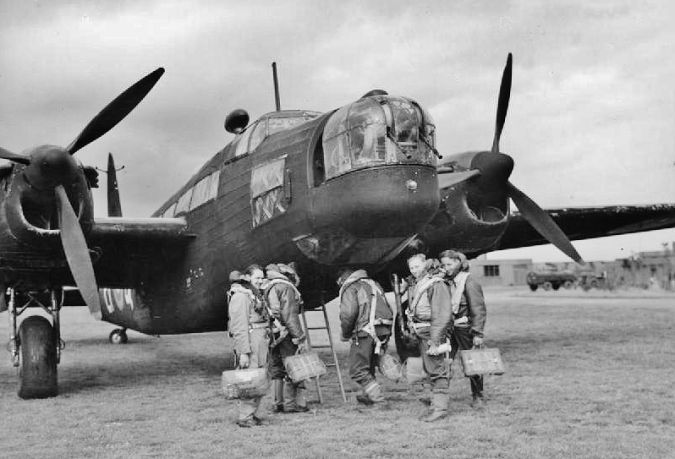
Just before the outbreak of the war, Viv and Les Butcher were persuaded not to get engaged as Viv was only seventeen. Les and his older brother, Ken, were apprenticed electricians and both joined the RAF with Ken providing electrical technical training throughout the hostilities while Les became a navigator/observer joining 103 squadron flying Vickers Wellington bombers.
The diary showed there had been much correspondence between Viv and Les and their plan to get engaged that summer with their marriage to be in the summer of 1942.
On a raid over Dusseldorf Les’ Wellington bomber was shot down into the river Rhine and the six-man crew perished. Three bodies were eventually brought ashore and were subsequently buried in a cemetery close to the Dutch border. Of Les there was no sign, and the dreaded telegram was received “missing in action”. He was one of over 55,000 air crew in RAF Bomber command who lost their lives in the war. The diary showed that it took several months for Viv to accept that Les was lost to her.
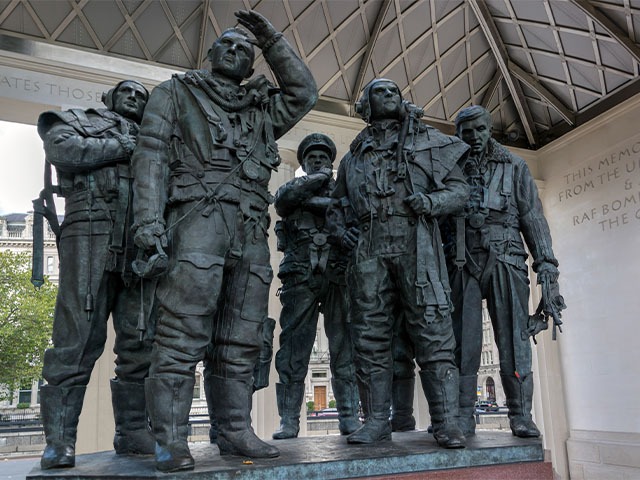
Statue near Green Park in central London which commemorates the loss of over 55,000 aircrew in Bomber Command during WW2
Fast forward to 1942 and Viv married Ken with the eventual birth of the speaker and her brother. Ken always knew that he was not the first love of Viv, but it was not known if he had read the diary. But the speaker accepts that she and her brother would not have been born had Les survived the war.
July was a strange month for local magazines as the Villager took a break and for some unknown reason, we failed to get into the Basinga or their Basinga Extra and the usual lack of response from the Loddon Valley Link continues. The Basingstoke Gazette continues to ignore us. August will see the Villager returning while the Rabbiter has a break.
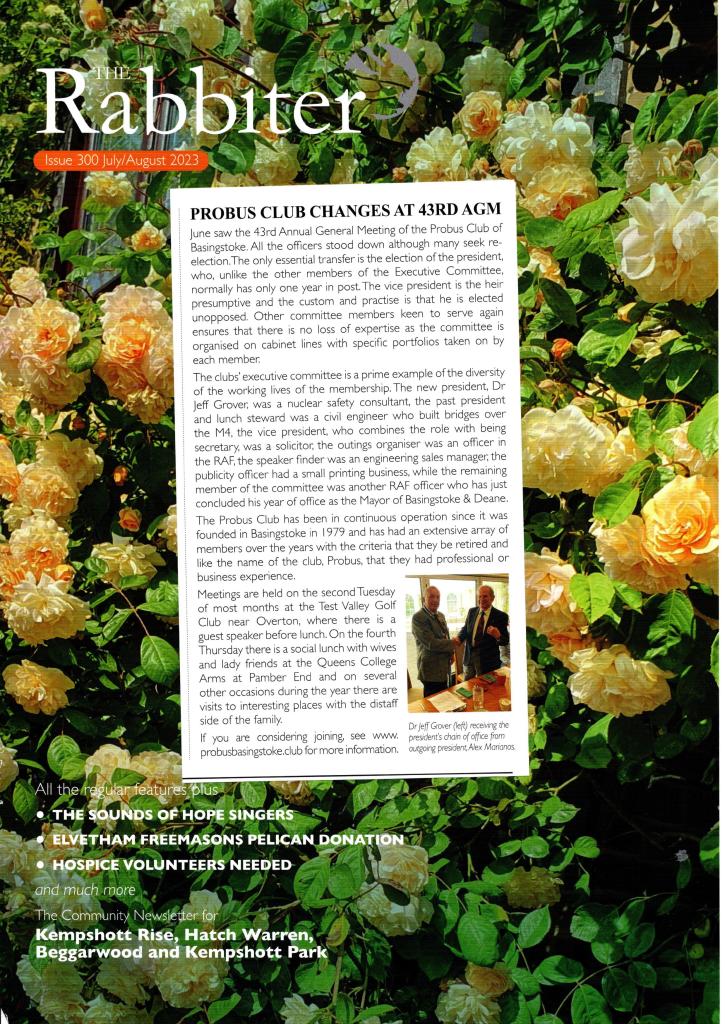
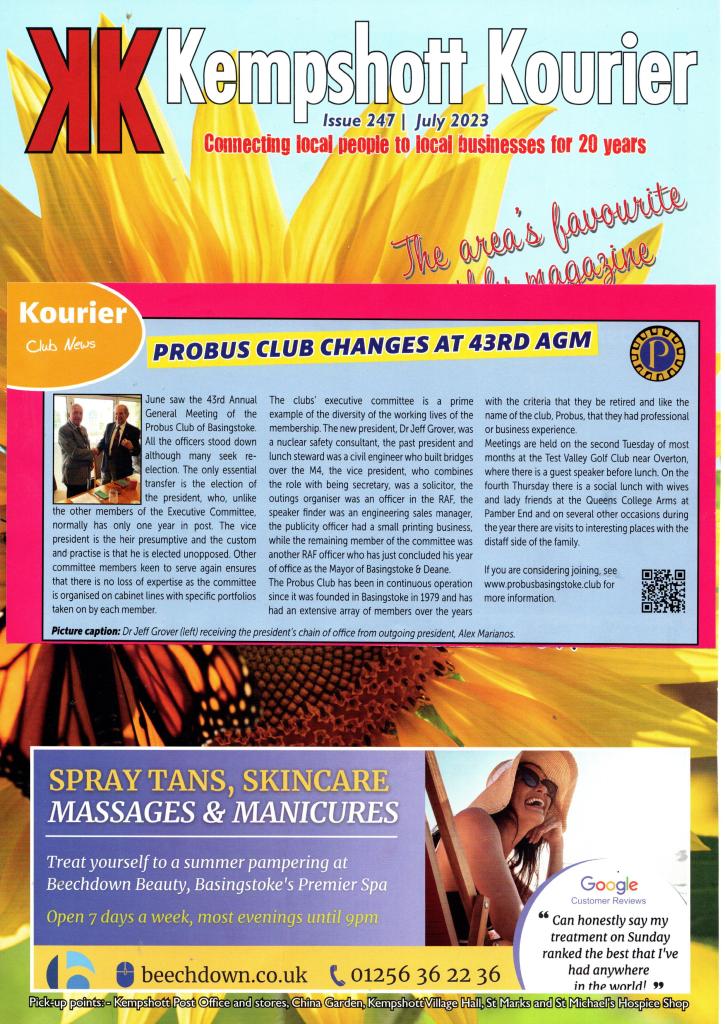
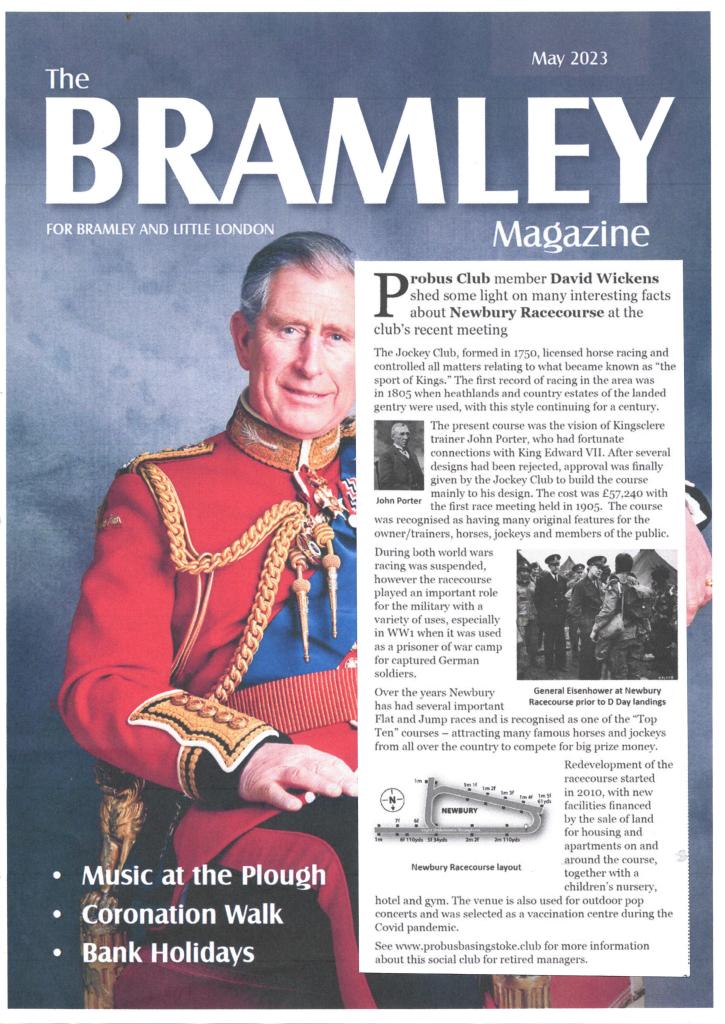
The Probus AGM was the feature in the four magazines that supported us.
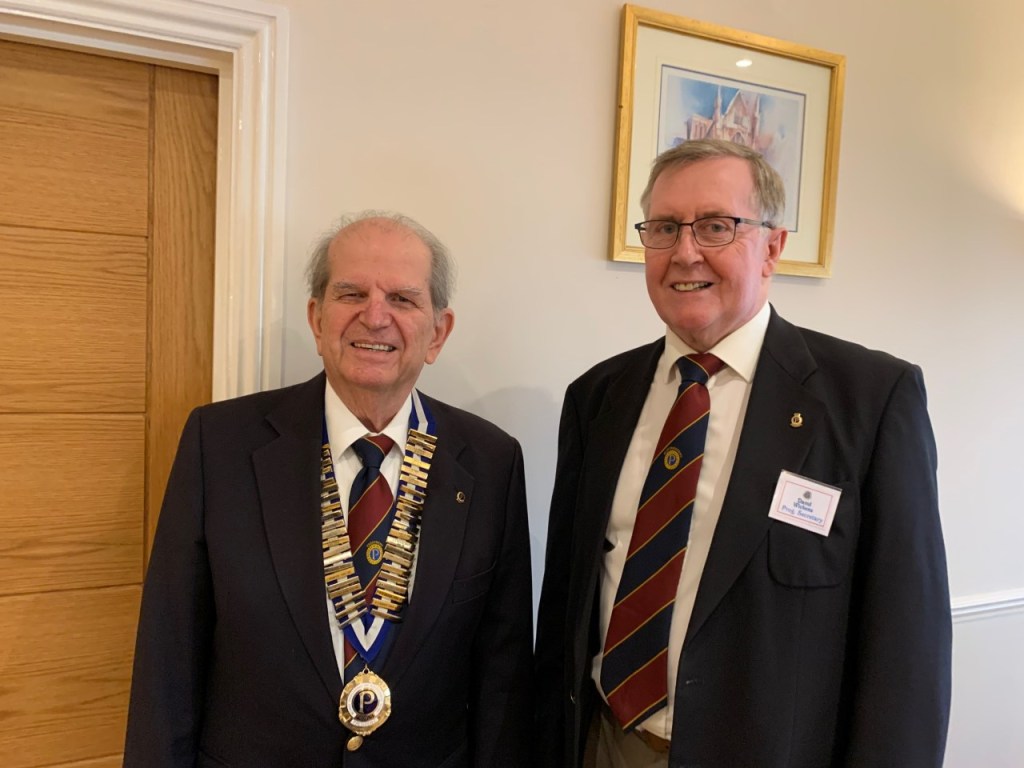
Dr Jeff Groverreceiving the President’s chain of office from immediate past president, Alex Marianos
June 13th saw the 43rd Annual General Meeting of the Probus Club of Basingstoke. All the officers stood down although many seek re-election. The only essential transfer is the election of the president, who, unlike the other members of the Executive Committee, normally has only one year in post. The custom and practise is that the president is elected unopposed and the vice president is the heir presumptive. Other committee members keen to serve again ensures that there is no loss of expertise as the committee is organised on cabinet lines with specific portfolios taken on by each member.
The club’s executive committee is a prime example of the diversity of the working lives of the membership. The new president, Dr Jeff Grover, was a nuclear safety consultant, Alex Marianos is now the past president and lunch steward who was a civil engineer who built bridges over the M4, the vice president, Stephen Thair, who combines the role with being secretary, was a solicitor, the outings organiser, Chris Perkins, was an officer in the RAF, David Wickens is the speaker finder and was an engineering sales manager, the publicity officer, Paul Flint, had a small printing business, while the remaining member of the committee, Paul Miller, was another RAF officer who has just concluded his year of office as the Mayor of Basingstoke & Deane.
The Probus Club has been in continuous operation since it was founded in Basingstoke in 1979 and has had an extensive array of members over the years with the criteria that they be retired and like the name of the club, Probus, that they had professional or business experience.
The report about the Spring Ladies’ lunch featured in five magazines and the Basinga Extra web site.
Those with a keen eye will see that our report in the Villager magazine also contained information about the forthcoming 43rd AGM – the reason being that this magazine will not be having a July edition for their summer break whereas the majority of the remainder take August away.
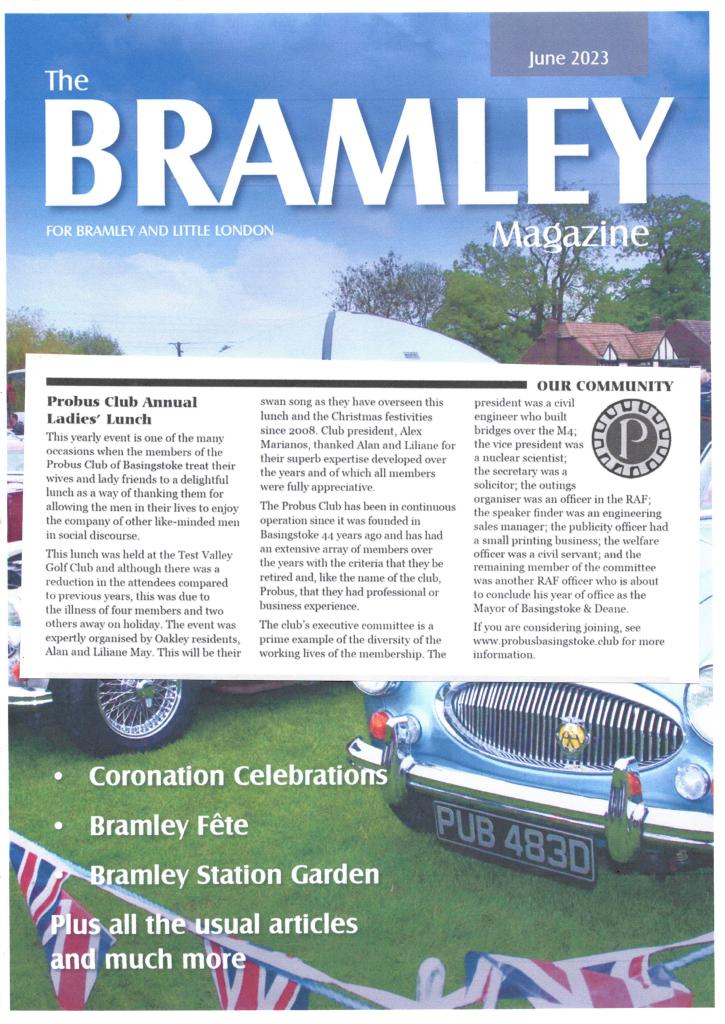
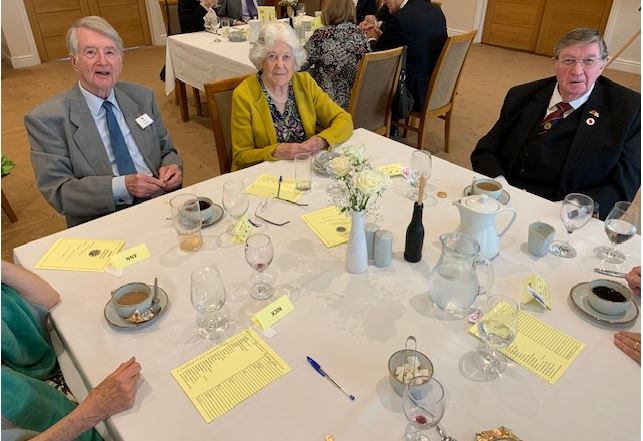
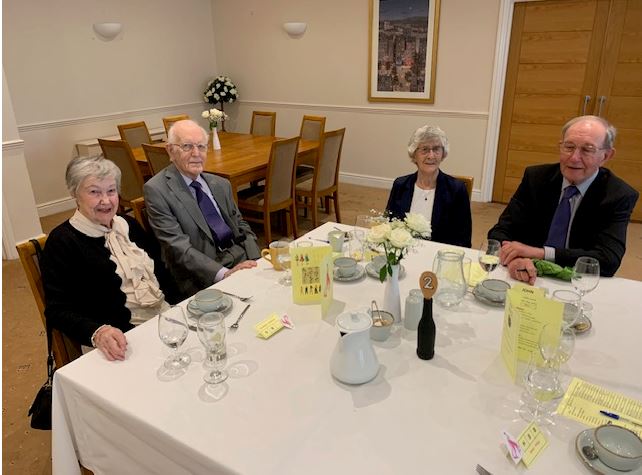
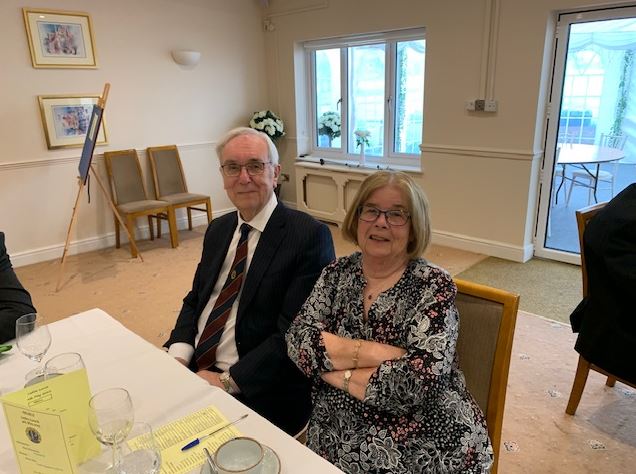
This yearly event is one of the many occasions when the members of the Probus Club of Basingstoke treat their wives and lady friends to a delightful lunch as a way of thanking them for allowing the men in their lives to enjoy the company of other likeminded men in social discourse.
This lunch was held at the Test Valley Golf Club and although there was reduction in the attendees compared to previous years this was due to the illness of four members and two others away on holiday. The event was expertly organised by Oakley residents, Alan and Liliane May. This will be their swan song as they have overseen this lunch and the Christmas festivities since 2008. Club president, Alex Marianos, thanked Alan and Liliane for their superb expertise developed over the years and which all members were fully appreciative.
President Alex & Sarah Marianos with Dr Nick Waring & Ann RaisonJohn & Jocelyn Kynoch and Richard WoodElizabeth & Derek Roberts with friends Kate & John SaundersPaul Flint with Janet FaggTony & Jan Allen with Alan & Liliane MayStephen & Maragaret Thair with David Wickens
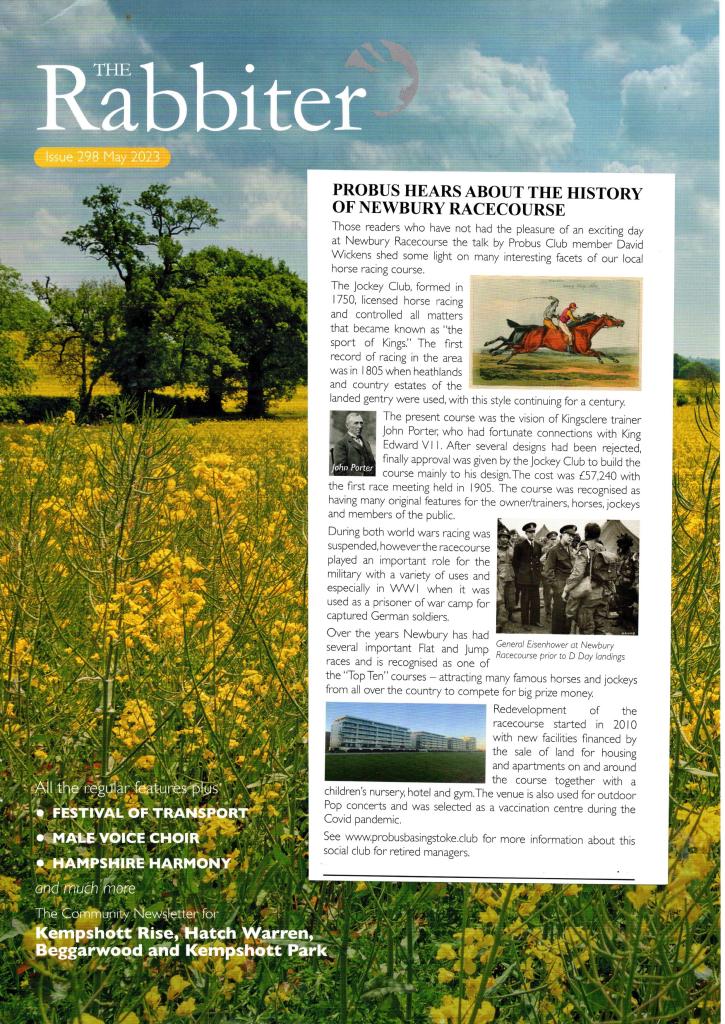
The report about the history of Newbury Racecourse was well received by all the local magazines except for the Loddon Valley Link magazine. The shorter version of the report being most popular among the editors although the Kempshott Kourier used the longer version. The Basinga chose to include this report within their Basinga Extra digital site.
President Alex Marianos with speaker David Wickens
Those readers who have not had the pleasure of an exciting day at Newbury races the talk by Probus Club member David Wickens shed some light on many interesting facets of our local horse racing course. He was so interested in equine matters that a few years ago he moved from his long-term home in Chineham to one of the new apartments overlooking the Newbury Racecourse.
The formation of The Jockey Club, based in Newmarket in 1750, formalised all aspects of horse racing which had become known as “the sport of Kings.” They were responsible for the regulation of horse racing and the recording of pedigrees, controlling all matters including issuing licences for trainers, jockeys and racecourses. However, in earlier centuries there had always been horse racing when heathlands and country estates of the landed gentry were used.
Horse racing across heathlands with the commonly held incorrect artistic view of equine movements
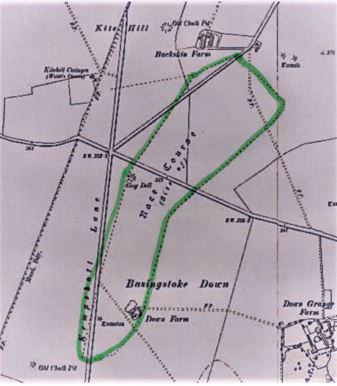
Basingstoke racecourse superimposed over present day Five Ways junction in Kempshott
Basingstoke had its own racecourse with the first recording of such an event in the London Gazette in 1687. It took place on the downs near to what is now known as Kempshott and Buckskin and across present day Stratton Park which straddles land between Pack Lane and Buckskin Lane. By 1729, the course was marked out by posts and racing continued with a gap of twenty-three years until 1850. Thereafter the course at Hackwood Park was used. Basingstoke racecourse was still marked on Ordnance Survey maps of 1960.
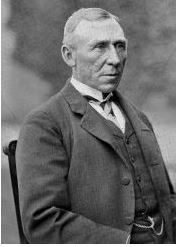
Meanwhile, a similar situation of heathland style racing in Newbury had mirrored what had happened, not only in Basingstoke but around the country. During the latter part of the nineteenth century John Porter was a successful trainer who ran his stable at Kingsclere. In the surrounding area there existed about 60 racing stables with around 1,700 horses in training, all of which had to travel to race meeting in other parts of the country. He could see the potential for a formalised racecourse in his local area. But it proved a difficult task to bring to fruition.
John Porter the founder of Newbury Racecourse
John Porter had identified a suitable site on the estate of Lloyd Harry Baxendale, and discussed the purchase of land, some 300 acres for £30,000. The Jockey Club repeatedly turned down his plans and at the last meeting in 1904 he happened to meet King Edward VII, for whom he had trained many winners. He explained to the King his frustration at having his plans continuously rejected. A few weeks later he was given approval by the Jockey Club and granted a licence to build the Newbury Racecourse.
It took only nine months to build and was the finest in the country with many original features for the owners/trainers, horses, jockeys and members of the public. Still today it is in the top ten courses in the country. The cost was £57,240 with the first race meeting held in September 1905, with over 15,000 in attendance. A new railway` station was even built adjacent to the course with a covered walkway for the King.
During both world wars racing was suspended, however the racecourse played an important role for the military with a variety of uses. In WW1 it was used as a prisoner of war camp for captured German soldiers and a troop camp for the cavalry. The PoWs lived in the horse boxes and tents for the first year then about 3,000 were sent to prison ships on the south coast. Thereafter it was used for munitions storage and tank repairs.
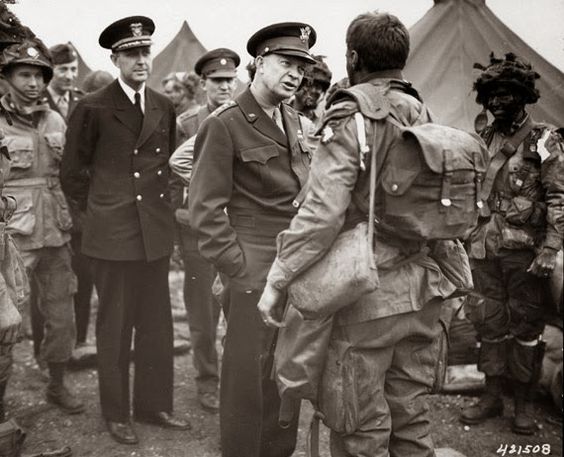
Gen “Ike” Eisenhowerat Newbury Racecourse on 5 June 1944 the day before “D” Day
In WW2 it was initially a troop camp and in 1942 was handed over to the US Army for storage of ammunition during which they constructed a railway marshalling yard with over 37 miles of railway track and concrete roads built on the racecourse to support the local USAF air base at Greenham Common. The stables were again used to house PoWs. Supreme Allied Commander, General Eisenhower, visited on 5th June 1944 the day prior to D Day landings. US control of the course lasted until 1949.
Redevelopment of the racecourse started in 2010 with new facilities financed by the sale of land for housing and apartments on and around the course together with a children’s nursery, hotel and gym. The venue is also used for outdoor Pop concerts and was selected as a vaccination centre during the Covid pandemic
The Grandstand today contains some original detailsLand sale for apartments financed recent modernisation

























You must be logged in to post a comment.