Probus Member Ticks One Off His Bucket List

Many people watch this annual event either as bystanders or seeing reports on television, the world-famous London to Brighton veteran car run. It was set up to celebrate the change in the law in 1896 that increased speed limits from 4 to 14 miles per hour dispensing with the need to have a man with a red flag walking in front of new-fangled self-propelled vehicles.

This year there was another celebration, that of it being the 125th anniversary of the 1,000 miles Trial round Britain of 1900. A Wolsey car that took place on that rally was also an entry on this year’s London to Brighton run.

A good reason, then, for Dave Kitson, a member of the Probus Club of Basingstoke with a well known penchant for things mechanical and aeronautical, to make a day of it. He could see the start in Hyde Park in London and then follow events by train and bus as the rally progressed to Brighton.

His travel plans immediately unravelled as the first train from Basingstoke on Sunday arrived in the capital at 8.35 am, far too late to see the first cars setting off at 7.00 am. So, he decided to watch the rally go past at Westminster Bridge. And it was here that things took an unexpected turn to the bizarre.

Standing below Big Ben as it chimed 8.45 am, a car, unusually with no passenger, stopped at the traffic lights. Dave made eye contact with the driver, raised his hitch-hiking thumb, pointed at the empty passenger seat and to his great surprise, was invited onboard. Not dressed for the exposure of an open car the kindly driver found a drover’s coat that went some way to avoid Dave becoming too cold.

A surprised Dave Kitson on board a 1904 Cadillac

Regulations state that all entries must have been manufactured before 1905 with the oldest participant this year being made in 1894. Our intrepid hitch hiker’s car, entry number 289, was a 1904 Cadillac which had a single cylinder eight horsepower horizontal engine, with two gears driving a chain to the rear wheels.

A similar Cadillac was sold six months ago for £145,000

The driver claimed that not only was this his 44th London to Brighton run but also in the rally this year he had another similar model of Cadillac being driven by a friend, and his son was driving a 1903 French made Panhard et Levassor which had a two-cylinder engine producing 7 horsepower. The three cars had a total value of around three hundred thousand pounds.

Not only did Dave have the unexpected pleasure of being a participant in this world-famous rally he had the additional duties of helping to look out for the route markers, make left arm signals and best of all acknowledge the applause of the spectators lining the route.

More than once, it was necessary to give the appropriate hand signal to drivers cutting across in front of a 121-year-old car that did not have ABS brakes and sometimes hardly any brakes at all.

Next to the Cadillac is the American made White steamer car

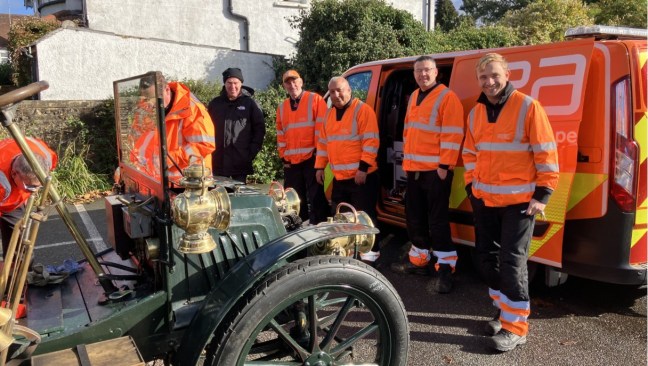
The RAC were out in force and in front of every stationary van was a veteran car in distress. It became obvious that as they caught up with the driver’s son that his Panhard was alarmingly emitting steam. They stopped at a petrol station to refill the radiator and carried on to Purley where many cars had pulled into a church car park for a desperately welcome hot coffee.

Much mechanic expertise ready to resolve any problems

It was there while investigating the water loss of the Panhard that a team of eight RAC mechanics diagnosed a seized water pump and declared the problem terminal. It was probably an unrealistic expectation that any of their service vans would carry a replacement water pump for an ancient French car.

End of the rally for the Panhard et Levassor with a seized water pump

It was here that Dave’s adventure came to a halt. The son took the dad’s Cadillac to drive on to Brighton while dad was left to organise rescue transport to take the Panhard back to Yorkshire after following to Brighton to collect both Cadillacs that were two of 340 cars that reached Brighton from 400 starters.

Dave travelled from Purley station back to Basingstoke, reflecting on his experience that was always the final scene in the Aardman Animation films when Wallace says” It had been a grand day out, Gromit.”

Probus Hears About The History Of Television

Speaker and Probus Club member, Gareth Lewis, outlined the development of a subject deeply affecting our lives: that of television.

Speaker Gareth Lewis

Where did it come from? Was it invented? Did it happen by accident? The concept of transmitting sound, let alone pictures by wire, was beyond the imaginations of the greatest minds in preceding years.

Although considered by many that television was simply ‘invented’ in this country by Scotsman John Logie Baird, there were many scientists before him in the 18th and 19th centuries whose developments paved the way that ultimately resulted in electronic television.

Italian Volta, in 1799, created the first battery. Using this invisible force of electricity Sir Humphrey Davy, inventor of the miners’ safety lamp, created the first arc lamp. In 1896, William Crookes developed the cathode ray tube to show that cathode rays could travel through space in straight lines causing residual gasses to glow. This was further developed by Ferdinand Braun in Germany with his phosphor-coated display tube which laid the groundwork for electronic imaging.

The brilliance at Cambridge University of JJ Thomson (Nobel Physics Prize recipient in 1906) further developed the tube, causing a “beam” of rays to be controlled. Several of his students and later his son all won the Nobel Prize in Physics.

Early in the 1900s, Archibald Campbell Simpson, a British Theoretical Scientist, published a paper proposing a ‘scanning system’ that would eventually form the basis of transmitting an image.

Baird used this electro-mechanical scanning method to develop the first transmission by wire from one room to another of the image of the head of a ventriloquist’s dummy. The British Government recognised the potential of such a system and funded its development.

John Logie Baird with his first transmission

It was the development of wireless transmissions following inventions by Marconi that the GPO became involved with the early radio broadcasts in 1906.

The British Broadcasting Company was formed 1922 as a trade body for the radio industry. It was converted in 1926 into The British Broadcasting Corporation and financed by a radio licence. Under government direction, the BBC played a pivotal role in bringing into existence the TV system using studios.

It will soon be 100 years since the Baird system of transmission using a scanning disk was first broadcast. The Baird Televisor sets sold to affluent Londoners were made by the Plessey Company and cost the equivalent of several year’s earning of the average man.

Meanwhile, in America, Philo Farnswoth, firstly at Westinghouse and then at RCA, in cooperation with Russian émigré Mr Zworykin, developed the first electronic practical TV camera tube, the Iconoscope. This was further developed by a British Russian scientist, Isaac Schoenberg at the EMI laboratories in Hayes, Middlesex, into a more robust and usable camera tube, the CPS Emitron. The first ‘High-Definition TV system” was in development.

Guided by the Government, in 1937 the BBC trialed both the mechanical Baird and the EMI electronic transmission systems eventually settling on the EMI/Marconi version that was able to provide an image consisting of 405 lines – the world’s first high-definition television.

Public television broadcasting began in the London area in 1936 but ceased in September 1939 at the outbreak of WW2.

Alexandra Palace began transmissions in 1936

Technical advances in radar made during hostilities brought improvements in the quality of transmissions when resuming in 1946. Again, the GPO was heavily involved in building lines to enable regional broadcasting to be introduced which necessitated substantial investment.

Gareth Lewis shared several memorable experiences from his forty-one-year career in broadcast engineering, which took him to many places around the world. Starting with the BBC in 1968 he worked in the famous Television Centre at White City as a project engineer. During the ruinous year of industrial unrest in the UK 1975, he moved to South Africa to be a part of the introduction of colour television in that country.

Returning to England after several years working overseas, he joined Sony in Basingstoke and among other things, became involved with the engineers working for a little-known Australian TV mogul – Rupert Murdoch. Murdoch wanted to broadcast four channels simultaneously by satellite to the UK, and Sony was able to supply equipment that would achieve this aim, which was the start of Sky Television based in Brentford, West London.

Gareth Lewis is of the opinion that over the next few years, the days of linear broadcasting schedules of programmes may disappear. It will become normal to stream programmes to watch at leisure, as is now happening with internet provided television. Possibly then, the days of the BBC licence fee may become a thing of the past.

Probus Hears About HMS Broadsword in the Falklands War 1982

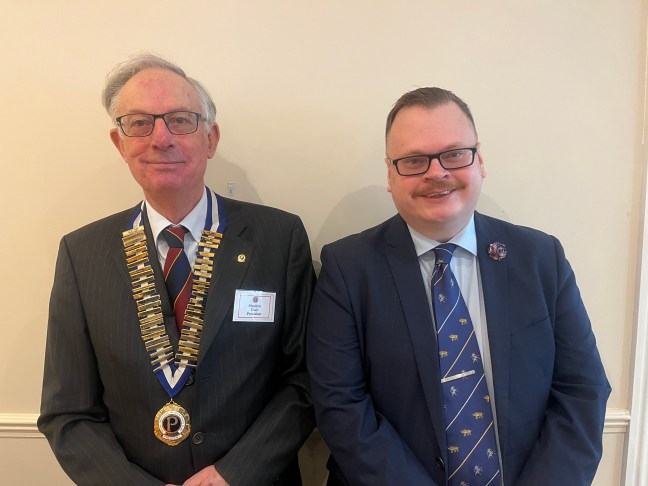
President Stephen Thair with speaker Charlie Threlfall

For speaker Charlie Threlfall, as a short-term Royal Navy officer, the prospect of a goodwill tour of ten countries had great appeal.

Aged 19 in early April 1982 he was on HMS Broadsword at anchor in Gibraltar. They were readying for a series of social events and cocktail parties across the world as they planned to show off their three years old warship. Launched in 1979 as a Type 22 Guided Missile Frigate with a displacement of 4,500 tons and a crew of 235, HMS Broadsword was the epitome of the latest thinking in naval warfare. It had no traditional gun batteries but an assortment of guided missiles that could lock on a target without fail.

HMS Broadsword

That very week, on 2nd April 1982, Sub Lieutenant Charlie Threlfall’s life changed forever. The Falkland Islands in the South Atlantic were invaded by Argentinian forces. On 5th April HMS Broadsword left Gibraltar heading for Ascension Island, about halfway to the Malvinas, as the Argentinians called this British protectorate.

There, a group of twenty war ships and supply vessels was assembled, painting out any identification marks to confuse any attacking forces. Southbound, they sailed in close convoy using no radar and no lights at night so that they could not be located by the enemy. The crew went on Defence Watches of six hours on, six hours off. They were lucky to get four hours sleep each day for ten weeks.

The British submarine Conqueror sank the Argentinian cruiser General Belgrano on 2 May. Questions were asked in Britain if it was a legitimate target as it was purported to be sailing away from the conflict zone, a situation denied years later by the ship’s captain. All Argentinian naval ships were ordered back to port and then only aerial attacks continued at the extreme limits of their range.

Action stations came on 4h May when HMS Sheffield was hit by an air launched anti-ship Exocet missile. 170 sailors from the Sheffield were rescued by Broadsword.

HMS Broadsword, along with HMS Coventry were positioned in San Carlos Water, and were unable to spot enemy aircraft approaching over land, and were strafed and bombed, being unable to offer much resistance. Crew were instructed not to shoot at helicopters only fast jets.

Broadsword and Coventry were then positioned at sea to the west of the Falklands to draw aircraft fire from the troops. With two approaching enemy jets HMS Coventry was hit by three 500lb bombs, caught fire and eventually sank. But as it came across the bow of Broadsword it prevented them from firing their missiles.

It was then discovered that at sea it was impossible to reload the four Exocet launchers on Broadsword once the initial four missiles had been fired. One of many lessons learnt during this conflict and that were eventually incorporated into naval practice. Having the correct missiles and numerous life-threatening experiences ultimately enhanced sailors’ safety.

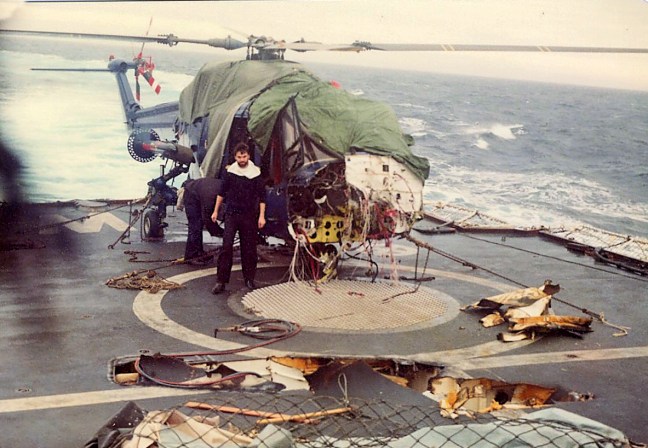
HMS Broadsword had a narrow escape from following the fate of HMS Coventry as a 1000lb bomb travelling at 450 mph hit the ship towards the stern, 10 feet above water level, travelled through two decks and emerged upwards through the flight deck, where it took off the nose of a Lynx helicopter, and bounced overboard, failing to explode.

Lynx Helicopter Missing its Nose
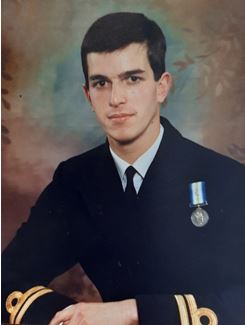
Charlie Threlfall promoted to Lieutenant

Six British war ships were lost and sixteen damaged during this conflict. 649 Argentinian military personnel, 255 British and three civilian islanders lost their lives. Charlie Threlfall knows the name of the Argentinian pilot who sent the 1000lb bomb into the side of HMS Broadsword. He says he would never shake his hand as two of his fellow schoolboys from his street on the Isle of Wight were in this conflict. One was a cook and was killed in this action while another, like himself, survived, thereby becoming a member of the ‘Bomb Alley Survivors Club’

Probus Visit D-Day HQ

Probus members and families outside of Southwick House

A group of Probus members and families had an impressive visit to Southwick House (locally pronounced “Suthick”) positioned five miles north of Portsmouth that had a pivotal role in the planning of D-Day, the largest amphibious assault in history.

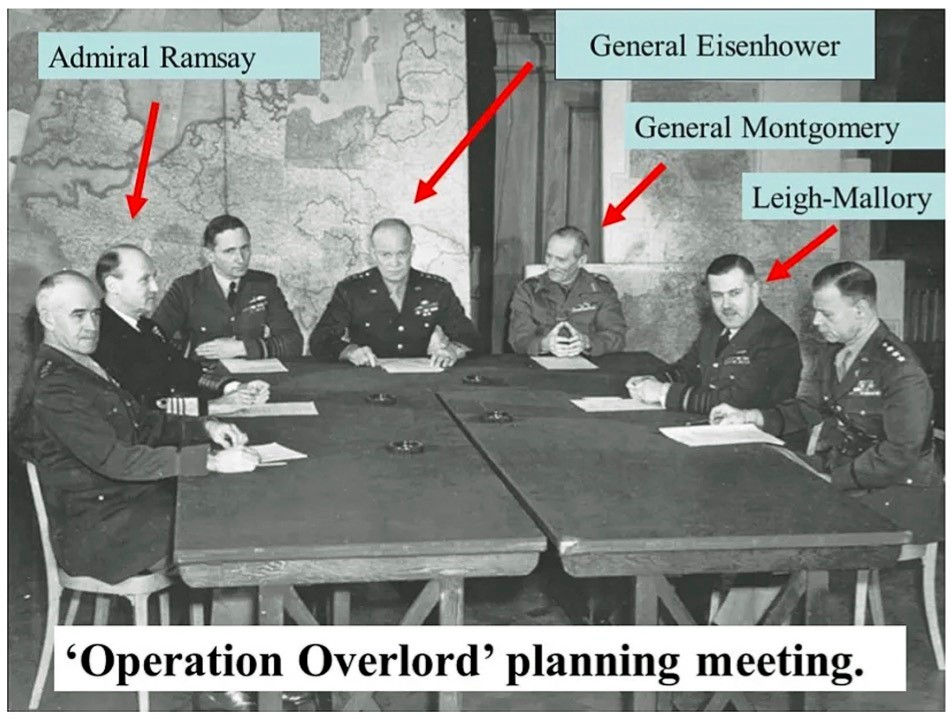
 It was the Supreme Headquarters of the main allied commanders, including Allied Supreme Commander General Dwight D Eisenhower, Naval Commander-in-Chief Admiral Ramsey, Army Commander-in-Chief General Montgomery, and Commander-in-Chief Allied Air Force, Air Chief Marshal Leigh-Mallory. The grounds became the Main Tactical Base for the 21st Army Group for their forthcoming invasion plans.

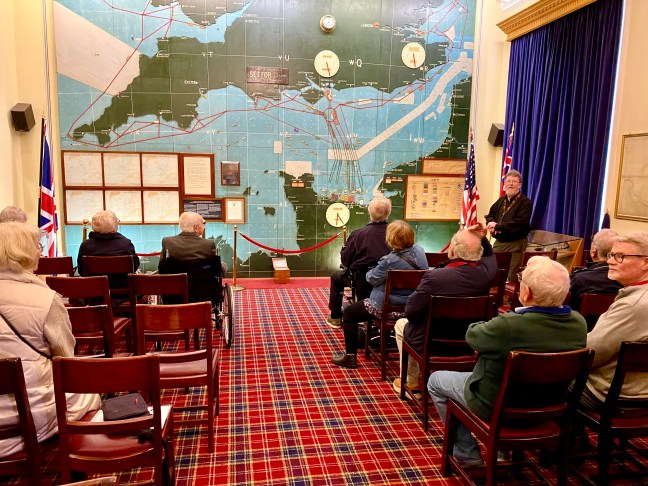
Richard Callaghan, the curator, gave an extensive narrative about the map room that still contains the enormous graphic showing the invasion plans. His talk was interwoven with anecdotes about incidents involving the main characters that gave life to this history lesson.

Map Room with the large wall graphic showing the planning routes

Deception was used to convince the German high command that the invasion would come across the shortest route from Kent to Pas de Calais which caused German divisions to move from the Normandy region.

James Stagg was the meteorologist providing weather forecasts to the senior planning group. As a civilian he would have difficulty in ensuring he would be taken seriously so he was presented with the uniform of a RAF Group Captain. It was Stagg that convinced General Eisenhower to postpone the assault from the planned day of 5th June to 6th June 1944.

Group Captain James Stagg became head of the Meteorological Office post war
Kay Summersby, driver, secretary and “friend” of General Eisenhower

6,000 ships were involved moving from all regions of southern England to the main dispersal area that became known as Piccadilly Circus and then had to pass through corridors cleared through minefields in the Channel. Thanks to detailed planning only seven ships were involved in collisions.

Despite the break in the weather there was still a swell, and the floating Sherman tanks were launched too far out from the shore resulting in only four out of thirty-two reaching the beach. It had been necessary to ensure that the beach would support such vehicles by nighttime investigations in the previous weeks that had not been spotted by the land-based Germans.

LCT (Landing Craft Tank) ships were vital to carrying tanks and heavy equipment to the beaches

In the adjacent bar room, the original weather maps were on the wall along with other memorabilia including models of two LCT (Landing Craft Tank) ships that were the subject of a talk some years ago by Probus member Brian Nagle.

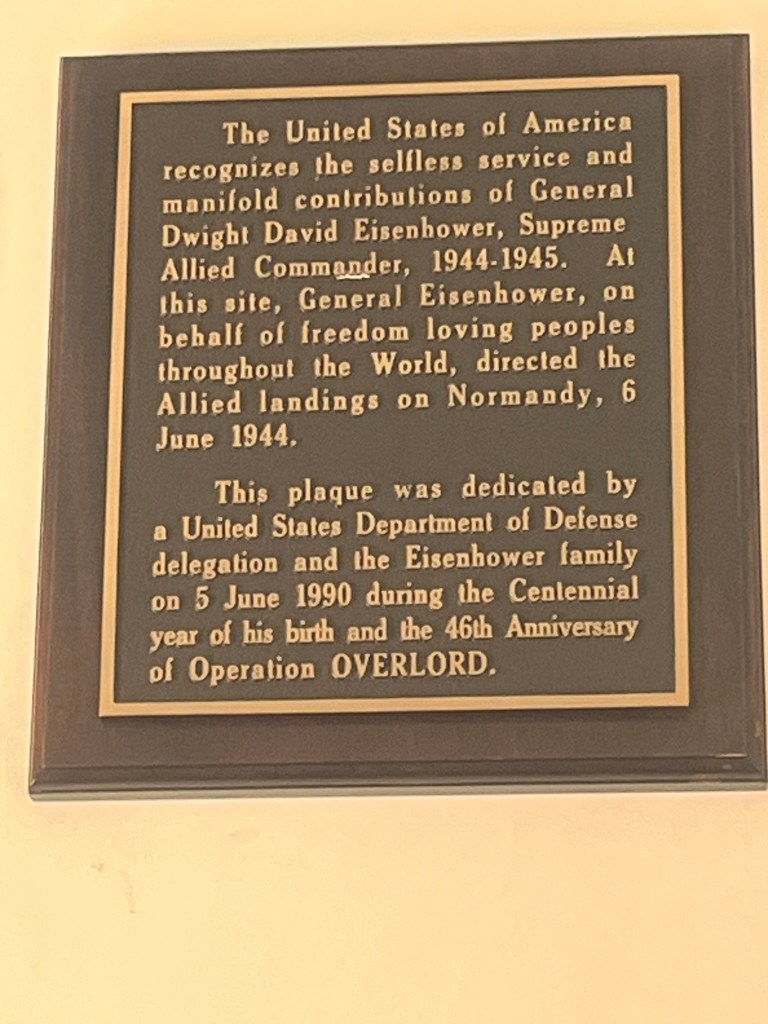
Commemorative plaque on the wall of the Officers’ mess in Southwick House

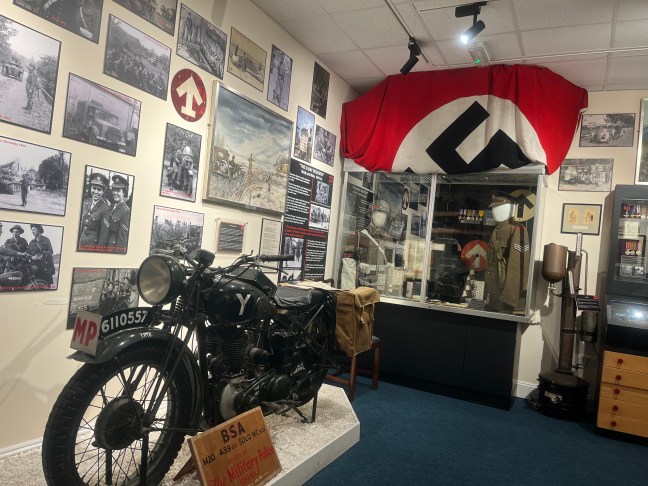
There followed a visit to the Royal Military Police Museum, based on the same military establishment, that showed the development from the early days of the Provost Marshall to the Red Caps known today.

Military Police Museum shows the history of this unit to the present day.