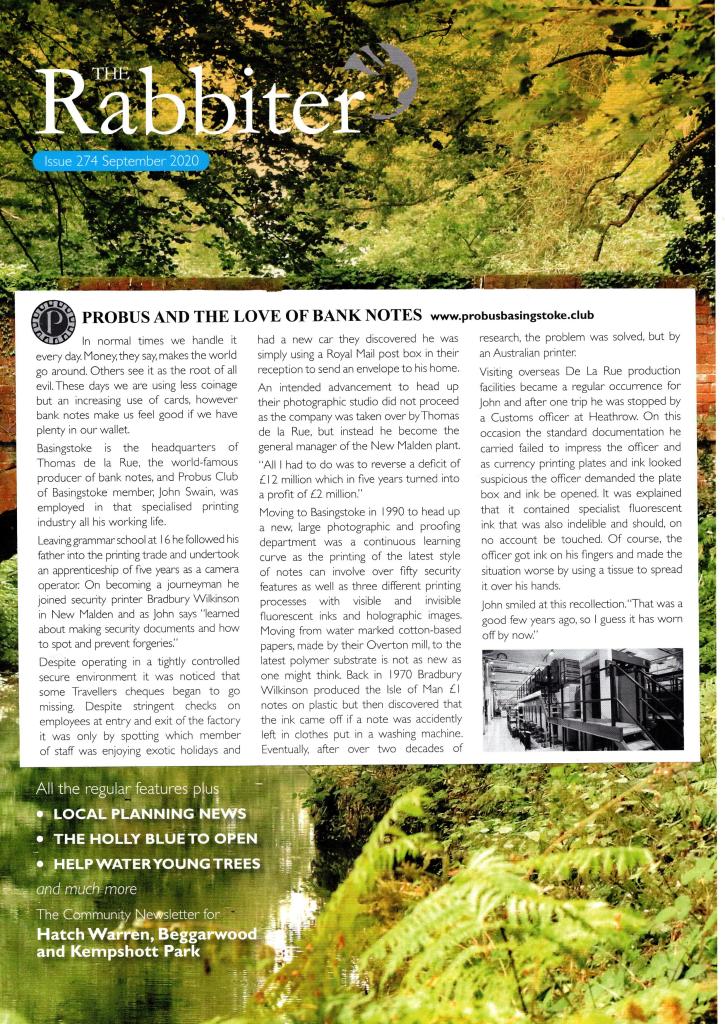
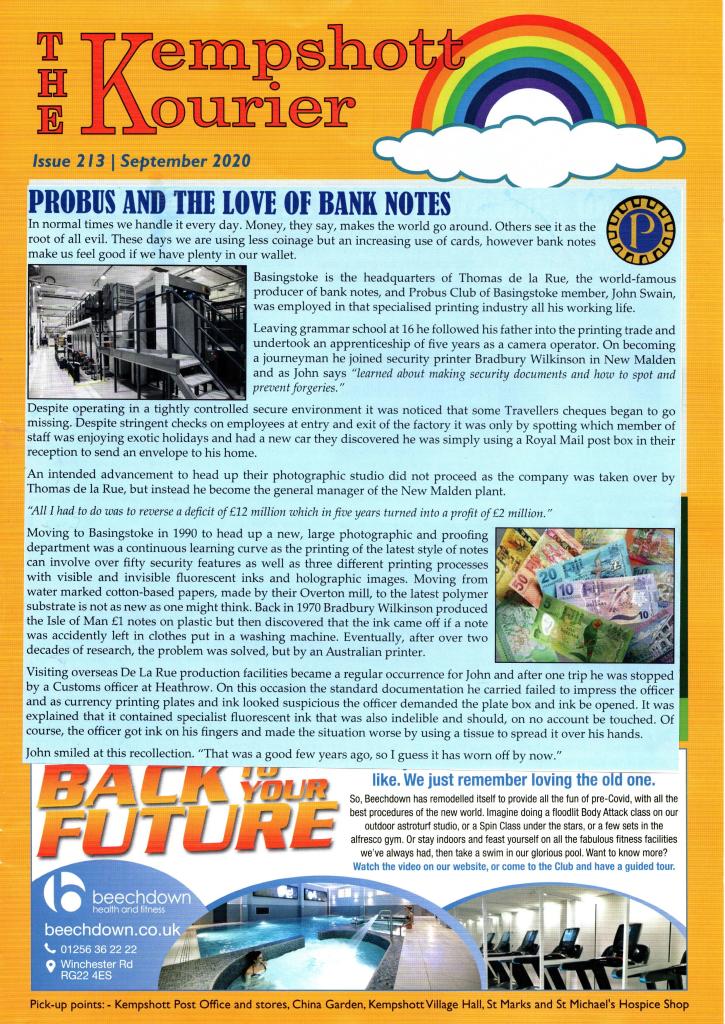
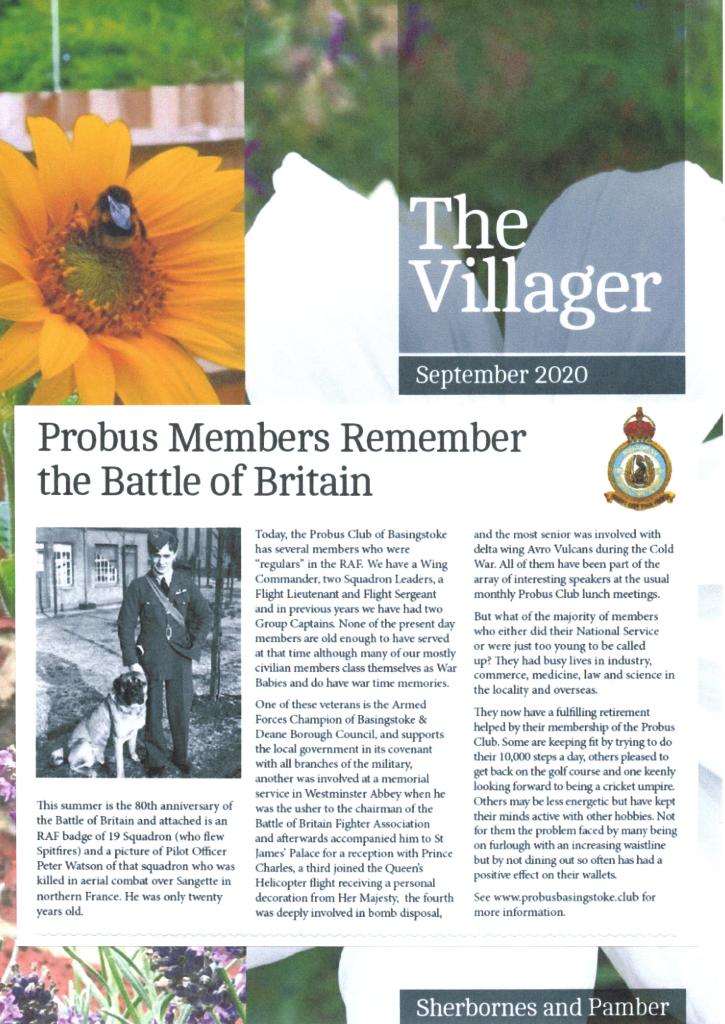
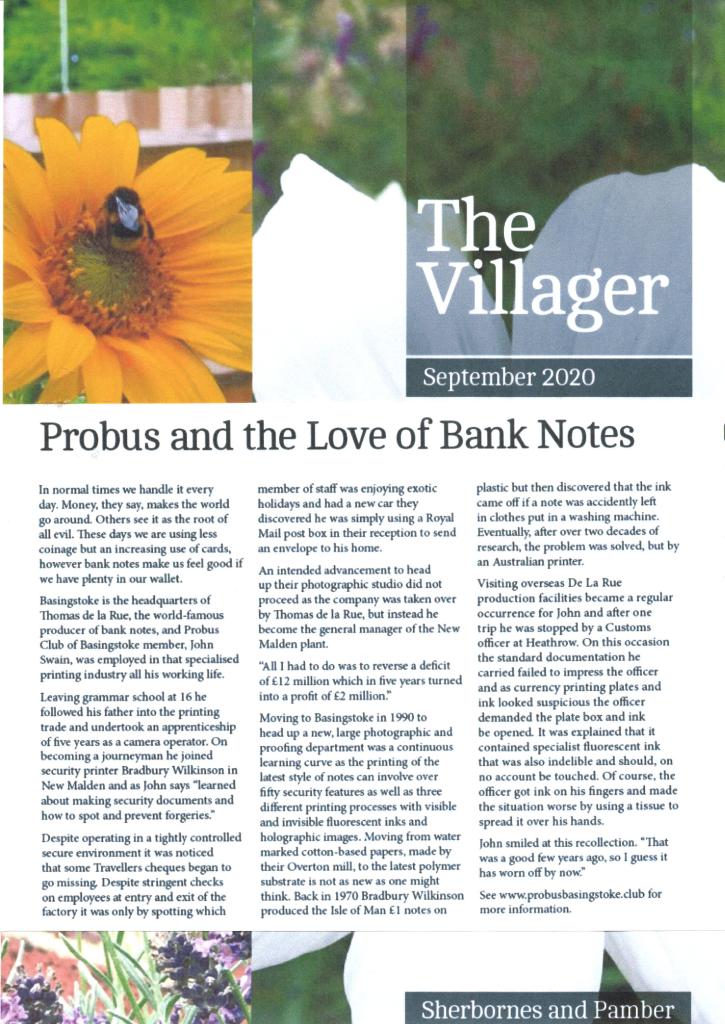
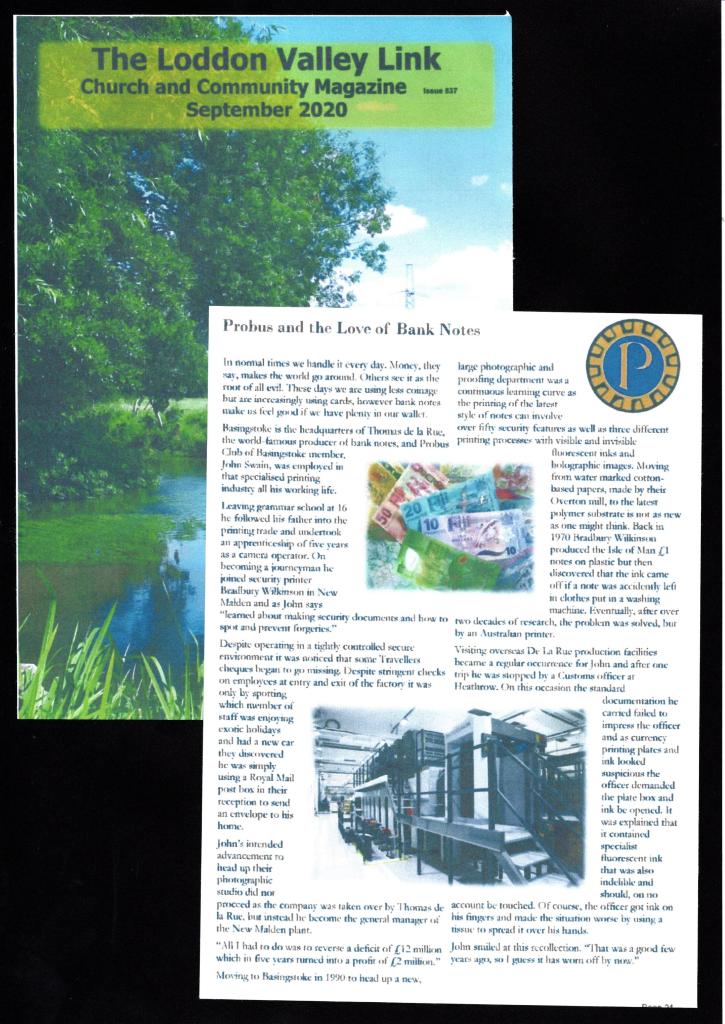
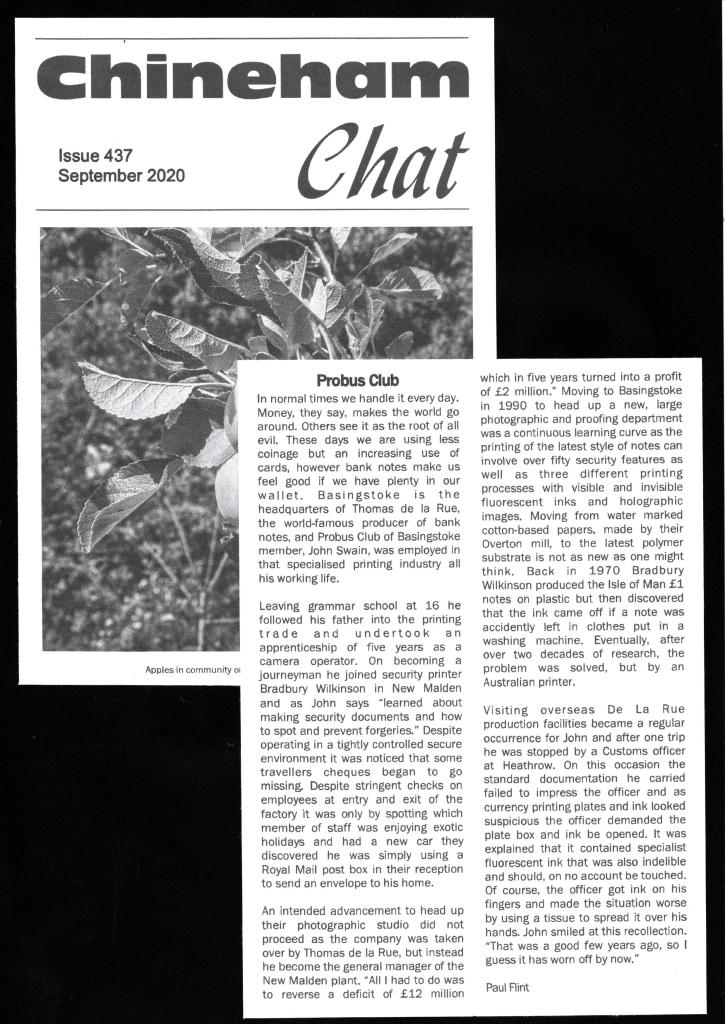
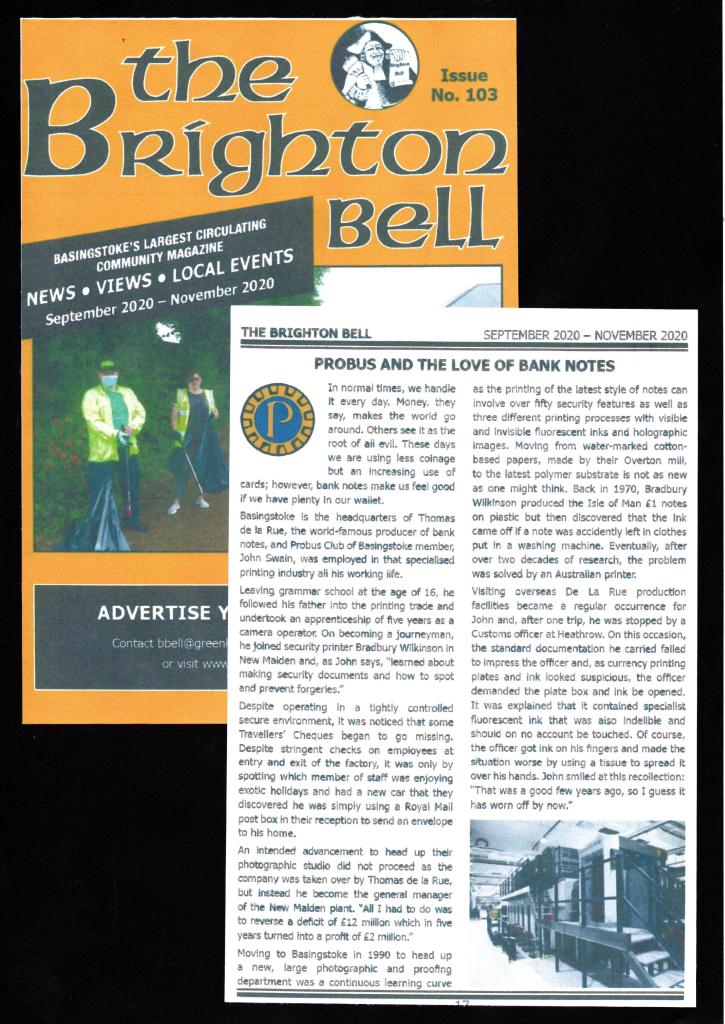
Here are copies of the publicity achieved in the September editions of the local magazines. And it is pleasing to see all these magazines have returned to having a physically printed publication. Nine appearances is very encouraging, helped, in the main, about something close to our hearts (and wallets), namely the subject of bank notes.
Due to understandable space limitations, it is a pity that the magazines are never able to utilise more of the pictures provided to them, nor, indeed, to include a caption. The inclusion of either would provide their readers with a little more appreciation about the subject matter. At least this is not a concern when I post these reports on our web site.
You will note that the Villager magazine (Sherborne St John) also featured a previous report about the Battle of Britain. However we failed to appear in Popley Matters and in the Basinga (Old Basing & Lytchpit) and despite the magazine advising its readers that the Probus article could be seen on the Basinga Extra web site it failed to appear here as well. On checking with them they blame a new web master. They have tentatively offered to run our report within their October magazine.
I must start with my father. He left school at 14 and became an office boy in a local firm making surgical needles. Redditch, where we were living is/was renowned for needles of all sorts as well as fishing tackle and springs. Anyway he climbed the greasy pole and became office manager and left and set up his own company.
Display card of surgical needles produced by Nick Waring’s father’s company.
As a boy he had joined St John’s Ambulance brigade and got more involved with this when as a key worker he was not called up during the war. With his exposure to ambulance work and the making of different needles for the full range of surgical operations he had always wanted to train as a doctor but coming from a poor family there was no chance of it. I was clearly influenced by his experiences and with some difficulty was accepted into the Welsh National School of Medicine in Cardiff in 1966.
As a student things were pretty hectic with few free periods and once on the wards we spent lots of time hanging around in the evenings to see as much as we could. It was then you learnt how to suture and do a lot of the procedures you would need later on. Yes the patients were practiced on! There was a saying “see one, do one, teach one” it was during such an evening session that I had the chance to assist at my first operation. About 10pm a surgeon came into casualty saying that he needed two assistants for a renal transplant later that night. It was about 3am by the time we were all gowned up and hanging onto a retractor terrified we might do something wrong. The amazing thing was that the new kidney was inserted under the skin in the groin rather than the abdomen – a real learning experience.
Another very memorable time was when I had to clerk (take a history) from a Mr Bell who was an octogenarian but when aged only 3 had been operated on by Lord Lister who introduced antiseptics. It really shrank the history of modern medicine into a lifetime. Another such occasion was when our professor of bacteriology told us that he had once been tasked with transporting the “world” supply of antibiotics in his brief case.
The first baby I delivered as a student arrived on a very hot and humid evening (no air con then) the day man landed on the moon. It was a boy and no prizes for guessing what they called him!
My first paid post after 5 years training was very fortuitous. I saw an advertisement in the British Medical Journal for 3 jobs in Southampton. I was invited for an interview to find that 2 of the positions were to work for professors. One was Prof Donald Acheson who, unknown to me, was a founder member of the Faculty of Community Medicine of the Royal College of Physicians as well as being the first Dean of the new embryonic Southampton medical school. During the inquisition I mentioned for some reason that I was interested in community medicine and amazingly he hired me. He subsequently became the national Chief Medical Officer and went on to work for WHO.
The system of training then was 2 years pre-clinical, 3 years clinical, and a year split between house jobs in a medical and surgical speciality. You were then fully registered and could set up as a GP straight away but the concept of vocational training was being developed. This involved another 2 years in various jobs in hospital and a year as a trainee. If you were lucky you then were accepted into a practice where you wanted to settle and after about 3 years of working up to parity you became a full profit sharing partner. Very few GPs were then salaried or part time or indeed female.
After Southampton, where I met my wife, I had 3 jobs in Cardiff and a stint in Wrexham before returning to Cardiff for a trainee year. So why did I choose general practice? I had spent a year in children’s medicine and thought that was my future but in Wales, at least, there was huge competition for consultancies in paediatrics and even then very little support with lifelong rotas of one in two, or worse, of evening and night work after a full day’s work. Together with that there were difficult exams to navigate and I had just got married and we had our first daughter. General practice seemed an altogether better option and I have never regretted it.
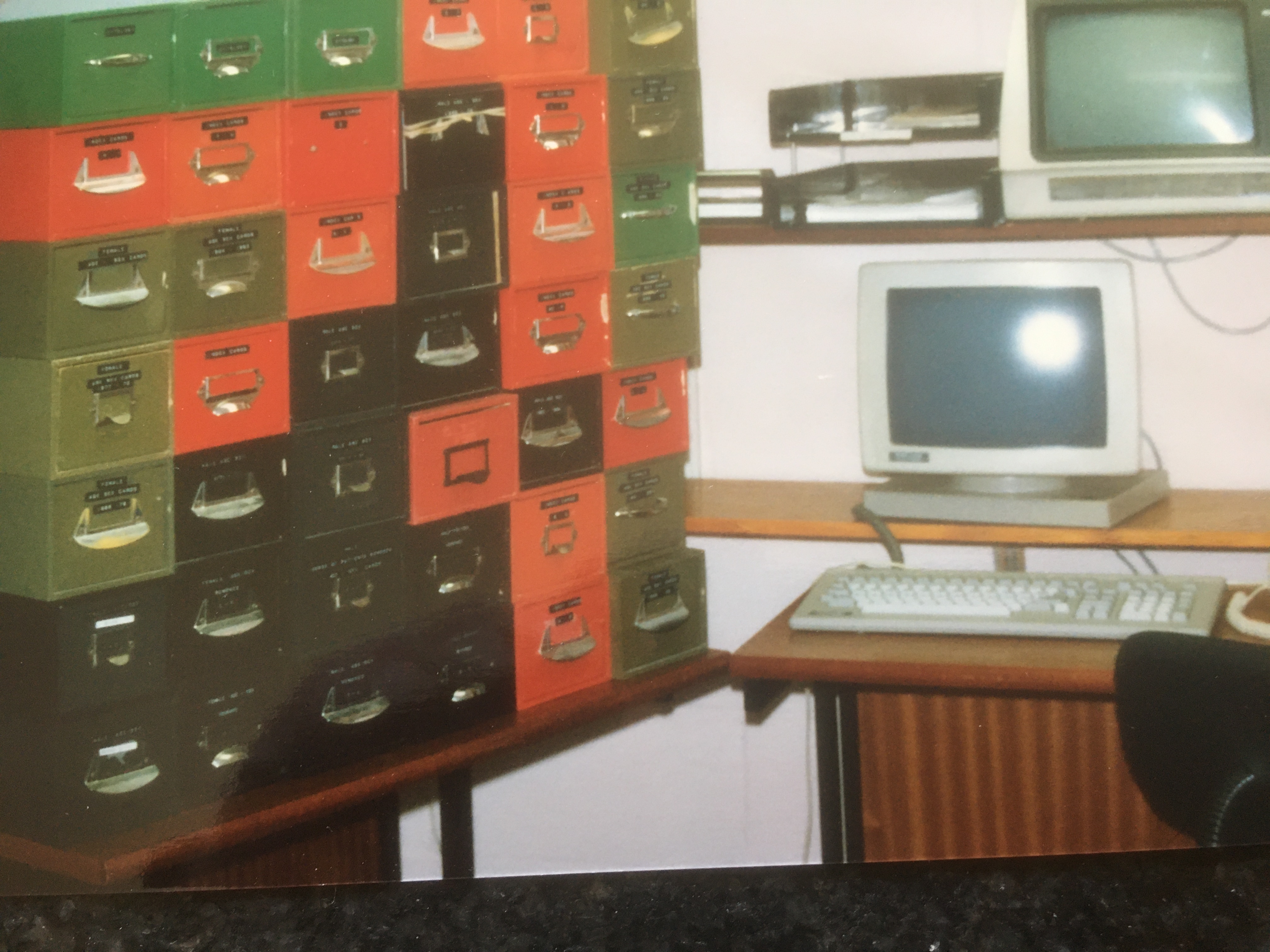
In 1976 when I started in Basingstoke as a GP a book had just been published titled “Six minutes for the Patient” This was revolutionary as very few doctors spent more than 5 minutes on a consultation and much of that was trying to find your way round the old brown, hand written, Lloyd George records. Those records had been first conceived by the Germans and were employed by the then British government.
Patients’ record cards were kept in envelopes in this filing system eventually being replaced with computer records.
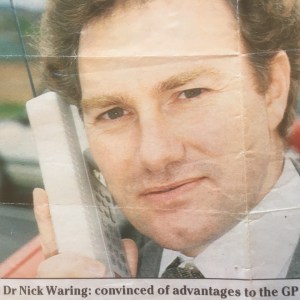
Our practice was coping with the rapid influx of patients from London; my personal list growing from 0 to 3500 in about 18 months. In addition, our consultation time was about double the national average initially as quite a few had no local extended family so all problems came to our door. In those days, of course, we did all our own on call on a I in 5 rota. When on duty we would be on for the evening and night following a full day and followed by another full day. We were also covering our maternity patients about half of our pregnant ladies delivering under our care. It always surprised me how many went into labour in the middle of the night! We had no mobile phones so out of hours calls came to us from our partners at home via a bleep. We then had to find a phone and re-plan our route around the patch. The change to the out of hours service with the Hantsdoc co-op came just in time as most of us were on our knees. My low point was probably when I was called out of bed five times after midnight.
Newspaper article featured a young Dr Waring with his “brick” mobile phone.
Things had to change, and the changes have been massive, largely enabled by the advent of computers as in so many areas of activity. We were able to build on our use of A4 paper records with enhanced coding and that in turn allowed us to tailor our provision of services to improve care. The NHS payment system also made data collection imperative. For a few years we were legally obliged to record everything on paper and the computer which was a big time waster. We became a bit paranoid about the millennium bug which we successfully avoided only to be caught out on the following 29th February.
All of the above has unfortunately meant that patients have less continuity of care seeing their own family practitioner only rarely as ancillary staff take on more of the traditional roles forced by increasing work load. It is a very different job to one I started with.
A postscript – since retirement and more time spent the other side of the desk I have become increasingly aware of how difficult it is to know when to seek help. If I feel that way with my experience then I am sure that others feel it more so. It is a constant dilemma as to how society can best use the service responsibly. Educating the public about when to present and when self- care is more appropriate is an area that requires more consideration but it is better to call unnecessarily than to not call when you need to.
This was a 1950s/60s advertising slogan for pilots for the Royal Navy’s Fleet Air Arm. I had been interested in flying since, at the age of 15, I had cadged a ride from a member at the London Aeroplane Club at Panshanger, near Hertford, where my family home was. He took me up in a Tiger Moth for about an hour, and we even did some aerobatics (not bad for a first flight!). I was pretty well hooked. When I went to University, I joined the RAFVR Squadron there. We flew Chipmunks – a bit different from the Tiger Moth – and were based at the Filton Aerodrome of the Bristol Aeroplane Company. Quite a laugh – taking off in a Chipmunk from the 100-yard-wide Brabazon runway that was 4.5 miles long. You could do several take off and landings in its length, and with the right cross wind, you could take off in its width. My service with them was ended when, instead of achieving my solo at the summer camp, I spent 3 weeks in the officer’s sick bay with a nasty bout of jaundice. Rather than having to go back a year in training the following September, I resigned.
It came alive again when I took my final exams in Chemistry, with the realisation that the last thing I wanted was a career as a chemist! I got through my degree, with the knowledge that I wanted to get into flying. Having decided that dark blue suited me better than RAF blue, I applied to the FAA. All went well with the selection procedure, interviews and aptitude tests. The medical was the final hurdle. To my – and the Naval doctor’s – consternation, it was found that I had limited hearing above 4000 Hertz in one ear. The MO told me that it was noise damage and guessed that I had done a fair bit of shooting, and that I was right-handed (all too true!). He said that the recent introduction of the Belgian FN automatic rifle had done the same thing to some of their marines until they introduced ear protection. I had a second assessment at Millbank, but the result was the same – so, no flying for me!
Strand 2 – Shooting
This goes back to the age of 11. At my prep school, they had a 25yard indoor range for .22 shooting. For a small fee, I could learn about target shooting. On arrival at my second school, I found that, not only could I shoot at a smart indoor range in the winter and spring terms, but in the summer, we cycled a couple of times a week the 2 or 3 miles to an outdoor range in a valley of the South Downs. Meanwhile, the Master responsible for shooting, with the CCF Sergeant Major, drove up in his brand-new Ford Popular with 8 or 10 .303 rifles and a load of ammunition. There we shot at 200 and 500 yards. I took to this, and for 5 years had 2 terms of .22 and one term of full bore, with occasional inter school meetings at other ranges in Sussex, and then the yearly Ashburton Shield meeting at Bisley.
Remembering that this was the 1950s, no one had heard of earmuffs for target shooting. Although you could buy earplugs at the shops at Bisley, I couldn’t afford those. The result was one damaged hearing and no “Flying Navy“ for me. Bridget said that it had saved my life!
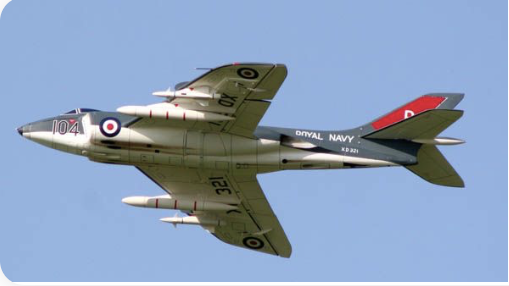
Although I had told the FAA that I wanted to fly helicopters, they said that I would fly whatever they told me to fly. I had done well in the flying aptitude tests, so it could well have been fixed wing jets. At that time, the Navy’s fast, carrier-borne jet was the Supermarine Scimitar. This was a big, heavy, multi-rôle, twin jet aircraft, operating from small aircraft carriers, such as HMS Illustrious and HMS Hermes. In service, 39 of the 76 aircraft purchased were lost to accidents, often during landing at sea. I have been told that, at that time, the average service life of a Naval fast jet pilot was about 3 years! Bridget was undoubtedly right!
The moral is, tell your young people to look after their ears when they are exposed to loud noise, and wear suitable protection!
In normal times we handle it every day. Money, they say, makes the world go around. Others see it as the root of all evil. These days we are using less coinage but an increasing use of cards, however bank notes make us feel good if we have plenty in our wallet.
Basingstoke is the headquarters of Thomas de la Rue, the world-famous producer of bank notes, and Foyle Park resident and Probus Club of Basingstoke member, John Swain, was employed in that specialised printing industry all his working life.
Leaving grammar school at 16 he followed his father into the printing trade and undertook an apprenticeship of five years as a camera operator. On becoming a journeyman he joined security printer Bradbury Wilkinson in New Malden and as John says “learned about making security documents and how to spot and prevent forgeries.”
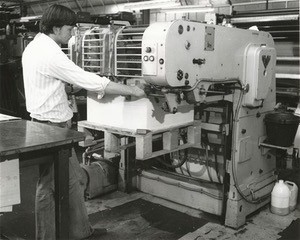
Security Printing at Bradbury & Wilkinson in 1980s
Despite operating in a tightly controlled secure environment it was noticed that some Travellers cheques began to go missing. Despite stringent checks on employees at entry and exit of the factory it was only by spotting which member of staff was enjoying exotic holidays and had a new car they discovered he was simply using a Royal Mail post box in their reception to send an envelope to his home.
An intended advancement to head up their photographic studio did not proceed as the company was taken over by Thomas de la Rue, but instead he become the general manager of the New Malden plant.
“All I had to do was to reverse a deficit of £12 million which in five years turned into a profit of £2 million.”
Moving to Basingstoke in 1990 to head up a new, large photographic and proofing department was a continuous learning curve as the printing of the latest style of notes can involve over fifty security features as well as three different printing processes with visible and invisible fluorescent inks and holographic images.
Numbering Boxes used on both sides of currency
Moving from water marked cotton-based papers, made by their Overton mill, to the latest polymer substrate is not as new as one might think. Back in 1970 Bradbury Wilkinson produced the Isle of Man £1 notes on plastic but then discovered that the ink came off if a note was accidently left in clothes put in a washing machine. Eventually, after over two decades of research, the problem was solved, but by an Australian printer.
Latest Currency Press can simultaneously print six colours both sides of a sheet.
Visiting overseas De La Rue production facilities became a regular occurrence for John and after one trip he was stopped by a Customs officer at Heathrow. On this occasion the standard documentation he carried failed to impress the officer and as currency printing plates and ink looked suspicious the officer demanded the plate box and ink be opened. It was explained that it contained specialist fluorescent ink that was also indelible and should, on no account be touched. Of course, the officer got ink on his fingers and made the situation worse by using a tissue to spread it over his hands.
John smiled at this recollection. “That was a good few years ago, so I guess it has worn off by now.”
Typically the month of August is quiet for the local magazines as the Rabbiter, Villager and Loddon Valley Link do not publish. However we failed to get a mention in the newly returned Link (but with a promise for September) but did get in the Basinga, Popley Matters,(still considering if they should return to a printed version), Chineham Chat (returning with a printed edition) and the Kempshott Kourier.
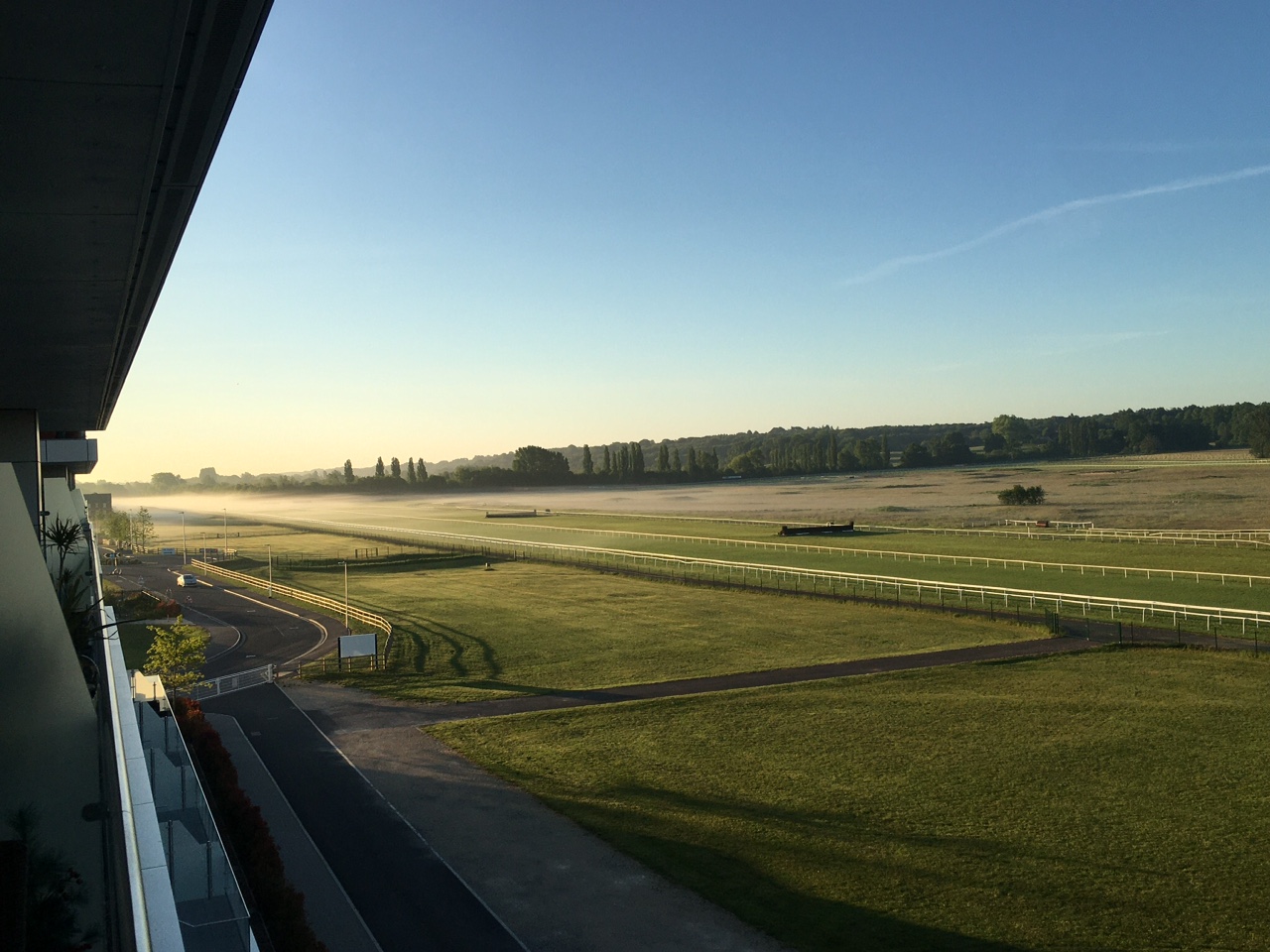
When I moved to Newbury Racecourse two years ago having lived in Basingstoke for some forty years little did I know then what an added benefit it would be for me in the past months during ‘Lockdown’.
With an uninterrupted view overlooking the racecourse it’s a constantly changing landscape from early morning sunrise and mists to late evening sunsets and all the weather in between that I can see advancing over fives miles away from Beacon Hill direction – even where the rainbow finishes – no pot of gold though!
Early morning mist over the course
Breakfast time normally brings the daily flypast of geese in ‘V’ formation and a small family of deer grazing in the middle of the racecourse. Later in the day sees a variety of birds especially numerous red kites that rise on the thermals and circle without even moving their wings – some evenings the odd fox running down the racecourse – maybe I should place a bet as he always wins!
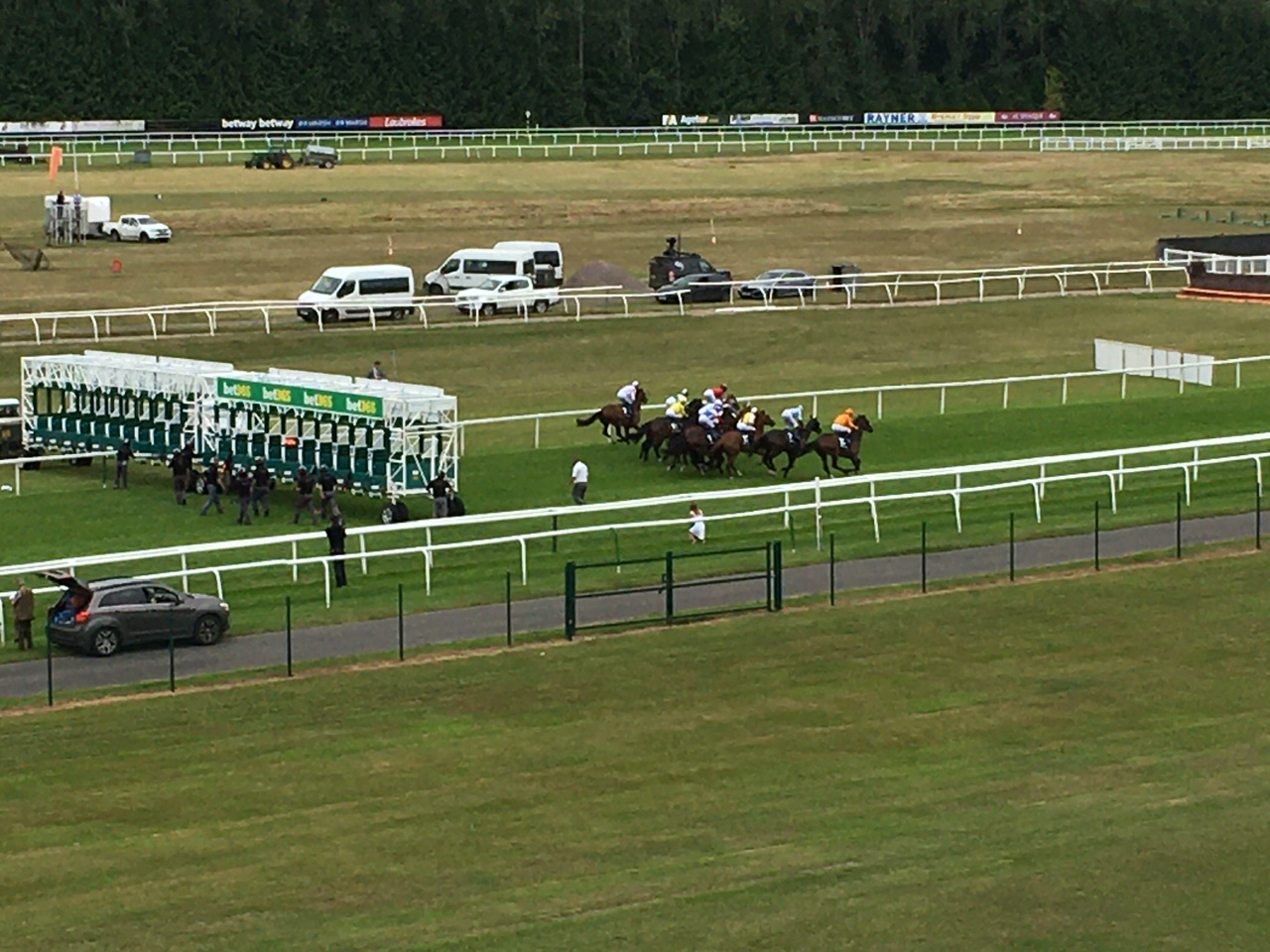
Now that some restrictions have been lifted and horse racing has resumed ‘behind closed doors’ I can enjoy my own private view of the races!
Racing in progress – at last!
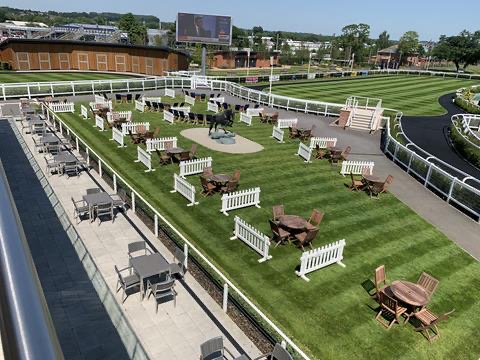
Newbury Racecourse have held a few ‘Pub in the Paddock’ events with plenty of outdoor tables and spacing with sporting events on the big screen – yes I have participated and enjoyed a few pints while watching the sports.
Social distancing for drinkers
Recently they have held ‘drive in’ karaoke and theatre events in the middle of the racecourse to help improve their income. Around the racecourse there is always maintenance being carried out from grass cutting to watering the complete track as required.
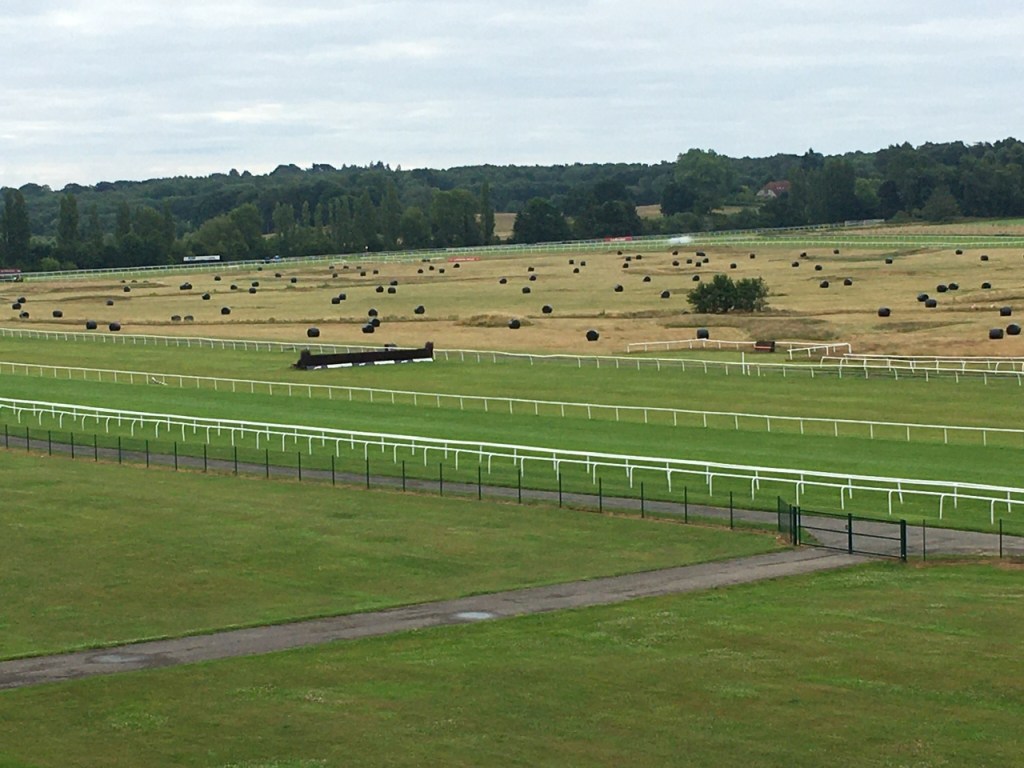
One unusual sight this year has been in the middle of the course where the grass has been allowed to grow and a few weekends ago cut and made into bales of hay and then wrapped in plastic for storage – another source of income in these unusual times.
Hay bales in the distance
So although ‘Lockdown’ has meant I have spent a considerable amount of time in my apartment there is always a changing view and I have enjoyed my time sitting on my balcony watching the wildlife, eating and sometimes having a G & T or a glass of wine –
No pot of gold at the end of this rainbow
life can be tough sometimes but I’m coping in the circumstances and hope we can all meet up again soon when it’s safe to do so.
This summer is the 80th anniversary of the Battle of Britain when Churchill said “Never in the field of human conflict was so much was owed by so many to so few.” Most of the Spitfire and Hurricane pilots were very young men who themselves asked how they should live if you are twenty and will be dead by the end of summer.
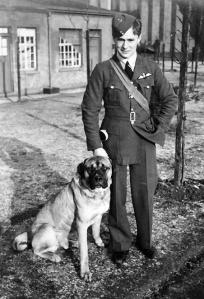
Spitfire Pilot P/O Peter Watson killed in action age 20
Today the Probus Club of Basingstoke has several members who were “regulars” in the RAF. We have a Wing Commander, two Squadron Leaders, a Flight Lieutenant and Flight Sergeant and in previous years we have had two Group Captains. While the father of one of the current ex-RAF members was a Spitfire pilot during the early part of the war, none of the present day members are old enough to have served at that time although many of our mostly civilian members class themselves as War Babies and do have war time memories.
The presence of RAF Odiham does have a part to play on why some of these members live in Basingstoke following retirement. Although Odiham played a significant role during the war with a wide variety of aircraft types there were three airfields in Hampshire that operated Spitfire and Hurricane squadrons that contributed their efforts during the Battle of Britain. These were Boscombe Down (56 and 249 Squadrons Hurricanes) Middle Wallop (609 Squadron Spitfires and 238 Squadron Hurricanes) and Lee on Solent that was used by many RAF Spitfire and Hurricane squadrons during the Battle of Britain.
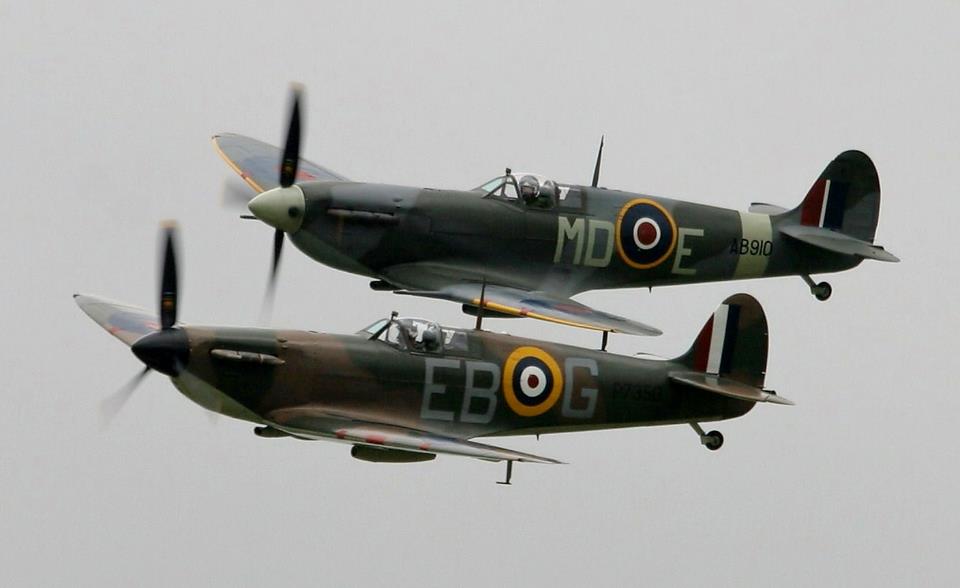
Supermarine Spitfires from 133 Eagle Squadron – Biggin Hill. The top aircraft is flown by the father of Probus member Cllr Paul Miller. Spitfires, with superior manoeuvrability, were used against German fighters.
Today, one of these veterans is the Armed Forces Champion of Basingstoke & Deane Borough Council, and supports the local government in its covenant with all branches of the military, another was involved at a memorial service in Westminster Abbey when he was the usher to the chairman of the Battle of Britain Fighter Association and afterwards accompanied him to St James’ Palace for a reception with Prince Charles, a third joined the Queen’s Helicopter flight receiving a personal decoration from Her Majesty, the fourth was deeply involved in bomb disposal, and the most senior was involved with delta wing Avro Vulcans during the Cold War. All of them have been part of the array of interesting speakers at the usual monthly Probus Club lunch meetings.
10 July 1940 was the start of this first decisive battle in history fought entirely in the air. It is poignant that eighty years to the day was the funeral of forces’ sweetheart, Dame Vera Lynn and there was a fly-past of two Spitfires over her home. Both of these iconic planes were spotted over Basingstoke flying abreast back to their bases at Duxford and RAF Conningsby.
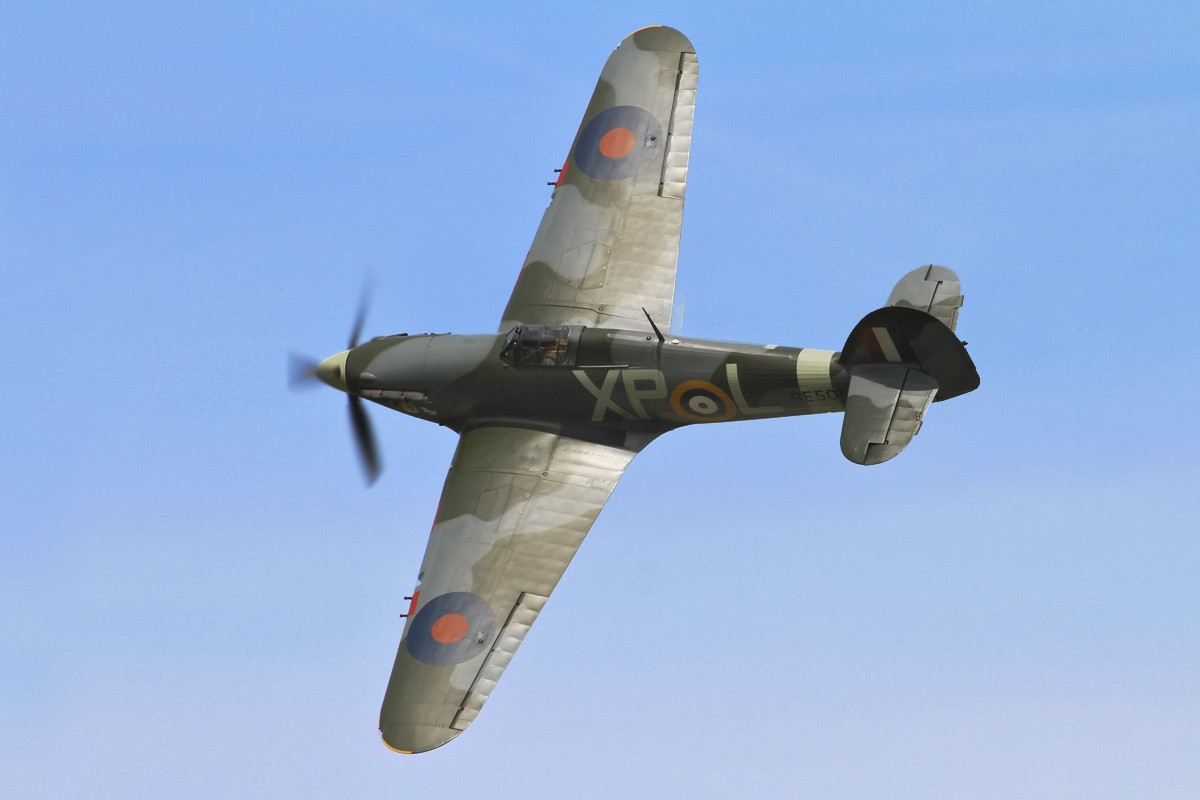
Hawker Hurricanes were used against German bombers
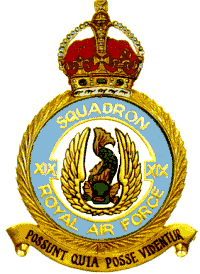
But what of the majority of members who either did their National Service or were just too young to be called up? They had busy lives in industry, commerce, medicine, law and science in the locality and overseas. They now have a fulfilling retirement helped by their membership of the Probus Club. Some are keeping fit by trying to do their 10,000 steps a day, others pleased to get back on the golf course and one keenly looking forward to being a cricket umpire. Others may be less energetic but have kept their minds active with other hobbies. Not for them the problem faced by many being on furlough with an increasing waistline but by not dining out so often has had a positive effect on their wallets. Photos were kindly supplied by Chris Perkins MVO (Badge and P/O Peter Watson) and the two images of planes from Paul Miller.
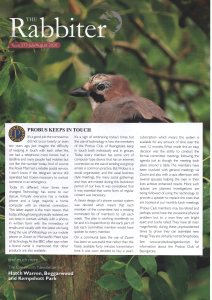
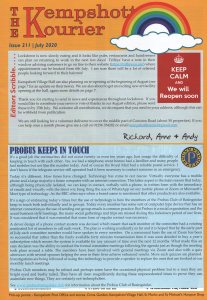
The publicity achieved in the July editions of the local magazines can be seen below. The Rabbiter, Kempshott Kourier and the Bramley magazines continued with their conventionally printed A4 size publications albeit with reduced pagination. Despite providing copy to the returning Villager magazine we did not appear – the editor has a great love of white space otherwise it cannot be said that there was not enough room for our report. Likewise, we did not appear in the Loddon Valley Link, Basinga (not even in their Extra – online version) or in the online Popley Matters.
We did feature in the quarterly A5 size Brighton Bell and Winklebury Way magazines. You will notice a close similarity in these publications and the reason being is that the same person is editor of both magazines – Andy McCormick, who is the leader of the Labour group of councillors at Basingstoke & Deane BC.
We featured in the Chineham Chat blog pages and they are planning the return of their printed version in August, as is the Link (Oakley) although they have changed their position in now planning a free issue to all households. This, so the editor claims, means reduced pagination, which she has warned may mean that they will not have space for our Probus reports. Popley Matters are considering their future as unless they obtain enough advertisements to cover the printing costs then they may remain purely a digital online publication.
Bearing mind that August means that the Rabbiter, Bramley and Villager do not publish means that we shall not have our usual coverage.
Shortly after football came back on TV, with empty terraces but with crowd noise, one Sunday afternoon I happened to see Nottingham Forest versus Huddersfield Town. Being from the Nottingham area I was pleased Forest won 3 : 1. While watching the game my mind wandered back to the time I played on that ground. In those days, in the mid-1950s, the City ground, as it is known, had a much smaller capacity. Although Forest won the FA cup in 1959 the glory days of winning the European Cup twice under Brian Clough and Peter Taylor lay many years ahead. One thing I do remember is that the only thing that separated the fans from the pitch was a low white wall.
At Meadow Lane, the home of Notts County, on whose pitch I also played that same year, it only had a wooden picket fence. The days of Health and Safety regulations were very far in the future.
Was I a budding football star in the making? Certainly not. My ancient grammar school played rugby (we used to call it rugger) and, except for Eton Fives and cricket, a round ball was not even permitted on the school grounds. So what was I doing playing on both of Nottingham’s famous football grounds?
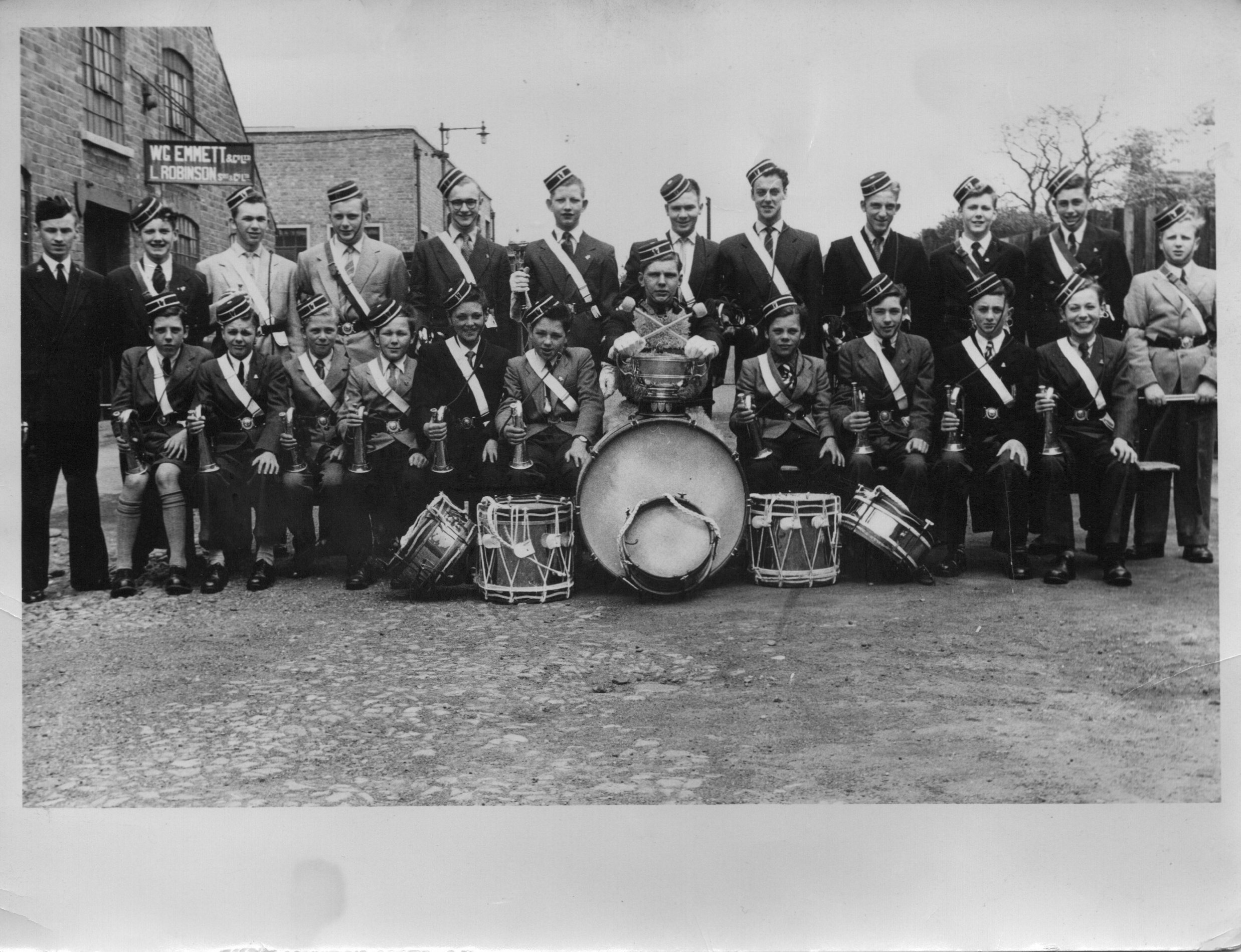
I was in the band that played at half time. This was not any band but the Bugle Band Champions of the Nottingham Battalion of the Boys’ Brigade. And I was a proud bugler.
Bugle Band Champions 1955 – I am sitting on far-right
In those days whenever the Boys’ Brigade, affectionately known as the BB, went on a church parade the local populace of my town of Beeston, a short way from Nottingham, would come out of their houses to watch as the band led the company of over 120 boys. I was desperate to join and managed to gain entrance before the correct admission age of twelve, helped by the fact that my mother’s uncle was deputy captain.
I didn’t know then how the 17th Nottingham (Beeston) Company of the Boys’ Brigade would have a major influence on the rest of my life.
Having its own substantial premises the Beeston Lads’ Club had been founded by a local industrialist in memory of his son killed in WW1. Unlike most Boys’ Brigade companies ours was not affiliated to a specific church. With a fulltime warden, an ex-Grenadier Guards officer, always known as “Skip”, the building had both junior and senior games rooms with snooker and table tennis, a gymnasium, drill hall with stage used for sell-out pantomimes and upstairs there were craft rooms to teach Morse code, Semaphore and First Aid. There was a Bible Class room used for morning service on those Sundays we did not go on a church parade.
Open five weeknights I headed there after finishing my school “prep”, joining several classes which required commitment as badges were only awarded after two or even three years of application. And not only that, the benefactors had presented the club with its own sports field for football and cricket. The Scouts and Sea Scouts, who had their own boat on the River Trent, just could not compete, especially with not having a band.
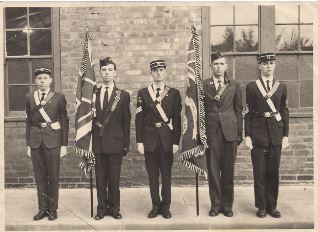
Repeating the success of being Bugle Band Champions I was also a member of the drill squad that became Battalion champions which resulted in me becoming a member of our Colour Party. By now I had gained various promotions, was a sergeant, and had recently been awarded the Queen’s Badge. This highest honour then gained me my position as a management trainee with a large and famous printing company in the city. I didn’t know at the final interview that the managing director was the President of the Nottingham Battalion of the BB.
Colour Party 1959 – I am on far-right
And that commercial printing company had involvement with just about every other industry in the country. Consequently, the graphic arts kept my interest for the next forty-nine years. Over this time, working in various parts of the country meant my three children were all born in different counties. My last position as a salaried employee, with a grand title, took me around the world three times but it came to a shuddering halt with a world financial crisis in 1992/3. I arrived in Basingstoke for the last twelve years of my working life, as the owner of my small business, Kall Kwik Printing, which stood at the corner of Winchester Street and New Street.
But the interest in all industrial and commercial undertakings was maintained because there were very few businesses in Basingstoke, and also the great and good, that we did not have some relationship with over the years. And none of it would have happened if I was not the holder of the Queen’s Badge in the Boys’ Brigade.
There is no doubt that anyone who knows Geoff Twine, who was Probus President 2008/9, is also aware that he was in uniform for many adult years. Probus members of a certain number of service years heard the remarkable story he told at one of our meetings some time ago about the three years he spent in the depths of a slate quarry in north Wales where, as member of the RAF Bomb Disposal Unit, he was literally defusing and disposing of thousands of bombs that were stored there after WW2.
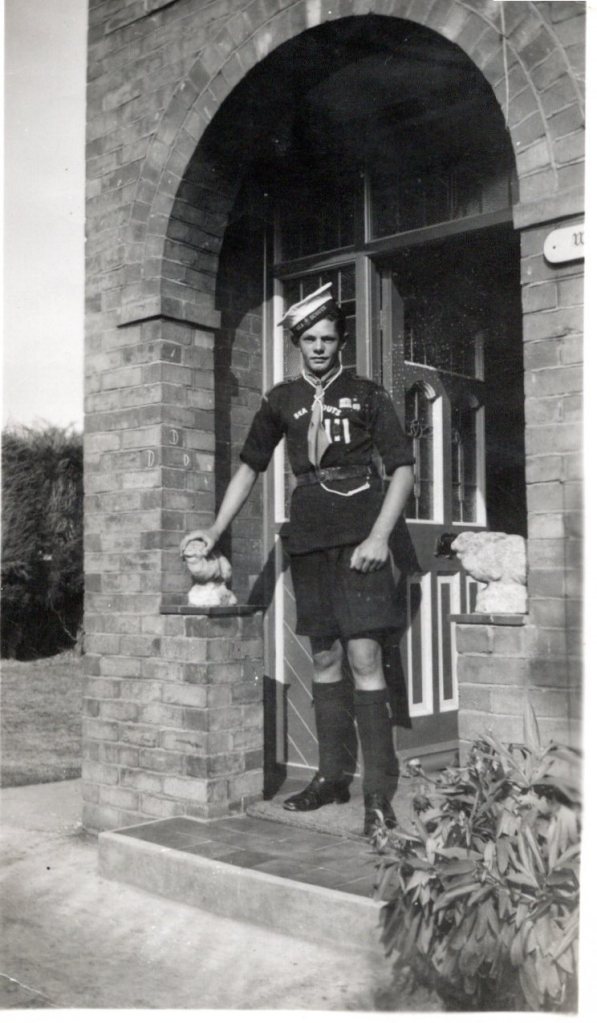
Perhaps being in uniform has always had a fascination for Geoff because it has emerged that when he was ten years old he joined the 1st Southbourne Sea Scouts. His family ran a farm close to Chichester so the sea was commonplace to him as were boats. At the time it was 1942 and due to wartime security measures private citizens were barred from using their pleasure craft – but not the Sea Scouts whose headquarters were adjacent to Chichester harbour. Because his Sea Scout group were affiliated to the Admiralty at Portsmouth not only did they row or sail most weekends using a selection of boats but the Admiralty gave them a whaler for competitive activities in Portsmouth Harbour.
With the adjacent RAF Thorney Island home to various wartime aircraft there were occasions when disasters occurred and the Sea Scouts could leap into action in rescue bids trying to save stricken aircrew from Printsted Harbour. A Wellington bomber taking off northbound was cut in two by a Mosquito flying east to west. The rear gunner and his turret fell into the mud but although two members of Geoff’s Sea Scouts, only 14 or 15 at the time, waded out to attempt a rescue, unfortunately, the crewman was dead.
Another occasion was when an RAF Beverley crashed into the sea short of the runway at RAF Thorney Island. A fellow Sea Scout used his father’s boat and saved a number of the crew for which a special thank you parade was held for him
Geoff made his own canoe which saw him load it up with camping gear and paddle from Itchenor to Birdham Lock and then hike to Wittering for an overnight camp and then reverse the journey the following day. As a fourteen-year-old, it was expected then that such solo adventures were needed as markers on the path to becoming a Senior Scout.
It was as a fifteen years old Senior Scout that in 1947 Geoff attended the first post-war international Scout Jamboree at Sens in France. Still memorable was the devastation caused during the war that had ceased only two years earlier. Geoff still has his identity badge issued for the Jamboree together with many other badges swapped with Scouts from other countries.
After the Jamboree Geoff seemed to lose his enthusiasm for Scouting, but that may be because he discovered girls. And anyway, National Service was approaching and a lengthy career in the RAF became a chosen path with some experiences that could form a story for another day.






 Although I had told the FAA that I wanted to fly helicopters, they said that I would fly whatever they told me to fly. I had done well in the flying aptitude tests, so it could well have been fixed wing jets. At that time, the Navy’s fast, carrier-borne jet was the Supermarine Scimitar. This was a big, heavy, multi-rôle, twin jet aircraft, operating from small aircraft carriers, such as HMS Illustrious and HMS Hermes. In service, 39 of the 76 aircraft purchased were lost to accidents, often during landing at sea. I have been told that, at that time, the average service life of a Naval fast jet pilot was about 3 years! Bridget was undoubtedly right!
 Moving to Basingstoke in 1990 to head up a new, large photographic and proofing department was a continuous learning curve as the printing of the latest style of notes can involve over fifty security features as well as three different printing processes with visible and invisible fluorescent inks and holographic images.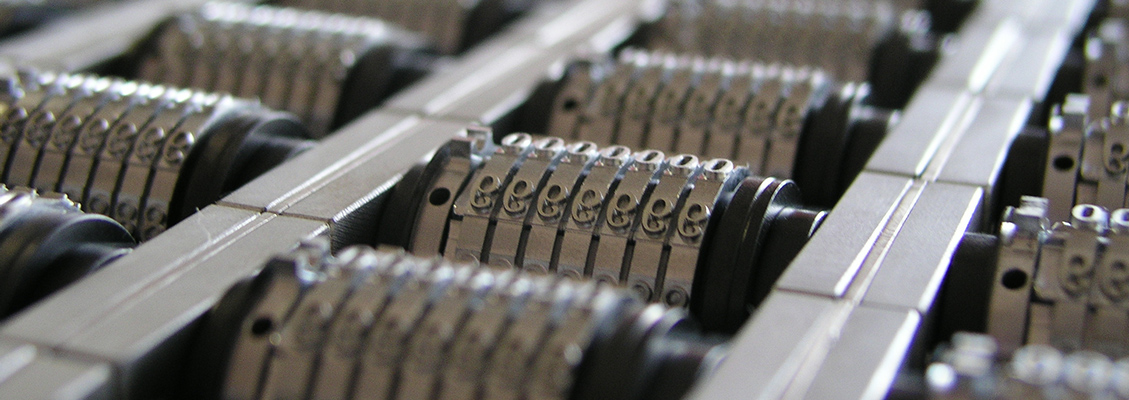







 Probus Club of Basingstoke
You must be logged in to post a comment.