Probus Visit to R.N.L.I. Calshot 20 November 2025

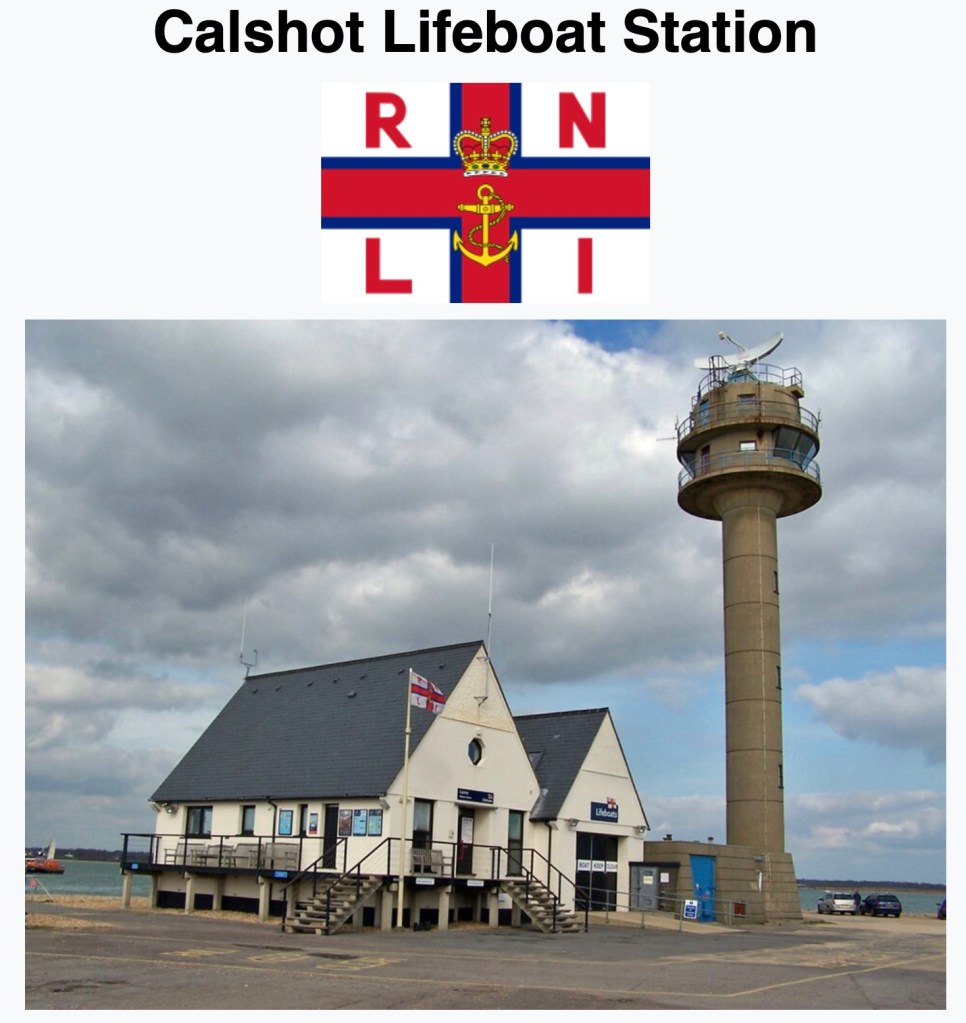
An extremely chilly but very sunny day greeted our group of twenty-one members and families of the Probus Club of Basingstoke for a visit to the RNLI Station at the very end of Calshot Spit.
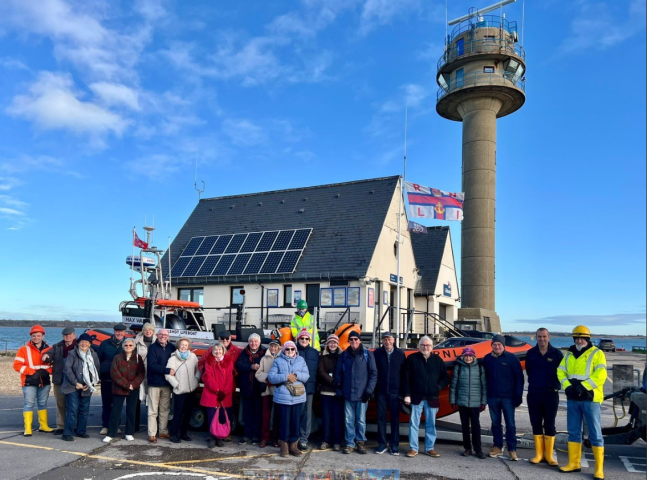
Members and Wives/Lady Friends in Front of ‘B’ Class Lifeboat

The RNLI is the charity that saves lives at sea. Its volunteers provide a 24-hour search and rescue service around the United Kingdom and Republic of Ireland coasts. The RNLI operates 238 lifeboat stations in the UK and Ireland and more than 240 lifeguard units on beaches around the UK and Channel Islands. The RNLI is independent of Coastguard and government and depends on voluntary donations and legacies to maintain its rescue service.
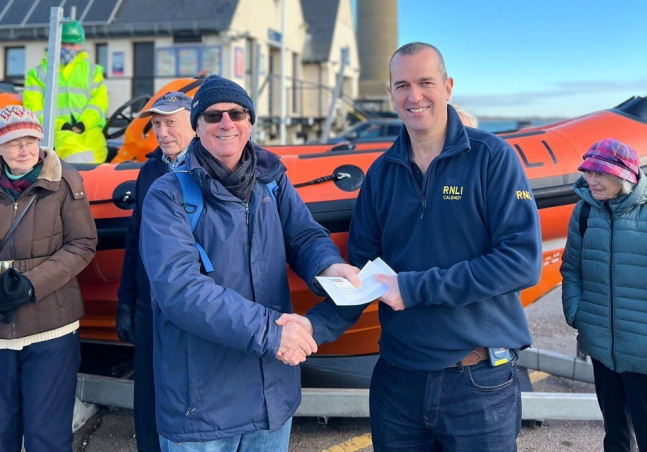
President Stephen Thair Presents Cheque to Charlie Threlfall
l

Since the RNLI was founded in 1824, its lifeboat crews and lifeguards have saved over 146,700 lives. Until its closure in 1961, Calshot Spit had been the site of RAF Calshot, which was the primary seaplane/flying boat development and training unit in the United Kingdom.

A historic seaplane at RAF Calshot, showcasing the site’s aviation heritage.
Readying for takeoff

After the departure of the RAF, Hampshire County Council opened an educational activities centre on the site. The centre was regularly being asked by HM Coastguard to use its boats, to go out and rescue people in trouble off shore. The huge increase of maritime call-outs were such, that, negotiations were established with the RNLI, with a view to there being a more formalised rescue service for this busy stretch of water. A year was spent evaluating this proposition and as a result, a RNLI lifeboat station was established on the site in 1970.

In 1996, the RNLI funded the construction of new shore facilities for Calshot Station, constructed on concrete stanchions to prevent flooding. Hampshire County Council provided a new boarding jetty for use jointly by the lifeboat station and the Calshot Activity Centre.
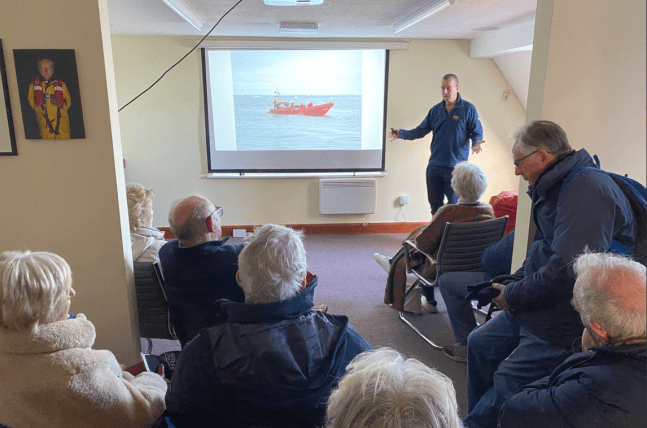
Briefing About The R.N.L.I. by Charlie Threlfall

Various all-weather lifeboats have seen service at Calshot over the years, but in 2012, the Calshot board of trustees decided that the base would cease to be an all-weather facility. Consequently, the last larger Tyne class lifeboat was withdrawn on 4th of April of that year. Since then, Calshot has been officially re-designated as an Inshore lifeboat station with a responsibility stretching from the River Itchen bridge in Southampton, all the way down the Solent to the Isle of Wight. As such, it has necessitated keeping pace with improvements in facilities both for lifeboats and crews: not to mention the constantly evolving changes in equipment and operational procedures. Calshot at present, is equipped with both ‘D’ and ‘B’ class lifeboats. The D-class lifeboat is of an inflatable type serving the RNLI lifeboat fleet as well as a number of Independent Lifeboats around the UK and Ireland. It is one of the smallest lifeboats operated by the RNLI, and unlike other members of the inshore lifeboat fleet, does not have a rigid hull. At Calshot, it normally has a crew of three or and is primarily used for surfer/swimmer incidents as well as assisting in cliff or mud bank rescues. The very nature of its work requires a swift response, and the D-class can normally be deployed very quickly.

Explanation About ‘D’ Class Lifeboat

The much larger “Atlantic 85” B-class lifeboat named ‘Max Walls’ is stationed at Calshot. It is a fast inshore rescue craft and is named after Atlantic College in South Wales where it was designed. Capable of reaching a useful 35 kts, it can be deployed in shallow waters as well as handling challenging, open sea conditions. It is equipped with powerful twin 115hp Yamaha outboard engines and has a self-righting mechanism. It is also equipped with modern advanced navigation and communication systems.

All Aboard The ‘B’ Class Lifeboat Class Lifeboat

An incredible visit was had by all and we were royally treated to the fine hospitality afforded by the RNLI Calshot Crew. Due to the restricted space within the base, we were limited in party size. However, the Probus Club of Basingstoke has booked for a return trip in the spring of 2026

Report by Chris Perkins MVO

Probus Learn About Local Hero

Natalie Larner with President Stephen Thair

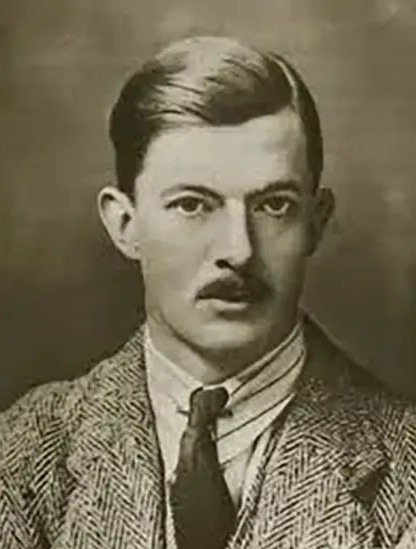
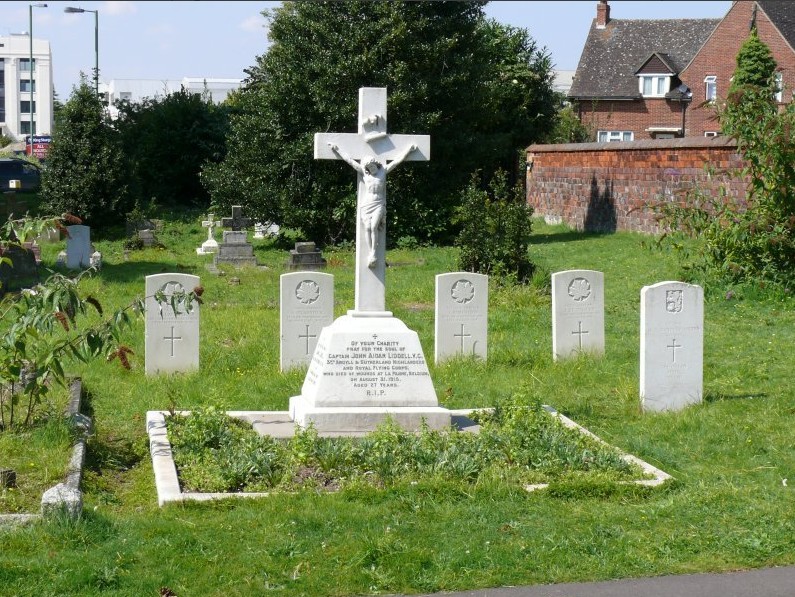
Sherfield-on-Loddon resident Natalie Larner gave an outline to the Probus Club of Basingstoke of Captain John Aidan Liddell VC MC whose 1915 burial in South View cemetery, Basingstoke was attended by many dignitaries and public crowds.

Although he was born near Newcastle in 1888, during the early 1900s and after the First World War, the Liddell family lived at Sherfield Manor which today is Sherfield School. As a lasting connection one of the buildings at Sherfield Village Hall bears the family name and on 11 November each year a special service is held to commemorate his memory.

John Aidan Liddell 1888 – 1915

Following Balliol College, Oxford, where he had obtained a first-class degree in Zoology, at the age of 24 and not wanting to be a ’slacker’ John Aidan Liddell joined the Argyll and Sutherland Highlanders following his maternal grandfather into a Scottish regiment.

When the first World War started, with the rank of Lieutenant, he commanded a Maxim machine gun section on the Western Front that remained unsupported for 43 days. For this action and for saving the Company Sergeant Major he received the MC.

This long time at the front, spent either in action or the suboptimal conditions of front-line trenches, where he changed his socks only once in that time, took a toll on his health and he was given leave.

Lt Liddell at the Western Front

Before the outbreak of the war, he had trained as a pilot, flying a Boxkite at the Vickers school at Brooklands and following recuperation from his battlefield experiences he joined the Royal Flying Corps being promoted to Captain and was stationed at Saint-Omer in northern France.

RE 5 Biplane with pilot positioned behind observer who had Lewis light machine gun

On 31 July 1915 he, together with an observer/gunner, was flying a two-seater RE 5 biplane at 5,000 feet near Bruges when they were fired on by enemy aircraft. Badly wounded with a shattered right thigh he lost consciousness and the plane nose-dived. Regaining consciousness, he was able to regain control at only 3,000 feet above enemy lines.

The plane was badly damaged and with the crew member, 2nd Lieutenant Roland Peck, also wounded, he managed to fly back to base saving not only the plane but also the life of his observer. Captain Liddell had his right leg amputated but died due to septicaemia a month later. He was 27 years old.

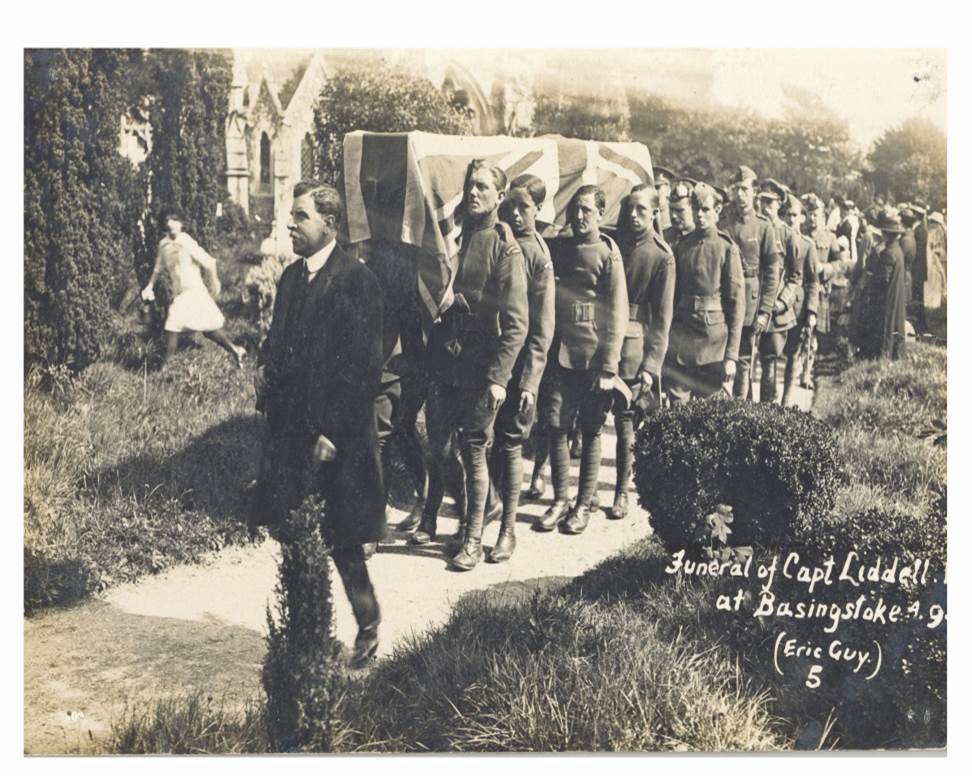
There had been much publicity in the British newspapers of this event so that when his body was brought back to England and following a Catholic mass held in London, the coffin travelled to Basingstoke by train where it was met with pipers from his regiment. The cortege passed through the town where crowds lined the streets and flags flown at half half-mast. His observer was amongst many who attended the funeral.

The posthumous VC was presented to his father by King George V at Buckingham Palace on 17 November 1915. Only four such medals were awarded to members of the Royal Flying Corps.

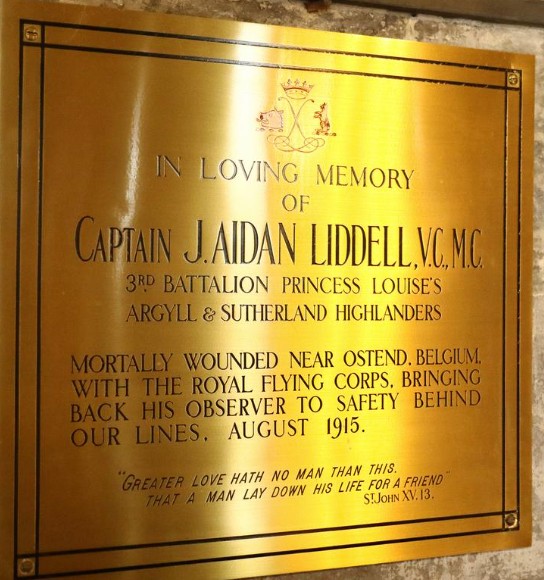
Several commemorative plaques of Captain John Aidan Liddell VC MC are found around Britain, but Sherfield-on-Loddon has its own memorials. His name can be seen topping the list of other local men who lost their lives during this conflict on the village war memorial. And in 2015, the century after his death, a commemorative engraved paving stone, atop a brick plinth, was positioned near the crossroad in the village. Sherfield-on-Loddon residents are justly proud of their local man who became a war hero.

Probus at Remembrance Service

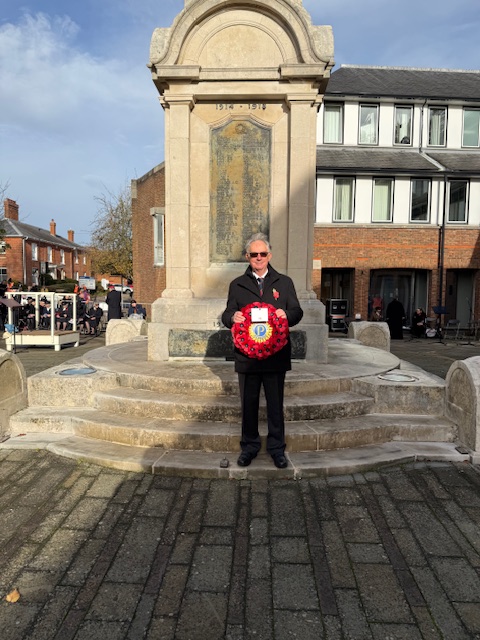
Stephen Thair and Paul Klinger, as President and Vice President respectively, represented the Club at the Remembrance Sunday Service and commemoration which was held at the Basingstoke War Memorial.

The event was very well attended with Veterans, the Gurkhas, Cadets, Scouts and Guides marching in the Parade to take their positions around the War Memorial, and many members of the public in attendance.

The Salvation Army Band provided the music, and the Odiham Military Wives Choir sang two songs. The service was led by Chaplain Charles Lewis.

There was a well-timed flypast by a Chinook helicopter from RAF Odiham and the Two Minutes Silence was initiated by the Last Post performed by a member of the Salvation Army.

The first wreaths were laid by the Mayor of Basingstoke and Deane and other civic dignitaries, and then representatives of other organisations followed, Stephen Thair laying a wreath on behalf of the Club. The wreath-laying was followed by the Remembrance Service, led by the Chaplain.

The event was a very moving commemoration and remembrance of those who had given their lives on behalf of our Country so that we can enjoy the freedoms that we have today. It was encouraging that it was so well attended, not only by veterans of the armed services and members of the civilian uniformed services, but also by so many  young people from  schools and various youth organisations in the area.

Stephen Thair

Probus Member Ticks One Off His Bucket List

Many people watch this annual event either as bystanders or seeing reports on television, the world-famous London to Brighton veteran car run. It was set up to celebrate the change in the law in 1896 that increased speed limits from 4 to 14 miles per hour dispensing with the need to have a man with a red flag walking in front of new-fangled self-propelled vehicles.

This year there was another celebration, that of it being the 125th anniversary of the 1,000 miles Trial round Britain of 1900. A Wolsey car that took place on that rally was also an entry on this year’s London to Brighton run.

A good reason, then, for Dave Kitson, a member of the Probus Club of Basingstoke with a well known penchant for things mechanical and aeronautical, to make a day of it. He could see the start in Hyde Park in London and then follow events by train and bus as the rally progressed to Brighton.

His travel plans immediately unravelled as the first train from Basingstoke on Sunday arrived in the capital at 8.35 am, far too late to see the first cars setting off at 7.00 am. So, he decided to watch the rally go past at Westminster Bridge. And it was here that things took an unexpected turn to the bizarre.

Standing below Big Ben as it chimed 8.45 am, a car, unusually with no passenger, stopped at the traffic lights. Dave made eye contact with the driver, raised his hitch-hiking thumb, pointed at the empty passenger seat and to his great surprise, was invited onboard. Not dressed for the exposure of an open car the kindly driver found a drover’s coat that went some way to avoid Dave becoming too cold.

A surprised Dave Kitson on board a 1904 Cadillac

Regulations state that all entries must have been manufactured before 1905 with the oldest participant this year being made in 1894. Our intrepid hitch hiker’s car, entry number 289, was a 1904 Cadillac which had a single cylinder eight horsepower horizontal engine, with two gears driving a chain to the rear wheels.

A similar Cadillac was sold six months ago for £145,000

The driver claimed that not only was this his 44th London to Brighton run but also in the rally this year he had another similar model of Cadillac being driven by a friend, and his son was driving a 1903 French made Panhard et Levassor which had a two-cylinder engine producing 7 horsepower. The three cars had a total value of around three hundred thousand pounds.

Not only did Dave have the unexpected pleasure of being a participant in this world-famous rally he had the additional duties of helping to look out for the route markers, make left arm signals and best of all acknowledge the applause of the spectators lining the route.

More than once, it was necessary to give the appropriate hand signal to drivers cutting across in front of a 121-year-old car that did not have ABS brakes and sometimes hardly any brakes at all.

Next to the Cadillac is the American made White steamer car

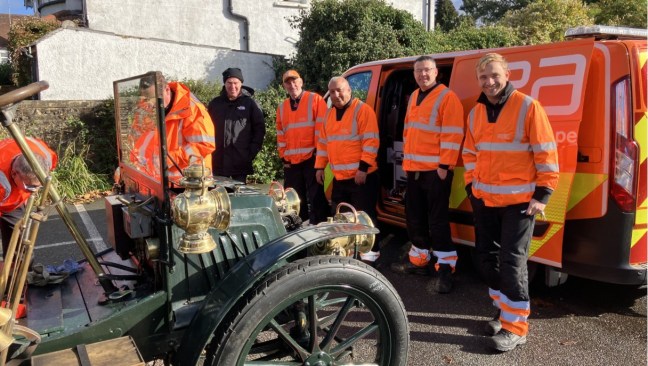
The RAC were out in force and in front of every stationary van was a veteran car in distress. It became obvious that as they caught up with the driver’s son that his Panhard was alarmingly emitting steam. They stopped at a petrol station to refill the radiator and carried on to Purley where many cars had pulled into a church car park for a desperately welcome hot coffee.

Much mechanic expertise ready to resolve any problems

It was there while investigating the water loss of the Panhard that a team of eight RAC mechanics diagnosed a seized water pump and declared the problem terminal. It was probably an unrealistic expectation that any of their service vans would carry a replacement water pump for an ancient French car.

End of the rally for the Panhard et Levassor with a seized water pump

It was here that Dave’s adventure came to a halt. The son took the dad’s Cadillac to drive on to Brighton while dad was left to organise rescue transport to take the Panhard back to Yorkshire after following to Brighton to collect both Cadillacs that were two of 340 cars that reached Brighton from 400 starters.

Dave travelled from Purley station back to Basingstoke, reflecting on his experience that was always the final scene in the Aardman Animation films when Wallace says” It had been a grand day out, Gromit.”

Publicity Results in November 2025

A split this month with the Portland Russian Spy Ring featuring in the Kempshott Kourier and the Chineham People magazine (a new A5 sized publication for us which was launched in the late spring this year).

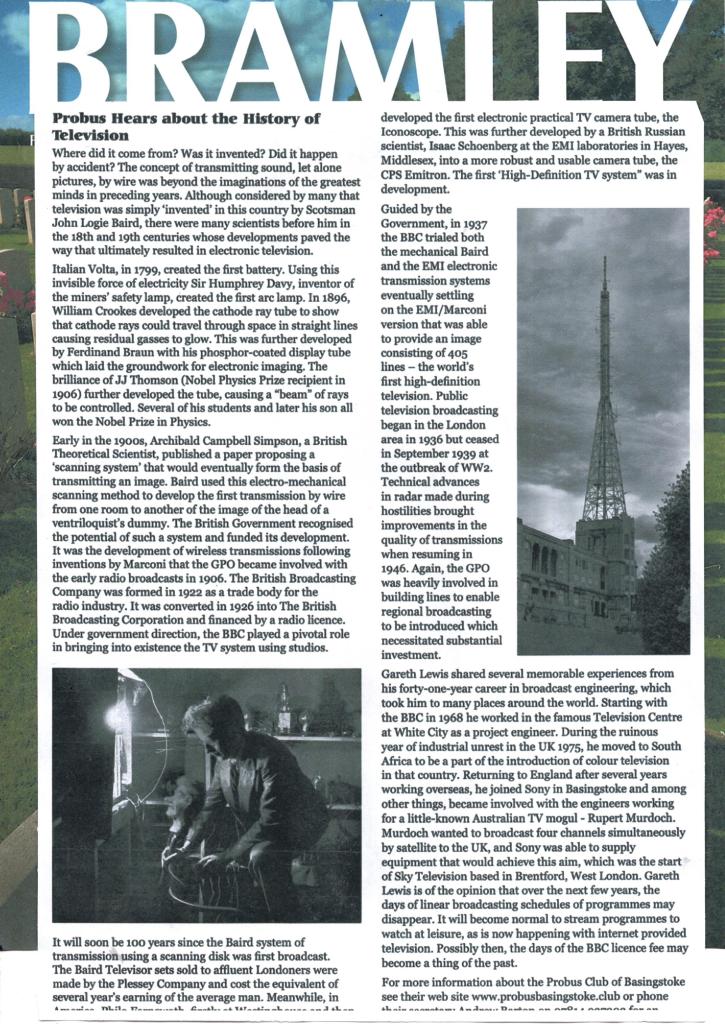
The others all covered the History of Television with the Rabbiter and Bramley giving us full pages while the Link and Basinga used the reduced length report. A rare occurrence was that we were too late for the Villager magazine in Sherborne St John.