

For speaker Charlie Threlfall, as a short-term Royal Navy officer, the prospect of a goodwill tour of ten countries had great appeal.
Aged 19 in early April 1982 he was on HMS Broadsword at anchor in Gibraltar. They were readying for a series of social events and cocktail parties across the world as they planned to show off their three years old warship. Launched in 1979 as a Type 22 Guided Missile Frigate with a displacement of 4,500 tons and a crew of 235, HMS Broadsword was the epitome of the latest thinking in naval warfare. It had no traditional gun batteries but an assortment of guided missiles that could lock on a target without fail.

That very week, on 2nd April 1982, Sub Lieutenant Charlie Threlfall’s life changed forever. The Falkland Islands in the South Atlantic were invaded by Argentinian forces. On 5th April HMS Broadsword left Gibraltar heading for Ascension Island, about halfway to the Malvinas, as the Argentinians called this British protectorate.
There, a group of twenty war ships and supply vessels was assembled, painting out any identification marks to confuse any attacking forces. Southbound, they sailed in close convoy using no radar and no lights at night so that they could not be located by the enemy. The crew went on Defence Watches of six hours on, six hours off. They were lucky to get four hours sleep each day for ten weeks.

The British submarine Conqueror sank the Argentinian cruiser General Belgrano on 2 May. Questions were asked in Britain if it was a legitimate target as it was purported to be sailing away from the conflict zone, a situation denied years later by the ship’s captain. All Argentinian naval ships were ordered back to port and then only aerial attacks continued at the extreme limits of their range.
Action stations came on 4h May when HMS Sheffield was hit by an air launched anti-ship Exocet missile. 170 sailors from the Sheffield were rescued by Broadsword.
HMS Broadsword, along with HMS Coventry were positioned in San Carlos Water, and were unable to spot enemy aircraft approaching over land, and were strafed and bombed, being unable to offer much resistance. Crew were instructed not to shoot at helicopters only fast jets.
Broadsword and Coventry were then positioned at sea to the west of the Falklands to draw aircraft fire from the troops. With two approaching enemy jets HMS Coventry was hit by three 500lb bombs, caught fire and eventually sank. But as it came across the bow of Broadsword it prevented them from firing their missiles.
It was then discovered that at sea it was impossible to reload the four Exocet launchers on Broadsword once the initial four missiles had been fired. One of many lessons learnt during this conflict and that were eventually incorporated into naval practice. Having the correct missiles and numerous life-threatening experiences ultimately enhanced sailors’ safety.
HMS Broadsword had a narrow escape from following the fate of HMS Coventry as a 1000lb bomb travelling at 450 mph hit the ship towards the stern, 10 feet above water level, travelled through two decks and emerged upwards through the flight deck, where it took off the nose of a Lynx helicopter, and bounced overboard, failing to explode.
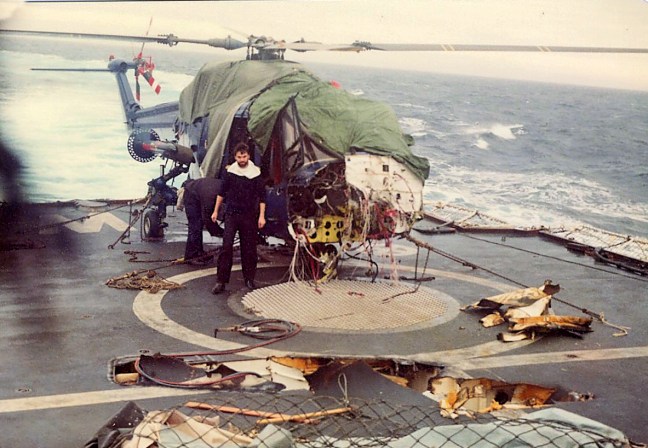
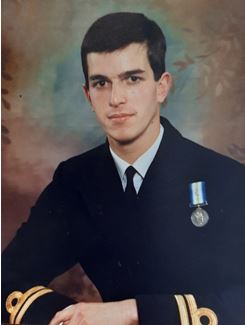
Six British war ships were lost and sixteen damaged during this conflict. 649 Argentinian military personnel, 255 British and three civilian islanders lost their lives. Charlie Threlfall knows the name of the Argentinian pilot who sent the 1000lb bomb into the side of HMS Broadsword. He says he would never shake his hand as two of his fellow schoolboys from his street on the Isle of Wight were in this conflict. One was a cook and was killed in this action while another, like himself, survived, thereby becoming a member of the ‘Bomb Alley Survivors Club’




 Probus Club of Basingstoke
You must be logged in to post a comment.