

There can’t be many people in this country who have not seen at least one Bond film featuring that smooth spy and womaniser, James Bond, who survives many tricky situations using a piece of equipment made by the in-house boffin known as Q.
Bond author Ian Fleming had been deputy head of Naval Intelligence during WW2 and knew they really did have such people in the background whose job as a Supply Officer, or Quartermaster, hence the use of the initial Q, to provide solutions for field operators facing life or death scenarios.
Speaker Guy Caplin had a lengthy career as a TV producer and director creating many top-rated programmes for Britain’s ITV network. Following retirement, he has investigated long forgotten and unknown war heroes. One such was Charles Fraser-Smith who was in MI 6 who invented the self-heating can of soup. He realised that British agents dropped into occupied France needed to blend in with the locals which included smelling like a native, so he invented garlic flavoured chocolate.
Another was Clayton Hutton (known as ‘Clutty’) who had been a pilot in WW1 and in 1939 was the manager of a jam making factory. He sent thirteen telegrams to the War Ministry offering his services and was eventually placed in MI 9 to act as Q to help the military either avoid capture or aid their escape. This suited his outlook because as a young man he had met the great escapologist Houdini and remained fascinated by all similar matters.
His many successful developments included printing maps on silk which was only made possible by his knowledge of jam making where pectin was used to stabilise the product and it stabilised the printing ink so that it did not run into the fabric.


He made compass needles as shirt collar stiffeners and miniature compasses that screwed into the back of uniform buttons with a left-hand thread to thwart German guards. Some razor blades were magnetised so that when placed on the surface of water they would point north.
The chewed wooden end of pencils provided cover for miniature compasses and boxes of fifty Players cigarettes became emergency food and survival kits for the RAF. Bomber command was losing one in five planes and Clutty realised that the large fur lined flying boots would be an obvious giveaway for escaping air crew, so he redesigned them. The foot section was made to look like a real shoe with the heel containing a map and compass, the laces were a Gigli saw that would cut through steel bars and padlocks and the cut off legs when turned inside out became a waistcoat.
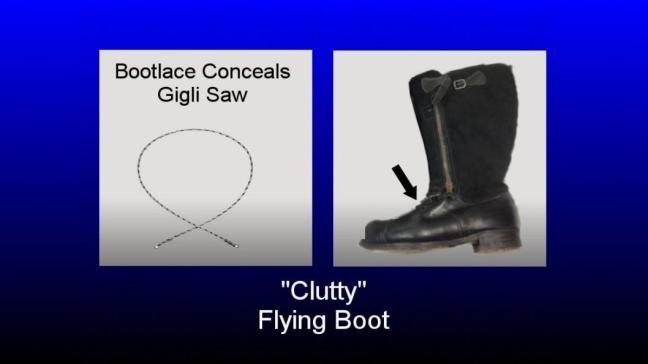
Red Cross parcels sent to the PoW camps were full of escape provisions. Civilian clothing was a must, and uniform jackets could have the lining removed and turned inside out to become a jacket that would look domestic. The fabric used for mess uniforms was the same colour as those of their guards, Officers caps could have the fabric taken off the peak to reveal a shiny black peak as used on civilian head gear.
Vinyl records that had music one side had a map and German currency secreted on the reverse, books had silk maps hidden in their covers and green edged handkerchiefs could have a map displayed after being soaked in water in which a yellow Rowntree’s Smartie had been dissolved.
While miniature radios and transmitters were fitted into twenty cigarette packets things like ‘Little Nellie’ the autogyro seen in the 1967 Bond film ‘You Only Live Twice’ or cars with revolving number plates and machine guns had yet to be invented. But who’s to say that there are no other Q sections busily at work today just in case their efforts might be needed in the future.

 Probus Club of Basingstoke
You must be logged in to post a comment.