News

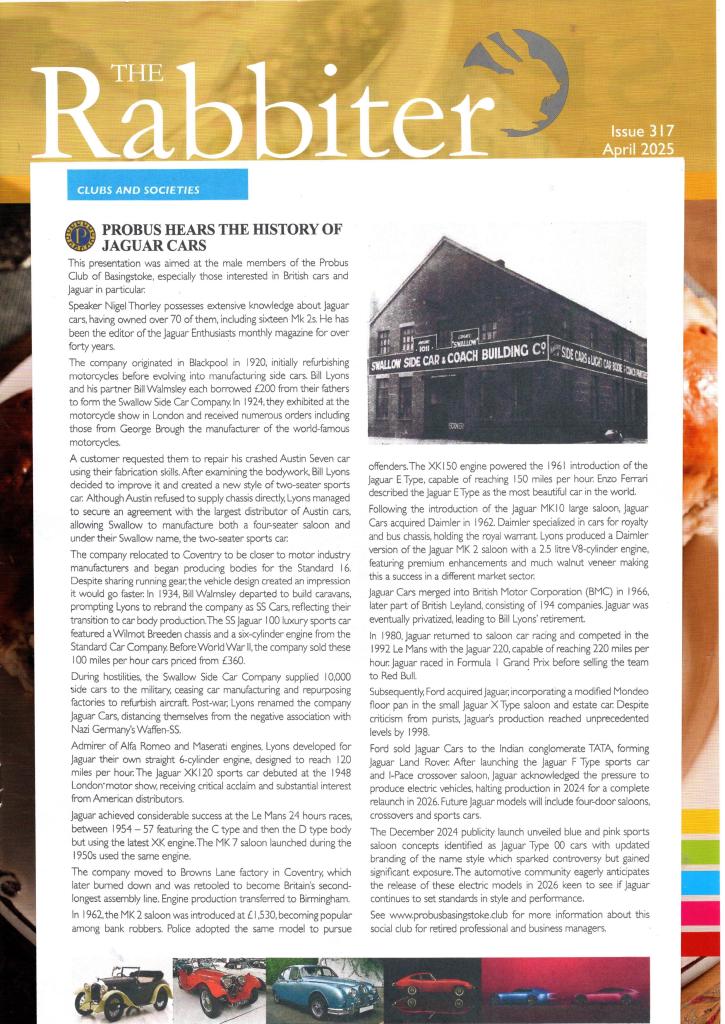
Probus Publicity in February 2025

A mixed offering this month with three subjects, The Man Behind Q, Dambusters and Titanic as the magazines caught up after some not having a January edition.

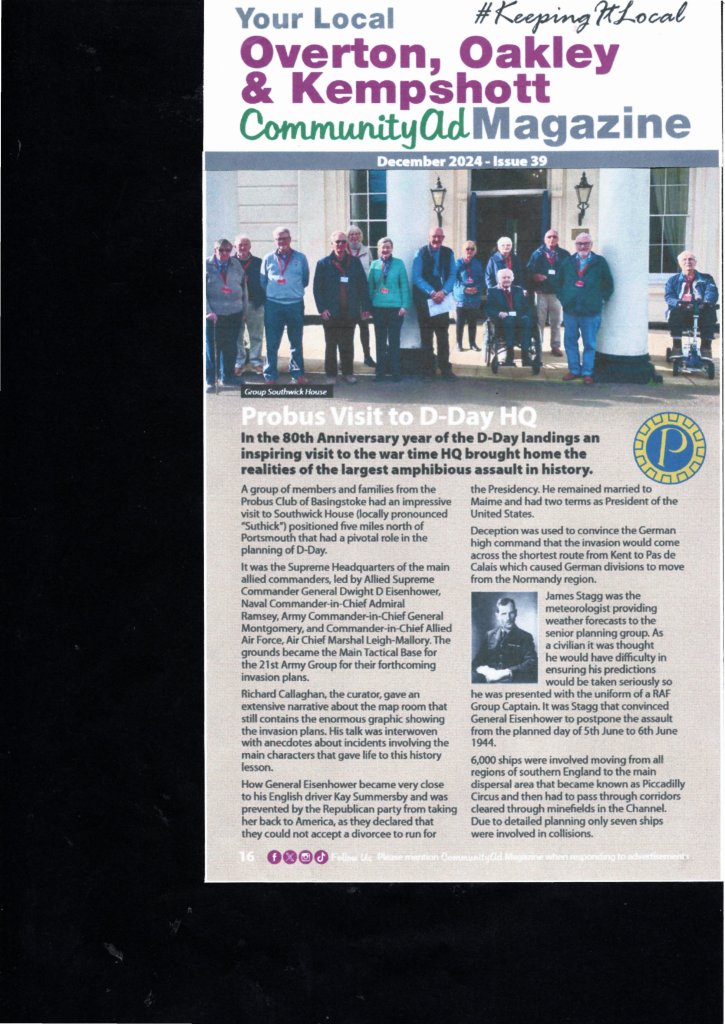
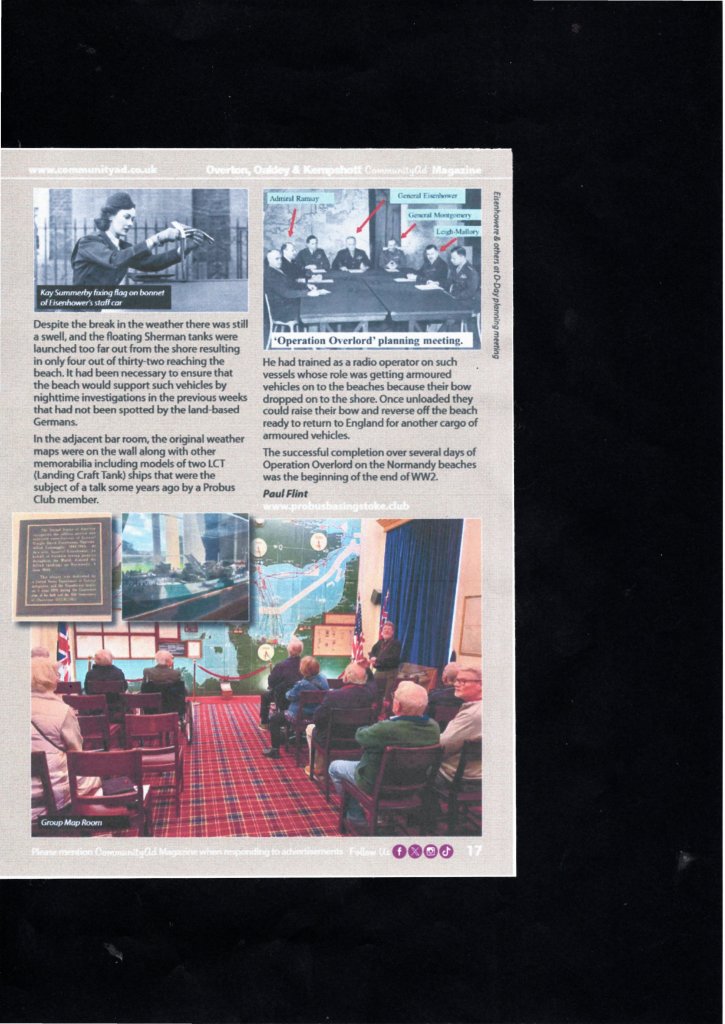
Full pages were obtained in the Rabbiter, Bramley, Villager, (reduced to fit on the covers) Link (almost) and the CommunityAd for Overton, Oakley & Kempshott allowing us a page and half.

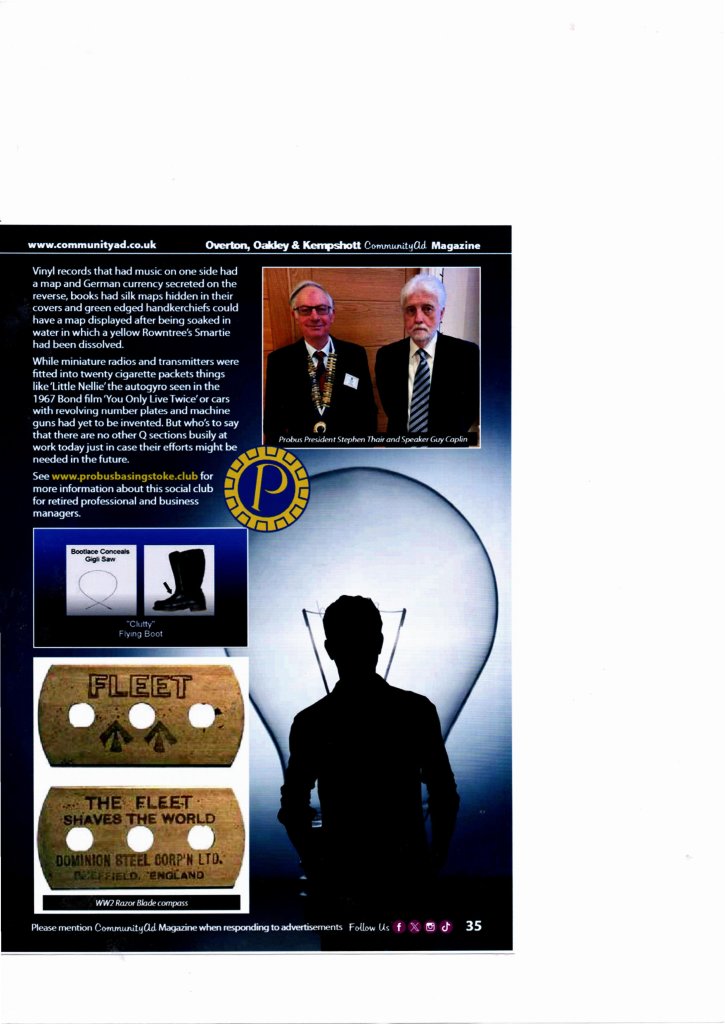
Probus Hears About The Man Behind ‘Q’

President Stephen Thair & Speaker Guy Caplin

There can’t be many people in this country who have not seen at least one Bond film featuring that smooth spy and womaniser, James Bond, who survives many tricky situations using a piece of equipment made by the in-house boffin known as Q.

Bond author Ian Fleming had been deputy head of Naval Intelligence during WW2 and knew they really did have such people in the background whose job as a Supply Officer, or Quartermaster, hence the use of the initial Q, to provide solutions for field operators facing life or death scenarios.

Speaker Guy Caplin had a lengthy career as a TV producer and director creating many top-rated programmes for Britain’s ITV network. Following retirement, he has investigated long forgotten and unknown war heroes. One such was Charles Fraser-Smith who was in MI 6 who invented the self-heating can of soup. He realised that British agents dropped into occupied France needed to blend in with the locals which included smelling like a native, so he invented garlic flavoured chocolate.

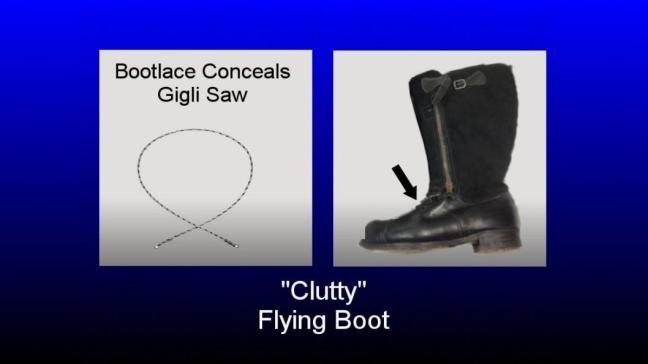
Another was Clayton Hutton (known as ‘Clutty’) who had been a pilot in WW1 and in 1939 was the manager of a jam making factory. He sent thirteen telegrams to the War Ministry offering his services and was eventually placed in MI 9 to act as Q to help the military either avoid capture or aid their escape. This suited his outlook because as a young man he had met the great escapologist Houdini and remained fascinated by all similar matters.

His many successful developments included printing maps on silk which was only made possible by his knowledge of jam making where pectin was used to stabilise the product and it stabilised the printing ink so that it did not run into the fabric.

He made compass needles as shirt collar stiffeners and miniature compasses that screwed into the back of uniform buttons with a left-hand thread to thwart German guards. Some razor blades were magnetised so that when placed on the surface of water they would point north.

The chewed wooden end of pencils provided cover for miniature compasses and boxes of fifty Players cigarettes became emergency food and survival kits for the RAF. Bomber command was losing one in five planes and Clutty realised that the large fur lined flying boots would be an obvious giveaway for escaping air crew, so he redesigned them. The foot section was made to look like a real shoe with the heel containing a map and compass, the laces were a Gigli saw that would cut through steel bars and padlocks and the cut off legs when turned inside out became a waistcoat.   

Red Cross parcels sent to the PoW camps were full of escape provisions. Civilian clothing was a must, and uniform jackets could have the lining removed and turned inside out to become a jacket that would look domestic. The fabric used for mess uniforms was the same colour as those of their guards, Officers caps could have the fabric taken off the peak to reveal a shiny black peak as used on civilian head gear.

Vinyl records that had music one side had a map and German currency secreted on the reverse, books had silk maps hidden in their covers and green edged handkerchiefs could have a map displayed after being soaked in water in which a yellow Rowntree’s Smartie had been dissolved.   

While miniature radios and transmitters were fitted into twenty cigarette packets things like ‘Little Nellie’ the autogyro seen in the 1967 Bond film ‘You Only Live Twice’ or cars with revolving number plates and machine guns had yet to be invented. But who’s to say that there are no other Q sections busily at work today just in case their efforts might be needed in the future.

‘Little Nellie’ autogyro in “You Only Live Twice”

Probus Publicity in January 2025

With only four local magazines publishing a January edition we achieved good coverage in all four. Two carried the Dambusters talk while the other two ran with the visit made to the D-Day Headquarters.

Probus Christmas Lunch Tuesday 17th December 2024

A new venue this year with a move to the Hartley Wintney Golf Club who served up an excellent quality meal and ensured each guest had the food of their choice.

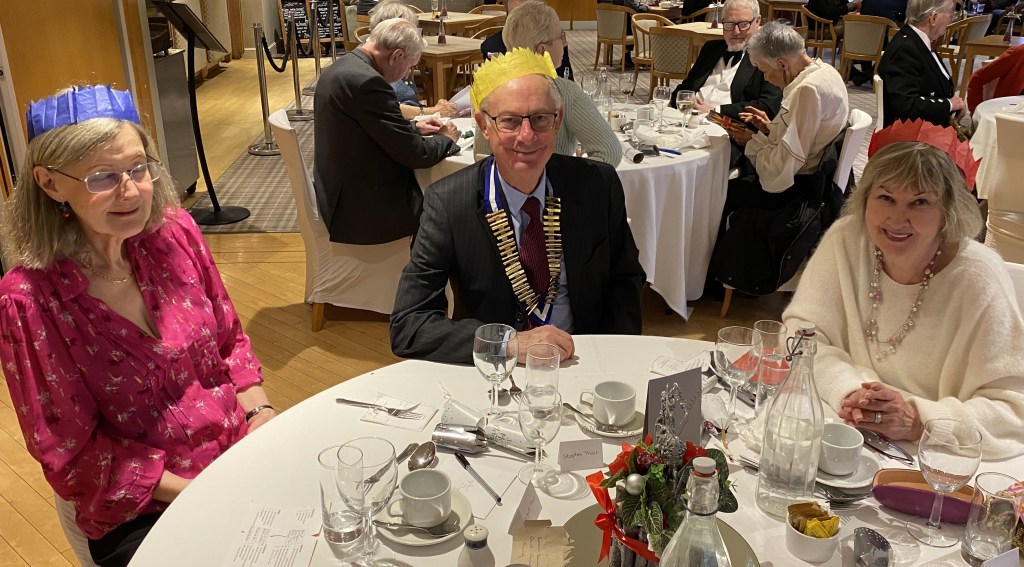
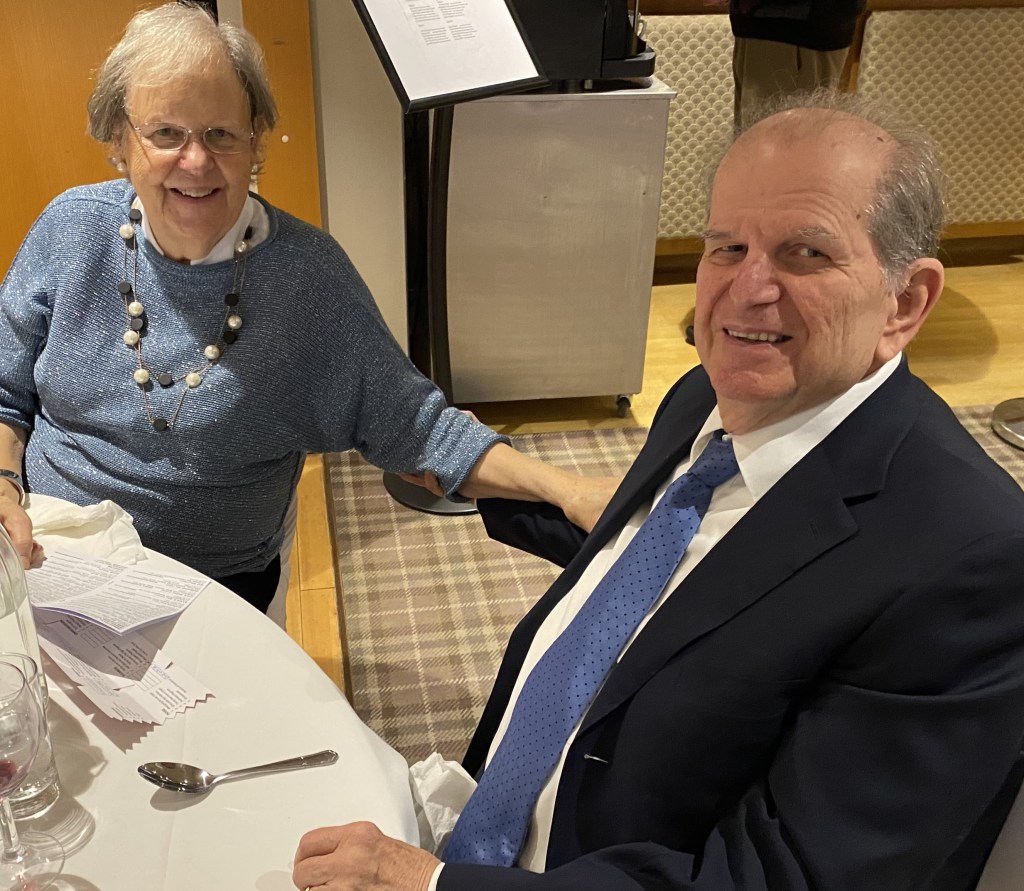
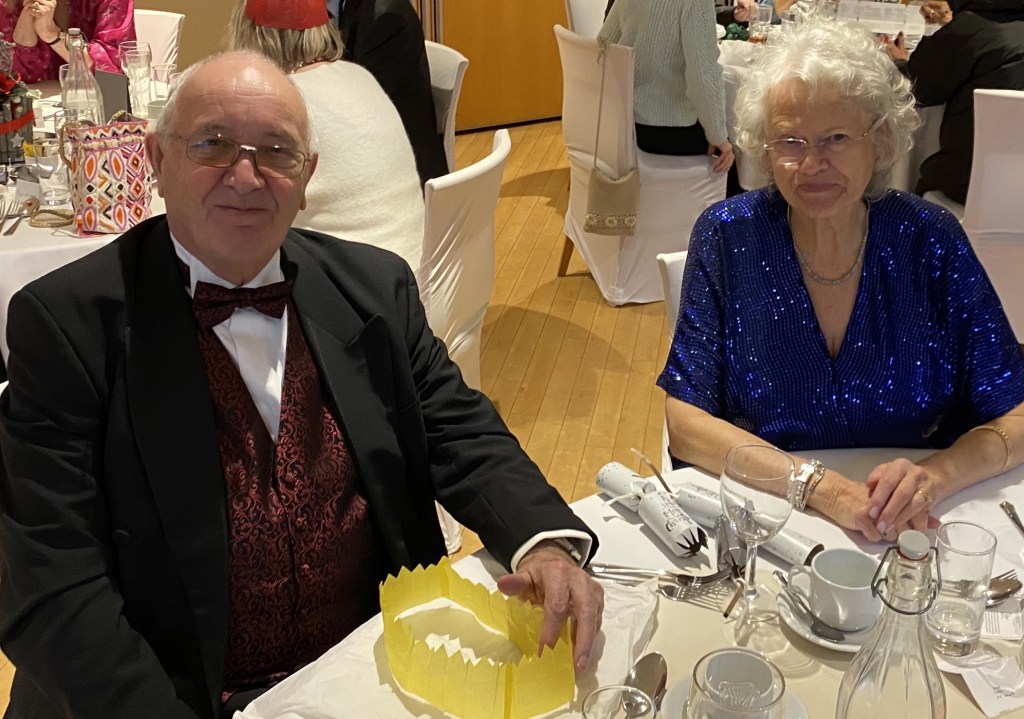
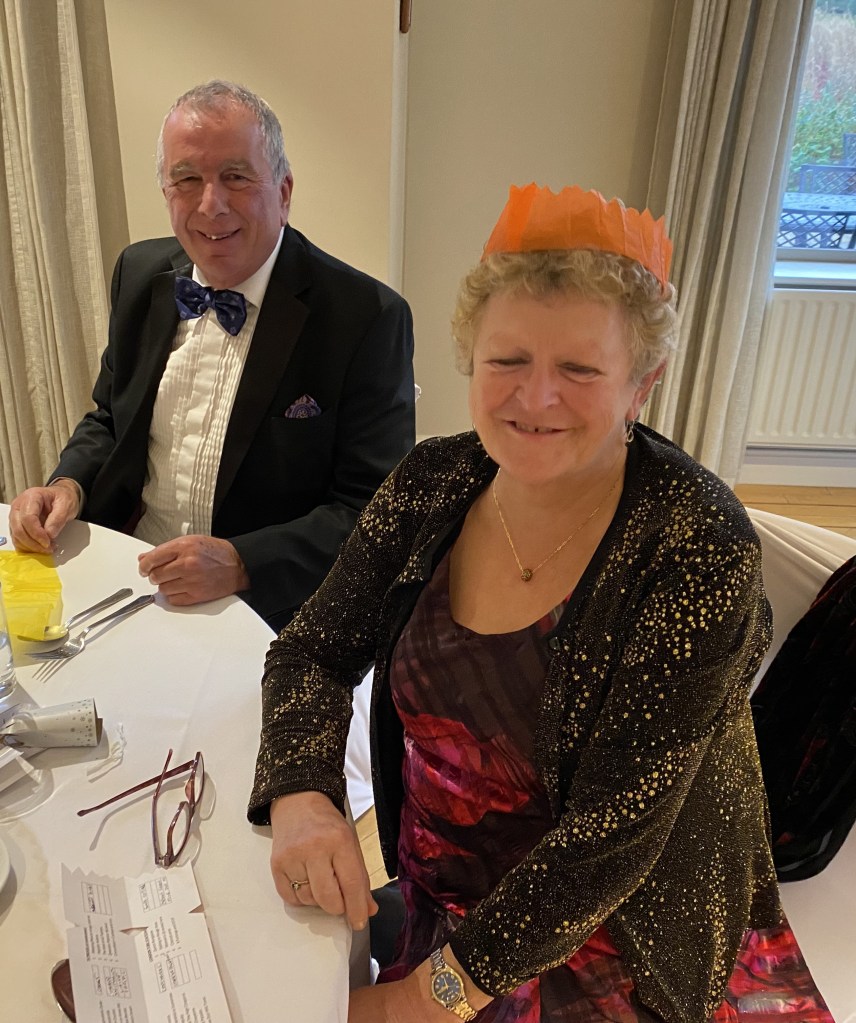
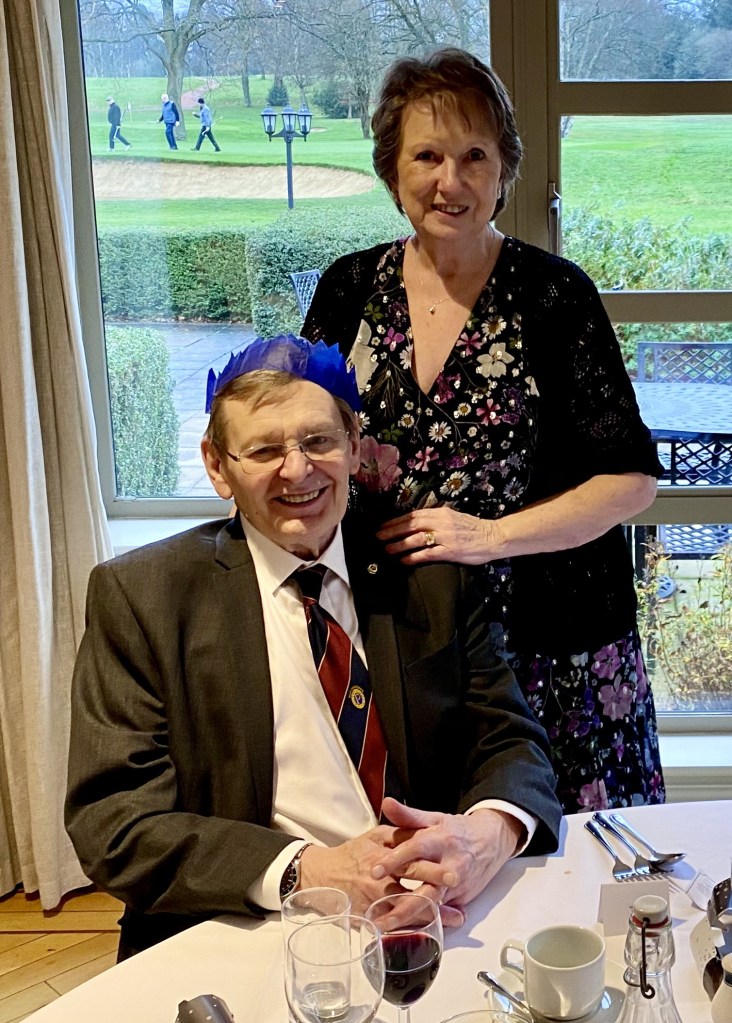
Hosted by our President Stephen Thair and his lady, Margaret, thirty-five sat down for lunch at 1.00pm sharp and were still chatting at the table until well after 3.30pm This was not because the food was slow in serving but indicates that an enjoyable time was had by all.

Grateful thanks go to John Swain and Jeff Grover for their organising skills in making all the arrangements for the day.

And special thanks go to Alan and Liliane May for their construction of a brain teaser puzzle based on nostalgic confectionary, London underground stations and television programmes with lead characters. It was clear from the groans emitting from tables that the results were obvious when Alan distributed the answer sheet. It was diplomatic not to check the results publicly.

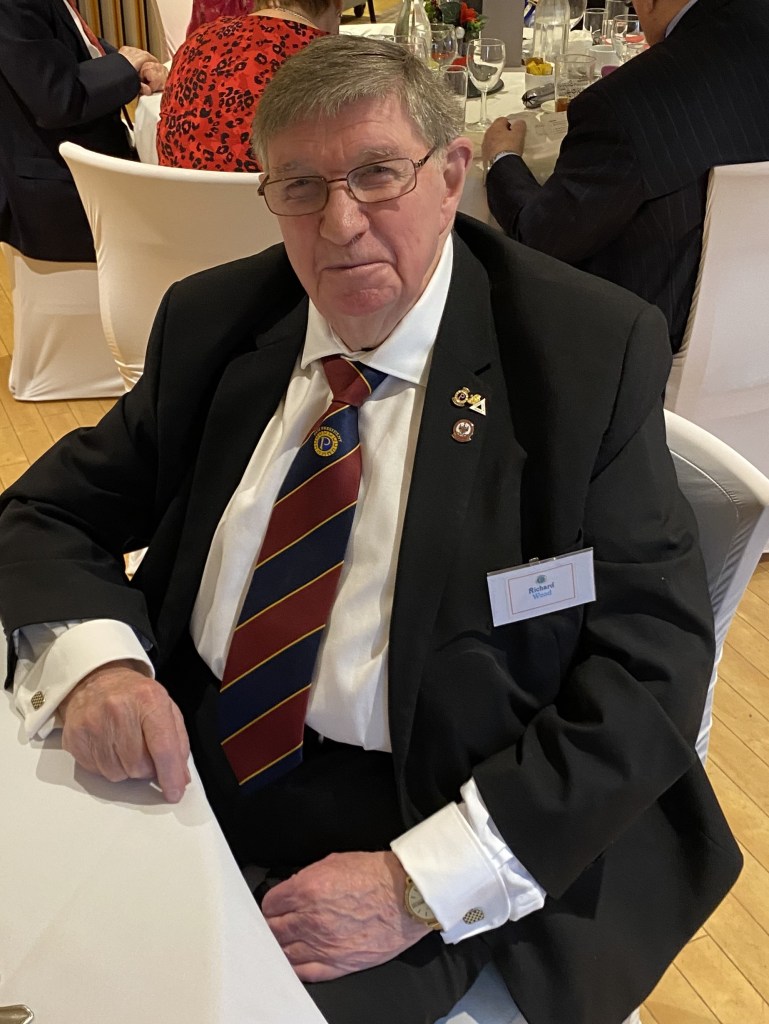
Mr Snappy Snaps was Chris Perkins, and the results of his David Bailey style efforts are published here but with everything going on, Alan and Liliane May somehow escaped his shutter.

It was good to see that our latest member, Mike and Liz Narracott, attended and greetings came from absent member David Wickens currently at his son’s home in Las Vegas and our secretary Andrew and Janice Barton who are in Perth, Western Australia.

President Stephen and Margaret Thair

Probus Publicity in December 2024

As has become the norm, the Kempshott Kourier was late, arriving halfway through November and therefore contains the report about the Titanic and times that was the subject of the talk by Dr Stephen Goss.
The other five local December magazines gave us good coverage about the visit to Southwick House that was the HQ for the D-Day landings 80 years ago. The Villager page had to be reduced to 80% to fit on the front cover for scanning purposes.

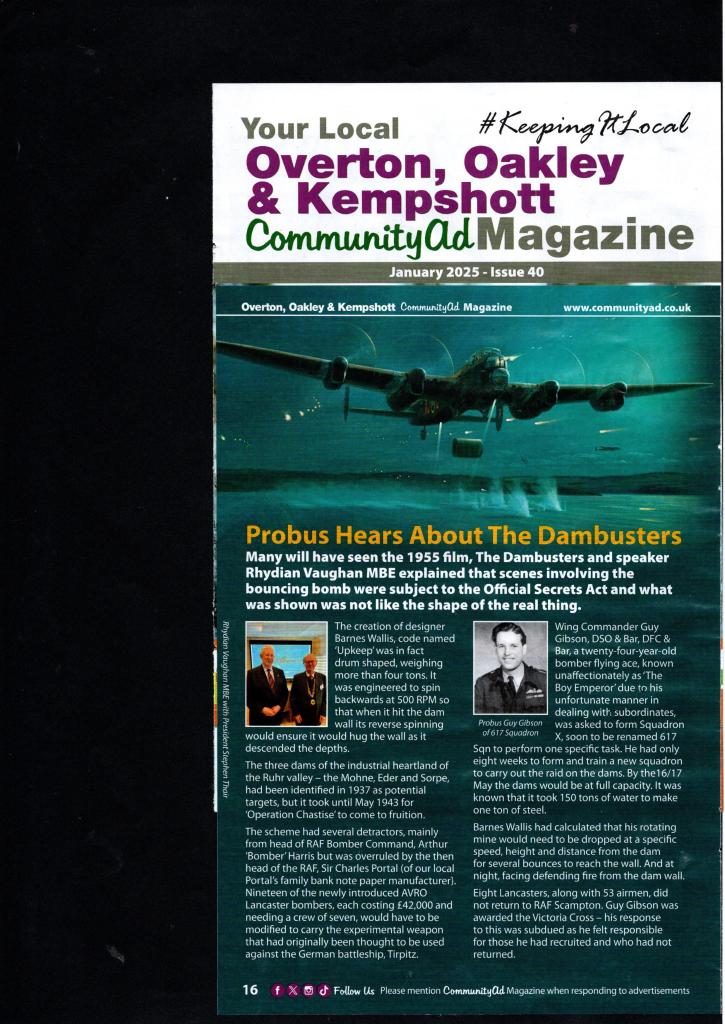
Probus Hears About The Dambusters

Speaker Rhydian Vaughan MBE with President Stephen Thair

Many will have seen the 1955 film, “The Dambusters” and speaker Rhydian Vaughan MBE explained that scenes involving the bouncing bomb were subject to the Official Secrets Act and what was shown was not like the shape of the real thing.

The creation of designer Barnes Wallis, code named ‘Upkeep’ was in fact drum shaped, weighing more than four tons. It was engineered to spin backwards at 500 RPM so that when it hit the dam wall its reverse spinning would ensure it would hug the wall as it descended the depths.

The three dams of the industrial heartland of the Ruhr valley. the Mohne, Eder and Sorpe had been identified in 1937 as potential targets, but it took until May 1943 for ‘Operation Chastise’ to come to fruition.

The scheme had several detractors, mainly from head of RAF Bomber Command, Arthur ‘Bomber’ Harris but was overruled by the then head of the RAF, Sir Charles Portal (of our local Portal’s family bank note paper manufacturer}. Nineteen of the newly introduced AVRO Lancaster bombers, each costing £42,000 and needing a crew of seven, would have to be modified to carry the experimental weapon that had originally been thought was to be used against the German battleship, Tirpitz.

Wing Commander Guy Gibson, DSO & Bar, DFC & Bar, a twenty-four-year-old bomber flying ace, known unaffectionately as ‘The Boy Emperor’ due to his unfortunate manner in dealing with subordinates, was asked to form Squadron X, soon to be renamed 617 Sqn to perform one specific task. He had only eight weeks to form and train a new squadron to carry out the raid on the dams. By the 16/17 May the dams would be at full capacity. It was known that it took one hundred and fifty tons of water to make 1 ton of steel.

Barnes Wallis had calculated that his rotating mine would need to be dropped at a specific speed, height and distance from the dam for several bounces to reach the wall. And at night, facing defending fire from the dam wall.

Eight Lancasters, along with 53 airmen, did not return to RAF Scampton. Guy Gibson was awarded the Victoria Cross – his response to this was subdued as he felt responsible for those he had recruited and who had not returned.

While the raid on the dams was a great morale booster, within a few months they had had been repaired as there was no follow up missions to prevent them being rebuilt. However, the labour needed was brought in from building the Atlantic Wall the German construction across the northern French coastline and it was subsequently recognised that had this delay not occurred the D-Day landings would have not succeeded.

Probus Publicity in November 2024

There is a mixture of subjects in the November (October) magazines because of the various publishing times in the month. The Kempshott Kourier showed the helicopter report about its flight to Alexandria and the CommunityAd magazine for Overton, Oakley & Kempshott ran late with our Summer Pub lunch.

The others all gave a good showing to the Titanic Times in Belfast. Some images have been reduced to fit on to magazine covers.

Probus Visit D-Day HQ

Probus members and families outside of Southwick House

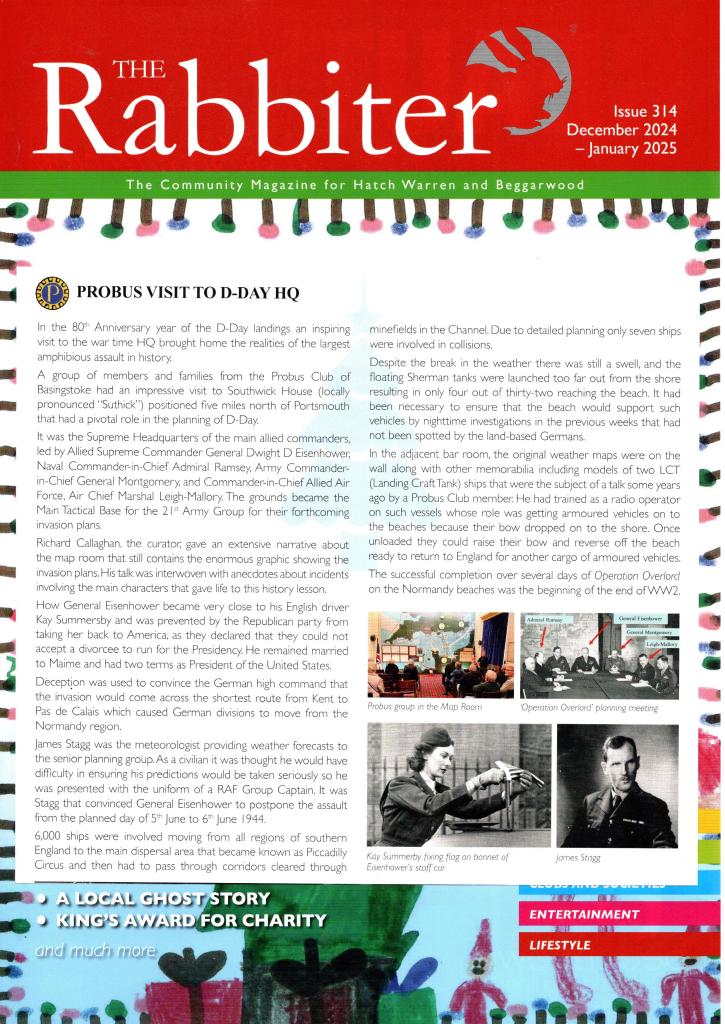
A group of Probus members and families had an impressive visit to Southwick House (locally pronounced “Suthick”) positioned five miles north of Portsmouth that had a pivotal role in the planning of D-Day, the largest amphibious assault in history.

 It was the Supreme Headquarters of the main allied commanders, including Allied Supreme Commander General Dwight D Eisenhower, Naval Commander-in-Chief Admiral Ramsey, Army Commander-in-Chief General Montgomery, and Commander-in-Chief Allied Air Force, Air Chief Marshal Leigh-Mallory. The grounds became the Main Tactical Base for the 21st Army Group for their forthcoming invasion plans.

Richard Callaghan, the curator, gave an extensive narrative about the map room that still contains the enormous graphic showing the invasion plans. His talk was interwoven with anecdotes about incidents involving the main characters that gave life to this history lesson.

Map Room with the large wall graphic showing the planning routes

Deception was used to convince the German high command that the invasion would come across the shortest route from Kent to Pas de Calais which caused German divisions to move from the Normandy region.

James Stagg was the meteorologist providing weather forecasts to the senior planning group. As a civilian he would have difficulty in ensuring he would be taken seriously so he was presented with the uniform of a RAF Group Captain. It was Stagg that convinced General Eisenhower to postpone the assault from the planned day of 5th June to 6th June 1944.

Group Captain James Stagg became head of the Meteorological Office post war
Kay Summersby, driver, secretary and “friend” of General Eisenhower

6,000 ships were involved moving from all regions of southern England to the main dispersal area that became known as Piccadilly Circus and then had to pass through corridors cleared through minefields in the Channel. Thanks to detailed planning only seven ships were involved in collisions.

Despite the break in the weather there was still a swell, and the floating Sherman tanks were launched too far out from the shore resulting in only four out of thirty-two reaching the beach. It had been necessary to ensure that the beach would support such vehicles by nighttime investigations in the previous weeks that had not been spotted by the land-based Germans.

LCT (Landing Craft Tank) ships were vital to carrying tanks and heavy equipment to the beaches

In the adjacent bar room, the original weather maps were on the wall along with other memorabilia including models of two LCT (Landing Craft Tank) ships that were the subject of a talk some years ago by Probus member Brian Nagle.

Commemorative plaque on the wall of the Officers’ mess in Southwick House

There followed a visit to the Royal Military Police Museum, based on the same military establishment, that showed the development from the early days of the Provost Marshall to the Red Caps known today.

Military Police Museum shows the history of this unit to the present day.

Probus Hears About The Titanic & Her Times

President Stephen Thair & Speaker Dr Stephen Goss

The peaceful period following the end of the Franco-Prussian war in 1871 up to the start of WW1 in 1914 was a time of great advances in social and artistic movements in Europe, centralised in France, and became known as the Belle Époque.

Follies Bergere tipifies the Belle Epoque period

At the same time there were shifting collaborations between nations where Britain, Austria and Prussia were allied against Napoleonic France. The unification of Italy and Germany brought other pressures with the arrangement between France and Russia seen by Germany as a particular threat which they met by re-arming with naval power. This brought them into direct competition with Britain who had the largest navy in history and the UK was also the most successful ship builders in the world.

By the 1890s Britain was losing its global predominance to both Germany and the USA. To maintain influence in the world the use of soft power was recognised as a replacement for gun boat diplomacy. One way was to have the most impressive, biggest and most luxurious ocean-going liners to attract the most wealthy and influential people in the world. Who better to build such leviathans but the most famous ship builders in the world, Harland & Wolff of Belfast.

This background was explained by speaker Dr Stephen Goss, himself an Ulsterman whose great grandfather was a painter on the RMS Titanic in this famous shipyard.

Belfast had boomed from the success of ship building with “Belfast Built” its signature and had become world leaders in ship construction, support services and finance. It was the only place to build three transatlantic liners for the White Star Line whose names are engraved in the annals of history, the Olympic, Titanic and Britannic.

At 46,000 tons the Titanic was the largest ship in the world and was fitted out to the most luxurious level. The staterooms were designed to exceed the expectations of the great and good while the second-class cabins on the Titanic were more than a match for first class on other liners. Its safety measures considerably exceeded the maritime regulations of the day. And to further pander to the wealthy clientele the Marconi Company was employed to relay ship to shore messages via the latest Morse Code signalling system.

The unsinkable RMS Titanic – the most luxurious ship in the world in 1912

During these years the increasing industrial and commercial activity in Belfast meant that there was extensive commercial traffic across the North Channel to Scotland and England as supplies were required from British manufacturers.

The pressure for Irish independence in the 1920s increasingly led to conflicts and to the three-year Irish war of independence between the forces of the Irish Republic – the Irish Republican Army (IRA) and the British Crown forces. This was a major concern to the business community in Ulster where 8,000 mostly Catholic workers had been driven out of the Belfast shipyards sparking sectarian violence in the city. There had been a long held fear an independent Catholic Dublin would negatively influence commercial matters between Belfast and Britain. The shipyards had become a Protestant closed shop and became afraid for the future of ship building and supporting industries that had brought so much prosperity throughout Ulster. The people in Belfast felt they had to protect their interests and in 1913 they had formed the Ulster Volunteer Force with 100,000 members. During WW1 they became the 36th (Ulster) Division and post war became the Ulster Special Constabulary when Northern Ireland was created in 1921.

When Home Rule was granted for Ireland it renamed itself the Irish Free State except the six counties of Ulster remained part of the United Kingdom, but the foundations were laid for generations of problems that in modern times became known as ‘The Troubles’.

The sinking of the Titanic on its maiden voyage is well known but the discovery of the wreck is far from straight forward as the Marconi operator that fateful night gave incorrect information that placed the stricken ship a few miles from its actual position.

RMS Titanic sank 2hrs 40mins after hitting an iceberg 0n 15 April 1912 with the loss of 1500 passengers and crew
Robert Ballard on board survey vessel Knorr

Over the years there had been several attempts to find the wreck, including one by oceanographer Robert Ballard. His ship contained the latest sonar and submersible technology, and he approached the US navy seeking support. While an agreement was reached to finance the search for the Titanic there was another reason for their support which was as cover for a top-secret mission. In the 1960s the US navy had lost two nuclear submarines in the North Atlantic Ocean in the area that supposedly contained the wreck of the Titanic, and they did not want the Russians to be aware of this search or its result.

The two submarines were located but that only left twelve days of the contract to find the Titanic and on 1st September 1985 a boiler was discovered in a debris field that led to the wreck. The survivors were wrong, and the Titanic had broken its back when descending below the waves. The rest, as they say, is history, culminating in June 2023 of the implosion of the observation submersible, Titan, with the loss of five lives.

Titan submersible that imploded in June 2023
Harland & Wolff’s Samson & Goliath Dock Cranes

And the future of Harland & Wolff remains uncertain as on 16th September 2024 it was reported the company entered administration for the second time in five years. The company is expected to continue operations normally while its non-core operations wind down.

Probus Publicity in October 2024

Apart from the traditionally late Kempshott Kourier which covered our Summer Pub Lunch the rest might be described as a “Full House” as all six other monthly magazines ran with the report about the helicopter flight to Alexandria.
There was a full page in the Villager (reduced for copying on to the front cover) with most of the remainder using at least half pages. It was good to see the Loddon Valley Link giving us some rare space and we made it into the printed version of the Basinga rather than in our usual position in their Extra.