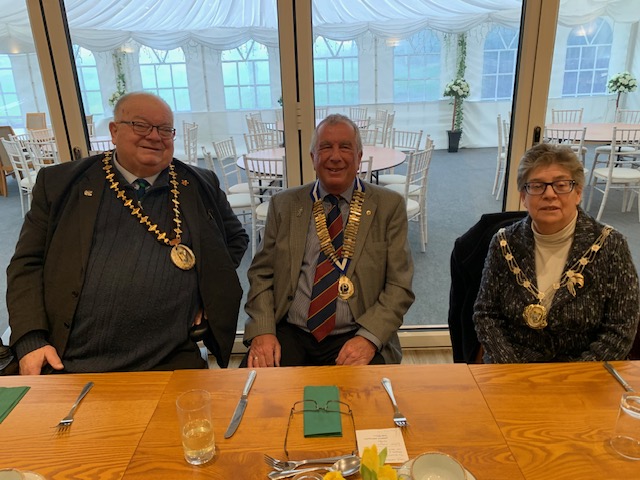
Guests of Honour at the latest Probus Club meeting at the Test Valley Golf Club were the Mayor and Mayoress of Basingstoke & Deane, Cllr David and Amanda Leeks. The club made a donation to the mayor’s charity appeal.
A triumvirate of Chains of Office
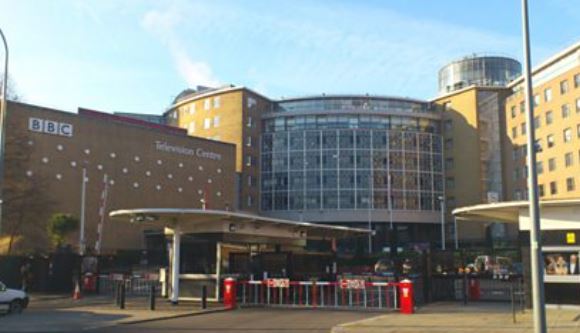
Before lunch they enjoyed a trip down memory lane as they were entertained by the speaker Jenny Mallin. She gave an insight into how the BBC Television Centre was designed and what TV production life was in the seventies. This was through her experiences gained over seven years working at the BBC Television Centre at White City in Wood Lane.
President Dr Jeff Grover with Jenny Mallin
The name White City came from the 120 white painted buildings and 20 pavilions specially constructed for the Franco British exhibition of 1908 on a site of 140 acres near Shepherds Bush in West London. It was attended by over 8 million visitors. The White City stadium was a last minute addition for use at the 1908 Olympics where for the first time gold, silver and bronze medals were awarded. The stadium was demolished in 1985. Over the years the site was used for other exhibitions and redeveloped for other uses including the building of the BBC Television Centre.
Known as the ‘Donut’ because of the circular central core it was the most technically advanced and fully embracing television production centre with eight studios, full props and wardrobe departments and was the best in the world. The attention to detail in programme making was paramount.
Despite such comprehensive supporting facilities, there was an increasing requirement for some programmes that needed an audience, so the nearby Shepherds Bush Green Empire was used. Eventually the BBC purchased it, becoming then known as the BBC Television Theatre. Programmes broadcast from here included the Billy Cotton Band Show, What’s My Line, Juke Box Jury, Crackerjack, the Black & White Minstrels, That’s Life and the Generation Game among many others.
Jenny recalled her time on the Generation Game as a Contestant Researcher and Games Deviser to three years on Mastermind with Magnus Magnusson and a myriad of disc jockeys on Top of the Pops and whether songs were sung live or mimed.
How news programmes were put together with breaking news events that demanded being featured with split seconds decisions on what to drop from the programme. News film taking up to an hour to process even after arriving at the BBC and then the introduction of ENG, electronic news gathering, with the use of camcorder type recordings taken by outside reporters.
Memories were stirred as Probus members enjoyed this nostalgic view of a simpler life when the only decision to be made about what to watch on the “telly” was whether your choice was on the BBC or on ITV.
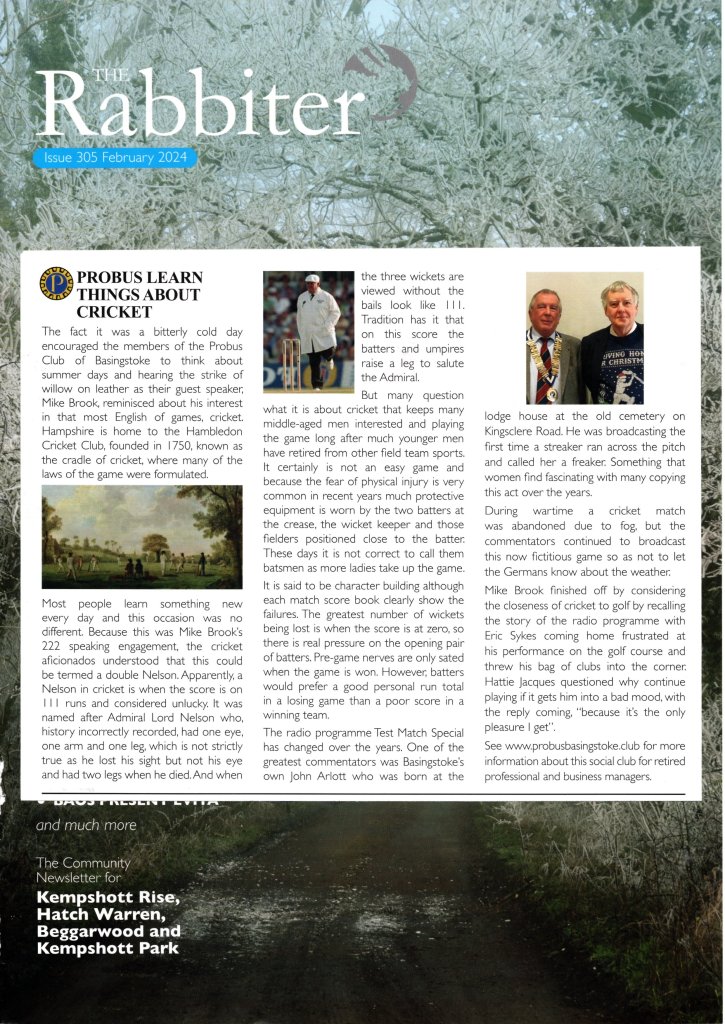
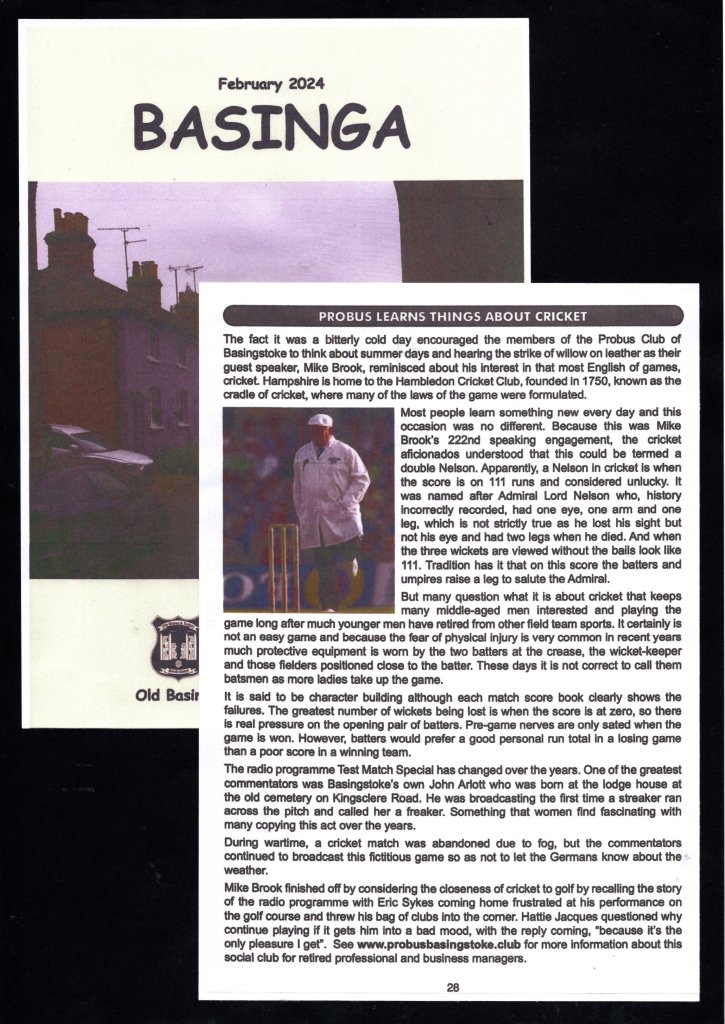
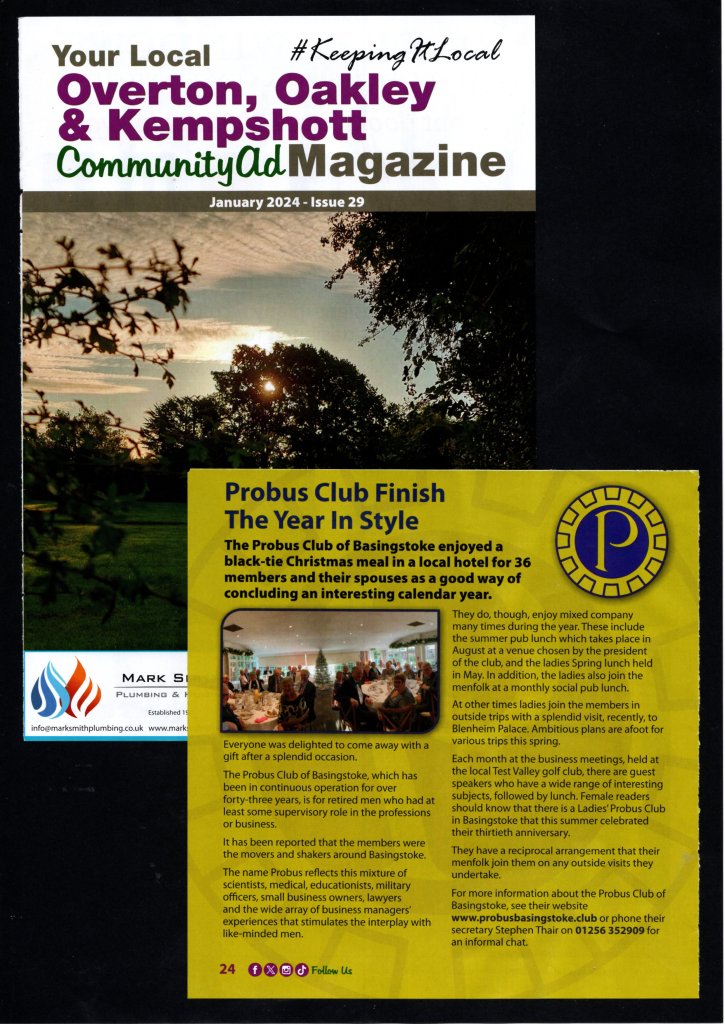
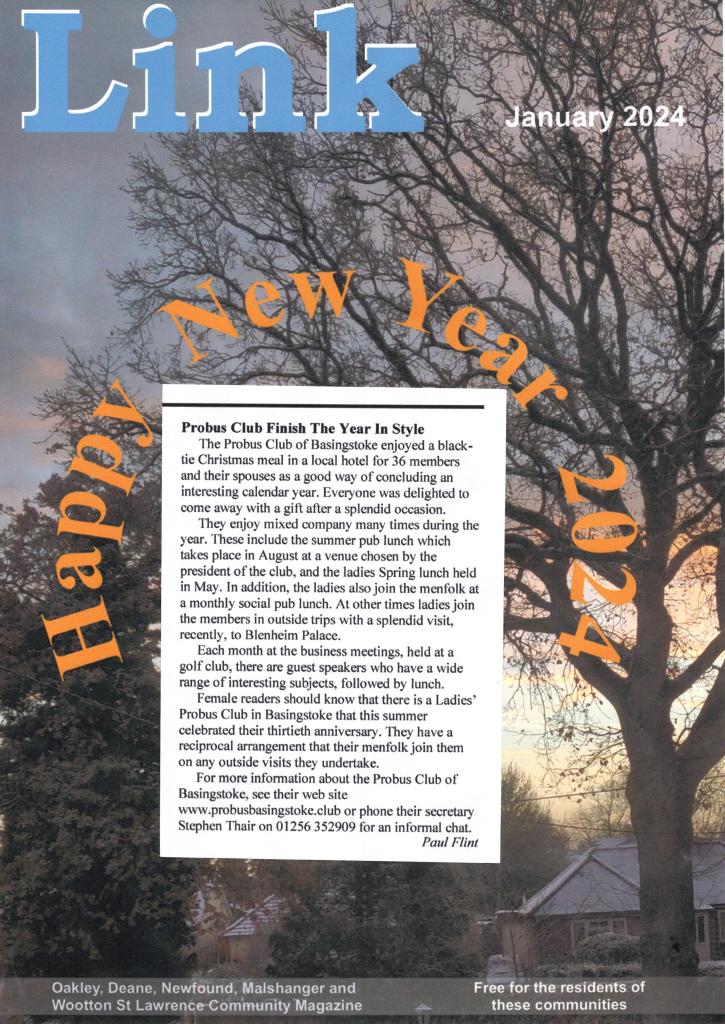
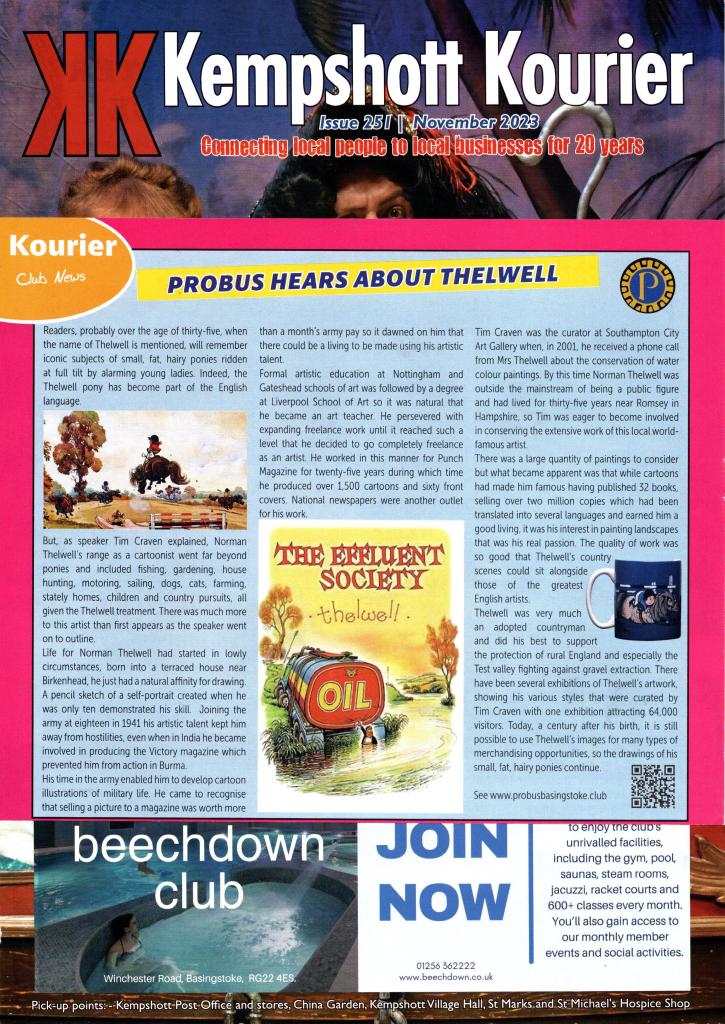
A good result for the Cricket report, helped by the addition of some illustrations to give interest. Also included are the Kempshott Kourier which arrived halfway through January and the new monthly from the CommunityAd publishers, again in late January, for their edition for Overton/Oakley/Kempshott. Both these two magazines featured the Probus Christmas lunch.
The memorial service for Derek Roberts, who passed away last November, was held on Saturday 27 January at St Mary’s church, Eastrop, Basingstoke.
The service was well attended with some affectionate tributes from Derek’s family and old friends and a contribution from the Basingstoke Male Voice Choir of which he was a member.
Derek joined our Probus Club in October 2015 and was a loyal supporter of our activities over the years with his wife, Elizabeth, and on many occasions was a member of the golf team.
Elizabeth and Derek at the Spring Ladies’ Lunch May 2023
Probus was represented at the service by Alex Marianos, Ian Nicholson and Stephen Thair and their respective wives.
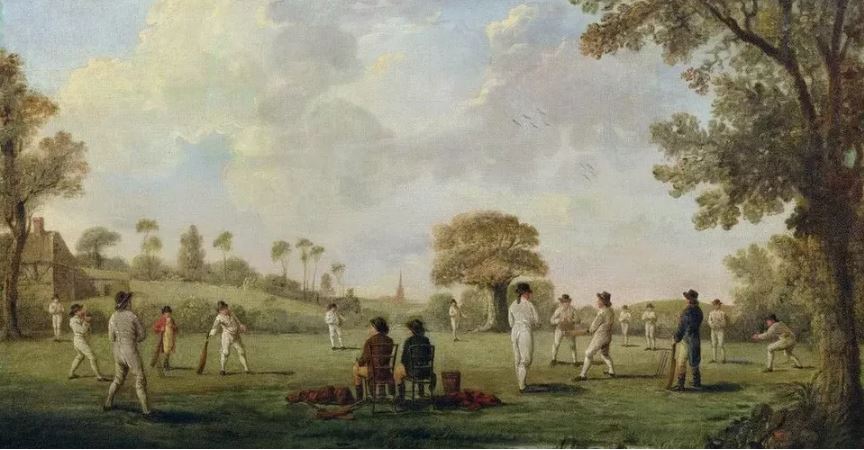
The fact it was a bitterly cold day encouraged the members of the Probus Club of Basingstoke to think about summer days and hearing the strike of willow on leather as their guest speaker, Mike Brook, reminisced about his interest in that most English of games, cricket. Hampshire is home to the Hambledon Cricket Club, founded in 1750, known as the cradle of cricket, where many of the laws of the game were formulated.
Hambledon Cricket Club the cradle of English cricket
Most people learn something new every day and this occasion was no different. Because this was Mike Brook’s 222 speaking engagement, the cricket aficionados understood that this could be termed a double Nelson.
Apparently, a Nelson in cricket is when the score is on 111 runs and considered unlucky. It was named after Admiral Lord Nelson who, many people recall history incorrectly, had one eye, one arm and one leg. This is not strictly true as he lost his sight but not his eye and had two legs when he died. And when the three wickets are viewed without the bails look like 111 which indicates the person at the crease is dismissed.
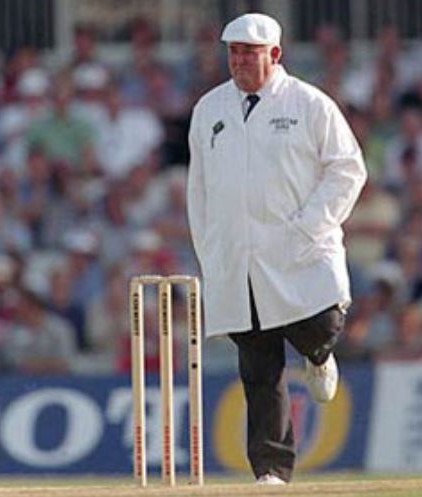
Tradition has it that on this score the batters and umpires raise a leg to salute the Admiral. Umpire David Shepherd was most superstitious about Nelson, he didn’t just bend his leg but attempted to keep it off the ground until the score was past 111 or multiples of that number.
Umpire David Shepherd at a Nelson
But many question what it is about cricket that keeps many middle-aged men interested and playing the game long after much younger men have retired from other field team sports.
It certainly is not an easy game and because the fear of physical injury is very common in recent years much protective equipment is worn by the two batters at the crease, the wicket keeper and those fielders positioned close to the batter. These days it is not correct to call them batsmen as more ladies take up the game.
It is said to be character building although each match score book clearly show the failures. The greatest number of wickets being lost is when the score is at zero, so there is real pressure on the opening pair of batters. Pre-game nerves are only sated when the game is won. However, batters would prefer a good personal run total in a losing game than a poor score in a winning team.
The radio programme Test Match Special, which has ball by ball commentary over the five days’ play has changed over the years. The schoolboy humour of Brian Johnston sometimes irked one of the greatest commentators, Basingstoke’s own John Arlott. He was born at the lodge house at the old cemetery on Kingsclere Road. and educated at Queen Mary’s grammar school in the town. He was at the microphone the first time a streaker ran across the pitch and called her a freaker. This activity is something that women find fascinating with many copying this act over the years.
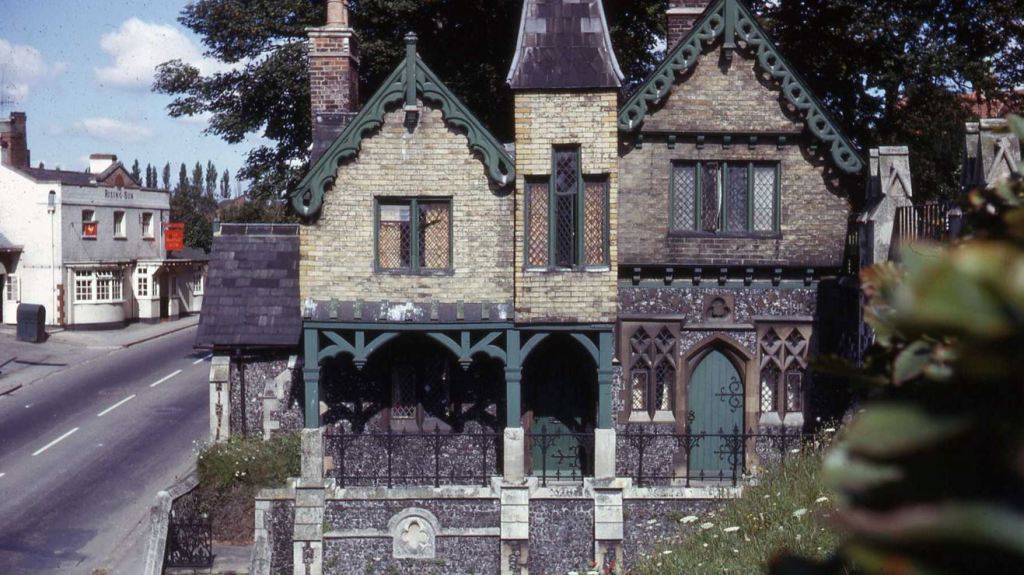
Basingstoke’s John ArlottHome of John Arlott
During wartime a cricket match was abandoned due to fog, but the commentators continued to broadcast this now fictitious game so as not to let the Germans know about the weather.
Mike Brook finished off by considering the closeness of cricket to golf by recalling the story of the radio programme with Eric Sykes coming home frustrated at his performance on the golf course and threw his bag of clubs into the corner. Hattie Jacques questioned why continue playing if it gets him into a bad mood, with the reply coming, “because it’s the only pleasure I get”.
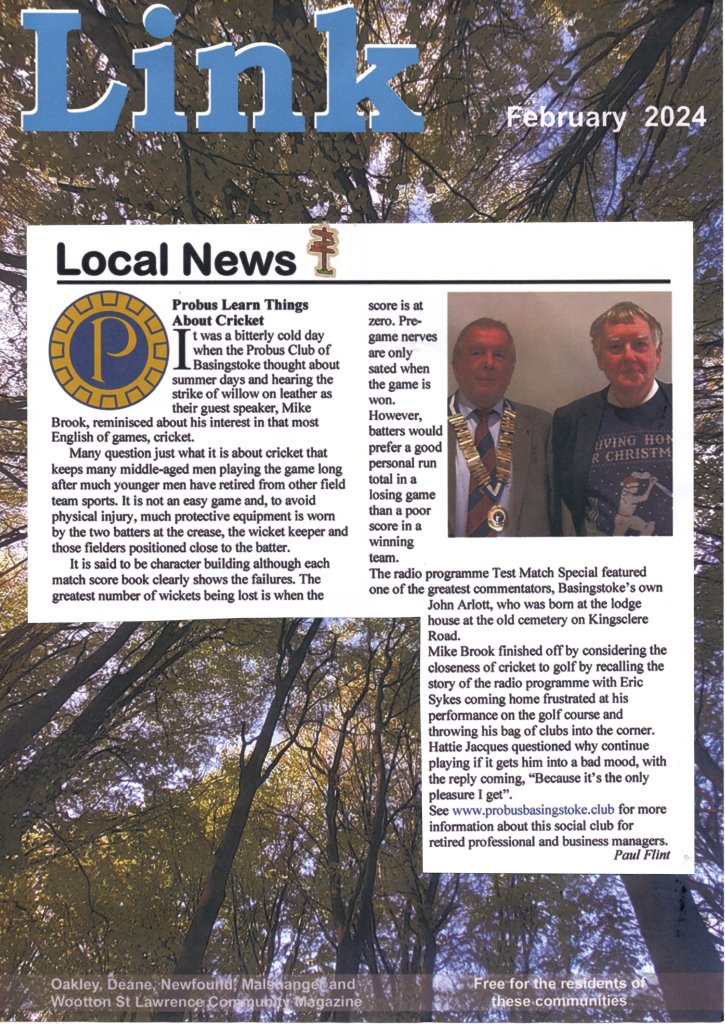
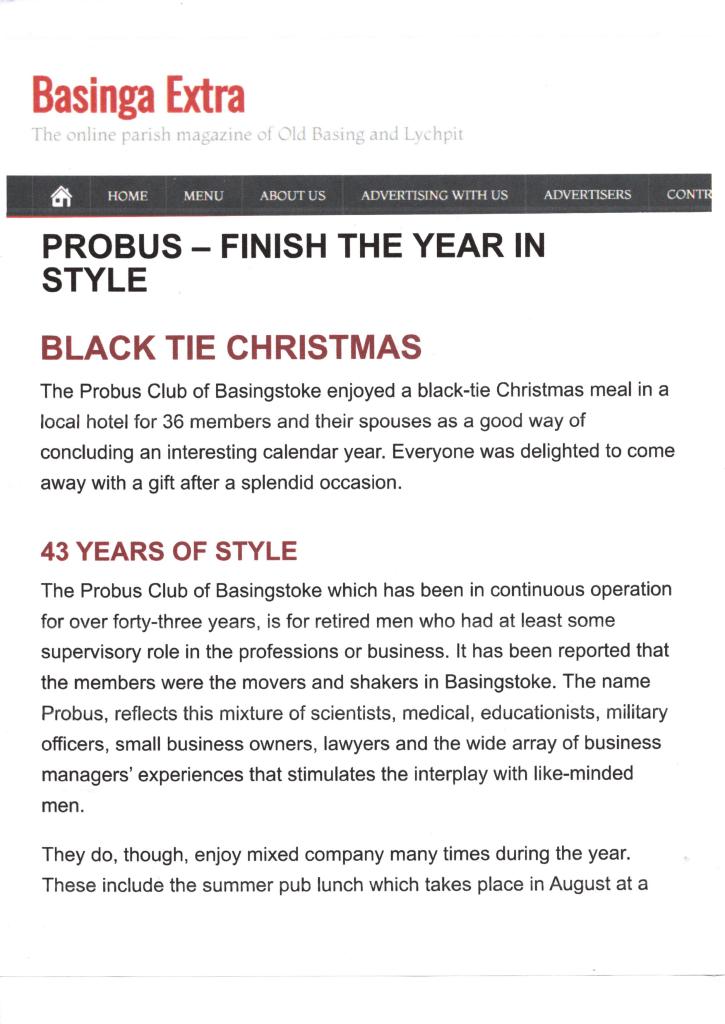
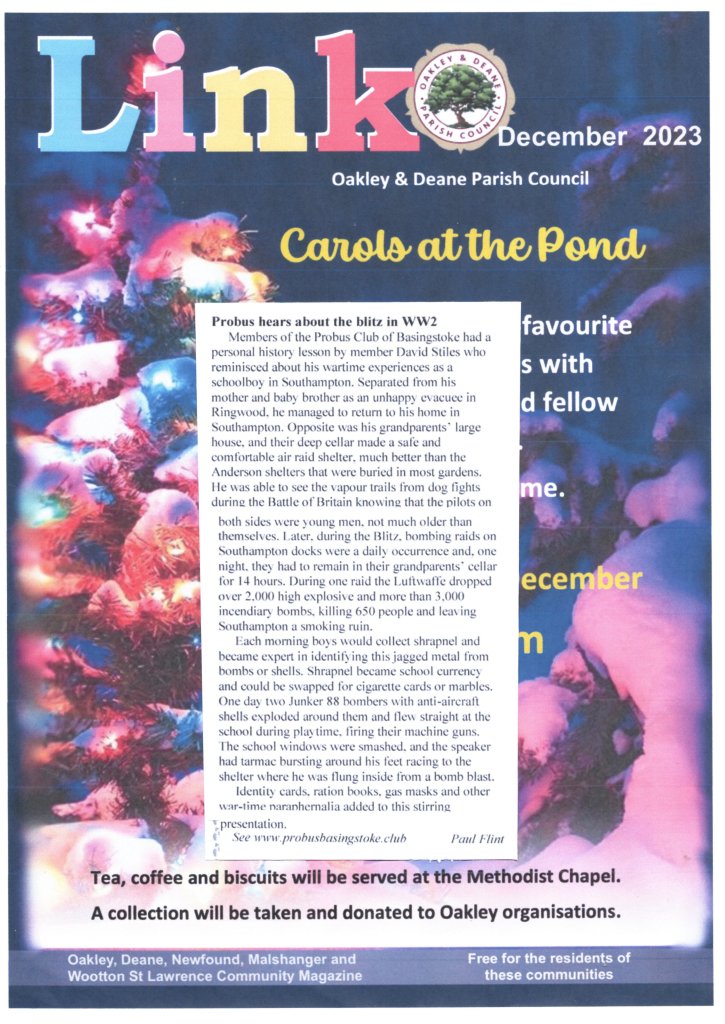
January is typically a quiet month for our publicity as only three of the local magazines have a January edition – the Link (Oakley), the Basinga and Kempshott Kourier.
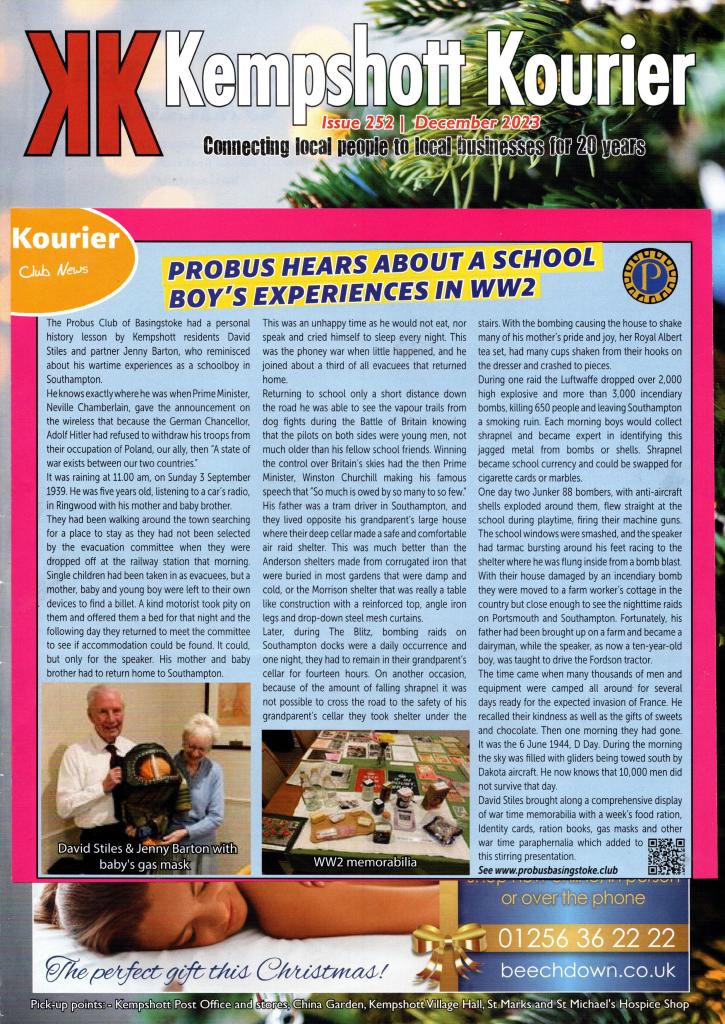
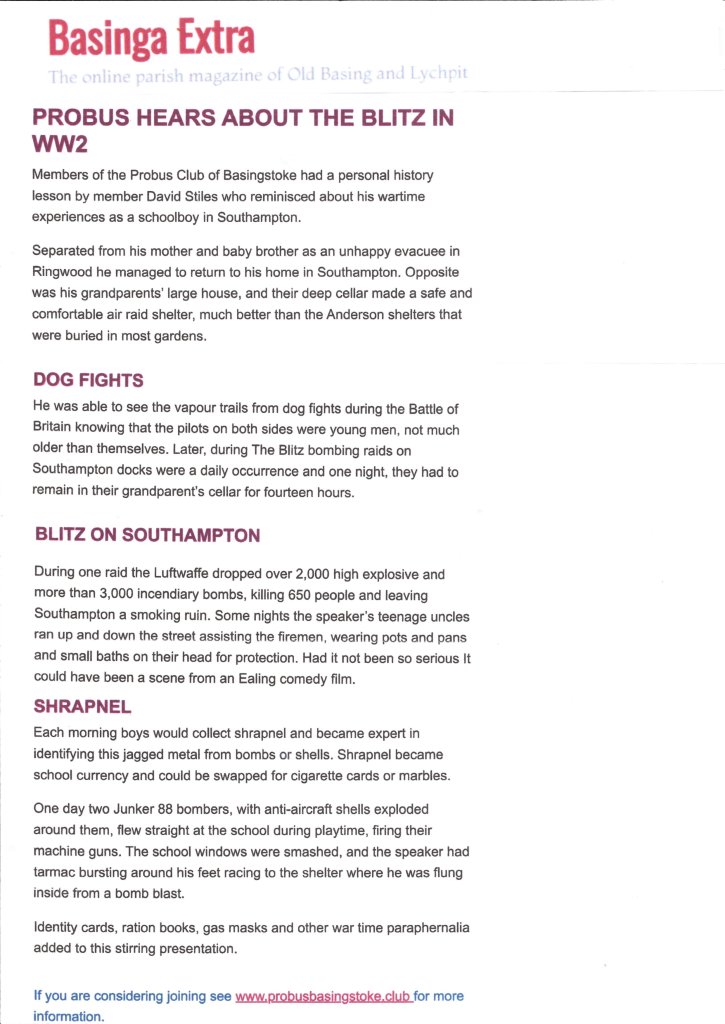
We had a small piece in the Link, had a two-page spread in the online Basinga Extra and as the Kempshott Kourier is always late the image shown in this month’s display is for their December magazine which featured the talk about WW2 memories of a schoolboy.
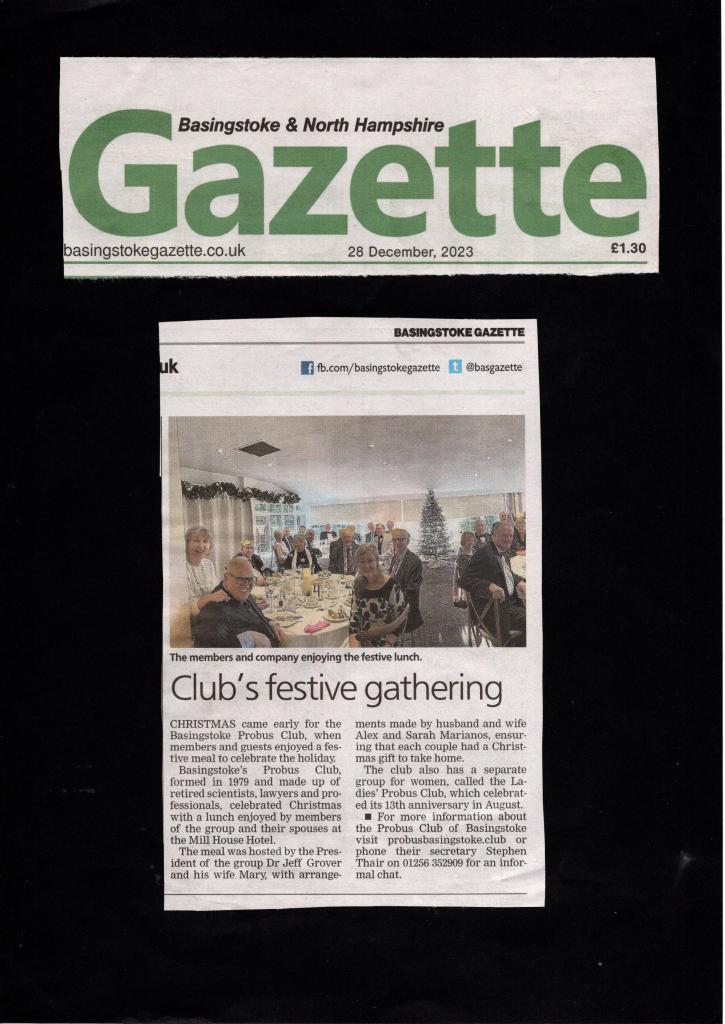
For once the Basingstoke Gazette gave us some space but chopped off half of the photograph and wrote most of their own script.
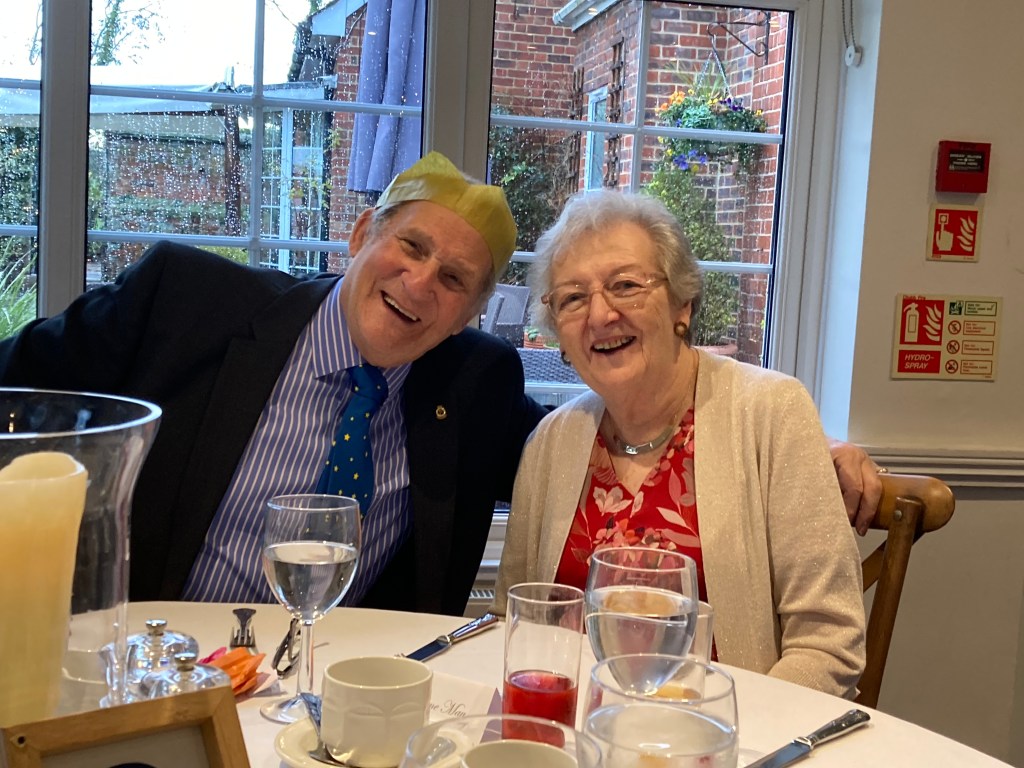
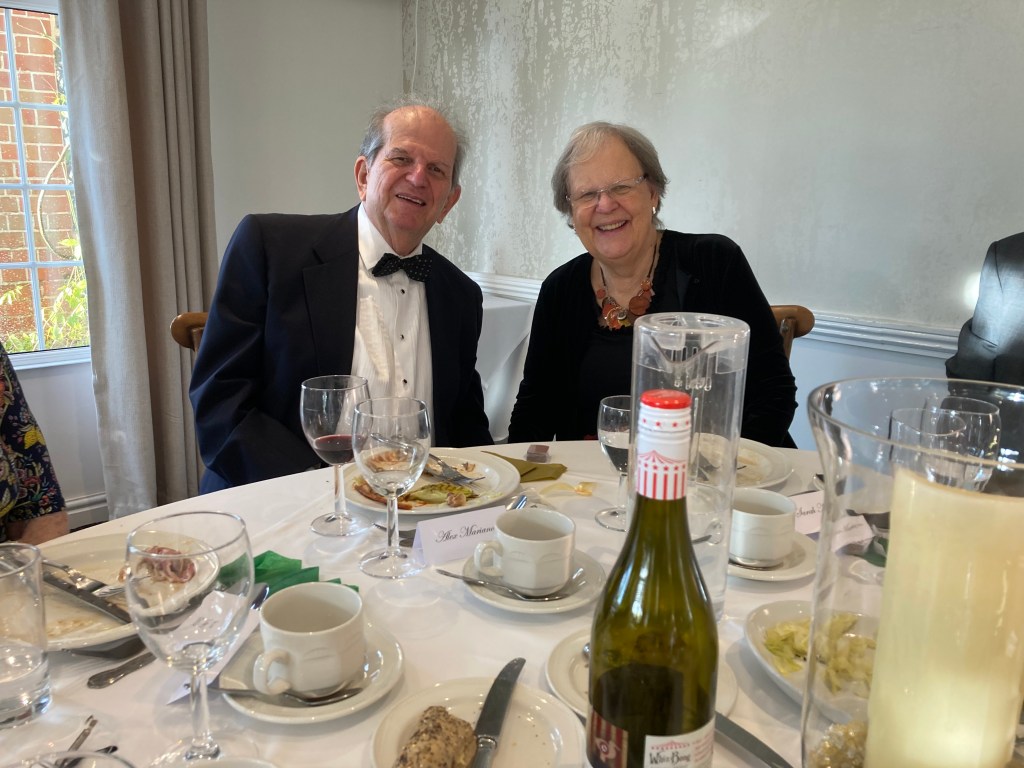
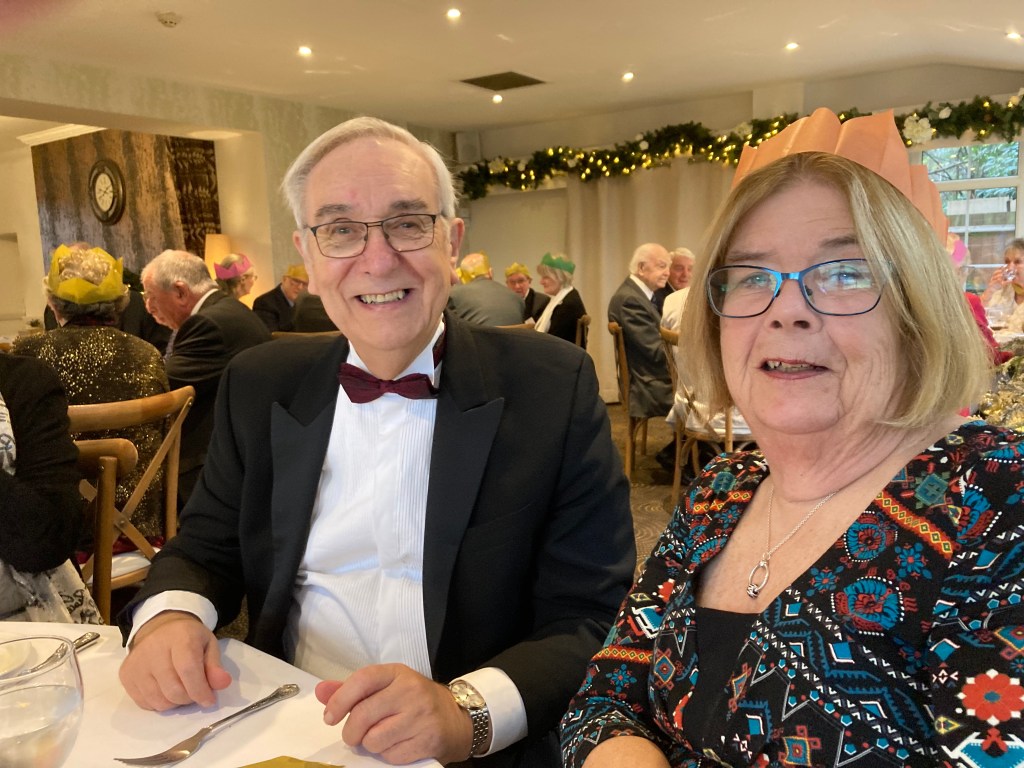
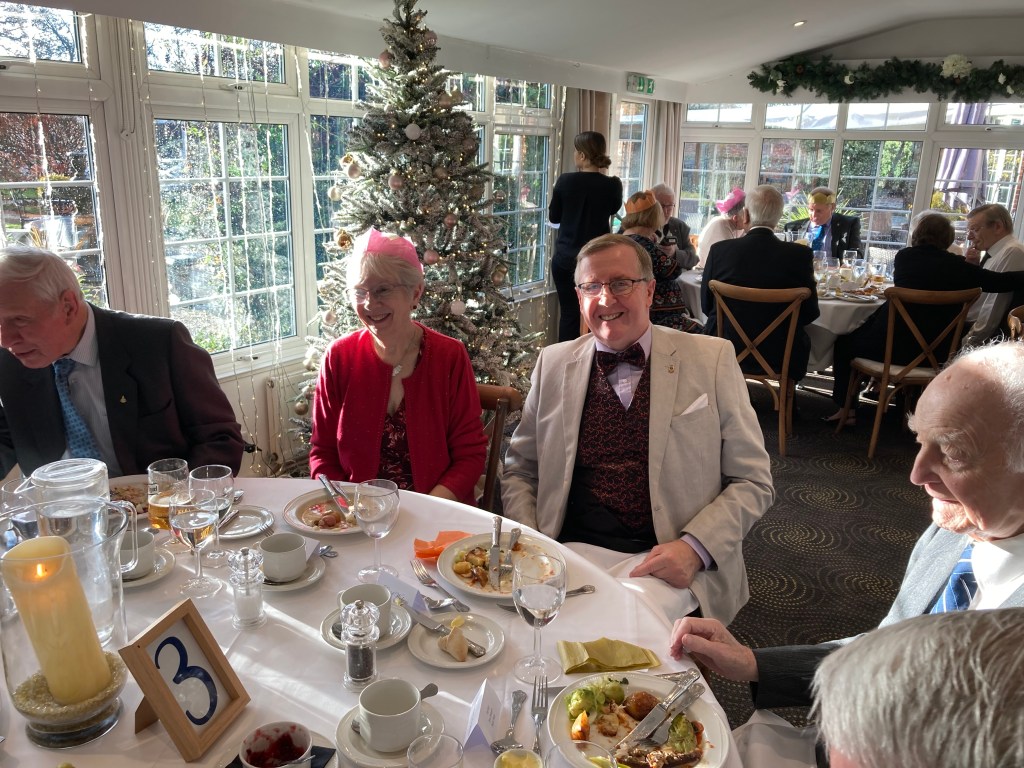
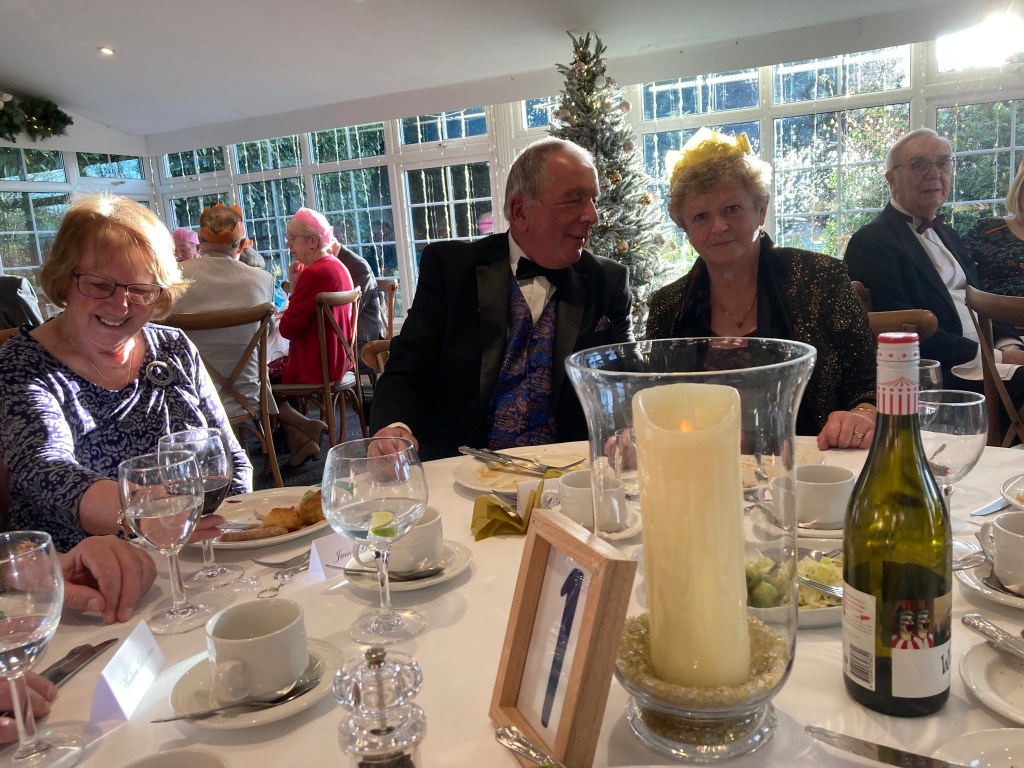
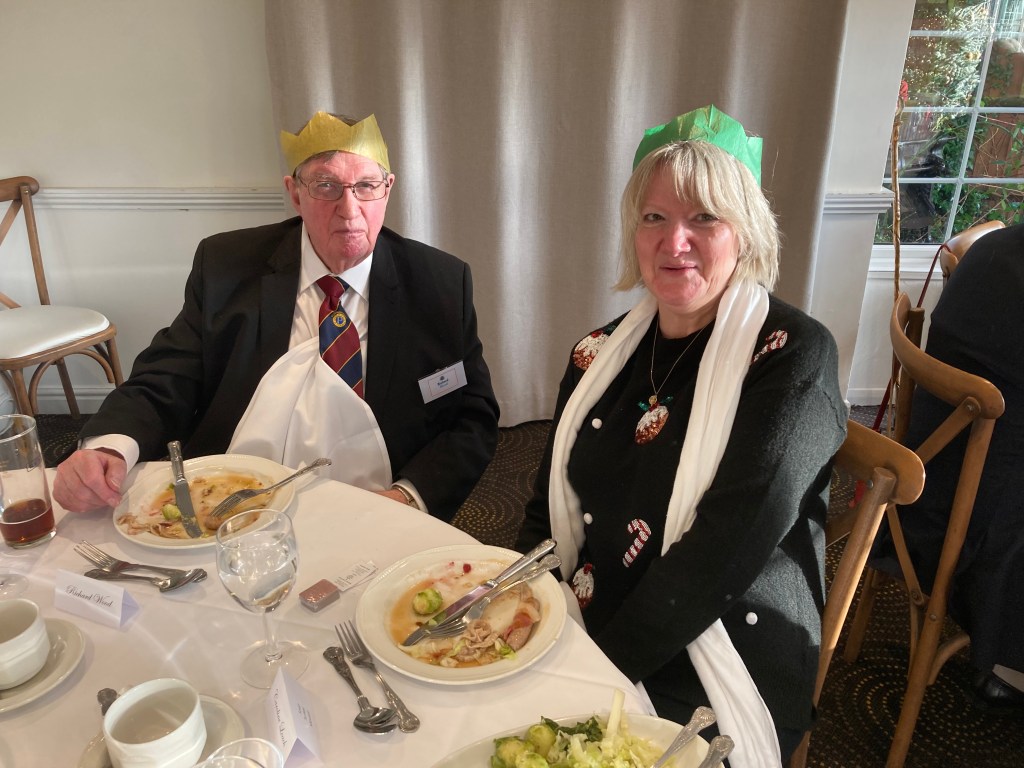
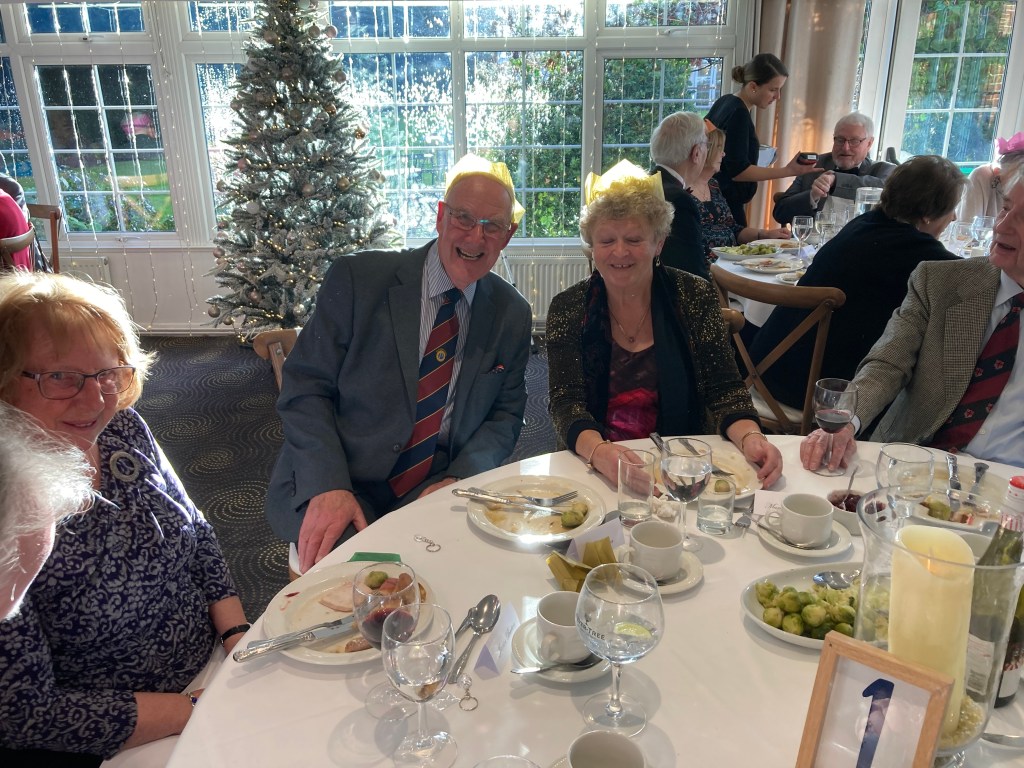
The Mill House hotel at Risley was once again the venue for the annual Christmas lunch. A combination of members, wives, families and friends, totalling thirty-six in all, enjoyed a splendid lunch in delightful surroundings, with good food and great company.
Hosted by President Dr Jeff Grover and his lady, Mary, the arrangements this year were the responsibility of our immediate past president and expert lunch steward, Alex Marianos, who was no doubt ably supported by his good lady wife, Sarah. This meant that everyone had the food of their choice and went away suitably replete with each couple taking home a Christmas gift.
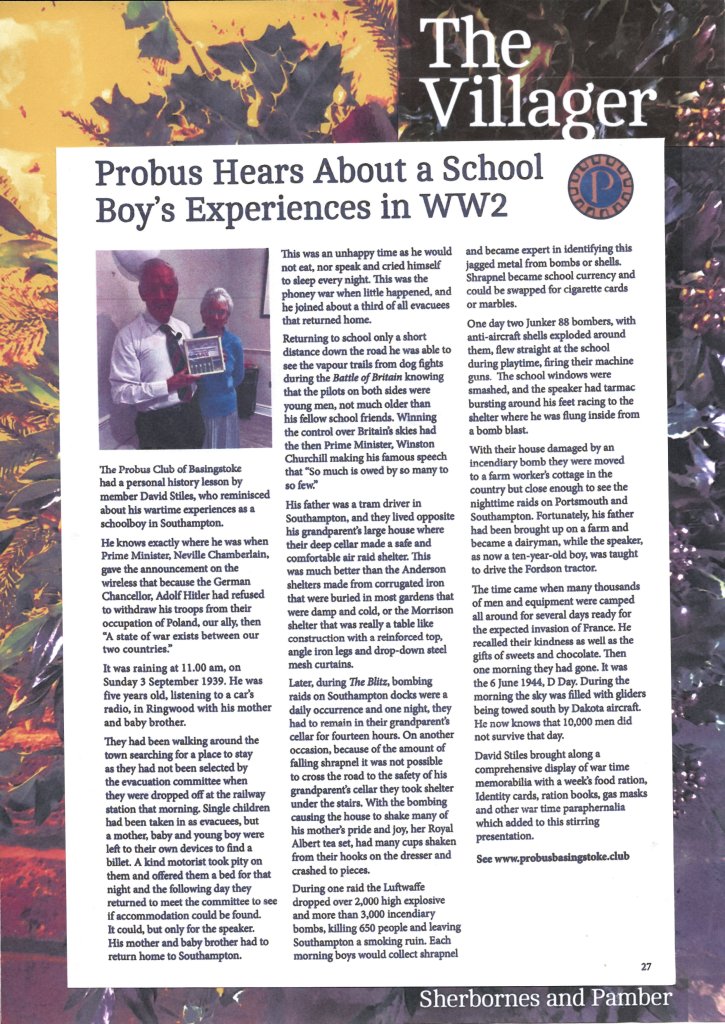
The report on the presentation by our member David Styles accompanied by his partner Jenny Barton about David’s recollections of being a schoolboy in WW2 were well covered in the local magazines.
The CommunityAd publishers are starting to have a monthly edition for Overton, Oakley & Kempshott and once again gave us a double page spread. They have now requested that they receive a report each month which is good news as we have never previously had any sort of publicity in Overton.
The Loddon Valley Link, as usual gave us a miss and the Kempshott Kourier has yet to provide the files to the printer for their December edition as at Monday 11 December.
The Probus Club of Basingstoke had a personal history lesson by Kempshott residents David Stiles and partner Jenny Barton, who reminisced about his wartime experiences as a schoolboy in Southampton.
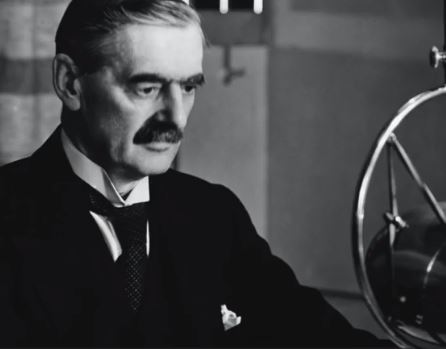
He knows exactly where he was when Prime Minister, Neville Chamberlain, gave the announcement on the wireless that because the German Chancellor, Adolf Hitler had refused to withdraw his troops from their occupation of Poland, our ally, then “A state of war exists between our two countries.”
Neville Chamberlain announcing a state of war
It was raining at 11.15 am, on Sunday 3 September 1939. He was five years old, listening to a car’s radio, in Ringwood with his mother and baby brother.
They had been walking around the town searching for a place to stay as they had not been selected by the evacuation committee when they were dropped off at the railway station that morning. Single children had been taken in as evacuees, but a mother, baby and young boy were left to their own devices to find a billet. A kind motorist took pity on them as he could see the mother was weeping and offered them a bed for that night. The following day they returned to meet the evacuation committee to see if accommodation could be found. It could, but only for the speaker. His mother and baby brother had to return home to Southampton.
It was was an unhappy period as although he was billeted with a kind family, he would not eat, nor speak and cried himself to sleep every night. This was the phoney war when little happened, and so he joined about a third of all evacuees that returned home.
Returning to school only a short distance down the road he was able to see the dog fights during the Battle of Britain knowing that the pilots on both sides were young men, not much older than his fellow school friends.
Winning the control over Britain’s skies had the then Prime Minister, Winston Churchill. on 20 August 1940, making his famous speech that “Never in the field of human conflict was so much owed by so many to so few.”
David Stiles’ father was a tram driver in Southampton, and they lived opposite his grandparent’s large house where their deep cellar made a safe and comfortable air raid shelter. This was much better than the Anderson shelters made from corrugated iron buried in most gardens that were damp and cold, or the Morrison shelter under which residents huddled during air raids that was really a table like construction with a reinforced top, angle iron legs and drop-down steel mesh curtains.
Anderson air raid shelter
Later, during The Blitz, bombing raids on Southampton docks were a daily occurrence and one night, they had to remain in their grandparent’s cellar for fourteen hours. On another occasion, because of the amount of falling shrapnel it was not possible to cross the road to the safety of his grandparent’s cellar they took shelter under the stairs. With the bombing causing the house to shake many of his mother’s Royal Albert tea set, her pride and joy, had many cups shaken from their hooks on the dresser and crashed to pieces.
Morrison shelter
During one raid the Luftwaffe dropped over 2,000 high explosive and more than 3,000 incendiary bombs, killing 650 people and leaving Southampton a smoking ruin. Some nights the speaker’s teenage uncles ran up and down the street assisting the firemen, wearing pots and pans and small baths on their head for protection. Had it not been so serious It could have been a scene from an Ealing comedy film.
Each morning boys would collect shrapnel and became expert in identifying this jagged metal from bombs or shells. Shrapnel became school currency and could be swapped for cigarette cards or marbles.
One day two Junker 88 bombers, with anti-aircraft shells exploded around them, flew straight at the school during playtime, firing their machine guns. The school windows were smashed, and the shells caused the tarmac to burst around his feet as he racing to the shelter where he was flung inside from a bomb blast.
With their house damaged by an incendiary bomb they were moved to a farm worker’s cottage in the country but close enough to see the night time raids on Portsmouth and Southampton. Fortunately, his father had been brought up on a farm and became a dairyman, while the speaker, as now a ten-year-old boy, was taught to drive the Fordson tractor.
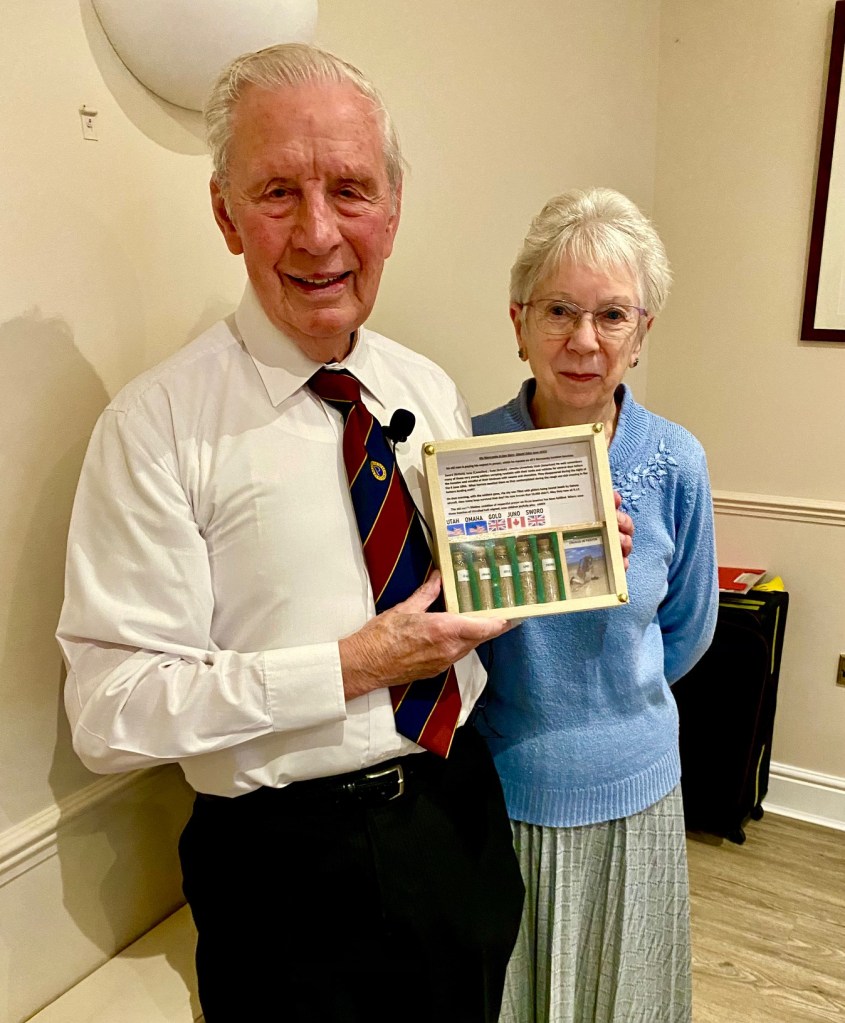
The time came when many thousands of men and equipment were camped for several days all around in fields and on roadside verges ready for the expected invasion of France. He recalled their kindness as well as the gifts of sweets and chocolate. Then one morning they had gone. It was June 6th, 1944, D Day. The troops headed for what has now become well known, the five beaches in northern France that go by the code names of Utah, Omaha, Gold, Juno and Sword invaded by British, American and Canadian troops. During the morning the sky was filled with gliders being towed south by Dakota aircraft. He now knows that 10,000 men did not survive that day.
Troop carrying gliders being towed across the English Channel on D Day 6 June 1944
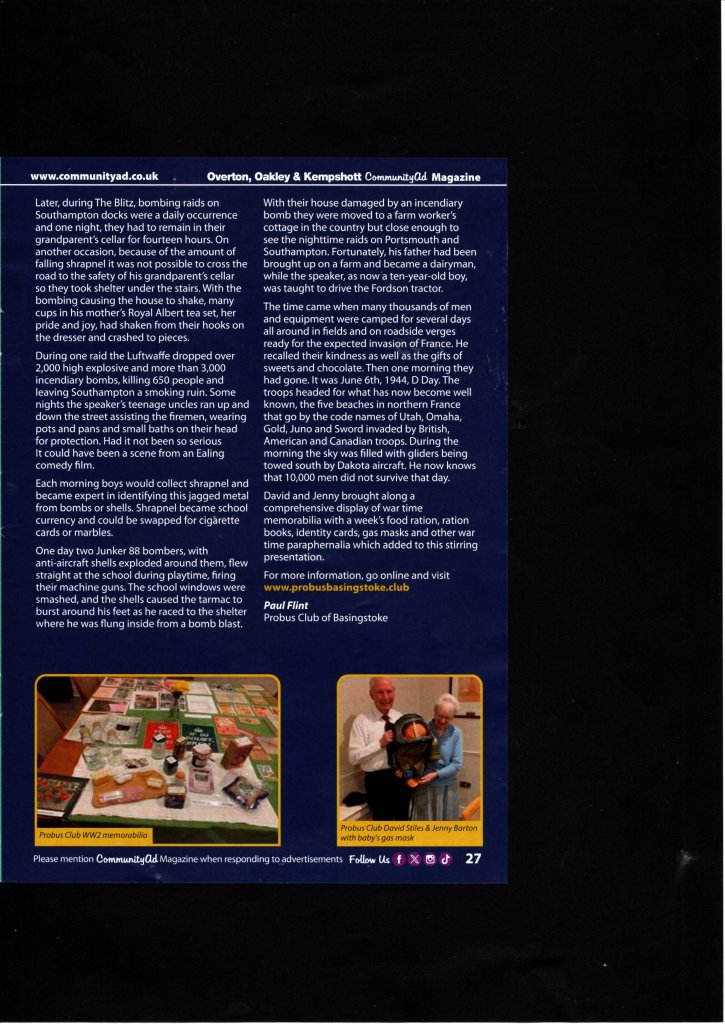
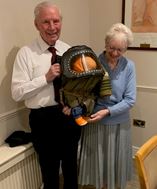
David and Jenny brought along a comprehensive display of war time memorabilia with a week’s food ration, ration books, identity cards, gas masks and other war time paraphernalia which added to this stirring presentation.
WW2 display of documents and foodFood rations for an adult for one weekDavid & Jenny with a baby’s gas maskDavid & Jenny with test tubes of sands from the D Day beaches.
A good result for our report on the popular artist Norman Thelwell who had three sides to his persona in being well known as the creator of stockily built ladies on tubby horses, a painter of English country scenes and a keen countryman supporting many green issues.
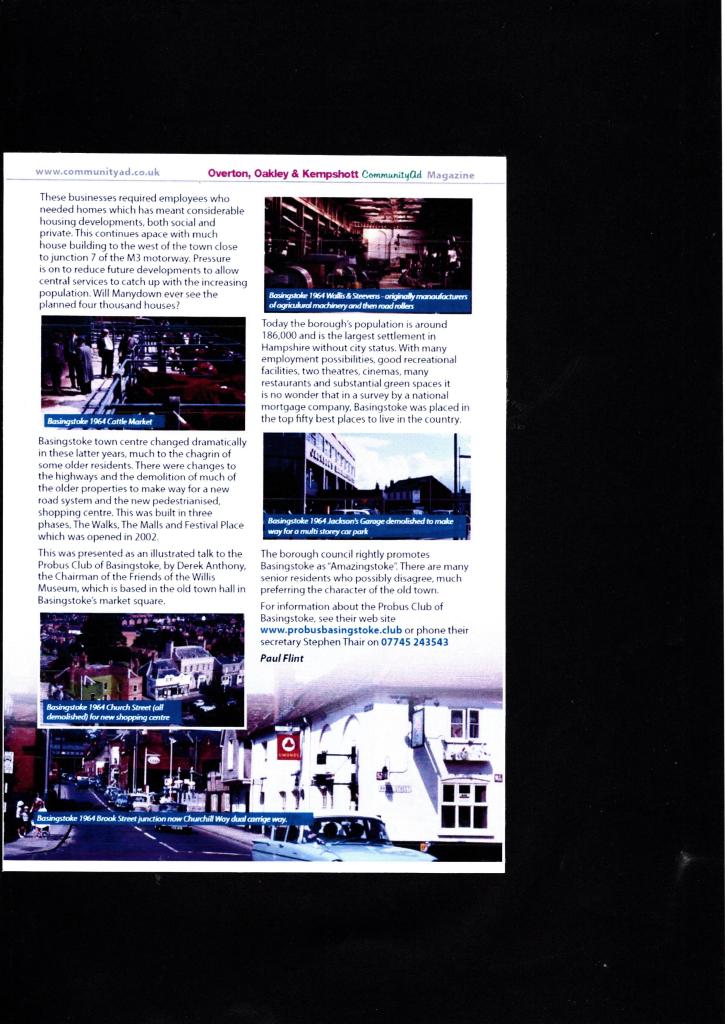
The CommunityAd magazine for Oakley, Overton & Kempshott gave us a double page spread about the changes over the years in Basingstoke.
In extremely wet conditions when the rain was relentless, a clear winner emerged some 7 points ahead of his nearest rival. There was a brief period when there was a break in the inclement conditions when the winner, clearly determined to succeed, removed his outer waterproof garments to reveal a golfing jumper depicting the wearer in days gone by. This psychological advantage spurred the owner to score a commendable 33 points.
Richard Stettner watches as Jeff Grover marches towards the holewhile Alan May & Geoff Twine seek shelter in their buggy
In second place was the host who normally only ever plays 9 holes at Test Valley and there was a real fear that he may get lost during the 2nd nine holes. Fortunately, this did not materialise.
Runners Up -Geoff Twine (4th), Richard Stettner (2nd) Jeff Grover (3rd)
Third and fourth places went to the defending champion and a nonagenarian who, in reality, put everyone to shame as he played commendably well under the onerous conditions. He lost only on countback over the last 9 holes.
Winner Alan May (centre) with Geoff Twine and Jeff Grover
The bedraggled golfers emerged over the horizon in two buggies and left the 18th green to be met by David Wickens who had laid on bacon and sausage butties and plates of chips that were eagerly devoured by all.
The official results were: 1. Alan May with 33 points 2. Richard Stettner on 26 points 3. Jeff Grover with 24 points 4. Geoff Twine with 24 points
The winner receives a trophy for safe keeping for 12 months and then has the responsibility for organising its defence in 2024.
Dry at last. Alan May proudly holding the winner’s shield



































 Probus Club of Basingstoke
You must be logged in to post a comment.