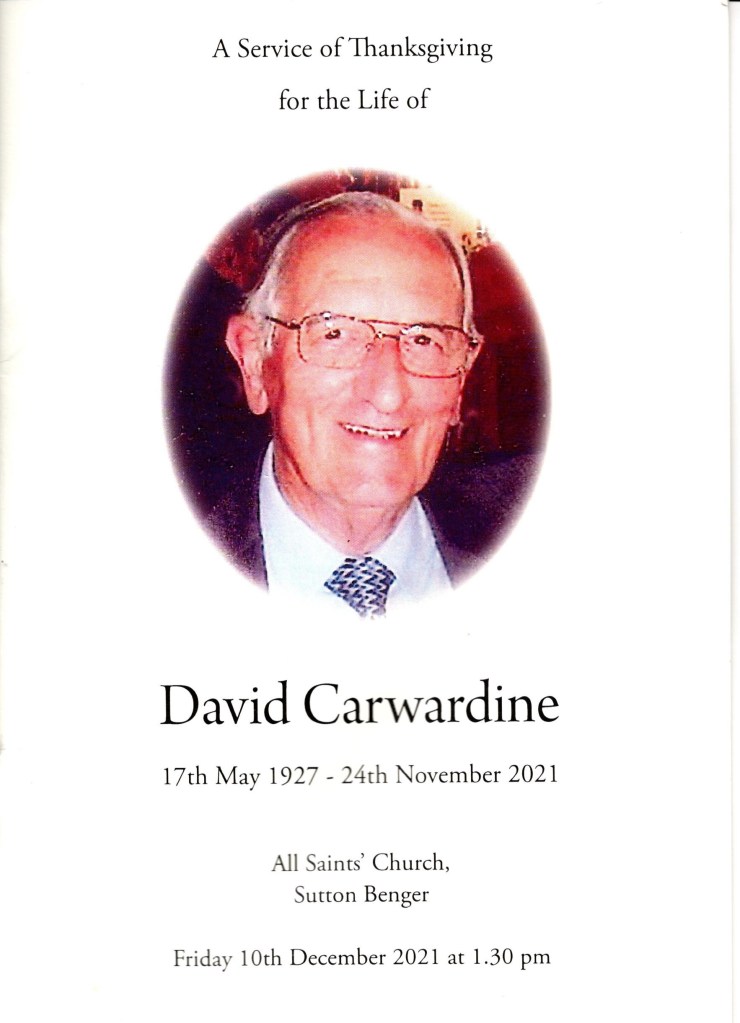
David Carwardine – a Service of Thanksgiving

Past Presidents Paul Flint and Chris Perkins MVO attended the service of thanksgiving for David Carwardine on Friday 10th December, following a family cremation held earlier that morning. It was held in Sutton Benger near Chippenham in Wiltshire close to where David and his wife, Betty, had moved to live in a retirement village to be close to his sons.

David had been a loyal and active member of the Probus Club of Basingstoke, serving as President in 1996/97. One of the changes he introduced was the Summer Pub lunch which has continued without break, except last year due to Covid restrictions.

While most of us knew of his background as the director and head of engineering at Lansing Bagnall and then his time as a Director of the British Institute of Management he was rightly proud of his father’s invention of the angle poise lamp. A sample was displayed at the service along with David’s photograph and flowers.

There are always things learned at funerals and for us it was that David had been a keen glider pilot and that he had a love of travelling that he has passed on to his two sons and granddaughters.

David’s ashes will be interred in a family plot in Bath.

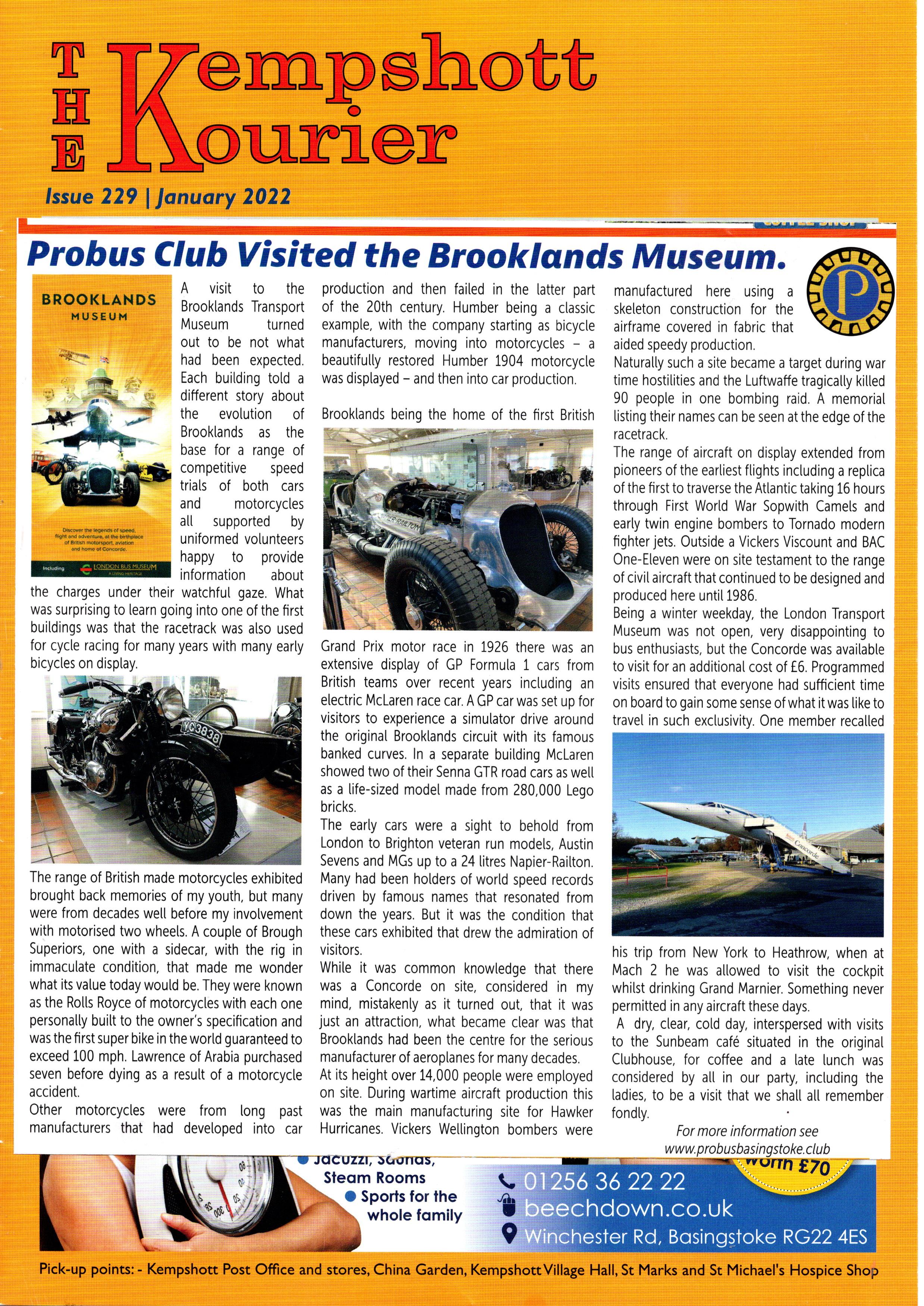
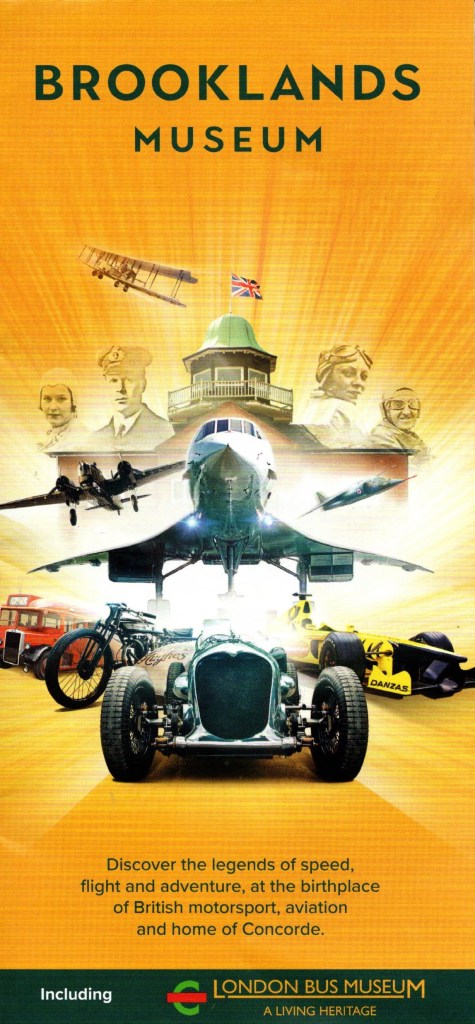
Probus Visit to Brooklands Transport Museum

When the sat nav announced that we had reached our destination something told me it was not true. We were down a broad private road that went around a bend to somewhere. From out of a shed in the middle of the road emerged a lady to explain, in a well-rehearsed manner, not only to myself but I think to the other six cars behind me, that this was not the entrance to the Brooklands Museum. Her redirection instructions worked because in a few minutes we drove around the rear of Mercedes World to the car park outside of Brooklands.

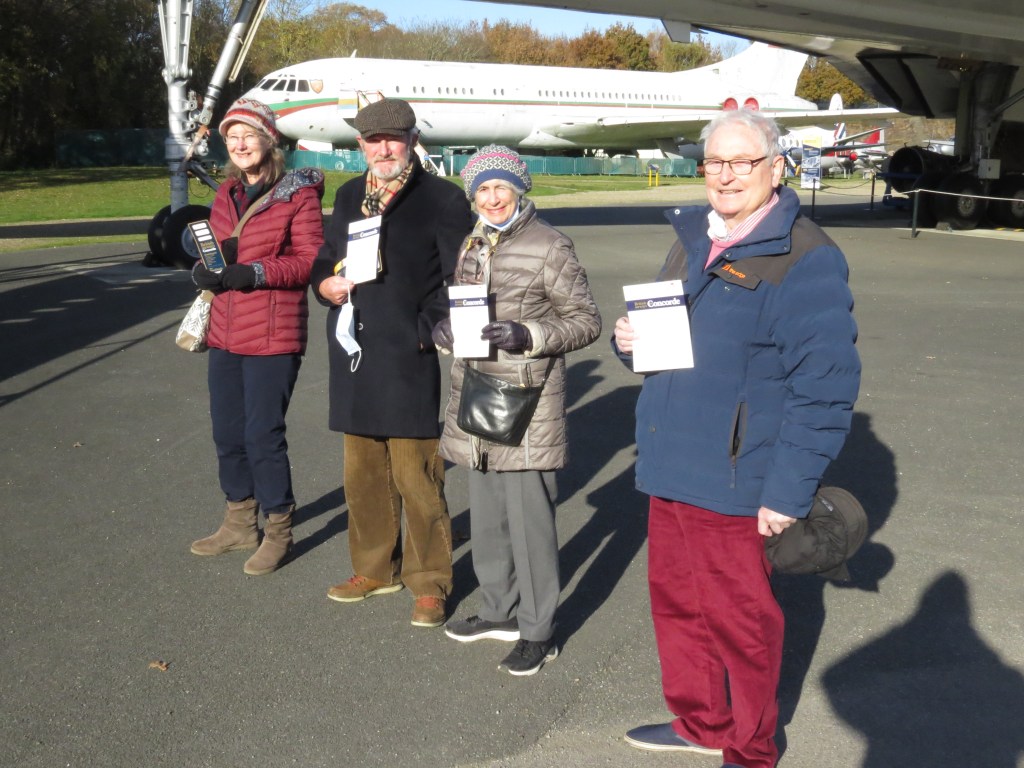
Chris Perkins, our Probus Club of Basingstoke outings organiser had carried out a recce and had prepaid our entrance tickets, so we gained admittance speedily. There were supposed to be fourteen of us consisting of members and spouses in our party, but winter colds had taken out a couple but the rest of us headed off eager to explore this famous site.

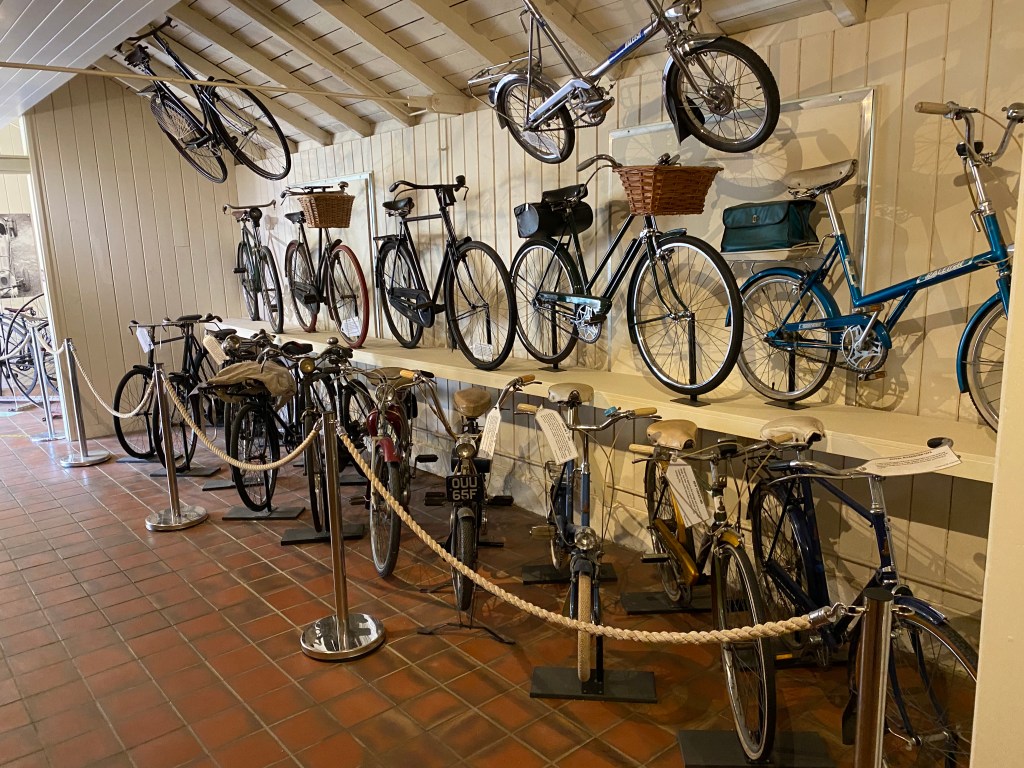
Each building told a different story about the evolution of Brooklands as the base for a range of competitive speed trials of both cars and motorcycles all supported by uniformed volunteers happy to provide information about the charges under their watchful gaze. Some readers will have seen the regular broadcasts on the Yesterday television channel about the work of the volunteers who bring some of the vehicles back to life. What was surprising to learn going into one of the first buildings was that the racetrack was also used for cycle racing for many years with many early bicycles on display.

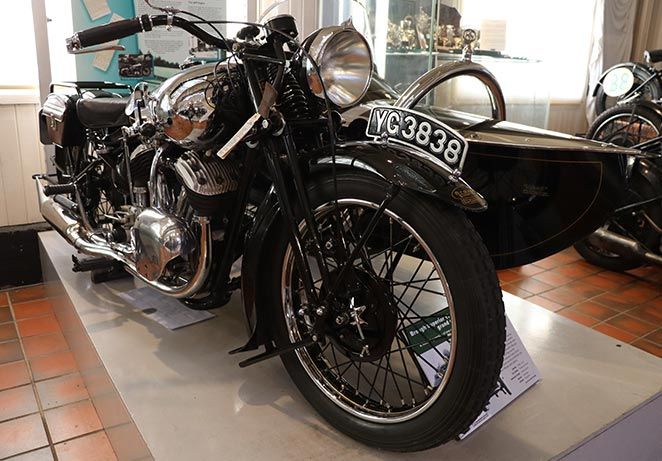
The range of British made motorcycles exhibited brought back memories of my youth, but many were from decades well before my involvement with motorised two wheels. A couple of Brough Superiors, one with a sidecar, with the rig in immaculate condition, that made me wonder what its value today would be. They were known as the Rolls Royce of motorcycles with each one personally built to the owner’s specification and was the first super bike in the world guaranteed to exceed 100 mph.

In the 1970s I lived in a house built in the grounds of the home that had been owned by George Brough, in Nottingham. I remember seeing photographs of Lawrence of Arabia on a Brough Superior outside the front door. The house was known as Pendine after a Brough Superior won the world speed record in 1936 at over 163 mph on Pendine Sands in south Wales.

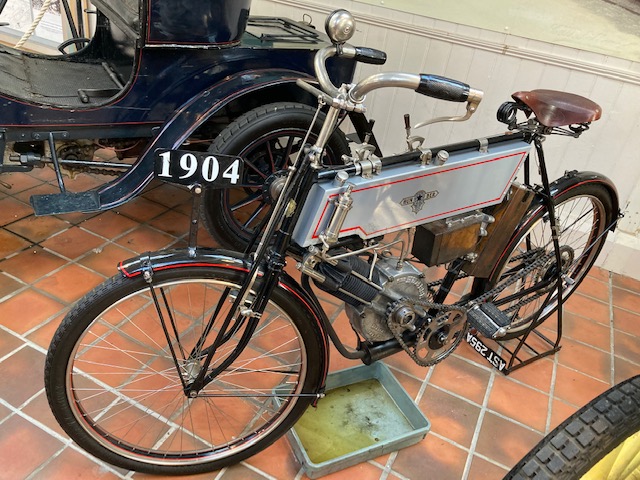
1904 Humber motorcycle

Other motorcycles were from long past manufacturers that had developed into car production and then failed in the latter part of the 20th century. Humber being a classic example, with the company starting as bicycle manufacturers, moving into motorcycles – a beautifully restored Humber 1904 motorcycle was displayed – and then into car production.

British Formula 1 Race cars


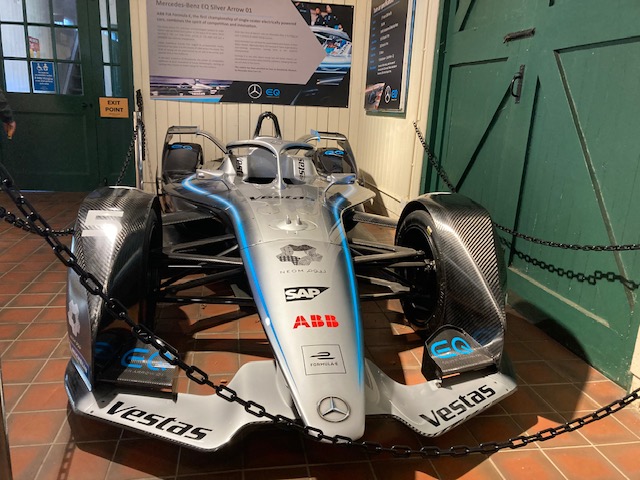
Brooklands being the home of the first British Grand Prix motor race in 1926 there was an extensive display of GP Formula 1 cars from British teams over recent years including an electric McLaren race car. A GP car was set up for visitors to experience a simulator drive around the original Brooklands circuit.

McLaren electric race car

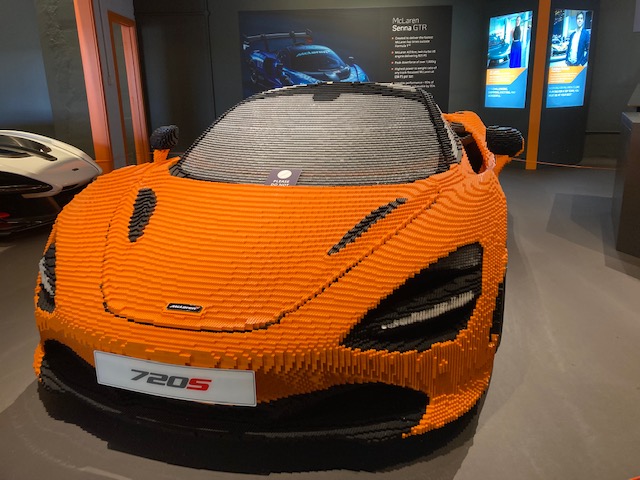
In a separate building McLaren showed two of their Senna GTR road cars as well as a life-sized model made from 280,000 Lego bricks.

The Lego McLaren
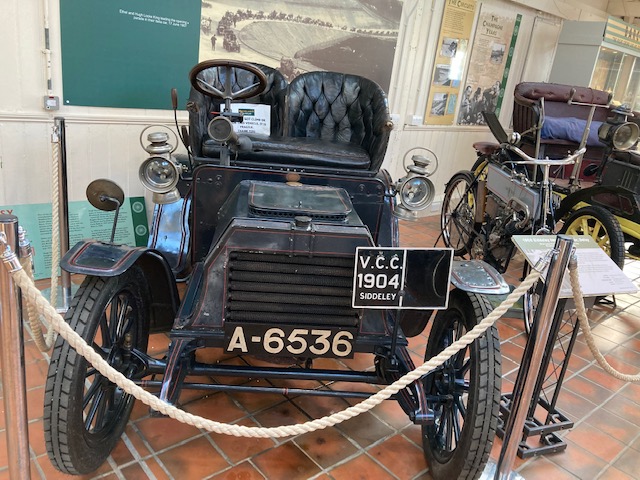
Siddeley 1904 Veteren Car Club Member

The early cars were a sight to behold from London to Brighton veteran run models, Austin Sevens and MGs up to a 24 litre Napier-Railton. Many had been holders of world speed records driven by famous names that resonated from down the years. But it was the condition that these cars exhibited that drew the admiration of visitors. Volunteers were seen going about in a dusting party to keep them looking bright and shiny.

Napier-Railton 24 Litres


Most of us had an image in our minds that Brooklands was known for early motor racing with its famous banked racing track but what was set out before our gaze was a myriad of buildings of various shapes and sizes from those early years as well as aircraft hangers. While it was common knowledge that there was a Concorde on site, considered in my mind, mistakenly as it turned out, that it was just an attraction, what became clear was that Brooklands had been the centre for the serious manufacturer of aeroplanes for many decades.

WW2 Vickers Wellington Bomber

At its height over 14,000 people were employed on site. During wartime aircraft production this was the main manufacturing site for Hawker Hurricanes, whose claim to fame was that they shot down more enemy aircraft than Spitfires. Vickers Wellington bombers were manufactured here using a skeleton construction for the airframe covered in fabric that aided speedy production. There was even a small exhibit that demonstrated how a range of bombs could be selected for specific raids and a practical demonstration how the bomb aimer released his load.

Naturally such a site became a target during war time hostilities and the Luftwaffe tragically killed 90 people in one bombing raid. A memorial listing their names can be seen at the edge of the racetrack.

The range of aircraft on display extended from pioneers of the earliest flights including a replica of the first to traverse the Atlantic taking 16 hours through First World War Sopwith Camels and early twin engined bombers to Tornado modern fighter jets. A Wellington bomber that crashed into Loch Ness during the 1940s had been rebuilt following its recovery.

BAC Tornado

Outside a Vickers Viscount and BAC One-Eleven were on site testament to the range of civil aircraft that continued to be designed and produced here until 1986.

Being a winter weekday, the London Transport Museum was not open, very disappointing to bus enthusiasts, but the Concorde was available to visit for an additional cost of £6. Programmed visits ensured that everyone had sufficient time on board to gain some sense of what it was like to travel in such exclusivity. One member recalled his trip from New York to Heathrow, when at Mach 2 he was allowed to visit the cockpit whilst drinking Grand Marnier. Something never permitted in any aircraft these days.

 A dry, clear, cold day, interspersed with visits to the Sunbeam café situated in the original Clubhouse, for coffee and a late lunch was considered by all in our party, including the ladies, to be a visit that we shall all remember fondly. One member stating very positively that he will take his grandchildren when they visit from abroad.

Around the banked bend at Brooklands on an electric scooter

As many will remember from the Nick Park Aardman Animations television films about characters made from Plasticine, the main man, Wallace, voiced by the late Peter Sallis, always said to his dog at the end of each adventure “A grand day out Gromit” And so it was.

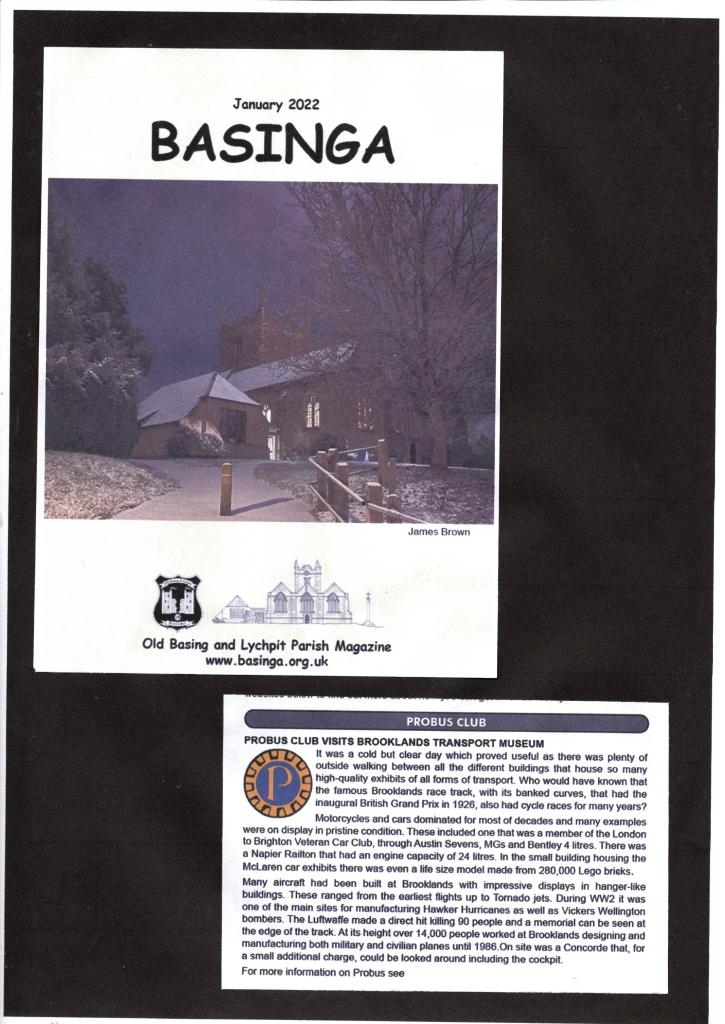
Probus Publicity in November 2021

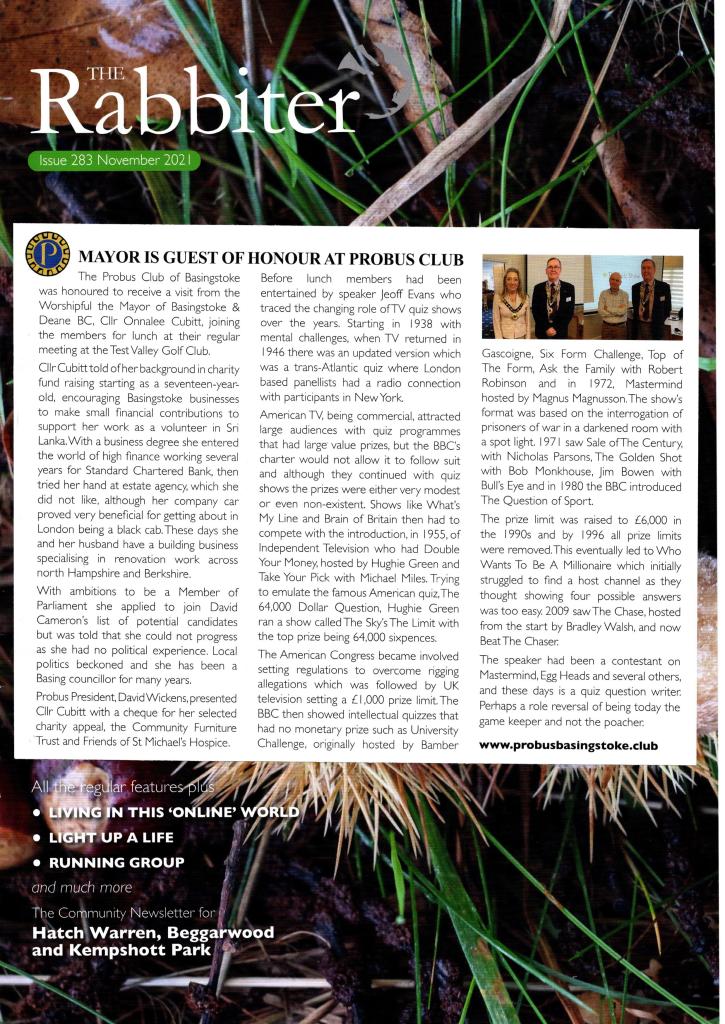
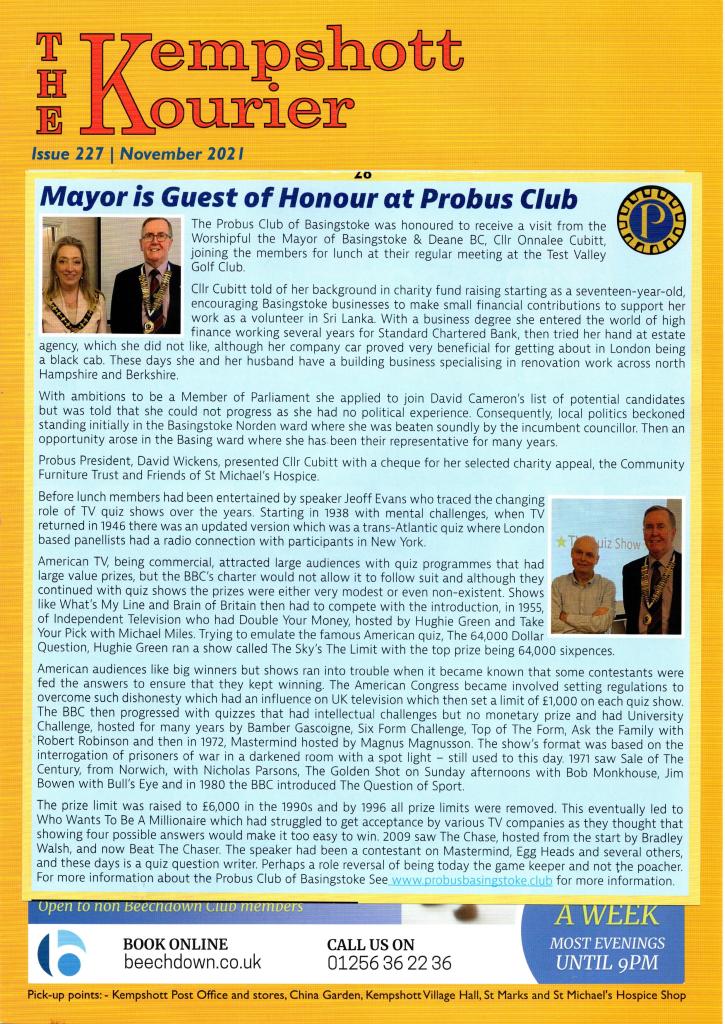
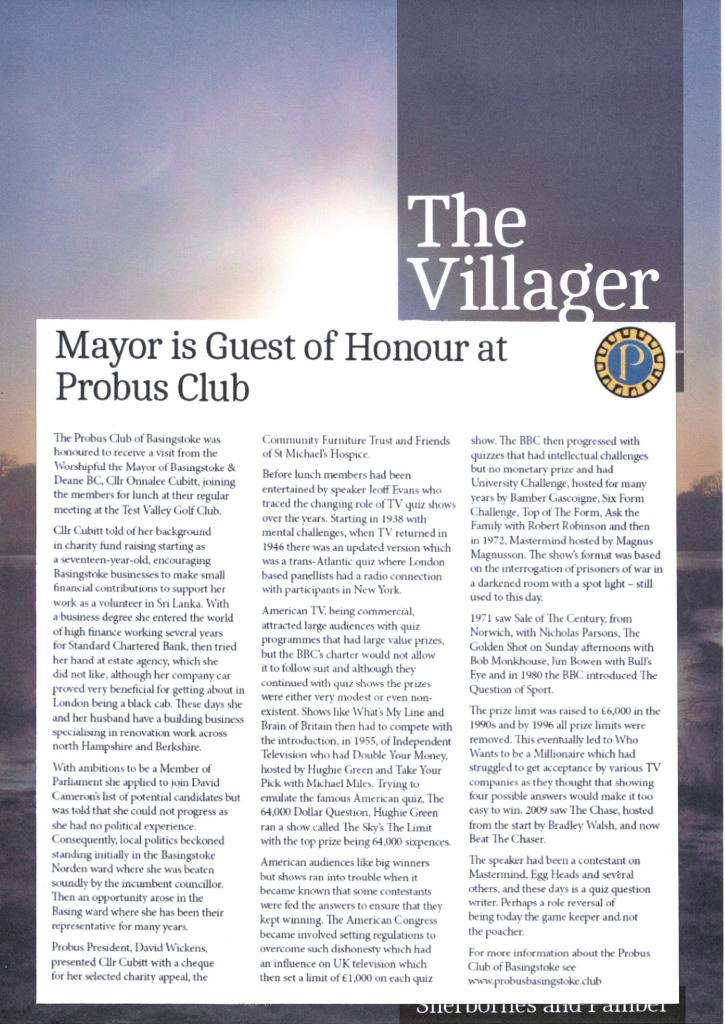
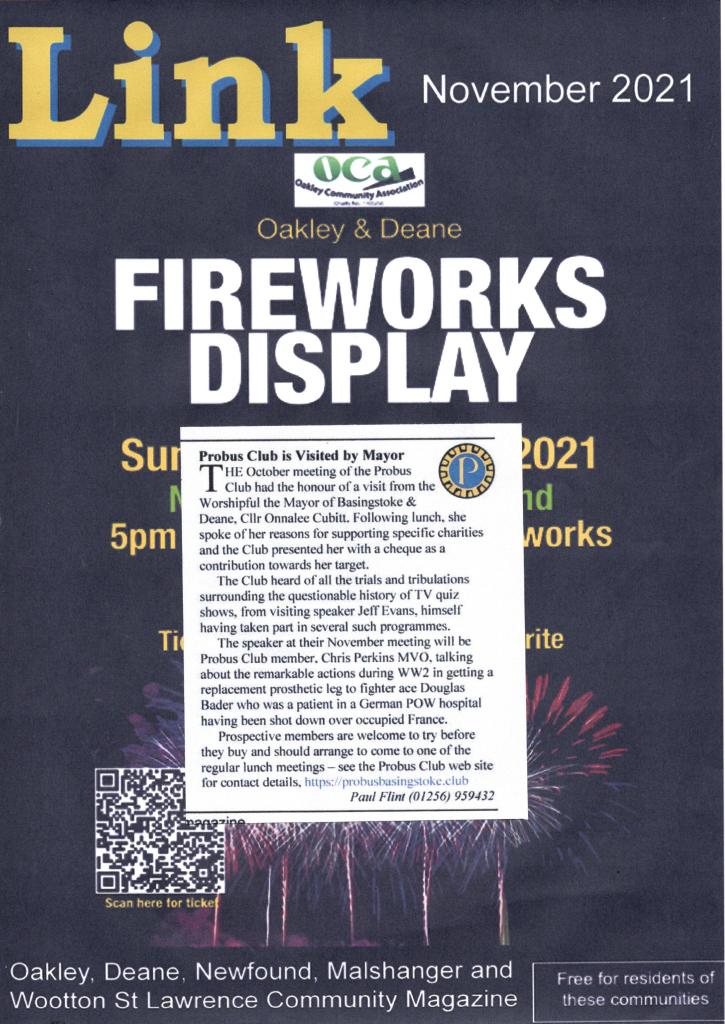
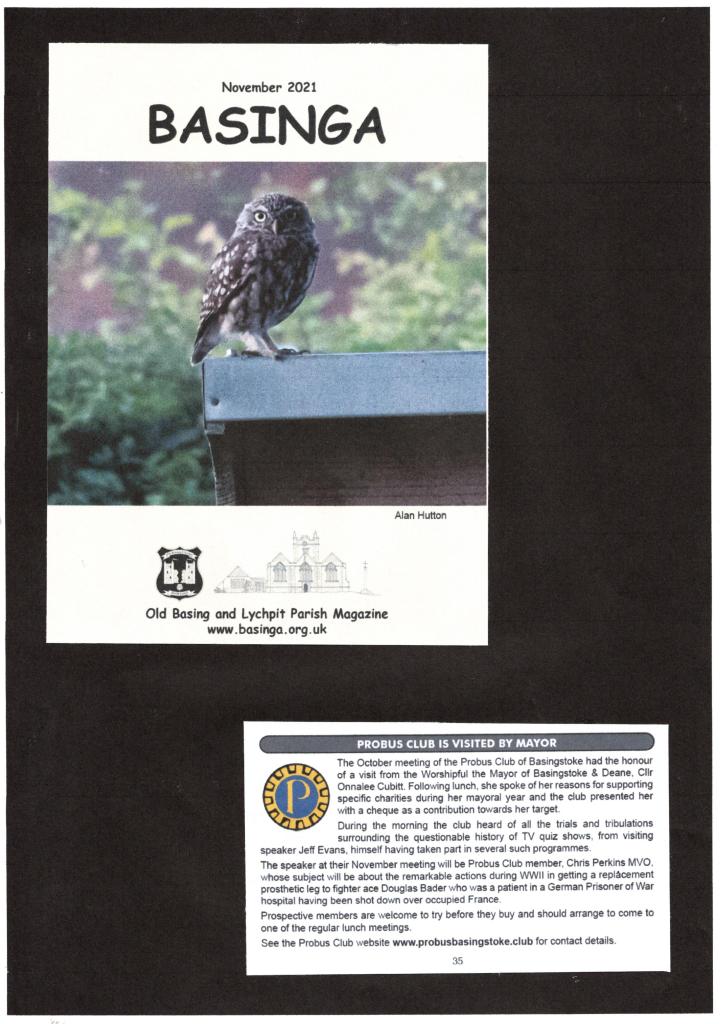
No doubt having the Mayor, Cllr Onnalee Cubitt, as our guest of honour at the October meeting as well as the speaker Jeff Evans on his subject of TV quiz shows proved to be a winning combination in gaining the interest of the local magazines.

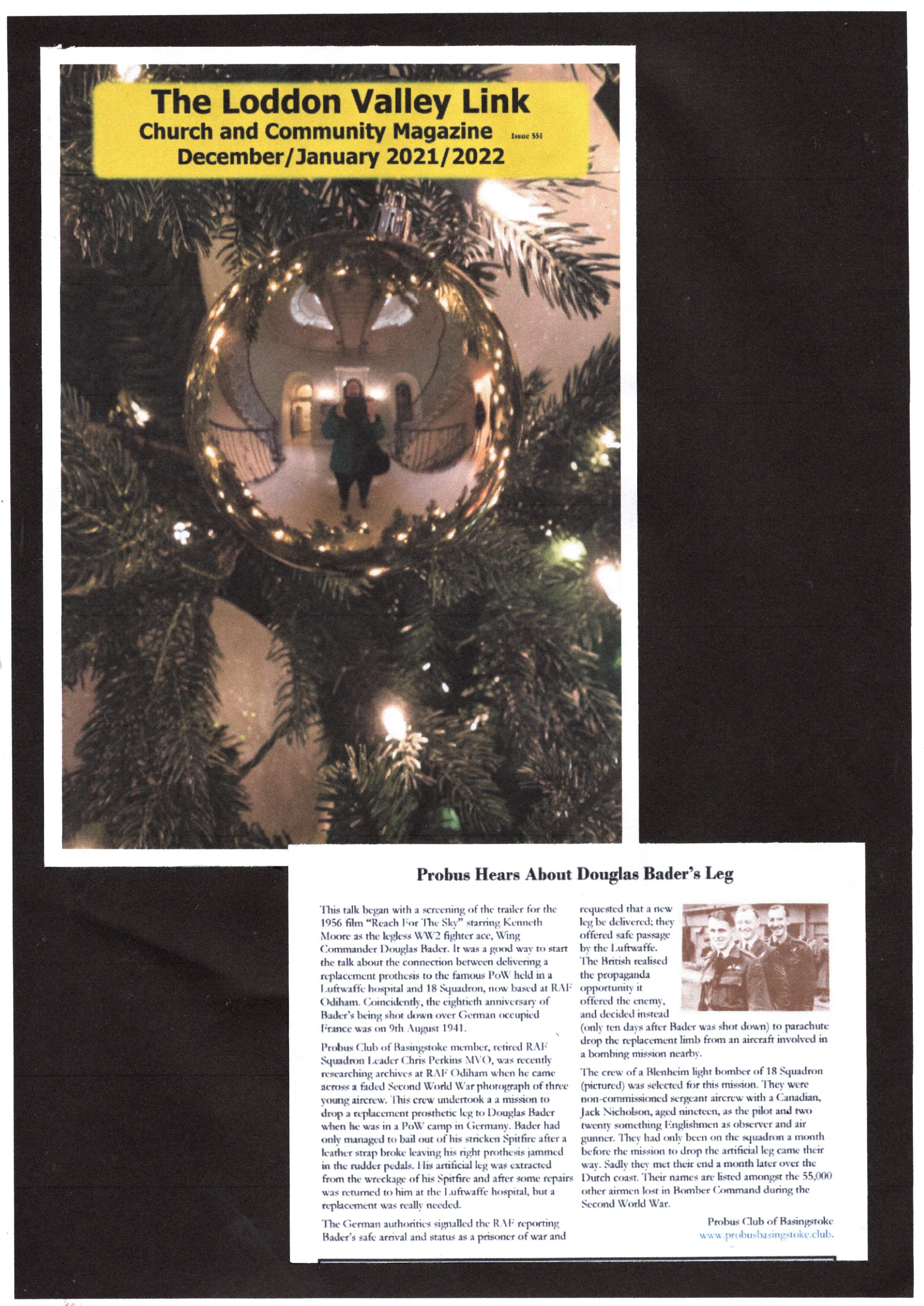
The exception continues to be the Loddon Valley Link where the new rotating editor has yet to have any interest in what our Probus Club is up to in maintaining the interest of our members. Their December/January edition is being edited by the experienced Jane Abrams, who has been known to feature some of our reports.

The Chineham Chat ‘blog’ seems to have stopped adding new reports; their last one was in August. So far my contact has not responded to my enquiries.
The national Probus magazine is poised for a come back in the New Year and our upcoming visit to the Brooklands Transport museum later in November might prove of sufficient interest to be included, always provided there are some interesting photographs.

Mayor is Guest of Honour

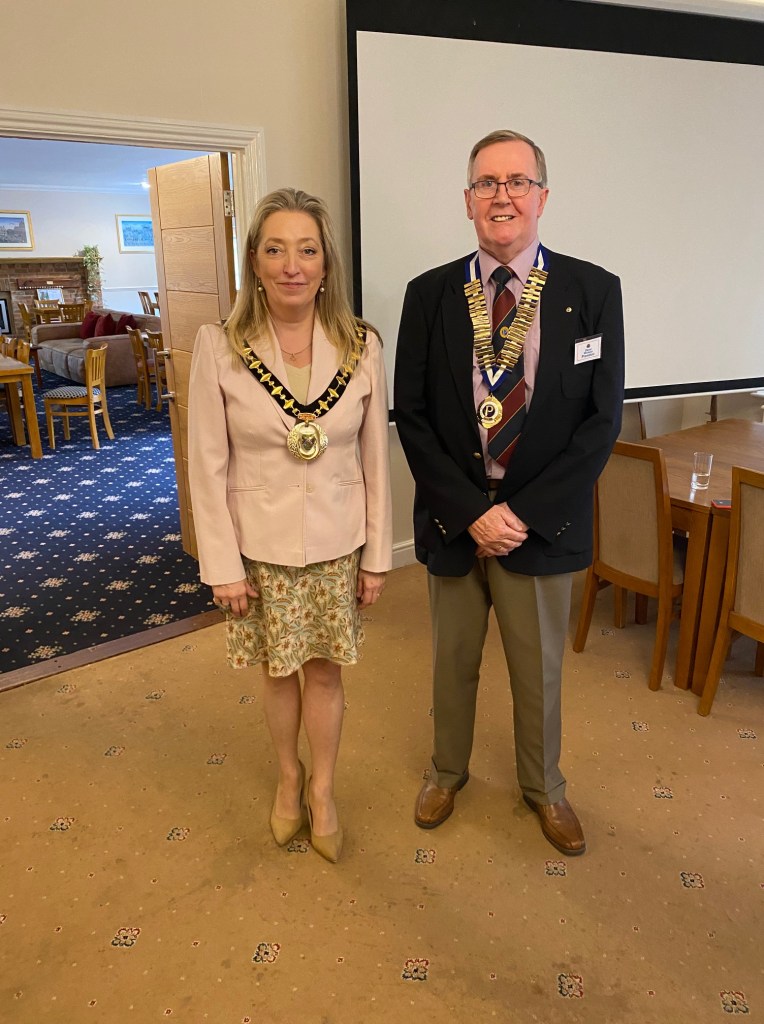
The Worshipful the Mayor of Basingstoke & Deane BC Cllr Onnalee Cubitt with Probus President David Wickens
Speaker Jeff Evans with Probus President David Wickens

The Probus Club of Basingstoke was honoured to receive a visit from the Worshipful the Mayor of Basingstoke & Deane BC, Cllr Onnalee Cubitt, joining the members for lunch at their regular meeting at the Test Valley Golf Club.

Cllr Cubitt told of her background in charity fund raising starting as a seventeen-year-old, encouraging Basingstoke businesses to make small financial contributions to support her work as a volunteer in Sri Lanka. With a business degree she entered the world of high finance working several years for Standard Chartered Bank, then tried her hand at estate agency, which she did not like, although her company car proved very beneficial for getting about in London being a black cab. These days she and her husband have a building business specialising in renovation work across north Hampshire and Berkshire.

With ambitions to be a Member of Parliament she applied to join David Cameron’s list of potential candidates but was told that she could not progress as she had no political experience. Consequently, local politics beckoned standing initially in the Basingstoke Norden ward where she was beaten soundly by the incumbent councillor. Then an opportunity arose in the Basing ward where she has been their representative for many years.

Probus President, David Wickens, presented Cllr Cubitt with a cheque for her selected charity appeal, the Community Furniture Trust and Friends of St Michael’s Hospice.

Before lunch members had been entertained by speaker Jeoff Evans who traced the changing role of TV quiz shows over the years. Starting in 1938 with mental challenges, when TV returned in 1946 there was an updated version which was a trans-Atlantic quiz where London based panellists had a radio connection with participants in New York.

American TV, being commercial, attracted large audiences with quiz programmes that had large value prizes, but the BBC’s charter would not allow it to follow suit and although they continued with quiz shows the prizes were either very modest or even non-existent. Shows like What’s My Line and Brain of Britain then had to compete with the introduction, in 1955, of Independent Television who had Double Your Money, hosted by Hughie Green and Take Your Pick with Michael Miles. Trying to emulate the famous American quiz, The 64,000 Dollar Question, Hughie Green ran a show called The Sky’s The Limit with the top prize being 64,000 sixpences.

American audiences like big winners but shows ran into trouble when it became known that some contestants were fed the answers to ensure that they kept winning. The American Congress became involved setting regulations to overcome such dishonesty which had an influence on UK television which then set a limit of £1,000 on each quiz show. The BBC then progressed with quizzes that had intellectual challenges but no monetary prize and had University Challenge, hosted for many years by Bamber Gascoigne, Six Form Challenge, Top of The Form, Ask the Family with Robert Robinson and then in 1972, Mastermind hosted by Magnus Magnusson. The show’s format was based on the interrogation of prisoners of war in a darkened room with a spot light – still used to this day.

1971 saw Sale of The Century, from Norwich, with Nicholas Parsons, The Golden Shot on Sunday afternoons with Bob Monkhouse, Jim Bowen with Bull’s Eye and in 1980 the BBC introduced The Question of Sport.

The prize limit was raised to £6,000 in the 1990s and by 1996 all prize limits were removed. This eventually led to Who Wants To Be A Millionaire which had struggled to get acceptance by various TV companies as they thought that showing four possible answers would make it too easy to win. 2009 saw The Chase, hosted from the start by Bradley Walsh, and now Beat The Chaser.

The speaker had been a contestant on Mastermind, Egg Heads and several others, and these days is a quiz question writer. Perhaps a role reversal of being today the game keeper and not the poacher.

Probus Back To Normal

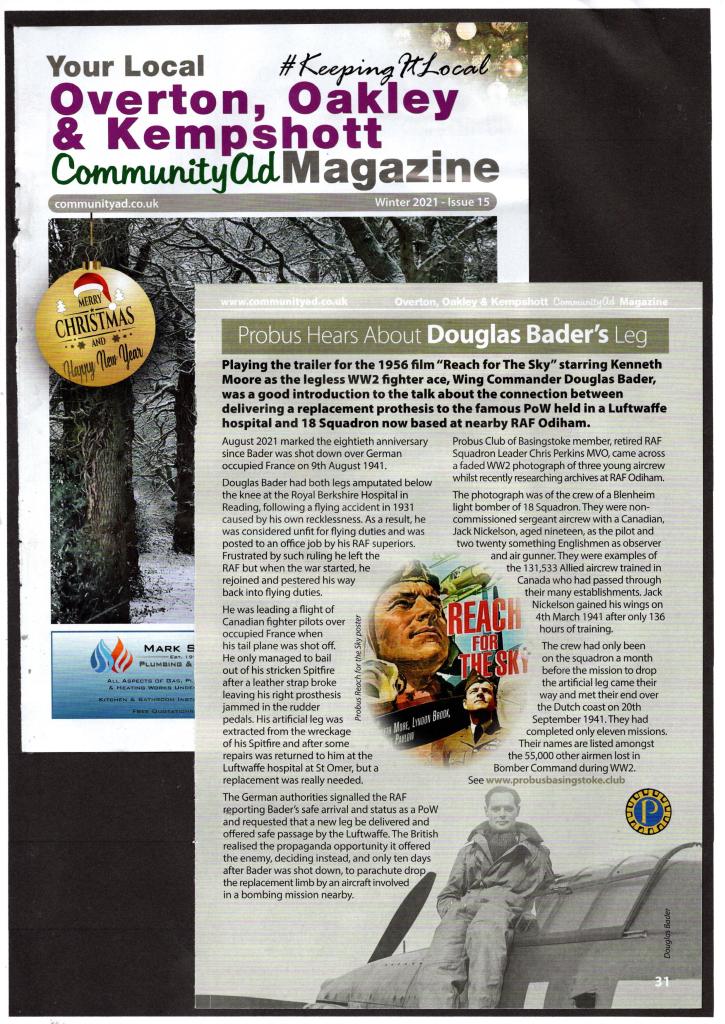
This is the first “not lockdowned” report on our publicity in the local magazines for October. They all ran with the story of our AGM and back to normal activities and within the Kempshott Kourier we had a full page advertisement seeking new members. Because of being quarterly the CommunityAd magazine for Old Basing & Lychpit  ran a double page spread about the Douglas Bader story of replacing one of his prosthetic legs when a PoW.

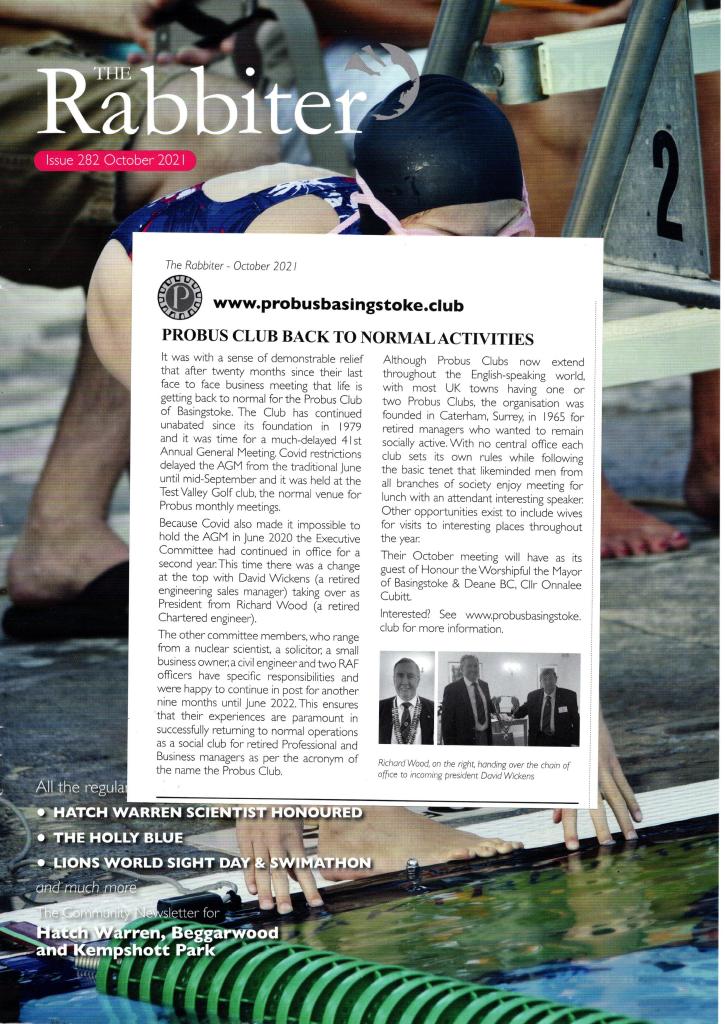
Probus Back to Normal Activities with 41st Annual General Meeting

It was with a sense of demonstrable relief that after twenty months since their last face to face business meeting that life is getting back to normal for the Probus Club of Basingstoke. The Club has continued unabated since its foundation in 1979 and it was time for a much-delayed 41st Annual General Meeting. Covid restrictions delayed the AGM from the traditional June until 14th September and it was held at the Test Valley Golf club, the normal venue for Probus monthly meetings.

David Wickens receiving the President’s chain of office from retiring President Richard Wood

Because Covid also made it impossible to hold the AGM in June 2020 the Executive Committee had continued in office for a second year. This time there was a change at the top with David Wickens (a retired engineering sales manager) taking over as President from Richard Wood (a retired Chartered engineer).

New President David Wickens will Continue as the Speaker Secretary

The other committee members, who range from a nuclear scientist, a solicitor, a small business owner, a civil engineer and two RAF officers have specific responsibilities and were happy to continue in post for another nine months until June 2022. This ensures that their experiences are paramount in successfully returning to normal operations as a social club for retired Professional and Business managers as per the acronym of the name the Probus Club.

Although Probus Clubs now extend throughout the English-speaking world, with most UK towns having one or two Probus Clubs, the organisation was founded in Caterham, Surrey, in 1965 for retired managers who wanted to remain socially active. With no central office each club sets its own rules while following the basic tenet that likeminded men from all branches of society enjoy meeting for lunch with an attendant interesting speaker. Other opportunities exist to include wives for visits to interesting places throughout the year.

Their October meeting will have as its guest of Honour the Worshipful the Mayor of Basingstoke & Deane BC, Cllr Onnalee Cubitt.

Publicity During Covid Lockdown – 18

Six magazines published our reports in their September editions. Four ran the Douglas Bader reports and two quarterlies the piece about Probus seeking new members. Once again the Link (Oakley) failed to use our report and there is no doubt that the pressure caused by their reduced pagination means that those reports not specifically about the Oakley area are squeezed out.

The same could probably be said about the Loddon Valley Link (Sherfield) where the new editor excluded our report. We are missing the now defunct Popley Matters and the Chineham Chat magazines – only time will tell if the Chat is resurrected.

That Faded Snapshot

It happened just a few weeks ago now, a chance glimpse of a small insignificant fading snapshot of a young WW2 bomber crew, attached to which was a sellotaped fading biro written note.  At least it credited their names and a date, but what initially intrigued Probus Club member, retired RAF Squadron Leader Chris Perkins MVO, was the connection with the ‘legless WW2 fighter ace’ Douglas Bader.  Seeing this old black and white photograph was on a quick visit to his old RAF Station Odiham carrying out research into the helicopter era of the 1970s and 80s concerning 18 Squadron.  What follows is yet another tale that should never be forgotten.

The Nickleson Crew


The 18 Squadron crew pictured comprised of Pilot, Jack Nickleson from Toronto Canada, Observer, Walter Meadows from Askrigg in Yorkshire and Air Gunner, John Pearson from Birmingham.  Walter and John were in their 20s, but their ‘Skipper’ Jack, was just 19 years old.  All were Non-Commissioned Sergeant Aircrew and had been on the squadron barely a month.  Sadly, their Operational Tour was to last just eleven missions and their names are listed amongst the 55,000 plus other airmen lost in Bomber Command during WW2.

To those of us growing up in the ‘black and white’ years of the 1950s, the wartime exploits of Bader, as portrayed magnificently by actor Kenneth Moore in the film ‘Reach For The Sky’, were very familiar.  It will be eighty years ago this August, that, on 9 August 1941 Wing Commander Douglas Bader, leading his Spitfire Wing from RAF Tangmere, was shot down over German occupied France.  He ‘bailed out’ minus his prosthetic right leg, which had become jammed by the rudder pedals during combat.  Thankfully, a leather retaining strap eventually broke allowing him to exit the aircraft.  Knocked unconscious on landing, he was taken to a Luftwaffe hospital in St Omer.

Wing Commander Douglas Bader

The battered artificial leg was subsequently recovered from the Spitfire wreckage and a temporary repair was carried out before being returned to him.  Bader was delighted!  It meant that he now had the mobility means to try an engineer an escape before being transported under escort to more a permanent incarceration in Germany.  In the meantime, however, the German Authorities had signalled the RAF reporting his ‘safe arrival’ and status as a POW and requesting that a replacement leg be delivered.  Safe passage for that aircraft by the Luftwaffe would be guaranteed.

Although the RAF were willing to devise a means of delivery, they were unwilling to offer a propaganda opportunity to the Germans by means of the ‘safe passage’ option.  It was therefore decided to parachute drop the replacement leg by an aircraft involved in a bombing operation nearby.  No 18 Squadron operating from a forward operating base at RAF Manston were allocated the task with six Blenheim light bombers and escorted, appropriately, by Spitfires of Bader’s Tangmere Wing.

Sgt Jack Nickleson and crew were chosen to deliver the box with replacement limb.  At that time, there was no devised procedure for dropping cargo from RAF Blenheim bombers and automatically deploy a suitable parachute. It was decided that the ‘best option’ would be to attach the box, ‘somehow’, to a standard partially opened crew parachute and ‘throw’ it out of the aircraft!  In theory this was a simple solution, but in practise it fell far short.

Once the crate containing the leg was delivered to the 18 Squadron at RAF Manston in Kent, Jack, Walter and John realised the enormity of their task.  To manhandle and dispatch the bulky crate attached to a partially opened cumbersome parachute out of a small escape hatch, was not going to be easy.  All this and bouncing around at 10,000 feet in formation with other aircraft and from the extremely cramped interior of the bomber.  But this they did and very successfully.  Needless to say, a following press release on the operation at the time, in typical fashion, falsely reported Bader’s leg as being delivered by ‘Our Fighter Boys’!    

Crate addressed to Wing Commander Douglas Bader a patient in the Luftwaffe hospital at St Omer in France
The replacement prothesis safely received at St Omer before passing to the POW patient

The ‘Nickleson Crew’ survived operations until 20th September 1941.  As part of an eight 18 Squadron aircraft low level mission to attack shipping off the Dutch coast, they were hit by anti-aircraft fire.  Their aircraft was seen to crash into the sea with the starboard engine on fire.  The bodies of Sgt Walter Meadows and Sgt John Pearson were both washed ashore during the weeks following the crash and they lie in Commonwealth War Graves Cemeteries.  The body of the young Sgt Jack Nickleson, Royal Canadian Air Force from Toronto, Canada was never found.  At 18 he had enlisted straight from high school in July the previous year and his flying career had spanned but a short, active but nevertheless eventful fourteen months.

The Nickleson crew in front of a Blenheim light bomber

ADDENDUM

Runnymede Memorial

The Air Forces Memorial

The Air Forces Memorial at Runnymede commemorates by name over 20,000 men and women of the air forces, who were lost in the Second World War during operations from bases in the United Kingdom and North and Western Europe, and who have no known graves.  They served in Bomber, Coastal, Fighter, Transport, Flying Training and Maintenance Commands.  They came from all parts of the Commonwealth plus countries in Europe that had been overrun, their airmen continuing to fight the enemy from the ranks of the Royal Air Force.

The Memorial stands upon the crest of Coopers Hill overlooking the River Thames and the fields of Runnymede, where in 1215 King John signed the Magna Carta thus sealing that document to the cause of English libertyIt is a fitting and hallowed place, therefore, to commemorate the ultimate sacrifice made by all those servicemen and women.  Unveiled by Her Majesty, Queen Elizabeth on 17 October 1953, it was designed by Sir Edward Maufe, the Commonwealth War Grave Commission’s Principal Architect responsible for the United Kingdom after World War Two.  His main aim was to create an atmosphere of quiet intimacy for all those coming to remember the missing.

The memorial site certainly lived up to all expectations on the day of my visit with perfect summer weather and clear warm conditions to take in the gleaming splendour of the architecture and quietly contemplate the multitude of names arranged in the cloistered panels within. My aim on the 19th of August was to seek out the name of a Flight Sergeant Jack Nickleson, the Captain of an 18 Squadron Blenheim bomber aircraft tasked with successfully delivering a replacement prosthetic limb to the renowned Wing Commander Douglas Bader, incarcerated as a POW by the German Luftwaffe at St Omer in Northern France.

Jack’s name is to be located on panel 60 of the memorial cloisters with all of of the Royal Canadian Air Force Airmen who gave their lives for our freedom in 1941.  It indeed was a privilege to pay my respects and place the small memorial cross and card below his name.  He is not forgotten and neither are his other crew members.  Sgt Walter Meadows, Observer/Bomb Aimer, is buried in Bergen-Op-Zoom and Sgt John Pearson, Air Gunner, in the military plot of Amsterdam New Eastern Cemetery.  Hopefully, with the lifting of continental travel restrictions, I’ll be able to accord them both the same recognition in my forthcoming battlefield tour activities.

Publicity During Covid Lockdown – 17

Come the month of August and most of the local magazines do not publish. It is disappointing therefore that even one that does, the Link, in Oakley, unfortunately, and rarely, did not include our piece. This can be perhaps put down to the fact that since resuming their printed editions they are now a free issue publication which means that advertising pays for the printing costs. Previously they made a charge to receive the magazine. The net result is that the pagination has reduced accordingly to match the paid for pages with editorial decisions having to be made about what is included or excluded from each edition.

The Loddon Valley Link, as previously mentioned, is tricky to gain a place in each printed edition and made more difficult because of their rotating editor policy. Our most supportive editor has now resigned and a new one has been installed but it may take time for a relationship to be built up so that the Probus Club reports become a standard feature.

The Chineham Chat still does not publish but they have maintained their “blog” type news site and we are successful with our press releases. The Kempshott Kourier sails on regardless of what happens to other publications although the editor has admitted that they have lost a couple of advertisers which makes it difficult to cover their costs.

Click on any image to enlarge

Summer Pub Lunch 12 August 2021

The first social get together for members of the Probus Club of Basingstoke, together with their spouses, in over eighteen months took place at the Longbridge Mill, Sherfield on Loddon.

Plenty of chatter filled the air as everyone had much to say after such a long absence due to the Covid pandemic. And yet It almost felt as though there had not been such a long absence from meeting together, perhaps, down to being such close relationships built solidly over many years.

There were good reasons for notable absences with holidays, clash of dates, family visitors from overseas and medical appointments and of course the sad loss of two members, and also the passing in recent months of the wives of two members.

We can now look forward to the resumption of the typical Probus Club activities starting with the delayed AGM in September.