
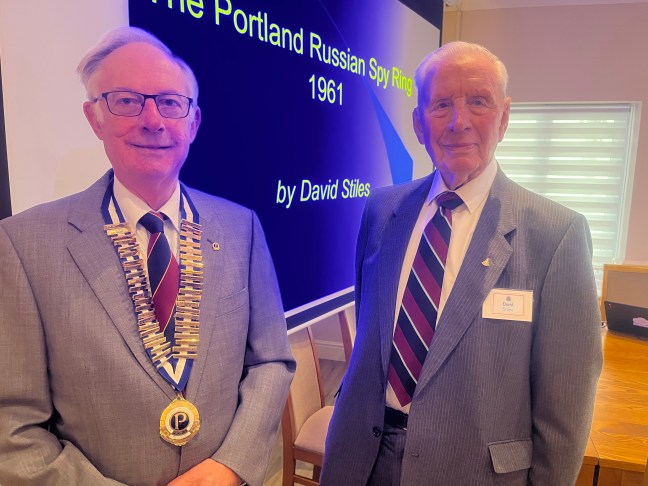
Readers of a certain vintage will no doubt remember the infamous Portland Russian Spy Ring caught in 1961. It was recalled by speaker and Probus Club member David Stiles, who considers that he had a personal involvement before the spies were unmasked.
Following service in the RAF he continued as a contractor on RAF bases. While based at RAF Tangmere near Chichester he was tasked to prepare a civilian Vickers Varsity aircraft to be held under guard to be instantly ready for some secret operation.

There were covert trips over three weeks when six men would arrive for night flights. He later concluded that these passengers were members of MI5, the section of the Secret Intelligence Service who are responsible for domestic security.
This period in history is known as ‘The Cold War’ with the Russians dividing Germany into East and West there was much spying activity by both sides. Honourably discharged from the Royal navy after the war, Harry Houghton had worked at HMS Osprey on Portland in Dorset. In 1952, he transferred to the British embassy in Warsaw, Poland.
He liked a drink and became involved with a woman who turned out to be a member of the Polish Intelligence Service. She encouraged him to import coffee from Britain to sell at inflated prices. When his side hustle was discovered and being short of money, he was encouraged to approach the Polish authorities to sell them secret information. Drinking concerns by superiors led him returning to England. He was posted to the Portland naval base in Dorset and more specifically in the Admiralty Underwater Weapons Establishment.
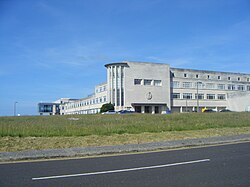
Much design work undertaken for HMS Dreadnought nuclear submarine
The AUWE was the centre of research into underwater weaponry and the first British nuclear submarine, HMS Dreadnought, had been launched in October 1960. Perhaps having been passed his details by Polish intelligence he was groomed by Gordon Lonsdale to develop an interest in Ethel Gee a filing clerk in AUWE. A spinster in her mid-forties she lived on Portland with her widowed mother and other family members.

Gordon Lonsdale was the cover name of Konon Molody, who had arrived in England under a Canadian passport and had been part of the Russian Spy Ring that had been operating in England since 1953. He provided the income needed by Harry Houghton that enabled a relationship to develop with Ethel Gee. Using a camera disguised as a cigarette lighter, Ethel would get copies of plans and information that he passed on to Lonsdale.
How would Lonsdale get this information to his masters in Moscow? Enter Helen and Peter Kroger. Their real names were Lona and Morris Cohen, American communists who used New Zealand passports. Lona Cohen had couriered classified documents about the “Manhattan Project” the US atom bomb development, to the Russian consulate in New York. The Americans considered they were ten years ahead of the Russians in nuclear development. Four years after the first atomic test, the Russians conducted their own nuclear bomb test, using specifications similar to those of the US device.
Peter and Helen Kroger rented a dormer bungalow in Ruislip in west London. Peter opened an antique book shop in London with customers across Europe including Russia. Gordon Lonsdale helped the Krogers dig out a cellar under their kitchen to house transmitting equipment while an aerial went in the roof.

Helen Kroger could transmit information in a couple of seconds. It was these transmissions that speaker David Stiles believes is what the mysterious flights with the MI5 personnel were tracking, eventually locating the bungalow in Ruislip.
Much of the information provided by Ethel Gee was reduced to microdots by Lonsdale and placed within the text in the antique books by Peter Kroger. The radio signals gave the destination address; the books were intercepted recovering the microdots.
In January 1961, MI5, which did not have power of arrest, arranged that the police detain all five people involved. This was followed by a trial at the Old Bailey in March 1961, held in camera. Certain information was released to the press, but much remains secret.
Gordon Londale was gaoled for 25 years but was involved in a spy swap after a four years. Helen and Peter Kroger received 20 years and were swapped for a British businessman. All three were received as Heroes of the Soviet Union. Harry Houghton and Ethel Gee received 15 years and were married in prison.
Over 2,000 documents had been photographed and David Stiles wondered if they really were not that important at all.


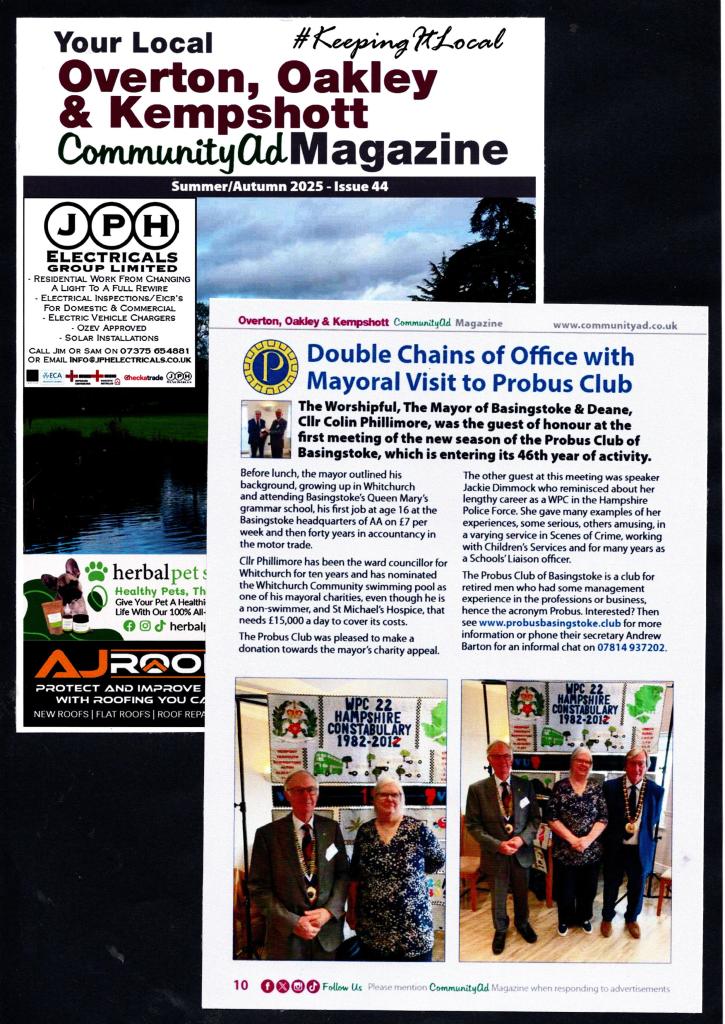
 Probus Club of Basingstoke
You must be logged in to post a comment.