
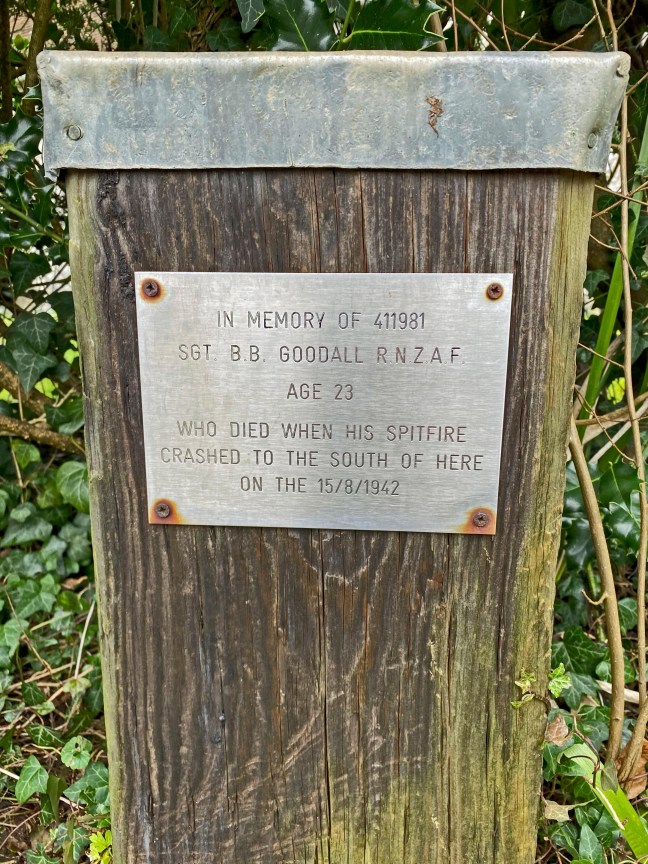
Kempshott resident and Probus Club of Basingstoke member Chris Perkins MVO was on a relaxing walk when he came across an unusual memorial to a crashed Spitfire pilot. The memorial was on a grass verge near to the church in the hamlet of Weston Patrick just south of Basingstoke.
What caused the plane to crash on 15th August 1942? Was it due to enemy action? Who was the aviator, a member of the Royal New Zealand Air Force? Was he another New Zealander who, like so many, had answered the call and had come to support the mother country in its hour of need?
Chris Perkins MVO retired from the RAF with the rank of Squadron Leader and always had a great interest in historical aspects of the RAF and had gained great experience in searching out information about matters that piqued his interest.
And, so it was, when he spotted this memorial.
RAF Lasham, these days the UK’s largest gliding society, created as a wartime airfield, was only a mile away so was this Spitfire heading there? Not so was what Chris discovered as his research took him through the history of this unfortunate accident,
Bernard Bryn Goodall, born near Auckland in New Zealand was descended from a family who had emigrated from Staffordshire in the 1860s. He had been educated at Putaruru High School where he had enjoyed rugby, cricket, tennis and swimming. At the time of applying for war service and joining the Royal New Zealand Air Force in January 1940 he was employed as a ‘Dryerman’ at the Whakatane Paper Mills that had only started manufacturing cardboard in 1939 and continues up to the present day.

In March 1941 he enlisted for aircrew training at the Initial Training Wing and then to No 3 Elementary Flying Training School. July 1941 saw him embark for Canada for advanced training under the Empire Training Scheme. In November 1941 he was awarded his ‘Wings’ and promoted to sergeant at No 6 Service Flying Training School, Dunnville, Ontario. A week later he proceeded to No 1 “Y” Depot, Halifax Nova Scotia to await embarkation for the United Kingdom.
Sgt Goodall NZ/411981 RNZAF, arrived at No 3 Personnel Reception Centre, Bournemouth, on 19th December 1941. On 10th February 1942 he was posted to No 58 Operational Training Unit, Grangemouth near Edinburgh, where he completed his training on Supermarine Spitfire aircraft.

On 21st April 1942 he was posted to No 41 Squadron at Herston in Sussex then on to Martlesham Heath in Suffolk, Hawkinge in Kent, Debden in Essex and in August 1942 to Longtown in Cumberland where 41 Squadron carried out ‘offensive sweep patrols’ moving shortly to Llanbedr in Wales to carryout patrols over the Irish sea.
Spitfire Mk Vb, serial number P8607, Code sign EB-C, had been built at the Castle Bromwich Aircraft Factory near Birmingham. They built 3,003 Mk Vb Spitfires between 1941 and 1943 out of a total of 3,991. Delivered to 9 Maintenance Unit on 11th June 1941, it was then deployed to three operational squadrons before arriving at No 41 squadron on 25th July 1942 and into the hands of Sgt Goodall. But what caused this Spitfire, at 17.45 hrs on Saturday 15th August 1942, to dive into farmland and kill the pilot outright?
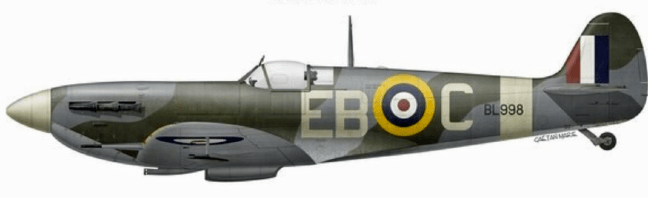
Powered by a Rolls Royce 45 series V12 engine that developed 1,440 HP
The Board of Inquiry established that Sgt Goodall had been detailed to deliver this Spitfire from RAF Station Debden in Essex to RAF Station Tangmere near Chichester in Sussex. His squadron was being repositioned there in readiness for the forthcoming ill-fated ‘Operation Jubilee’ raid on Dieppe that took place on 19th August 1942.
Presumably due to instrument failure, Sgt Goodall found himself flying in the wrong direction, a little to the northwest to where he needed to be. While there were no enemy aircraft in the vicinity neither was there any radar cover in that period of the war but on that eventful day the southern half of England had a low cloud base of only 1,000 feet.
It is assumed that he was descending through the low clouds to achieve sight of the ground and with little room to manoeuvre the Spitfire crashed into a field at Blounce Farm in Weston Patrick, partly burying itself and catching fire immediately. Sgt Goodall was killed instantly.

He was interred with full service honours at Brookwood Military Cemetery near Woking in Surrey, in grave reference Plot 2 Row 1, 1. This is an area of 37 acres making it the largest Commonwealth war cemetery in the United Kingdom. Sgt Goodall’s head stone follows one of the standard designs of the Commonwealth War Graves Commission.
Sgt Bernard Bryn Goodall had flown 312 hours as a pilot. He had taken part in 41 operational flights, being most offensive patrols, including 12 convoy patrols and 2 sector reconnaissance flights. He also took part in two low level attacks on enemy positions in France, a shipping reconnaissance and an air sea rescue search.
Like many citizens of countries in the British Empire, Bernard Bryn Goodall made the ultimate sacrifice in supporting this country’s war effort. He was 23 years old.




 Probus Club of Basingstoke
You must be logged in to post a comment.