
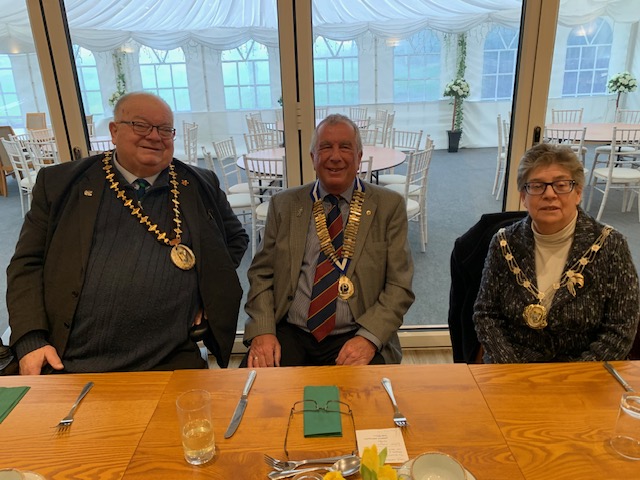
Guests of Honour at the latest Probus Club meeting at the Test Valley Golf Club were the Mayor and Mayoress of Basingstoke & Deane, Cllr David and Amanda Leeks. The club made a donation to the mayor’s charity appeal.
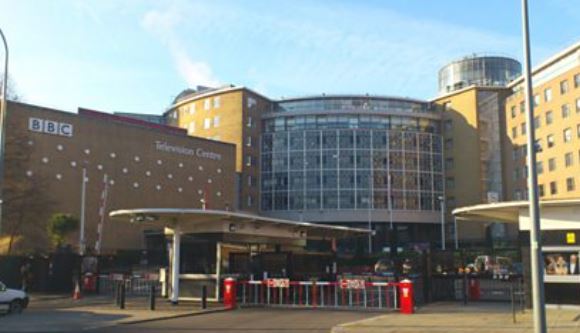
Before lunch they enjoyed a trip down memory lane as they were entertained by the speaker Jenny Mallin. She gave an insight into how the BBC Television Centre was designed and what TV production life was in the seventies. This was through her experiences gained over seven years working at the BBC Television Centre at White City in Wood Lane.

The name White City came from the 120 white painted buildings and 20 pavilions specially constructed for the Franco British exhibition of 1908 on a site of 140 acres near Shepherds Bush in West London. It was attended by over 8 million visitors. The White City stadium was a last minute addition for use at the 1908 Olympics where for the first time gold, silver and bronze medals were awarded. The stadium was demolished in 1985. Over the years the site was used for other exhibitions and redeveloped for other uses including the building of the BBC Television Centre.

Known as the ‘Donut’ because of the circular central core it was the most technically advanced and fully embracing television production centre with eight studios, full props and wardrobe departments and was the best in the world. The attention to detail in programme making was paramount.

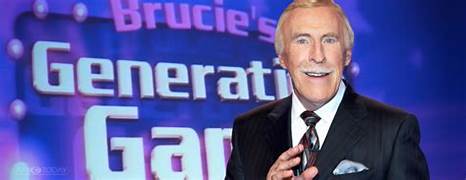
Despite such comprehensive supporting facilities, there was an increasing requirement for some programmes that needed an audience, so the nearby Shepherds Bush Green Empire was used. Eventually the BBC purchased it, becoming then known as the BBC Television Theatre. Programmes broadcast from here included the Billy Cotton Band Show, What’s My Line, Juke Box Jury, Crackerjack, the Black & White Minstrels, That’s Life and the Generation Game among many others.
Jenny recalled her time on the Generation Game as a Contestant Researcher and Games Deviser to three years on Mastermind with Magnus Magnusson and a myriad of disc jockeys on Top of the Pops and whether songs were sung live or mimed.
How news programmes were put together with breaking news events that demanded being featured with split seconds decisions on what to drop from the programme. News film taking up to an hour to process even after arriving at the BBC and then the introduction of ENG, electronic news gathering, with the use of camcorder type recordings taken by outside reporters.
Memories were stirred as Probus members enjoyed this nostalgic view of a simpler life when the only decision to be made about what to watch on the “telly” was whether your choice was on the BBC or on ITV.
 Probus Club of Basingstoke
You must be logged in to post a comment.