
The Probus Club of Basingstoke had a personal history lesson by Kempshott residents David Stiles and partner Jenny Barton, who reminisced about his wartime experiences as a schoolboy in Southampton.
He knows exactly where he was when Prime Minister, Neville Chamberlain, gave the announcement on the wireless that because the German Chancellor, Adolf Hitler had refused to withdraw his troops from their occupation of Poland, our ally, then
“A state of war exists between our two countries.”
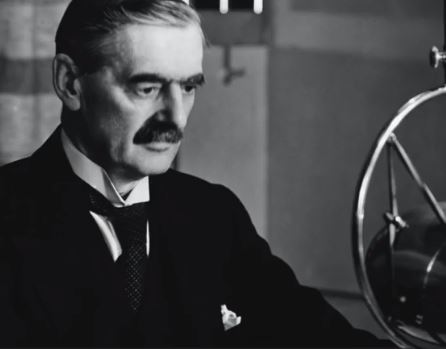
It was raining at 11.15 am, on Sunday 3 September 1939. He was five years old, listening to a car’s radio, in Ringwood with his mother and baby brother.
They had been walking around the town searching for a place to stay as they had not been selected by the evacuation committee when they were dropped off at the railway station that morning. Single children had been taken in as evacuees, but a mother, baby and young boy were left to their own devices to find a billet. A kind motorist took pity on them as he could see the mother was weeping and offered them a bed for that night. The following day they returned to meet the evacuation committee to see if accommodation could be found. It could, but only for the speaker. His mother and baby brother had to return home to Southampton.
It was was an unhappy period as although he was billeted with a kind family, he would not eat, nor speak and cried himself to sleep every night. This was the phoney war when little happened, and so he joined about a third of all evacuees that returned home.
Returning to school only a short distance down the road he was able to see the dog fights during the Battle of Britain knowing that the pilots on both sides were young men, not much older than his fellow school friends.
Winning the control over Britain’s skies had the then Prime Minister, Winston Churchill. on 20 August 1940, making his famous speech that
“Never in the field of human conflict was so much owed by so many to so few.”
David Stiles’ father was a tram driver in Southampton, and they lived opposite his grandparent’s large house where their deep cellar made a safe and comfortable air raid shelter. This was much better than the Anderson shelters made from corrugated iron buried in most gardens that were damp and cold, or the Morrison shelter under which residents huddled during air raids that was really a table like construction with a reinforced top, angle iron legs and drop-down steel mesh curtains.

Later, during The Blitz, bombing raids on Southampton docks were a daily occurrence and one night, they had to remain in their grandparent’s cellar for fourteen hours. On another occasion, because of the amount of falling shrapnel it was not possible to cross the road to the safety of his grandparent’s cellar they took shelter under the stairs. With the bombing causing the house to shake many of his mother’s Royal Albert tea set, her pride and joy, had many cups shaken from their hooks on the dresser and crashed to pieces.

During one raid the Luftwaffe dropped over 2,000 high explosive and more than 3,000 incendiary bombs, killing 650 people and leaving Southampton a smoking ruin. Some nights the speaker’s teenage uncles ran up and down the street assisting the firemen, wearing pots and pans and small baths on their head for protection. Had it not been so serious It could have been a scene from an Ealing comedy film.
Each morning boys would collect shrapnel and became expert in identifying this jagged metal from bombs or shells. Shrapnel became school currency and could be swapped for cigarette cards or marbles.
One day two Junker 88 bombers, with anti-aircraft shells exploded around them, flew straight at the school during playtime, firing their machine guns. The school windows were smashed, and the shells caused the tarmac to burst around his feet as he racing to the shelter where he was flung inside from a bomb blast.
With their house damaged by an incendiary bomb they were moved to a farm worker’s cottage in the country but close enough to see the night time raids on Portsmouth and Southampton. Fortunately, his father had been brought up on a farm and became a dairyman, while the speaker, as now a ten-year-old boy, was taught to drive the Fordson tractor.
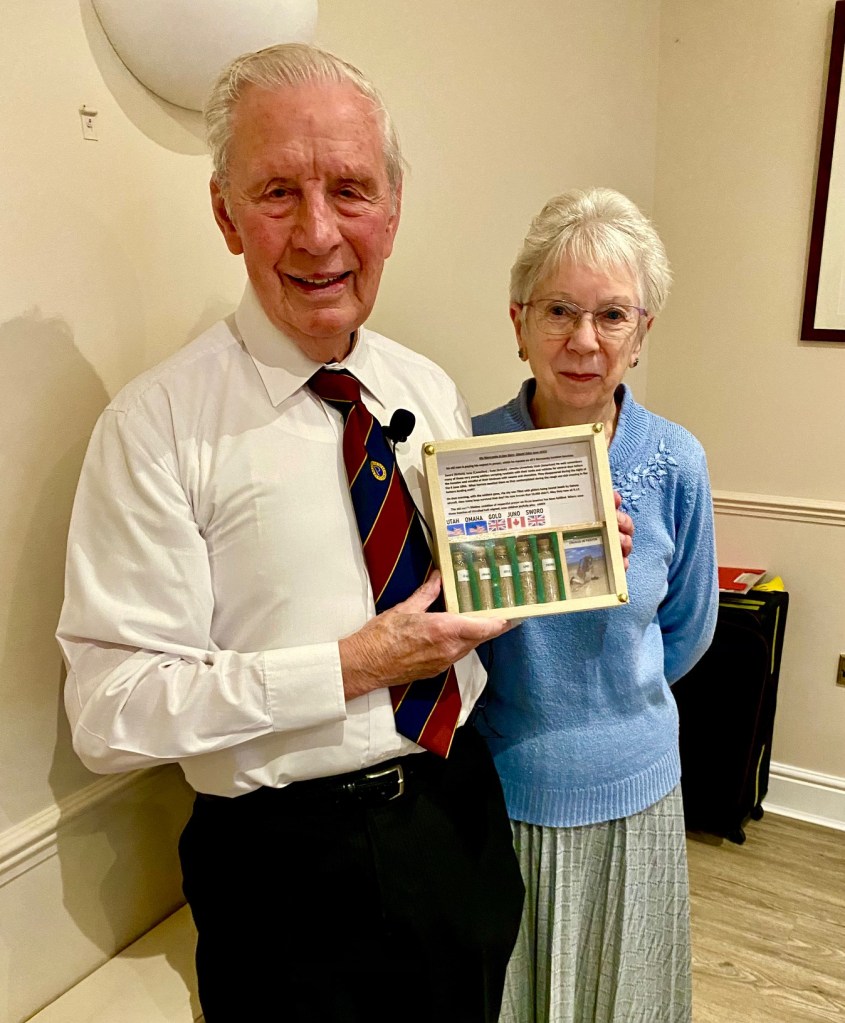
The time came when many thousands of men and equipment were camped for several days all around in fields and on roadside verges ready for the expected invasion of France. He recalled their kindness as well as the gifts of sweets and chocolate. Then one morning they had gone. It was June 6th, 1944, D Day. The troops headed for what has now become well known, the five beaches in northern France that go by the code names of Utah, Omaha, Gold, Juno and Sword invaded by British, American and Canadian troops. During the morning the sky was filled with gliders being towed south by Dakota aircraft. He now knows that 10,000 men did not survive that day.

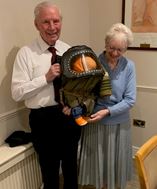
David and Jenny brought along a comprehensive display of war time memorabilia with a week’s food ration, ration books, identity cards, gas masks and other war time paraphernalia which added to this stirring presentation.








 Probus Club of Basingstoke
You must be logged in to post a comment.