

Readers, probably over the age of thirty-five, when the name of Thelwell is mentioned, will remember iconic subjects of small, fat, hairy ponies ridden at full tilt by alarming young ladies. Indeed, the Thelwell pony has become part of the English language.
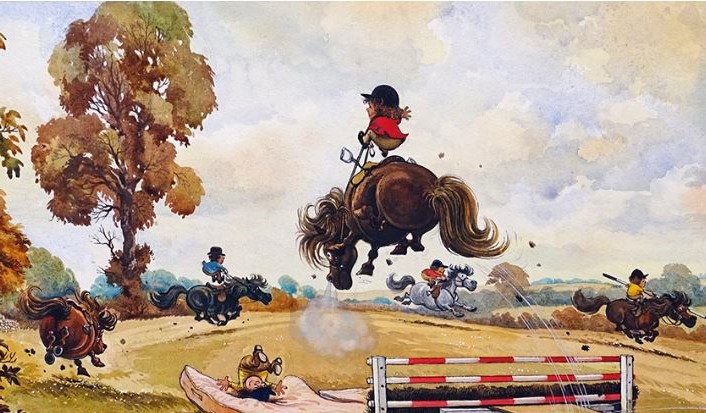
But, as speaker Tim Craven explained, Norman Thelwell’s range as a cartoonist went far beyond ponies and included fishing, gardening, house hunting, motoring, sailing, dogs, cats, farming, stately homes, children and country pursuits, all given the Thelwell treatment. There was much more to this artist than first appears as the speaker went on to outline.
Life for Norman Thelwell had started in lowly circumstances, born into a terraced house near Birkenhead, he just had a natural affinity for drawing. A pencil sketch of a self-portrait created when he was only ten demonstrated his skill. Joining the army at eighteen in 1941 his artistic talent kept him away from hostilities, even when in India he became involved in producing the Victory magazine which prevented him from action in Burma.
His time in the army enabled him to develop cartoon illustrations of military life. He came to recognise that selling a picture to a magazine was worth more than a month’s army pay so it dawned on him that there could be a living to be made using his artistic talent.
Formal artistic education at Nottingham and Gateshead schools of art was followed by a degree at Liverpool School of Art so it was natural that he became an art teacher. He persevered with expanding freelance work until it reached such a level that he decided to go completely freelance as an artist. He worked in this manner for Punch Magazine for twenty-five years during which time he produced over 1,500 cartoons and sixty front covers. National newspapers were another outlet for his work.
Tim Craven was the curator at Southampton City Art Gallery when, in 2001, he received a phone call from Mrs Thelwell about the conservation of water colour paintings. By this time Norman Thelwell was outside the mainstream of being a public figure and had lived for thirty-five years near Romsey in Hampshire, so Tim was eager to become involved in conserving the extensive work of this local world-famous artist.

There was a large quantity of paintings to consider but what became apparent was that while cartoons had made him famous having published 32 books, selling over two million copies which had been translated into several languages and earned him a good living, it was his interest in painting landscapes that was his real passion. The quality of work was so good that Thelwell’s country scenes could sit alongside those of the greatest English artists.
Thelwell was very much an adopted countryman and did his best to support the protection of rural England and especially the Test Valley fighting against gravel extraction. There have been several exhibitions of Thelwell’s artwork, showing his various styles that were curated by Tim Craven with one exhibition attracting 64,000 visitors.
Today, a century after his birth, it is still possible to use Thelwell’s images for many types of merchandising opportunities, so the drawings of his small, fat, hairy ponies continue.

 Probus Club of Basingstoke
You must be logged in to post a comment.